
MindSpore 自动微分
代码原地址:
https://www.mindspore.cn/tutorial/zh-CN/r1.2/autograd.html
MindSpore计算一阶导数方法 mindspore.ops.GradOperation (get_all=False, get_by_list=False, sens_param=False),其中get_all为False时,只会对第一个输入求导,为True时,会对所有输入求导;
get_by_list为False时,不会对权重求导,为True时,会对权重求导;
sens_param对网络的输出值做缩放以改变最终梯度。
get_all : 决定着是否根据输出对输入进行求导。
get_by_list : 决定着是否对神经网络内的参数权重求导。
sens_param : 对网络的输出进行乘积运算后再求导。(通过对网络的输出值进行缩放后再进行求导)
网络的前向传播:
import numpy as np

import mindspore.nn as nn

import mindspore.ops as ops

from mindspore import Tensor

from mindspore import ParameterTuple, Parameter

from mindspore import dtype as mstype

class Net(nn.Cell):

    def __init__(self):

        super(Net, self).__init__()

        self.matmul = ops.MatMul()

        self.z = Parameter(Tensor(np.array([1.0, 1.0, 1.0], np.float32)), name='z')

    def construct(self, x, y):

        x = x * self.z

        out = self.matmul(x, y)

        return out

model = Net()

for m in model.parameters_and_names():

    print(m)

x = Tensor([[0.8, 0.6, 0.2], [1.8, 1.3, 1.1]], dtype=mstype.float32)

y = Tensor([[0.11, 3.3, 1.1], [1.1, 0.2, 1.4], [1.1, 2.2, 0.3]], dtype=mstype.float32)

result = model(x, y)

print(result)

n_x = np.array([[0.8, 0.6, 0.2], [1.8, 1.3, 1.1]], dtype=np.float32)

n_y = np.array([[0.11, 3.3, 1.1], [1.1, 0.2, 1.4], [1.1, 2.2, 0.3]], dtype=np.float32)

result = model(x, y)

print(result)
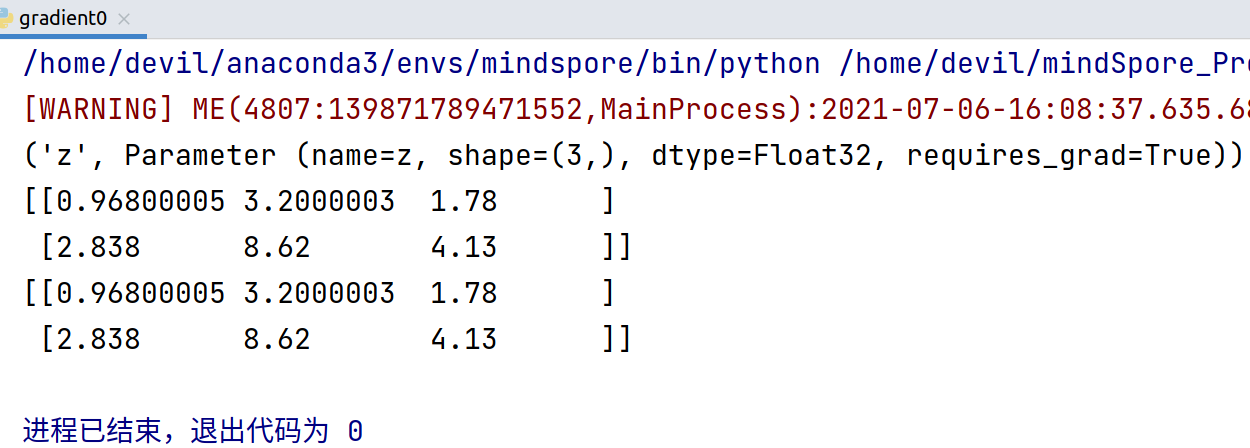
=======================================================
反向传播:
import numpy as np

import mindspore.nn as nn

import mindspore.ops as ops

from mindspore import Tensor

from mindspore import ParameterTuple, Parameter

from mindspore import dtype as mstype

class Net(nn.Cell):

    def __init__(self):

        super(Net, self).__init__()

        self.matmul = ops.MatMul()

        self.z = Parameter(Tensor(np.array([1.0, 1.0, 1.0], np.float32)), name='z')

    def construct(self, x, y):

        x = x * self.z

        out = self.matmul(x, y)

        return out

class GradNetWrtX(nn.Cell):

    def __init__(self, net):

        super(GradNetWrtX, self).__init__()

        self.net = net

        self.grad_op = ops.GradOperation()

    def construct(self, x, y):

        gradient_function = self.grad_op(self.net)

        return gradient_function(x, y)

x = Tensor([[0.8, 0.6, 0.2], [1.8, 1.3, 1.1]], dtype=mstype.float32)

y = Tensor([[0.11, 3.3, 1.1], [1.1, 0.2, 1.4], [1.1, 2.2, 0.3]], dtype=mstype.float32)

output = GradNetWrtX(Net())(x, y)

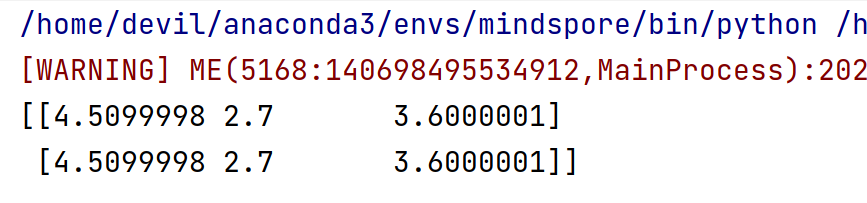
print(output)
因为, ops.GradOperation(),
mindspore.ops.GradOperation (get_all=False, get_by_list=False, sens_param=False)
get_all=False, 表示只对第一个输入向量求导,也就是对x 求梯度, 结果得到x的梯度:
如果想对所有的输入求梯度, ops.GradOperation(get_all=True)
代码:
import numpy as np

import mindspore.nn as nn

import mindspore.ops as ops

from mindspore import Tensor

from mindspore import ParameterTuple, Parameter

from mindspore import dtype as mstype

class Net(nn.Cell):

    def __init__(self):

        super(Net, self).__init__()

        self.matmul = ops.MatMul()

        self.z = Parameter(Tensor(np.array([1.0, 1.0, 1.0], np.float32)), name='z')

    def construct(self, x, y):

        x = x * self.z

        out = self.matmul(x, y)

        return out

class GradNetWrtX(nn.Cell):

    def __init__(self, net):

        super(GradNetWrtX, self).__init__()

        self.net = net

        self.grad_op = ops.GradOperation(get_all=True)

    def construct(self, x, y):

        gradient_function = self.grad_op(self.net)

        return gradient_function(x, y)

x = Tensor([[0.8, 0.6, 0.2], [1.8, 1.3, 1.1]], dtype=mstype.float32)

y = Tensor([[0.11, 3.3, 1.1], [1.1, 0.2, 1.4], [1.1, 2.2, 0.3]], dtype=mstype.float32)

output = GradNetWrtX(Net())(x, y)

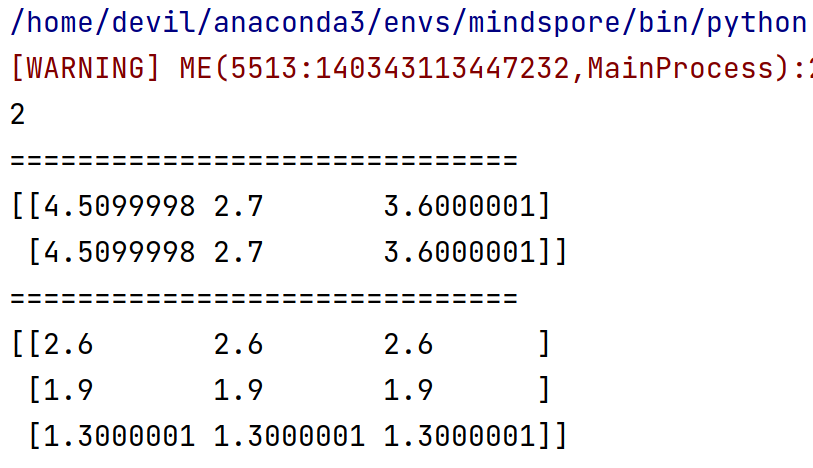
print(len(output))

print('='*30)

print(output[0])

print('='*30)

print(output[1])
对网络的所有输入求导,即,对 x ,y 求梯度。
对权重求一阶导
对权重求一阶导数其实与前面相比有两个地方要更改:
1. 求导函数要写明对权重求导,即传入参数 get_by_list=True
即,
self.grad_op = ops.GradOperation(get_by_list=True)
2. 具体求导时要传入具体待求导的参数(即,权重):
self.params = ParameterTuple(net.trainable_params())
gradient_function = self.grad_op(self.net, self.params)
细节:
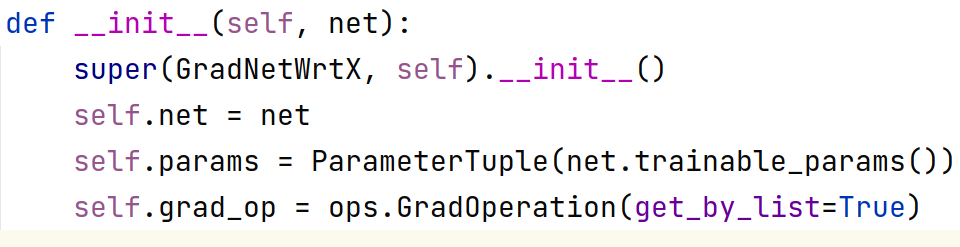

需要知道的一点是如果我们设置了对权重求梯度,则默认不会再对输入求梯度:
代码:
import numpy as np

import mindspore.nn as nn

import mindspore.ops as ops

from mindspore import Tensor

from mindspore import ParameterTuple, Parameter

from mindspore import dtype as mstype

class Net(nn.Cell):

    def __init__(self):

        super(Net, self).__init__()

        self.matmul = ops.MatMul()

        self.z = Parameter(Tensor(np.array([1.0, 1.0, 1.0], np.float32)), name='z')

    def construct(self, x, y):

        x = x * self.z

        out = self.matmul(x, y)

        return out

class GradNetWrtX(nn.Cell):

    def __init__(self, net):

        super(GradNetWrtX, self).__init__()

        self.net = net

        self.params = ParameterTuple(net.trainable_params())

        self.grad_op = ops.GradOperation(get_by_list=True)

    def construct(self, x, y):

        gradient_function = self.grad_op(self.net, self.params)

        return gradient_function(x, y)

model = Net()

x = Tensor([[0.8, 0.6, 0.2], [1.8, 1.3, 1.1]], dtype=mstype.float32)

y = Tensor([[0.11, 3.3, 1.1], [1.1, 0.2, 1.4], [1.1, 2.2, 0.3]], dtype=mstype.float32)

output = GradNetWrtX(model)(x, y)

print(len(output))

print('='*30)

print(output[0])

print('='*30)
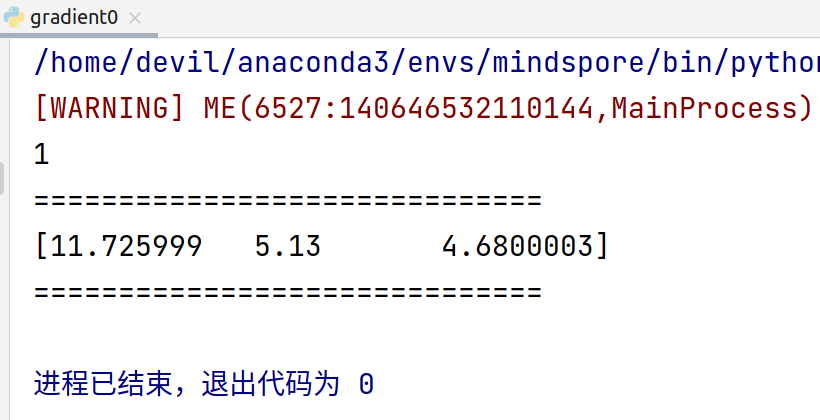
如果对网络内部权重求梯度同时也想对输入求梯度,只能显示的设置 get_all=True,
即,
self.grad_op = ops.GradOperation(get_all=True, get_by_list=True)
此时输出的梯度为 元组 , tuple(所有输入的梯度, 内部权重梯度)
也就是说这种情况返回的是一个两个元素的元组,元组中第一个元素是所有输入的梯度,第二个是所有内部权重的梯度。
代码:
import numpy as np

import mindspore.nn as nn

import mindspore.ops as ops

from mindspore import Tensor

from mindspore import ParameterTuple, Parameter

from mindspore import dtype as mstype

class Net(nn.Cell):

    def __init__(self):

        super(Net, self).__init__()

        self.matmul = ops.MatMul()

        self.z = Parameter(Tensor(np.array([1.0, 1.0, 1.0], np.float32)), name='z')

    def construct(self, x, y):

        x = x * self.z

        out = self.matmul(x, y)

        return out

class GradNetWrtX(nn.Cell):

    def __init__(self, net):

        super(GradNetWrtX, self).__init__()

        self.net = net

        self.params = ParameterTuple(net.trainable_params())

        self.grad_op = ops.GradOperation(get_all=True, get_by_list=True)

    def construct(self, x, y):

        gradient_function = self.grad_op(self.net, self.params)

        return gradient_function(x, y)

model = Net()

x = Tensor([[0.8, 0.6, 0.2], [1.8, 1.3, 1.1]], dtype=mstype.float32)

y = Tensor([[0.11, 3.3, 1.1], [1.1, 0.2, 1.4], [1.1, 2.2, 0.3]], dtype=mstype.float32)

output = GradNetWrtX(model)(x, y)

print(len(output))

print('='*30)

print(output[0])

print('='*30)

print(output[1])
运行结果:
[WARNING] ME(6838:140435163703104,MainProcess):2021-07-06-16:56:49.250.395 [mindspore/_check_version.py:109] Cuda version file version.txt is not found, please confirm that the correct cuda version has been installed, you can refer to the installation guidelines: https://www.mindspore.cn/install
2
==============================
(Tensor(shape=[2, 3], dtype=Float32, value=
[[ 4.50999975e+00, 2.70000005e+00, 3.60000014e+00],
[ 4.50999975e+00, 2.70000005e+00, 3.60000014e+00]]), Tensor(shape=[3, 3], dtype=Float32, value=
[[ 2.59999990e+00, 2.59999990e+00, 2.59999990e+00],
[ 1.89999998e+00, 1.89999998e+00, 1.89999998e+00],
[ 1.30000007e+00, 1.30000007e+00, 1.30000007e+00]]))
==============================
(Tensor(shape=[3], dtype=Float32, value= [ 1.17259989e+01, 5.13000011e+00, 4.68000031e+00]),)
进程已结束,退出代码为 0
MindSpore 自动微分的更多相关文章
- MindSpore:自动微分
MindSpore:自动微分 作为一款「全场景 AI 框架」,MindSpore 是人工智能解决方案的重要组成部分,与 TensorFlow.PyTorch.PaddlePaddle 等流行深度学习框 ...
- MindSpore多元自动微分
技术背景 当前主流的深度学习框架,除了能够便捷高效的搭建机器学习的模型之外,其自动并行和自动微分等功能还为其他领域的科学计算带来了模式的变革.本文我们将探索如何用MindSpore去实现一个多维的自动 ...
- 附录D——自动微分(Autodiff)
本文介绍了五种微分方式,最后两种才是自动微分. 前两种方法求出了原函数对应的导函数,后三种方法只是求出了某一点的导数. 假设原函数是$f(x,y) = x^2y + y +2$,需要求其偏导数$\fr ...
- pytorch学习-AUTOGRAD: AUTOMATIC DIFFERENTIATION自动微分
参考:https://pytorch.org/tutorials/beginner/blitz/autograd_tutorial.html#sphx-glr-beginner-blitz-autog ...
- 自动微分(AD)学习笔记
1.自动微分(AD) 作者:李济深链接:https://www.zhihu.com/question/48356514/answer/125175491来源:知乎著作权归作者所有.商业转载请联系作者获 ...
- <转>如何用C++实现自动微分
作者:李瞬生转摘链接:https://www.zhihu.com/question/48356514/answer/123290631来源:知乎著作权归作者所有. 实现 AD 有两种方式,函数重载与代 ...
- (转)自动微分(Automatic Differentiation)简介——tensorflow核心原理
现代深度学习系统中(比如MXNet, TensorFlow等)都用到了一种技术——自动微分.在此之前,机器学习社区中很少发挥这个利器,一般都是用Backpropagation进行梯度求解,然后进行SG ...
- PyTorch自动微分基本原理
序言:在训练一个神经网络时,梯度的计算是一个关键的步骤,它为神经网络的优化提供了关键数据.但是在面临复杂神经网络的时候导数的计算就成为一个难题,要求人们解出复杂.高维的方程是不现实的.这就是自动微分出 ...
- 【tensorflow2.0】自动微分机制
神经网络通常依赖反向传播求梯度来更新网络参数,求梯度过程通常是一件非常复杂而容易出错的事情. 而深度学习框架可以帮助我们自动地完成这种求梯度运算. Tensorflow一般使用梯度磁带tf.Gradi ...
- PyTorch 自动微分示例
PyTorch 自动微分示例 autograd 包是 PyTorch 中所有神经网络的核心.首先简要地介绍,然后训练第一个神经网络.autograd 软件包为 Tensors 上的所有算子提供自动微分 ...
随机推荐
- 说一下 session 的工作原理?
session 的工作原理是客户端登录完成之后,服务器会创建对应的 session,session 创建完之后,会把 session 的 id 发送给客户端,客户端再存储到浏览器中.这样客户端每次访问 ...
- MESI--CPU缓存一致性协议
概念 MESI(Modified Exclusive Shared Or Invalid)(也称为伊利诺斯协议,是因为该协议由伊利诺斯州立大学提出)是一种广泛使用的支持写回策略的缓存一致性协议. ME ...
- 5分钟带你了解RabbitMQ的(普通/镜像)集群
前言 让我们深入探讨RabbitMQ的集群配置,了解各种集群模式的利弊.本次讨论的重点是帮助您快速理解RabbitMQ集群的运作方式,以及选择最适合您需求的模式.好的,话不多说.在RabbitMQ中, ...
- 第四届物联网与机器学习国际学术会议(IoTML 2024)
[ACM独立出版,高录用,见刊检索快速稳定]第四届物联网与机器学习国际学术会议(IoTML 2024) [IoTML 2023会后三个半月内完成EI检索]2024 4th International ...
- APOLLO DEV环境列表无法显示解决,重启对应的Apollo服务
APOLLO DEV环境列表无法显示解决,重启对应的Apollo服务 找到项目中的apollo-core jar包中的配置文件,查看dev.meta的服务器配置IP:端口 apollo-env.pro ...
- mysql的varchar和oracle的varchar2比较
首先说结论: 1.mysql存储的是字符数(不分语言) 2.oracle存储的需要看定义,如果定义为varchar2(n),则默认是n个字节,如果是varchar2(n char)则是n个字节. 3. ...
- python之集合学习
*******************集合{set}******************* 1.集合set 可变 特点:是由不同元素组成 是无序的 集合中元素必须是不可变类型例如(字符串/元祖/数字) ...
- git clone 时拉取子模块
git clone 时拉取子模块 对还未下载的项目: git clone --recursive 对已下载的项目: git submodule sync git submodule update -- ...
- Excel插件之连接数据数据库秒数处理,办公轻松化
接上文,对excel连接数据库需求的进一步优化: Excel 更改数据同步更新到Mysql数据库 1.通过mysql for excel 插件的思路,了解到一个新的插件 sqlcel,通过这个插件ex ...
- throws和try catch的区别
1.throws是表明方法抛出异常,需要调用者来处理,如果不想处理就一直向外抛,最后会有jvm来处理: 2.try catch 是自己来捕获别人抛出的异常,然后在catch里面去处理: 一般情况下,第 ...