
HotSpot的类模型(3)
上一篇 HotSpot的类模型(2) 介绍了类模型的基础类Klass的重要属性及方法,这一篇介绍一下InstanceKlass及InstanceKlass的子类。
2、InstanceKlass类
每个InstanceKlass对象表示一个具体的Java类(这里的Java类不包括Java数组)。InstanceKlass类及重要属性的定义如下:
class InstanceKlass: public Klass {

 ...

 protected:

  // Annotations for this class

  Annotations*       _annotations;

  // Array classes holding elements of this class.

  Klass*             _array_klasses;

  // Constant pool for this class.

  ConstantPool*     _constants;

  // The InnerClasses attribute and EnclosingMethod attribute. The

  // _inner_classes is an array of shorts. If the class has InnerClasses

  // attribute, then the _inner_classes array begins with 4-tuples of shorts

  // [inner_class_info_index, outer_class_info_index,

  // inner_name_index, inner_class_access_flags] for the InnerClasses

  // attribute. If the EnclosingMethod attribute exists, it occupies the

  // last two shorts [class_index, method_index] of the array. If only

  // the InnerClasses attribute exists, the _inner_classes array length is

  // number_of_inner_classes * 4. If the class has both InnerClasses

  // and EnclosingMethod attributes the _inner_classes array length is

  // number_of_inner_classes * 4 + enclosing_method_attribute_size.

  Array<jushort>*   _inner_classes;

  // Array name derived from this class which needs unreferencing

  // if this class is unloaded.

  Symbol*           _array_name;

  // Number of heapOopSize words used by non-static fields in this klass

  // (including inherited fields but after header_size()).

  int               _nonstatic_field_size;

  int               _static_field_size;    // number words used by static fields (oop and non-oop) in this klass

  // Constant pool index to the utf8 entry of the Generic signature,

  // or 0 if none.

  u2                _generic_signature_index;

  // Constant pool index to the utf8 entry for the name of source file

  // containing this klass, 0 if not specified.

  u2                _source_file_name_index;

  u2                _static_oop_field_count;// number of static oop fields in this klass

  u2                _java_fields_count;    // The number of declared Java fields

  int               _nonstatic_oop_map_size;// size in words of nonstatic oop map blocks

  u2                _minor_version;  // minor version number of class file

  u2                _major_version;  // major version number of class file

  Thread*           _init_thread;    // Pointer to current thread doing initialization (to handle recusive initialization)

  int               _vtable_len;     // length of Java vtable (in words)

  int               _itable_len;     // length of Java itable (in words)

  OopMapCache*      volatile _oop_map_cache;   // OopMapCache for all methods in the klass (allocated lazily)

  JNIid*            _jni_ids;              // First JNI identifier for static fields in this class

  jmethodID*        _methods_jmethod_ids;  // jmethodIDs corresponding to method_idnum, or NULL if none

  nmethodBucket*    _dependencies;         // list of dependent nmethods

  nmethod*          _osr_nmethods_head;    // Head of list of on-stack replacement nmethods for this class

  // Class states are defined as ClassState (see above).

  // Place the _init_state here to utilize the unused 2-byte after

  // _idnum_allocated_count.

  u1                _init_state;                    // state of class

  u1                _reference_type;                // reference type

  // Method array.

  Array<Method*>*   _methods;

  // Default Method Array, concrete methods inherited from interfaces

  Array<Method*>*   _default_methods;

  // Interface (Klass*s) this class declares locally to implement.

  Array<Klass*>*    _local_interfaces;

  // Interface (Klass*s) this class implements transitively.

  Array<Klass*>*    _transitive_interfaces;

  // Int array containing the vtable_indices for default_methods

  // offset matches _default_methods offset

  Array<int>*       _default_vtable_indices;

  // Instance and static variable information, starts with 6-tuples of shorts

  // [access, name index, sig index, initval index, low_offset, high_offset]

  // for all fields, followed by the generic signature data at the end of

  // the array. Only fields with generic signature attributes have the generic

  // signature data set in the array. The fields array looks like following:

  //

  // f1: [access, name index, sig index, initial value index, low_offset, high_offset]

  // f2: [access, name index, sig index, initial value index, low_offset, high_offset]

  //      ...

  // fn: [access, name index, sig index, initial value index, low_offset, high_offset]

  //     [generic signature index]

  //     [generic signature index]

  //     ...

  Array<u2>*        _fields;

  // embedded Java vtable follows here

  // embedded Java itables follows here

  // embedded static fields follows here

  // embedded nonstatic oop-map blocks follows here

  // embedded implementor of this interface follows here

  //   The embedded implementor only exists if the current klass is an

  //   iterface. The possible values of the implementor fall into following

  //   three cases:

  //     NULL: no implementor.

  //     A Klass* that's not itself: one implementor.

  //     Itsef: more than one implementors.

  // embedded host klass follows here

  //   The embedded host klass only exists in an anonymous class for

  //   dynamic language support (JSR 292 enabled). The host class grants

  //   its access privileges to this class also. The host class is either

  //   named, or a previously loaded anonymous class. A non-anonymous class

  //   or an anonymous class loaded through normal classloading does not

  //   have this embedded field.

  ...

}
重要属性的介绍如下表所示。
| 字段名 | 作用 |
| _annotations | Annotations类型的指针,保存该类使用的所有注解 |
| _array_klasses |
数组元素为该类的数组Klass指针,例如ObjArrayKlass是对象数组且元素类型为Object, 那么表示Object类的InstanceKlass对象的_array_klasses就是指向ObjArrayKlass的指针 |
| _array_name |
以该类为数组元素的数组的名字,如"[Ljava/lang/Object;" |
| _constants | ConstantPool类型的指针,用来保存类的常量池信息 |
| _inner_classes | 用一个jushort数组保存当前类的InnerClasses属性和EnclosingMethod属性 |
| _nonstatic_field_size | 非静态字段需要占用的内存大小 ,以字为单位 |
| _static_field_size | 静态字段需要占用的内存大小 ,以字为单位 |
| _generic_signature_index |
保存此类的Generic signature在常量池中的索引 |
| _source_file_name_index | 保存此类的源文件名在常量池中索引 |
| _static_oop_field_count | 此类包含的静态引用类型字段的数量 |
| _java_fields_count | 字段总数量 |
| _nonstatic_oop_map_size | 非静态的oop map block的内存大小,以字为单位 |
| _minor_version | 类的次版本号 |
| _major_version | 类的主版本号 |
| _init_thread | 执行此类初始化的Thread指针 |
| _vtable_len | Java虚函数表(vtable)所占用的内存大小,以字为单位 |
| _itable_len | Java接口函数表(itable)所占用的内存大小,以字为单位 |
| _oop_map_cache | OopMapCache指针,该类的所有方法的OopMapCache |
| _jni_ids/_methods_jmethod_ids | JNIid指针与jmethodID指针,这2个指针对于JNI方法操作属性和方法非常重要,在介绍JNI时会详细介绍。 |
| _dependencies | nmethodBucket指针,依赖的本地方法,以根据其_next属性获取下一个nmethod |
| _osr_nmethods_head | 栈上替换的本地方法链表的头元素 |
| _init_state |
表示类的状态,为枚举类型ClassState,定义了如下常量值:
|
| _reference_type | 引用类型 |
| _methods | 保存方法的指针数组 |
| _default_methods | 保存方法的指针数组,从接口继承的默认方法 |
| _local_interfaces | 保存接口的指针数组,直接实现的接口Klass |
| _transitive_interfaces | 保存接口的指针数组,包含_local_interfaces和通过继承间接实现的接口 |
| _default_vtable_indices | 默认方法在虚函数表中的索引 |
| _fields |
类的字段属性,每个字段的6个属性access,、name index、sig index、initial value index、low_offset、high_offset组成一个元组, access表示访问控制属性,根据name index可以获取属性名,根据initial value index可以获取初始值,根据low_offset与 high_offset可以获取该属性在内存中的偏移量。另外保存完所有属性之后还可能会保存泛型签名信息。 |
有了InstanceKlass与Klass中定义的这些属性足够用来保存Java类元信息。在后续的类解析中会看到对相关变量的属性填充操作。除了保存类元信息外,此类还有另外一个重要的功能,即支持方法分派,主要是通过Java虚方法表和Java接口函数表来完成的,不过C++并不像Java一样,保存信息时非要在类中定义出相关属性,C++只是在分配内存时为要存储的信息分配好特定的内存,然后直接通过内存偏移来操作即可。
接下来几个属性是没有对应的属性名,只能通过指针和偏移量的方式访问:
- Java vtable:Java虚函数表,大小等于_vtable_len;
- Java itables:Java接口函数表,大小等于 _itable_len;
- 非静态oop-map blocks ,大小等于_nonstatic_oop_map_size;
- 接口的实现类,只有当前类表示一个接口时存在。如果接口没有任何实现类则为NULL;如果只有一个实现类则为该实现类的Klass指针;如果有多个实现类,为当前类本身;
- host klass,只在匿名类中存在,为了支持JSR 292中的动态语言特性,会给匿名类生成一个host klass。
HotSpot在解析一个类时会调用InstanceKlass::allocate_instance_klass()方法分配内存,而分配多大的内存则是通过调用InstanceKlass::size()计算出来的,调用语句如下:
  int size = InstanceKlass::size(vtable_len,

								 itable_len,

								 nonstatic_oop_map_size,

		                         isinterf,

								 is_anonymous);
调用的size()方法的实现如下:
static int size(int vtable_length,

		          int itable_length,

                  int nonstatic_oop_map_size,

                  bool is_interface,

				  bool is_anonymous

  ){

    return align_object_size(header_size()    +  // header_size()为55

           align_object_offset(vtable_length) +

           align_object_offset(itable_length) +

           (

                  (is_interface || is_anonymous) ?

                  align_object_offset(nonstatic_oop_map_size) :

                  nonstatic_oop_map_size

		   ) +

           (

        		   is_interface ? (int)sizeof(Klass*)/HeapWordSize : 0

           ) +

           (

        		   is_anonymous ? (int)sizeof(Klass*)/HeapWordSize : 0)

		   );

  }
可以看到除了会为类中本身的属性分配内存,也会为vtable与itable等分配内存。调用的header_size()方法就是计算此类的对象所占用的内存大小,实现如下:
// Sizing (in words)

static int header_size(){

  return align_object_offset(sizeof(InstanceKlass)/HeapWordSize); // 以HeapWordSize为单位,64位一个字为8字节,所以值为8

}
调用的align_object_offset()方法是进行内存对齐,这是一块非常重要的C++知识点,后面会专门进行讲解。
3、InstanceKlass类的子类
InstanceKlass共有3个直接子类,这3个子类用来表示一些特殊的类,下面简单介绍一下这3个子类:
(1)InstanceRefKlass
java/lang/ref/Reference的子类需要使用InstanceRefKlass类来表示,因为这些类需要垃圾回收器特殊处理 ,在后续讲解强引用、弱引用、虚引用以及幽灵引用时在详细介绍。
(2)InstanceMirrorKlass类
用于表示特殊的java.lang.Class类,我们需要分清相关类的表示方法,如下图所示。
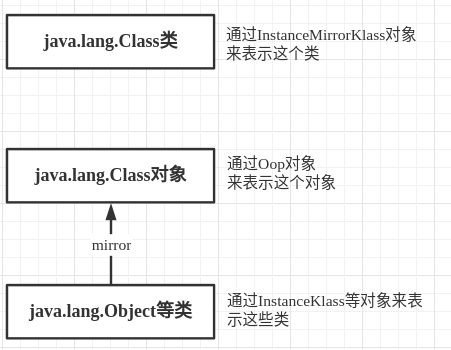
java.lang.Class对象是通过对应的Oop对象来保存类的静态属性,因此他们的实例大小不同,需要特殊的方式来计算他们的大小以及属性遍历。
Klass的属性_java_mirror就指向保存该类静态字段的Oop对象,可通过该属性访问类的静态字段。 Oop是HotSpot的对象表示模型,在后面会详细介绍。
(3)InstanceClassLoaderKlass类
没有添加新的字段,增加了新的oop遍历方法,主要用于类加载器依赖遍历使用。
创建InstanceKlass实例会调用InstanceKlass::allocate_instance_klass()方法。在创建时,会涉及到C++new运算符的重载,通过重载new运算符来分配对象的内存空间,也就是调用InstanceKlass::size()方法得到的大小,然后再调用对应类的构造函数初始化相应的属性。方法的实现如下:
InstanceKlass* InstanceKlass::allocate_instance_klass(

                                              ClassLoaderData* loader_data,

                                              int vtable_len,

                                              int itable_len,

                                              int static_field_size,

                                              int nonstatic_oop_map_size,

                                              ReferenceType rt,

                                              AccessFlags access_flags,

                                              Symbol* name,

                                              Klass* super_klass,

                                              bool is_anonymous,

                                              TRAPS) {

  bool isinterf = access_flags.is_interface();

  int size = InstanceKlass::size(vtable_len,

								 itable_len,

								 nonstatic_oop_map_size,

		                         isinterf,

								 is_anonymous);

  // Allocation

  InstanceKlass* ik;

  ///////////////////////////////////////////////////////////////////////

  if (rt == REF_NONE) {

    if (name == vmSymbols::java_lang_Class()) {

      ik = new (loader_data, size, THREAD) InstanceMirrorKlass(

                       vtable_len,

					   itable_len,

					   static_field_size,

					   nonstatic_oop_map_size,

					   rt,

                       access_flags, is_anonymous);

    } else if (

    	  name == vmSymbols::java_lang_ClassLoader() ||

          (

             SystemDictionary::ClassLoader_klass_loaded() &&

             super_klass != NULL &&

             super_klass->is_subtype_of(SystemDictionary::ClassLoader_klass()) // ClassLoader_klass为java_lang_ClassLoader

		  )

    ){

      ik = new (loader_data, size, THREAD) InstanceClassLoaderKlass(

                       vtable_len,

					   itable_len,

					   static_field_size,

					   nonstatic_oop_map_size,

					   rt,

                       access_flags, is_anonymous);

    } else {

      // normal class

      ik = new (loader_data, size, THREAD) InstanceKlass(

				vtable_len, itable_len,

				static_field_size,

				nonstatic_oop_map_size,

				rt,

				access_flags, is_anonymous);

    }

  }

  ///////////////////////////////////////////////////////////////////////

  else {

    // reference klass

    ik = new (loader_data, size, THREAD) InstanceRefKlass(

				vtable_len, itable_len,

				static_field_size,

				nonstatic_oop_map_size,

				rt,

				access_flags, is_anonymous);

  }

  ///////////////////////////////////////////////////////////////////////

  // 添加所有类型到我们内部类加载器列表中,包括在根加载器中的类

  // Add all classes to our internal class loader list here,

  // including classes in the bootstrap (NULL) class loader.

  // loader_data的类型为ClassLoaderData*,通过ClassLoaderData中的_klasses保持通过InstanceKlass._next_link属性保持的列表

  loader_data->add_class(ik);

  return ik;

}
方法的实现比较简单,当rt等于REF_NONE时,也就是为非Reference类型时,会根据类名创建对应C++类的对象。Class类创建InstanceMirrorKlass、ClassLoader类或ClassLoader的子类创建InstanceClassLoaderKlass类、普通类通过InstanceKlass来表示。当rt不为REF_NONE时,会创建InstanceRefKlass对象。REF_NONE枚举常量的定义如下:
// ReferenceType is used to distinguish between java/lang/ref/Reference subclasses

enum ReferenceType {

  REF_NONE,      // Regular class

  REF_OTHER,     // Subclass of java/lang/ref/Reference, but not subclass of one of the classes below

  REF_SOFT,      // Subclass of java/lang/ref/SoftReference

  REF_WEAK,      // Subclass of java/lang/ref/WeakReference

  REF_FINAL,     // Subclass of java/lang/ref/FinalReference

  REF_PHANTOM    // Subclass of java/lang/ref/PhantomReference

};
可以看到,所有的Reference及子类都会用InstanceRefKlass来表示。当无法判断到底是哪个子类时,会将Reference设置为REF_OTHER。
相关文章的链接如下:
1、在Ubuntu 16.04上编译OpenJDK8的源代码
HotSpot的类模型(3)的更多相关文章
- HotSpot的类模型(4)
我们继续接着上一篇 HotSpot的类模型(3)分析,这次主要分析表示java数组的C++类. 4.ArrayKlass类 ArrayKlass继承自Klass,是所有数组类的抽象基类,类及重要属性的 ...
- HotSpot的类模型(2)
在前一篇文章 HotSpot的二分模型中已经讲过,HotSpot采用了OOP-Klass模型描述Java的类和对象.Klass模型采用Klass类及相关子类来表示具体的Java类,可以理解这些类为Ja ...
- HotSpot类模型之InstanceKlass
上一篇 HotSpot源码分析之类模型 介绍了类模型的基础类Klass的重要属性及方法,这一篇介绍一下InstanceKlass及InstanceKlass的子类. 1.InstanceKlass类 ...
- HotSpot类模型之ArrayKlass
上一篇分析了 HotSpot类模型之InstanceKlass ,这次主要分析表示java数组类型的C++类. 1.ArrayKlass类 ArrayKlass继承自Klass,是所有数组类的抽象基类 ...
- .NET使用DAO.NET实体类模型操作数据库
一.新建项目 打开vs2017,新建一个项目,命名为orm1 二.新建数据库 打开 SqlServer数据库,新建数据库 orm1,并新建表 student . 三.新建 ADO.NET 实体数据模型 ...
- laravel5.8笔记五:基类控制器和基类模型
建立基类的目的就是为了方便继承.比如:Admin模块访问,是否登陆.检测登陆可以写到基类里面 控制器基类 原始基类:app\Http\Controllers\Controller.php,我们下面要做 ...
- Paddle Graph Learning (PGL)图学习之图游走类模型[系列四]
Paddle Graph Learning (PGL)图学习之图游走类模型[系列四] 更多详情参考:Paddle Graph Learning 图学习之图游走类模型[系列四] https://aist ...
- DL4NLP——词表示模型(一)表示学习;syntagmatic与paradigmatic两类模型;基于矩阵的LSA和GloVe
本文简述了以下内容: 什么是词表示,什么是表示学习,什么是分布式表示 one-hot representation与distributed representation(分布式表示) 基于distri ...
- 自定义MVC框架之工具类-模型类
截止目前已经改造了5个类: ubuntu:通过封装验证码类库一步步安装php的gd扩展 自定义MVC框架之工具类-分页类的封装 自定义MVC框架之工具类-文件上传类 自定义MVC框架之工具类-图像处理 ...
随机推荐
- java实现第四届蓝桥杯三部排序
三部排序 题目描述 一般的排序有许多经典算法,如快速排序.希尔排序等. 但实际应用时,经常会或多或少有一些特殊的要求.我们没必要套用那些经典算法,可以根据实际情况建立更好的解法. 比如,对一个整型数组 ...
- ZSH隐藏命令行前面的用户名和主机名
修改vim ~/.zshrc文件,在文件底部增加 隐藏用户名和主机名 prompt_context() {} 只保留用户名,隐藏主机名 prompt_context() { if [[ "$ ...
- 使用WPF实现的 喜马拉雅FM 资源下载工具
因为喜马拉雅pc网站上没有提供下载功能,之前有个同事问我有没有办法将资源下载到本地,当然通过浏览器F12也能找到下载地址,但挺麻烦.正好最近想学wpf,周末在家也没事,于是对着百度撸了下代码.当然只能 ...
- 双向链表都不懂,还说懂Redis?
目录 redis源码分析系列文章 前言 API使用 lpush左侧插入数据 rpush右侧插入数据 删除某个数据 修改某个数据 具体逻辑图 双向链表的定义 节点ListNode 整体架构 双向链表的实 ...
- Flask 项目目录蓝图
Flask 项目目录蓝图 小型项目 大型项目 定义蓝图 注册蓝图 template_folder="XXX" 参数是指 模板文件夹 注意 优先是找templates 在找自己指定的 ...
- ODEINT 求解常微分方程(1)
An example of using ODEINT is with the following differential equation with parameter k=0.3, the ini ...
- GCDLCM 【米勒_拉宾素数检验 (判断大素数)】
GCDLCM 题目链接(点击) 题目描述 In FZU ACM team, BroterJ and Silchen are good friends, and they often play some ...
- java特性 JDK JRE JVM
1简单性 2可移植性性(跨平台) 3面向对象 4高性能 5分布式 6动态性 7多线程 8安全性JDK:java开发工具 . JRE:JDK:java运行环境 . JVM:JDK:java虚拟机
- 大数据之Hudi + Kylin的准实时数仓实现
问题导读:1.数据库.数据仓库如何理解?2.数据湖有什么用途?解决什么问题?3.数据仓库的加载链路如何实现?4.Hudi新一代数据湖项目有什么优势? 在近期的 Apache Kylin × Apach ...
- c常用函数-strcpy和strncpy
strcpy和strncpy strcpy在脚本开发中经常用到,例如处理参数等,它的作用是把一个字符串复制到另一个字符串中. strncpy的作用是把一个字符串中的指定长度复制到另一个字符串中,如果指 ...