
Entity Framework Code-First(10.2):Entity Mappings
Entity Mappings using Fluent API:
Here, we will learn how to configure an entity using Fluent API.
We will use the following Student and Standard domain classes of the school application.
public class Student

{

    public Student()

    {

    }

    public int StudentID { get; set; }

    public string StudentName { get; set; }

    public DateTime? DateOfBirth { get; set; }

    public byte[]  Photo { get; set; }

    public decimal Height { get; set; }

    public float Weight { get; set; }

    public Standard Standard { get; set; }

}

public class Standard

{

    public Standard()

    {

    }

    public int StandardId { get; set; }

    public string StandardName { get; set; }

    public ICollection<Student> Students { get; set; }

 }
Configure Default Schema:
First, let's configure a default schema for the tables in the database. However, you can change the schema while creating the individual tables. The following example sets the default Admin schema.
public class SchoolContext: DbContext

{

    public SchoolDBContext(): base()

    {

    }

    public DbSet<Student> Students { get; set; }

    public DbSet<Standard> Standards { get; set; }

    protected override void OnModelCreating(DbModelBuilder modelBuilder)

    {

        //Configure default schema

        modelBuilder.HasDefaultSchema("Admin");

    }

}
Map Entity to Table:
Code-First will create the database tables with the name of DbSet properties in the context class - Students and Standards in this case. You can override this convention and can give a different table name than the DbSet properties, as shown below.
namespace CodeFirst_FluentAPI_Tutorials

{

    public class SchoolContext: DbContext

    {

        public SchoolDBContext(): base()

        {

        }

        public DbSet<Student> Students { get; set; }

        public DbSet<Standard> Standards { get; set; }

        protected override void OnModelCreating(DbModelBuilder modelBuilder)

        {

                //Configure default schema

            modelBuilder.HasDefaultSchema("Admin");

            //Map entity to table

            modelBuilder.Entity<Student>().ToTable("StudentInfo");

            modelBuilder.Entity<Standard>().ToTable("StandardInfo","dbo");

        }

    }

}
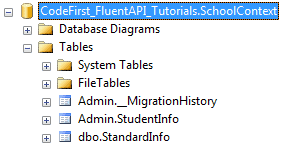
As you can see in the above example, we start with the Entity<TEntity>() method. Most of the time, you have to start with the Entity<TEntity>() method to configure it using Fluent API. We have used ToTable() method to map Student entity to StudentInfo and Standard entity to StandardInfo table. Notice that StudentInfo is in Admin schema and StandardInfo table is in dbo schema because we have specified dbo schema for StandardInfo table.
Map Entity to Multiple Table:
The following example shows how to map Student entity to multiple tables in the database.
namespace CodeFirst_FluentAPI_Tutorials

{

    public class SchoolContext: DbContext

    {

        public SchoolDBContext(): base()

        {

        }

        public DbSet<Student> Students { get; set; }

        public DbSet<Standard> Standards { get; set; }

        protected override void OnModelCreating(DbModelBuilder modelBuilder)

        {

            modelBuilder.Entity<Student>().Map(m =>

            {

                m.Properties(p => new { p.StudentId, p.StudentName});

                m.ToTable("StudentInfo");

            }).Map(m => {

                m.Properties(p => new { p.StudentId, p.Height, p.Weight, p.Photo, p.DateOfBirth});

                m.ToTable("StudentInfoDetail");

            });

            modelBuilder.Entity<Standard>().ToTable("StandardInfo");

        }

    }

}
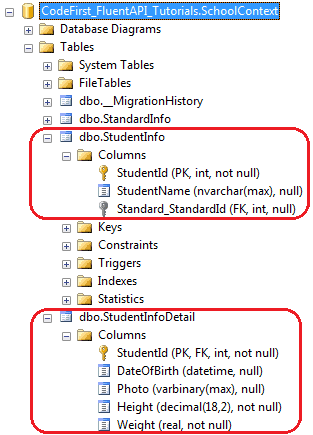
As you can see in the above example, we mapped some properties of Student entity to StudentInfo table and other properties to StudentInfoDetail table using Map() method. Thus, Student entity will split into two tables, as shown below.
Map method need the delegate method as a parameter. You can pass Action delegate or lambda expression in Map method, as shown below.
using System.Data.Entity.ModelConfiguration.Configuration;

namespace CodeFirst_FluentAPI_Tutorials

{

    public class SchoolContext: DbContext

    {

        public SchoolDBContext(): base()

        {

        }

        public DbSet<Student> Students { get; set; }

        public DbSet<Standard> Standards { get; set; }

        protected override void OnModelCreating(DbModelBuilder modelBuilder)

        {

            modelBuilder.Entity<Student>().Map(delegate(EntityMappingConfiguration<Student> studentConfig)

            {

                studentConfig.Properties(p => new { p.StudentId, p.StudentName });

                studentConfig.ToTable("StudentInfo");

            });

            Action<EntityMappingConfiguration<Student>> studentMapping = m =>

            {

                m.Properties(p => new { p.StudentId, p.Height, p.Weight, p.Photo, p.DateOfBirth });

                m.ToTable("StudentInfoDetail");

            };

            modelBuilder.Entity<Student>().Map(studentMapping);

            modelBuilder.Entity<Standard>().ToTable("StandardInfo");

        }

    }

}
Entity Framework Code-First(10.2):Entity Mappings的更多相关文章
- Entity Framework Code-First(10.3):Property Mappings
Property Mappings using Fluent API: Here, we will learn how to configure properties of an entity cla ...
- Entity Framework Code first(转载)
一.Entity Framework Code first(代码优先)使用过程 1.1Entity Framework 代码优先简介 不得不提Entity Framework Code First这个 ...
- ASP.NET MVC深入浅出系列(持续更新) ORM系列之Entity FrameWork详解(持续更新) 第十六节:语法总结(3)(C#6.0和C#7.0新语法) 第三节:深度剖析各类数据结构(Array、List、Queue、Stack)及线程安全问题和yeild关键字 各种通讯连接方式 设计模式篇 第十二节: 总结Quartz.Net几种部署模式(IIS、Exe、服务部署【借
ASP.NET MVC深入浅出系列(持续更新) 一. ASP.NET体系 从事.Net开发以来,最先接触的Web开发框架是Asp.Net WebForm,该框架高度封装,为了隐藏Http的无状态模 ...
- Entity Framework Code First (三)Data Annotations
Entity Framework Code First 利用一种被称为约定(Conventions)优于配置(Configuration)的编程模式允许你使用自己的 domain classes 来表 ...
- Entity Framework Code First (二)Custom Conventions
---------------------------------------------------------------------------------------------------- ...
- Entity Framework Code First (一)Conventions
Entity Framework 简言之就是一个ORM(Object-Relational Mapper)框架. Code First 使得你能够通过C#的类来描述一个模型,模型如何被发现/检测就是通 ...
- Entity Framework Code First (七)空间数据类型 Spatial Data Types
声明:本文针对 EF5+, Visual Studio 2012+ 空间数据类型(Spatial Data Types)是在 EF5 中引入的,空间数据类型表现有两种: Geography (地理学上 ...
- Entity Framework Code First (四)Fluent API - 配置属性/类型
上篇博文说过当我们定义的类不能遵循约定(Conventions)的时候,Code First 提供了两种方式来配置你的类:DataAnnotations 和 Fluent API, 本文将关注 Flu ...
- Entity Framework Code First (八)迁移 Migrations
创建初始模型和数据库 在开始使用迁移(Migrations)之前,我们需要一个 Project 和一个 Code First Model, 对于本文将使用典型的 Blog 和 Post 模型 创建一个 ...
随机推荐
- 双向链表(C++实现)
////////////////////////////////////////////////////////////////////////////////////// /////// 这里建立两 ...
- 使用ksar解析sar监控日志
sar 是属于sysstat包中的一个工具 安装sysstat包后,默认创建一个/etc/cron.d/sysstat文件,其默认内容为: # run system activity accounti ...
- perl常用字符串函数
1.$position = index(string,substring,skipchars): 该函数返回子串substring在字符串string中的位置,如果不存在,则返回-1:参数skipch ...
- 解决css的float父div没有高度
在做页面设计常会碰到css的float父div没有高度的情况,HTML代码设计 <div class='box'> <div class='float_left'></d ...
- 分享知识-快乐自己:Shrio 案例Demo概述
Shiro 权限认证核心: POM:文件: <!--shiro-all--> <dependency> <groupId>org.apache.shiro</ ...
- 原生JS实现淡入淡出效果(fadeIn/fadeOut/fadeTo)
淡入淡出效果,在日常项目中经常用到,可惜原生JS没有类似的方法,而有时小的页面并不值得引入一个jQuery库,所以就自己写了一个,已封装, 有用得着的朋友, 可以直接使用. 代码中另附有一个设置元素透 ...
- java--Hibernate实现分页查询
首先在Action类定义当前页的值 private Integer currPage = 1 setter,getter 在spring IOC容器进行注入该变量 在Action类写一个findAll ...
- Java进阶06 容器
Java中有一些对象被称为容器(container).容器中可以包含多个对象,每个对象称为容器中的一个元素.容器是用对象封装的数据结构(data structure). 充满梦想的容器 不同的数据结构 ...
- bzoj 4817: [Sdoi2017]树点涂色 LCT+树链剖分+线段树
题目: Bob有一棵n个点的有根树,其中1号点是根节点.Bob在每个点上涂了颜色,并且每个点上的颜色不同. 定义一条路径的权值是:这条路径上的点(包括起点和终点)共有多少种不同的颜色. Bob可能会进 ...
- 2017.10.6北京清北综合强化班DAY6
题目大意:改变一个数的位置 把一个序列变成不下降序列 题解: 设置一个pre,如果破坏单调性,就把‘删除’这个.否则把pre修改为当前元素的值. 考试时这样得了90分,是因为我的做法只能过这样的数据 ...