
Learning How To Code Neural Networks
原文:https://medium.com/learning-new-stuff/how-to-learn-neural-networks-758b78f2736e#.ly5wpz44d
This is the second post in a series of me trying to learn something new over a short period of time. The first time consisted of learning how to do machine learning in a week.
This time I’ve tried to learn neural networks. While I didn’t manage to do it within a week, due to various reasons, I did get a basic understanding of it throughout the summer and autumn of 2015.
By basic understanding, I mean that I finally know how to code simple neural networks from scratch on my own.
In this post, I’ll give a few explanations and guide you to the resources I’ve used, in case you’re interested in doing this yourself.
Step 1: Neurons and forward propagation
So what is a neural network? Let’s wait with the network part and start off with one single neuron.
A neuron is like a function; it takes a few inputs and calculates an output.
The circle below illustrates an artificial neuron. Its input is 5 and its output is 1. The input is the sum of the three synapses connecting to the neuron (the three arrows at the left).
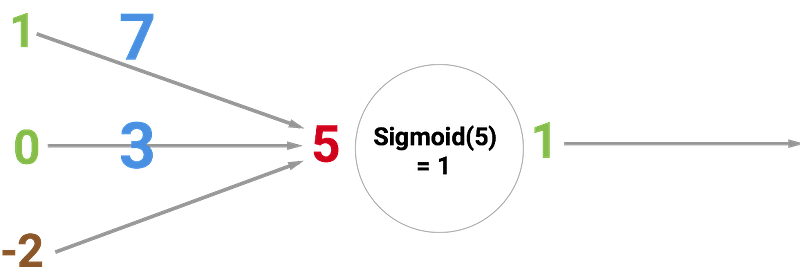
At the far left we see two input values plus a bias value. The input values are 1 and 0 (the green numbers), while the bias holds a value of -2 (the brown number).
The inputs here might be numerical representations of two different features. If we’re building a spam filter, it could be wether or not the email contains more than one CAPITALIZED WORD and wether or not it contains the word ‘viagra’.
The two inputs are then multiplied by their so called weights, which are 7 and 3 (the blue numbers).
Finally we add it up with the bias and end up with a number, in this case: 5 (the red number). This is the input for our artificial neuron.
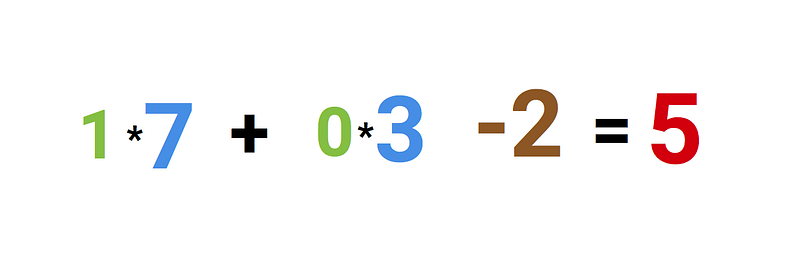
The neuron then performs some kind of computation on this number — in our case the Sigmoid function, and then spits out an output. This happens to be 1, as Sigmoid of 5 equals to 1, if we round the number up (more info on the Sigmoid function follows later).
If this was a spam filter, the fact that we’re outputting 1 (as opposed to 0) probably means that the neuron has labeled the text as ‘spam’.
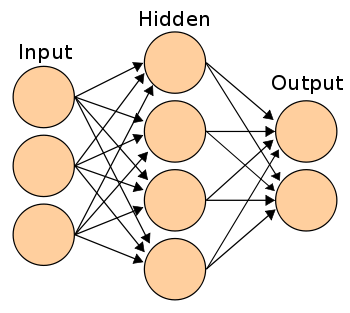
A neural network illustration from Wikipedia.
If you connect a network of these neurons together, you have a neural network, which propagates forward — from input output, via neurons which are connected to each other through synapses, like on the image to the left.
I can strongly recommend theWelch Labs videos on YouTube for getting a better intuitive explanation of this process.
Step 2: Understanding the Sigmoid function
After you’ve seen the Welch Labs videos, its a good idea to spend some time watching Week 4 of the Coursera’s Machine Learning course, which covers neural networks, as it’ll give you more intuition of how they work.
The course is fairly mathematical, and its based around Octave, while I prefer Python. Because of this, I did not do the programming exercises. Instead, I used the videos to help me understand what I needed to learn.
The first thing I realized I needed to investigate further was the Sigmoid function, as this seemed to be a critical part of many neural networks. I knew a little bit about the function, as it was also covered in Week 3 of the same course. So I went back and watched these videos again.
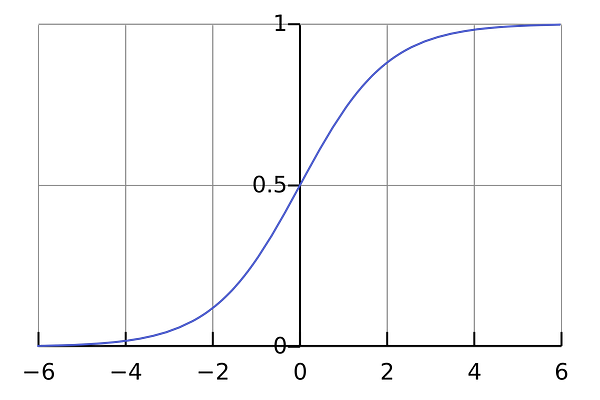
The Sigmoid function simply maps your value (along the horizontal axis) to a value between 0 and 1.
But watching videos won’t get you all the way. To really understand it, I felt I needed to code it from the ground up.
So I started to code a logistic regression algorithm from scratch (which happened to use the Sigmoid function).
It took a whole day, and it’s probably not a very good implementation of logistic regression. But that doesn’t matter, as I finally understood how it works. Check the code here.
You don’t need to perform this entire exercise yourself, as it requires some knowledge about and cost functions and gradient descent, which you might not have at this point.
But make sure you understand how the Sigmoid function works.
Step 3: Understanding backpropagation
Understanding how a neural network works from input to output isn’t that difficult to understand, at least conceptually.
More difficult though, is understanding how the neural network actually learns from looking at a set of data samples.
The concept is called backpropagation.
This essentially means that you look at how wrong the network guessed, and then adjust the networks weights accordingly.
The weights were the blue numbers on our neuron in the beginning of the article.
This process happens backwards, because you start at the end of the network (observe how wrong the networks ‘guess’ is), and then move backwards through the network, while adjusting the weights on the way, until you finally reach the inputs.
To calculate this by hand requires some calculus, as it involves getting some derivatives of the networks’ weights. The Kahn Academy calculus courses seems like a good way to start, though I haven’t used them myself, as I took calculus on university.
Note: there are a lot of libraries that calculates the derivatives for you, so if you’d like to start coding neural networks before completely understanding the math, you’re fully able to do this as well.
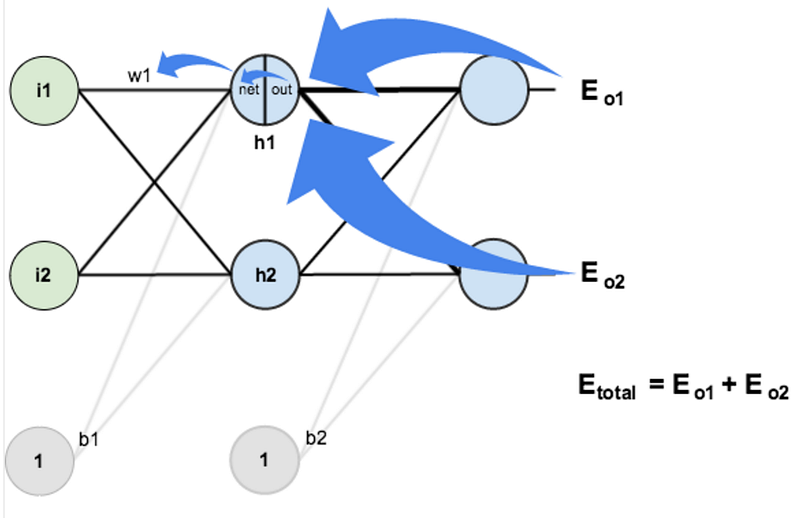
Screehshot from Matt Mazurstutorial on backpropagation.
The three best sources I found for understanding backpropagation are these:
- A Step by Step Backpropagation Example — by Matt Mazur
- Hackers Guide to Neural Nets —by Andrej Karpathy
- NeuralNetworksAndDeepLarning — by Michael Nielsen
You should definitely code along while you’re reading the articles, especially the two first ones. It’ll give you some sample code to look back at when you’re confused in the future.
Plus, I can’t really emphasize this enough:
You don’t learn much by reading about neural nets, you need to practice it to make the knowledge stick.
The third article is also fantastic, but I’ve used this more as a wiki than a plain tutorial, as it’s actually an entire book. It contains thorough explanations all the important concepts in neural networks.
These articles will also help you understand important concepts as cost functions and gradient descent, which play equally important roles in neural networks.
Step 4: Coding your own neural networks
In some articles and tutorials you’ll actually end up coding small neural networks. As soon as you’re comfortable with that, I recommend you to go all in on this strategy. It’s both fun and an extremely effective way of learning.
One of the articles I also learned a lot from was A Neural Network in 11 Lines Of Python by IAmTrask. It contains an extraordinary amount of compressed knowledge and concepts in just 11 lines.
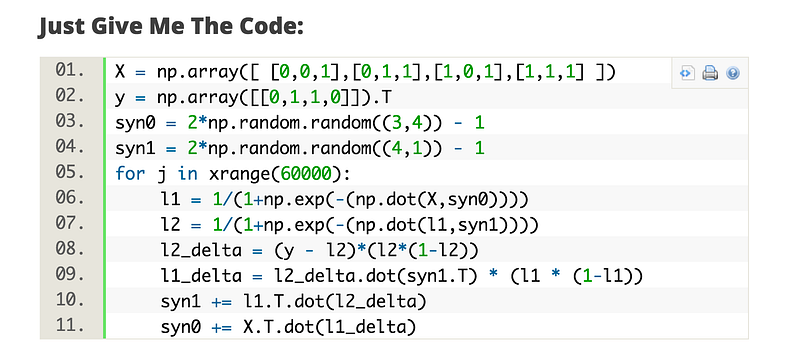
Screenshot from the IAmTrask tutorial
After you’ve coded along with this example, you should do as the article states at the bottom, which is to implement it once again without looking at the tutorial. This forces you to really understand the concepts, and will likely reveal holes in your knowledge, which isn’t fun. However, when you finally manage it, you’ll feel like you’ve just acquired a new superpower.
A little side note: When doing exercises I was often confused by the vectorized implementations some tutorials use, as it requires a little bit of linear algebra to understand. Once again, I turned myself back to the Coursera ML course, as Week 1 contains a full section of linear algebra review. This helps you to understand how matrixes and vectors are multiplied in the networks.
When you’ve done this, you can continue with this Wild ML tutorial, by Denny Britz, which guides you through a little more robust neural network.
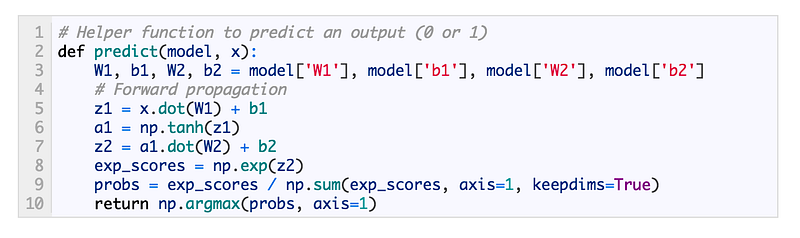
Screenshot from the WildML tutorial.
At this point, you could either try and code your own neural network from scratch or start playing around with some of the networks you have coded up already. It’s great fun to find a dataset that interests you and try to make some predictions with your neural nets.
To get a hold of a dataset, just visit my side project Datasets.co (← shameless self promotion) and find one you like.

Visit Datasets.co to get hold of a dataset
Anyway, the point is that you’re now better off experimenting with stuff that interests you rather than following my advices.
Personally, I’m currently learning how to use Python libraries that makes it easier to code up neural networks, like Theano, Lasagne and nolearn. I’m using this to do challenges on Kaggle, which is both great fun and great learning.
Good luck!
And don’t forget to press the heart button if you liked the article :)
Learning How To Code Neural Networks的更多相关文章
- 1506.01186-Cyclical Learning Rates for Training Neural Networks
1506.01186-Cyclical Learning Rates for Training Neural Networks 论文中提出了一种循环调整学习率来训练模型的方式. 如下图: 通过循环的线 ...
- Coursera Deep Learning 2 Improving Deep Neural Networks: Hyperparameter tuning, Regularization and Optimization - week2, Assignment(Optimization Methods)
声明:所有内容来自coursera,作为个人学习笔记记录在这里. 请不要ctrl+c/ctrl+v作业. Optimization Methods Until now, you've always u ...
- Coursera Deep Learning 2 Improving Deep Neural Networks: Hyperparameter tuning, Regularization and Optimization - week1, Assignment(Initialization)
声明:所有内容来自coursera,作为个人学习笔记记录在这里. Initialization Welcome to the first assignment of "Improving D ...
- 吴恩达《深度学习》-课后测验-第一门课 (Neural Networks and Deep Learning)-Week 3 - Shallow Neural Networks(第三周测验 - 浅层神 经网络)
Week 3 Quiz - Shallow Neural Networks(第三周测验 - 浅层神经网络) \1. Which of the following are true? (Check al ...
- Coursera Deep Learning 2 Improving Deep Neural Networks: Hyperparameter tuning, Regularization and Optimization - week1, Assignment(Gradient Checking)
声明:所有内容来自coursera,作为个人学习笔记记录在这里. Gradient Checking Welcome to the final assignment for this week! In ...
- Coursera Deep Learning 2 Improving Deep Neural Networks: Hyperparameter tuning, Regularization and Optimization - week1, Assignment(Regularization)
声明:所有内容来自coursera,作为个人学习笔记记录在这里. Regularization Welcome to the second assignment of this week. Deep ...
- Coursera, Deep Learning 2, Improving Deep Neural Networks: Hyperparameter tuning, Regularization and Optimization - week1, Course
Train/Dev/Test set Bias/Variance Regularization 有下面一些regularization的方法. L2 regularation drop out da ...
- Coursera Deep Learning 2 Improving Deep Neural Networks: Hyperparameter tuning, Regularization and Optimization - week3, Hyperparameter tuning, Batch Normalization and Programming Frameworks
Tuning process 下图中的需要tune的parameter的先后顺序, 红色>黄色>紫色,其他基本不会tune. 先讲到怎么选hyperparameter, 需要随机选取(sa ...
- Coursera Deep Learning 2 Improving Deep Neural Networks: Hyperparameter tuning, Regularization and Optimization - week2, Optimization algorithms
Gradient descent Batch Gradient Decent, Mini-batch gradient descent, Stochastic gradient descent 还有很 ...
随机推荐
- (转)park1.0.0生态圈一览
转自博客:http://www.tuicool.com/articles/FVBJBjN Spark1.0.0生态圈一览 Spark生态圈,也就是BDAS(伯克利数据分析栈),是伯克利APMLab实验 ...
- bzoj 2150 最小路径覆盖
最小路径覆盖问题是:给定一个DAG,该DAG的一个路径覆盖是一个路径的集合,使得每个点属于且仅属于其中一条路径,问题就是求一个大小最小的路径集合. 做法是将每个点A拆成两个点A1,A2,如果A-> ...
- pkgadd 软件安装二种方法
安装文件 pkgadd -d /soft/top-3.6.1-sol10-x86-local 安装目录文件: pkgadd -d ./ SUNWi1cs SUNWi15cs
- mysql 审计插件编写
http://bbs.chinaunix.net/forum.php?mod=viewthread&tid=1864367&page=1#pid13527550 http://blog ...
- golang 字符串与整数, 布尔转换 strconv
strconv 是golang对于字符串和基本数据类型之间的转换字符串转整数testStr := "1000" testInt, err := strconv.Atoi(testS ...
- 使用Bootstrap 3开发响应式网站实践05,使用Tab、Modal、Form展示内容,使用Popover、Tooltip展示提示信息
本篇体验用Tab插件显示内容.Html部分为: <div class="row" id="moreInfo"> <div class=&quo ...
- andriod arcgis createPolygons创建带空的面
private void createPolygons() { // create input polygon 1 PointCollection pointsPoly = new PointColl ...
- 学习Android Studio里的Gradle
一直听说Gradle很强大,只是偶尔用Android Studio创建Demo的时候看到他一次,今天抽个时间完整记录一下. 1.gradle位置 Android Studio项目创建好之后,默认有3个 ...
- Eclipse——浏览功能
一,打开变量声明 或选择opendeclaration就能够查看变量的定义 二.打开类型层次结构(open type hierarchy) 或者点击F4 watermark/2/text/aHR0cD ...
- Java Net版短网址(ShortUrl)的算法及实现 待续
算法 1)将长网址md5生成32位签名串,分为4段, 每段8个字节; 2)对这四段循环处理, 取8个字节, 将他看成16进制串与0x3fffffff(30位1)与操作, 即超过30位的忽略处理; 3) ...