
吴恩达《深度学习》-课后测验-第一门课 (Neural Networks and Deep Learning)-Week 3 - Shallow Neural Networks(第三周测验 - 浅层神 经网络)
Week 3 Quiz - Shallow Neural Networks(第三周测验 - 浅层神经网络)
\1. Which of the following are true? (Check all that apply.) Notice that I only list correct options(以下哪一项是正确的?只列出了正确的答案)
【 】 is a matrix in which each column is one training example.(是一个矩阵,其中每个列都 是一个训练样本。)
【 】\(_4^{[2]}\) is the activation output by the 4th neuron of the 2nd layer(4 [2]是第二层第四层神经 元的激活的输出。)
【 】\(^{[2](12)}\) denotes the activation vector of the 2nd layer for the 12th training example.(表\(^{[2](12)}\)示第二层和第十二层的激活向量。)
【 】\(^{[2]}\) denotes the activation vector of the 2nd layer.(\(^{[2]}\) 表示第二层的激活向量。)
答案
全对
\2. The tanh activation usually works better than sigmoid activation function for hidden units because the mean of its output is closer to zero, and so it centers the data better for the next layer. True/False?(tanh 激活函数通常比隐藏层单元的 sigmoid 激活函数效果更好,因为其 输出的平均值更接近于零,因此它将数据集中在下一层是更好的选择,请问正确吗?)
【 】True(正确) 【 】 False(错误)
答案
True
Note: You can check this post and(this paper)(请注意,你可以看一下这篇文章 和这篇文档.)
As seen in lecture the output of the tanh is between -1 and 1, it thus centers the data which makes the learning simpler for the next layer.(tanh 的输出在-1 和 1 之间,因此它将数据集中在一起,使得下 一层的学习变得更加简单。)
\3. Which of these is a correct vectorized implementation of forward propagation for layer , where ≤ ≤ ? Notice that I only list correct options(其中哪一个是第 l 层向前传播的正确 向量化实现,其中 ≤ ≤ )(以下哪一项是正确的?只列出了正确的答案)
【 】$^{[]} = {[]}{[−1]} + ^{[]} $
【 】\(^{[]} = ^{[]} (^{[]} )\)
答案
全对
\4. You are building a binary classifier for recognizing cucumbers (y=1) vs. watermelons (y=0). Which one of these activation functions would you recommend using for the output layer?(您 正在构建一个识别黄瓜(y = 1)与西瓜(y = 0)的二元分类器。 你会推荐哪一种激活函数 用于输出层?)
【 】 ReLU 【 】 Leaky ReLU 11 【 】 sigmoid 【 】 tanh
答案
sigmoid
Note: The output value from a sigmoid function can be easily understood as a probability.(注意:来自 sigmoid 函数的输出值可以很容易地理解为概率。)
Sigmoid outputs a value between 0 and 1 which makes it a very good choice for binary classification.You can classify as 0 if the output is less than 0.5 and classify as 1 if the output is more than 0.5. It can be done with tanh as well but it is less convenient as the output is between -1 and 1. Sigmoid 输出的值介于 0 和 1 之间,这使其成为二元分类的一个非常好的选择。 如果输出小于 0.5,则可以将其归类为 0,如果输出大于 0.5,则归类为 1。 它也可以用 tanh 来完成,但是它不太方便,因为输出在-1 和 1 之间。)
\5. Consider the following code:(看一下下面的代码:)
A = np.random.randn(4,3)

B = np.sum(A, axis = 1, keepdims = True)

What will be B.shape?(请问 B.shape 的值是多少?)
答案
B.shape = (4, 1)
we use (keepdims = True) to make sure that A.shape is (4,1) and not (4, ). It makes our code more rigorous.(我们使用(keepdims = True)来确保 A.shape 是(4,1)而不是(4,),它使 我们的代码更加严格。)
\6. Suppose you have built a neural network. You decide to initialize the weights and biases to be zero. Which of the following statements are True? (Check all that apply)(假设你已经建立 了一个神经网络。 您决定将权重和偏差初始化为零。 以下哪项陈述是正确的?)
【 】Each neuron in the first hidden layer will perform the same computation. So even after multiple iterations of gradient descent each neuron in the layer will be computing the same thing as other neurons.(第一个隐藏层中的每个神经元节点将执行相同的计算。 所以即使经过 多次梯度下降迭代后,层中的每个神经元节点都会计算出与其他神经元节点相同的东西。)
【 】Each neuron in the first hidden layer will perform the same computation in the first iteration. But after one iteration of gradient descent they will learn to compute different things because we have “broken symmetry”.( 第一个隐藏层中的每个神经元将在第一次迭代中执行相 同的计算。 但经过一次梯度下降迭代后,他们将学会计算不同的东西,因为我们已经“破坏了 对称性”。)
【 】Each neuron in the first hidden layer will compute the same thing, but neurons in different layers will compute different things, thus we have accomplished “symmetry breaking” as described in lecture.(第一个隐藏层中的每一个神经元都会计算出相同的东西,但是不同层的神 经元会计算不同的东西,因此我们已经完成了“对称破坏”。)
【 】The first hidden layer’s neurons will perform different computations from each other even in the first iteration; their parameters will thus keep evolving in their own way.(即使在第一次迭 代中,第一个隐藏层的神经元也会执行不同的计算, 他们的参数将以自己的方式不断发展。)
答案
【★】Each neuron in the first hidden layer will perform the same computation. So even after multiple iterations of gradient descent each neuron in the layer will be computing the same thing as other neurons.(第一个隐藏层中的每个神经元节点将执行相同的计算。 所以即使经过 多次梯度下降迭代后,层中的每个神经元节点都会计算出与其他神经元节点相同的东西。)
\7. Logistic regression’s weights w should be initialized randomly rather than to all zeros, because if you initialize to all zeros, then logistic regression will fail to learn a useful decision boundary because it will fail to “break symmetry”, True/False?(Logistic 回归的权重 w 应该随 机初始化,而不是全零,因为如果初始化为全零,那么逻辑回归将无法学习到有用的决策边 界,因为它将无法“破坏对称性”,是正确的吗?)
【 】True(正确) 【 】 False(错误)
答案
False
Note: Logistic Regression doesn’t have a hidden layer. If you initialize the weights to zeros, the first example x fed in the logistic regression will output zero but the derivatives of the Logistic Regression depend on the input x (because there’s no hidden layer) which is not zero. So at the second iteration, the weights values follow x’s distribution and are different from each other if x is not a constant vector.(Logistic 回归没有隐藏层。 如果将权重初始化为零,则 Logistic 回归中的第一个样本 x 将输 出零,但 Logistic 回归的导数取决于不是零的输入 x(因为没有隐藏层)。 因此,在第二次迭代 中,如果 x 不是常量向量,则权值遵循 x 的分布并且彼此不同。)
\8. You have built a network using the tanh activation for all the hidden units. You initialize the weights to relative large values, using np.random.randn(..,..)1000. What will happen?(您已经 为所有隐藏单元使用 tanh 激活建立了一个网络。 使用 np.random.randn(..,..) 1000 将 权重初始化为相对较大的值。 会发生什么?)
【 】 It doesn’t matter. So long as you initialize the weights randomly gradient descent is not affected by whether the weights are large or small.(这没关系。只要随机初始化权重,梯度下降 不受权重大小的影响。)
【 】 This will cause the inputs of the tanh to also be very large, thus causing gradients to also become large. You therefore have to set \(\alpha\) to be very small to prevent divergence; this will slow down learning.(这将导致 tanh 的输入也非常大,因此导致梯度也变大。因此,您必须将 α 设 置得非常小以防止发散; 这会减慢学习速度。)
【 】 This will cause the inputs of the tanh to also be very large, causing the units to be “highly activated” and thus speed up learning compared to if the weights had to start from small values.(这会导致 tanh 的输入也非常大,导致单位被“高度激活”,从而加快了学习速度,而权重必须从小数值开始。)
【 】 This will cause the inputs of the tanh to also be very large, thus causing gradients to be close to zero. The optimization algorithm will thus become slow.(这将导致 tanh 的输入也很 大,因此导致梯度接近于零, 优化算法将因此变得缓慢。)
答案
【★】 This will cause the inputs of the tanh to also be very large, thus causing gradients to be close to zero. The optimization algorithm will thus become slow.(这将导致 tanh 的输入也很大,因此导致梯度接近于零, 优化算法将因此变得缓慢。)
Note:tanh becomes flat for large values, this leads its gradient to be close to zero. This slows down the optimization algorithm.(注:tanh 对于较大的值变得平坦,这导致其梯度接近于零。 这减慢了 优化算法。)
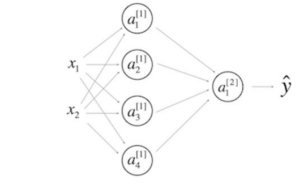
\9. Consider the following 1 hidden layer neural network:(看一下下面的单隐层神经网络)
【 】\(^{[1]}\) will have shape (4, 1)(\(^{[1]}\)的维度是(4, 1))
【 】\(^{[1]}\) will have shape (4, 2)(\(^{[1]}\)的维度是 (4, 2))
【 】\(^{[2]}\) will have shape (1, 4)(\(^{[2]}\) 的维度是 (1, 4))
【 】\(^{[2]}\) will have shape (1, 1)(\(^{[2]}\)的维度是 (1, 1))
答案
全对
Note: Check here for general formulas to do this.(注:来看一下公式) 
\10. In the same network as the previous question, what are the dimensions of \(^{[]}\) and \(^{[]}\) ?(在 和上一个相同的网络中,\(^{[]}\) 和 \(^{[]}\)的维度是多少?)
答案
【★】维度都是 (4,m))
Week 3 Code Assignments:
✧Course 1 - 神经网络和深度学习 - 第三周测验 - 浅层神经网络
✦assignment3:Planar data classification with one hidden layer)
吴恩达《深度学习》-课后测验-第一门课 (Neural Networks and Deep Learning)-Week 3 - Shallow Neural Networks(第三周测验 - 浅层神 经网络)的更多相关文章
- 吴恩达深度学习课后习题第5课第1周第3小节: Jazz Improvisation with LSTM
目录 Improvise a Jazz Solo with an LSTM Network Packages 1 - Problem Statement 1.1 - Dataset What are ...
- 【Deeplearning.ai 】吴恩达深度学习笔记及课后作业目录
吴恩达深度学习课程的课堂笔记以及课后作业 代码下载:https://github.com/douzujun/Deep-Learning-Coursera 吴恩达推荐笔记:https://mp.weix ...
- 吴恩达深度学习第2课第2周编程作业 的坑(Optimization Methods)
我python2.7, 做吴恩达深度学习第2课第2周编程作业 Optimization Methods 时有2个坑: 第一坑 需将辅助文件 opt_utils.py 的 nitialize_param ...
- 吴恩达深度学习第1课第4周-任意层人工神经网络(Artificial Neural Network,即ANN)(向量化)手写推导过程(我觉得已经很详细了)
学习了吴恩达老师深度学习工程师第一门课,受益匪浅,尤其是吴老师所用的符号系统,准确且易区分. 遵循吴老师的符号系统,我对任意层神经网络模型进行了详细的推导,形成笔记. 有人说推导任意层MLP很容易,我 ...
- 吴恩达深度学习第4课第3周编程作业 + PIL + Python3 + Anaconda环境 + Ubuntu + 导入PIL报错的解决
问题描述: 做吴恩达深度学习第4课第3周编程作业时导入PIL包报错. 我的环境: 已经安装了Tensorflow GPU 版本 Python3 Anaconda 解决办法: 安装pillow模块,而不 ...
- 吴恩达深度学习 反向传播(Back Propagation)公式推导技巧
由于之前看的深度学习的知识都比较零散,补一下吴老师的课程希望能对这块有一个比较完整的认识.课程分为5个部分(粗体部分为已经看过的): 神经网络和深度学习 改善深层神经网络:超参数调试.正则化以及优化 ...
- 深度学习 吴恩达深度学习课程2第三周 tensorflow实践 参数初始化的影响
博主 撸的 该节 代码 地址 :https://github.com/LemonTree1994/machine-learning/blob/master/%E5%90%B4%E6%81%A9%E8 ...
- 吴恩达深度学习笔记(十二)—— Batch Normalization
主要内容: 一.Normalizing activations in a network 二.Fitting Batch Norm in a neural network 三.Why does ...
- 吴恩达深度学习笔记(deeplearning.ai)之卷积神经网络(二)
经典网络 LeNet-5 AlexNet VGG Ng介绍了上述三个在计算机视觉中的经典网络.网络深度逐渐增加,训练的参数数量也骤增.AlexNet大约6000万参数,VGG大约上亿参数. 从中我们可 ...
随机推荐
- 最后之作-Last Order(bushi
最近化学学有机选修,讲羧酸的时候我想到一个问题:不考虑空间异构.能否稳定存在等问题,某高级饱和脂肪酸有多少种同分异构体?做为一名退役的OIer,我将它抽象为了另一个问题:含\(n\)个\(C\)的饱和 ...
- 《Java从入门到失业》第一章:计算机基础知识(三):程序语言简介
1.3程序语言简介 我们经常会听到一些名词:低级语言.高级语言.编译型.解释型.面向过程.面向对象等.这些到底是啥意思呢?在正式进入Java世界前,笔者也尝试简单的聊一聊这块东西. 1.3.1低级语言 ...
- VM获取子网掩码和网关
- Spring Security拦截器加载流程分析--练气中期
写在前面 上回我们讲了spring security整合spring springmvc的流程,并且知道了spring security是通过过滤器链来进行认证授权操作的.今天我们来分析一下sprin ...
- 七夕节表白3d相册制作(html5+css3)
七夕节表白3d相册制作 涉及知识点 定位 阴影 3d转换 动画 主要思路: 通过定位将所有照片叠在一起,在设置默认的样式以及照片的布局,最后通过设置盒子以及照片的旋转动画来达到效果. 代码如下: &l ...
- Hadoop 3.x 与Hadoop 2.x 的区别和优化点
Hadoop 3.x 与Hadoop 2.x 的区别和优化点 通用性 1.精简Hadoop内核,包括剔除过期的API和实现,将默认组件实现替换成最高效的实现(比如将FileOutputCommitte ...
- koa-graphql express-graphql 中如何 定义每一个字段resolver执行函数
第一种方式: 首先来看一下,官方给出的koa-graphql的例子, ```js var express = require('express'); var {graphqlHTTP} = requ ...
- ClickHouse和他的朋友们(9)MySQL实时复制与实现
本文转自我司大神 BohuTANG的博客 . 很多人看到标题还以为自己走错了夜场,其实没有. ClickHouse 可以挂载为 MySQL 的一个从库 ,先全量再增量的实时同步 MySQL 数据,这个 ...
- python123期末四题编程题 -无空隙回声输出-文件关键行数-字典翻转输出-《沉默的羔羊》之最多单词
1. 无空隙回声输出 描述 获得用户输入,去掉其中全部空格,将其他字符按收入顺序打印输出. ...
- 从后端到前端之Vue(六)表单组件
表单组件 做项目的时候会遇到一个比较头疼的问题,一个大表单里面有好多控件,一个一个做设置太麻烦,更头疼的是,需求还总在变化,一会多选.一会单选.一会下拉的,变来变去的烦死宝宝了. 那么怎么解决这个问题 ...