
[转帖]IOC Security: Indicators of Attack vs. Indicators of Compromise
IOC Security: Indicators of Attack vs. Indicators of Compromise
https://www.crowdstrike.com/blog/indicators-attack-vs-indicators-compromise/
- December 9, 2014
- Jessica DeCianno
- Endpoint Protection
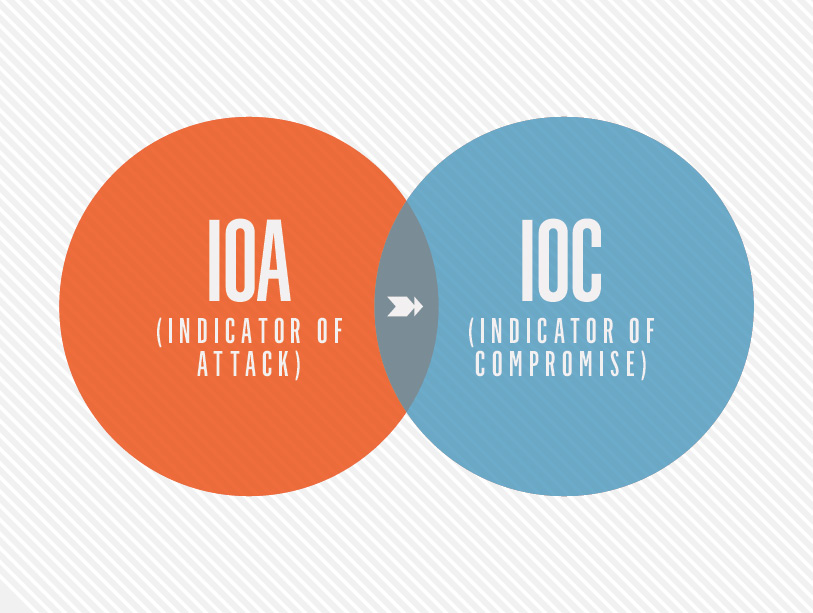
What is an Indicator of Compromise (IOC)?
First we should provide a definition of an indicator of compromise (IOC). An IOC is often described in the forensics world as evidence on a computer that indicates that the security of the network has been breached. Investigators usually gather this data after being informed of a suspicious incident, on a scheduled basis, or after the discovery of unusual call-outs from the network. Ideally, this information is gathered to create “smarter” tools that can detect and quarantine suspicious files in the future.
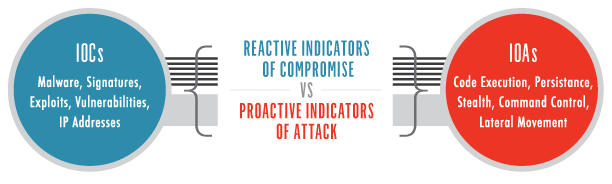
In the Cyber world, an IOC is an MD5 hash, a C2 domain or hardcoded IP address, a registry key, filename, etc. These IOCs are constantly changing making a proactive approach to securing the enterprise impossible. Because IOCs provide a reactive method of tracking the bad guys, when you find an IOC, there is a high probability that you have already been compromised.
What is an Indicator of Attack (IOA)?
Unlike Indicators of Compromise (IOCs) used by legacy endpoint detection solutions, indicators of attack (IOA) focus on detecting the intent of what an attacker is trying to accomplish, regardless of the malware or exploit used in an attack. Just like AV signatures, an IOC-based detection approach cannot detect the increasing threats from malware-free intrusions and zero-day exploits. As a result, next-generation security solutions are moving to an IOA-based approach pioneered by CrowdStrike.
Indicator of Attack – Physical World
One way to focus our discussion around Indicators of Attack (IOA’s) is to provide an example of how a criminal would plan and undertake to rob a bank in the physical world.
A smart thief would begin by “casing” the bank, performing reconnaissance and understanding any defensive vulnerabilities. Once he determines the best time and tactics to strike, he proceeds to enter the bank. The robber disables the security system, moves toward the vault, and attempts to crack the combination. If he succeeds, he pinches the loot, makes an uneventful getaway and completes the mission. IOA’s are a series of behaviors a bank robber must exhibit to succeed at achieving his objective. He has to drive around the bank (identifying the target), park, and enter the building before he can enter the vault. If he doesn’t disable the security system, it will alarm when he enters the vault and takes the money.
Of course, activities like driving around the bank, parking and entering the bank do not, on their own, indicate an attack is imminent. Moreover, opening a bank vault and withdrawing cash is not necessarily an IOA… if the individual is authorized to access the vault. Specific combinations of activity trigger IOA’s.
Indicator of Attack – Cyber World
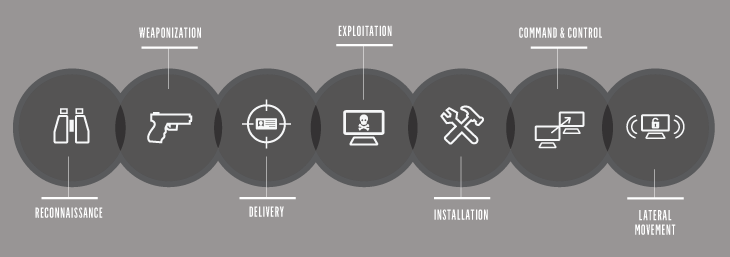
Let’s examine an example from the cyber world. An IOA represents a series of actions that an adversary must conduct to succeed. If we break down the most common and still the most successful tactic of determined adversaries – the spear phish – we can illustrate this point.
A successful phishing email must persuade the target to click on a link or open a document that will infect the machine. Once compromised, the attacker will silently execute another process, hide in memory or on disk and maintain persistence across reboots of the system. The next step is to make contact with a command and control site, informing his handlers that he awaits further instructions.
IOAs are concerned with the execution of these steps, the intent of the adversary and the outcomes he is trying to achieve. IOA’s are not focused on the specific tools he uses to accomplish his objectives.
By monitoring these execution points, gathering the indicators and consuming them via a Stateful Execution Inspection Engine, we can determine how an actor successfully gains access to the network and we can infer intent. No advance knowledge of the tools or malware (aka: Indicators of Compromise) is required.
Comparing an IOA to an IOC
In revisiting the bank robber analogy, imagine if we were only looking for IOC’s. In evidence from a previous robbery CCTV allowed us to identify that the bank robber drives a purple van, wears a Baltimore Ravens cap and uses a drill and liquid nitrogen to break into the vault. Though we try to track and observe these unique characteristics, his modus operandi (MO), what happens when the same individual instead drives a red car and wears a cowboy hat and uses a crowbar to access the vault? The result? The robber is successful again because we, the surveillance team, relied on indicators that reflected an outdated profile (IOCs).
Remember from above, an IOA reflects a series of actions an actor / robber must perform to be successful: enter the bank, disable the alarm systems, enter the vault, etc.
IOA’s are the Real-time Recorder
A by-product of the IOA approach is the ability to collect and analyze exactly what is happening on the network in real-time. The very nature of observing the behaviors as they execute is equivalent to observing a video camera and accessing a flight data recorder within your environment.
Returning to the physical world, when a detective arrives on a crime scene and has a gun, a body, and some blood they usually ask to see if anyone has any video of what transpired. The blood, body, and gun are IOCs that need to be manually reconstructed and are point-in-time artifacts. Very simply put, IOAs provide content for the video logs.
In the Cyber realm, showing you how an adversary slipped into your environment, accessed files, dumped passwords, moved laterally and eventually exfiltrated your data is the power of an IOA.

Real-world Adversary Activity – Chinese Actor
CrowdStrike’s Intelligence Team documented the following example activity attributed to a Chinese actor. The following example does highlight how one particular adversary’s activity eluded even endpoint protections.
This adversary uses the following tradecraft:
- In memory malware – never writes to disk
- A known and acceptable IT tool – Windows PowerShell with command line code
- Cleans up logs after themselves leaving no trace
Let’s explore the challenges that other endpoint solutions have with this tradecraft:
Anti-Virus – since the malware is never written to disk, most AV solutions set for an on-demand scan will not be alerted. On-demand scanning is only triggered on a file write or access. In addition, most proactive organizations perform a full scan only once a week because of the performance impact on the end user. If defenders were performing this full scan, and if the AV vendor was able to scan memory with an updated signature, they may provide an alert of this activity.
AV 2.0 Solutions – these are solutions that use machine learning and other techniques to determine if a file is good or bad. PowerShell is a legitimate windows system administration tool that isn’t (and shouldn’t be) identified as malicious. Thus, these solutions will not alert clients to this behavior.
Whitelisting – Powershell.exe is a known IT tool and would be allowed to execute in most environments, evading whitelisting solutions that may be in place.
IOC Scanning Solutions – since this adversary never writes to disk and cleans up after completing their work, what would we search for? IOC’s are known artifacts and in this case, there are no longer artifacts to discover. Moreover, most forensic-driven solutions require periodic “sweeps” of the targeted systems, and if an adversary can conduct his business between sweeps, he will remain undetected.
Final Words
In conclusion, at CrowdStrike, we know that our clients have adversary problems, not malware problems. By focusing on the tactics, techniques and procedures of targeted attackers, we can determine who the adversary is, what they are trying to access, and why. By the time you detect Indicators of Compromise, your organization has probably already been breached and may require an expensive incident response effort to remediate the damage.
By recording and gathering the indicators of attack and consuming them via a Stateful Execution Inspection Engine, you enable your team to view activity in real time and react in the present. Accessing your own network flight recorder avoids many of the time-consuming tasks associated with “putting the pieces together” after the fact. Providing first responders with the tools necessary to reconstruct the crime scene provides a cost-effective and proactive approach to confronting advanced persistent threats.
Interested in learning more about the IOA approach? Read our article on how CrowdStrike leverages Event Stream Processing (ESP) to detect malicious behavior.
[转帖]IOC Security: Indicators of Attack vs. Indicators of Compromise的更多相关文章
- [转帖]/etc/security/limits.conf的含义
https://www.cnblogs.com/pzk7788/p/7250723.html /etc/security/limits.conf 是 Linux 资源使用配置文件,用来限制用户对系统资 ...
- 《Network Security A Decision and Game Theoretic Approach》阅读笔记
网络安全问题的背景 网络安全研究的内容包括很多方面,作者形象比喻为盲人摸象,不同领域的网络安全专家对网络安全的认识是不同的. For researchers in the field of crypt ...
- Security Software Engineer
Security Software Engineer Are you excited to be part of the VR revolution and work on cutting edge ...
- [安全转帖]浅析安全威胁情报共享框架OpenIOC
浅析安全威胁情报共享框架OpenIOC https://www.freebuf.com/sectool/86580.html Indicator of compromise Outline: 1. I ...
- document.domain与js跨域的问题
以前如果要使iframe里面的脚本能访问parent的内容,但iframe和parent的二级域名相同,那一般都会在两者都写上document.domain="xxx.com" 以 ...
- Coablt strike官方教程中文译版本
安装和设置 系统要求 Cobalt Strike的最低系统要求 2 GHz +以上的cpu 2 GB RAM 500MB +可用空间 在Amazon的EC2上,至少使用较高核数的CPU(c1.medi ...
- Parity 钱包启动配置
Parity. Ethereum Client. By Wood/Paronyan/Kotewicz/Drwięga/Volf et al. Copyright 2015, 2016, 2017, 2 ...
- VC/MFC 编程技巧大总结
1 toolbar默认位图左上角那个点的颜色是透明色,不喜欢的话可以自己改. 2 VC++中 WM_QUERYENDSESSION WM_ENDSESSION 为系统关机消息. 3 Java学习书推荐 ...
- 【云计算】使用Libcloud屏蔽OpenStack、AWS、AliYun等虚拟化层差异
libcloud 是一个访问云计算服务的统一接口,该项目已经成为 Apache 组织的顶级项目,采用 Python 开发. Apache基金会于5月25日宣布,Libcloud已完成孵化.成为顶级项目 ...
随机推荐
- 2019-2020-1 20199302《Linux内核原理与分析》第八周作业
一.上课学习笔记 1.shell作用:①运行程序 ②重定向(输入/输出重定向) ③可编程(写脚本) 执行一个c程序时,如果切进另一个进程,会进入该进程而切不回原进程,所以需要为调用的进程创一个子进程. ...
- 改进欧拉公式求解常微分方程(c++)
#include<iostream> #include<iomanip> using namespace std; int main() { double x,y,h,temp ...
- cpu指令重排序的原理
目录: 1.重排序场景 2.追根溯源 3.缓存一致性协议 4.重排序原因 一.重排序场景 class ResortDemo { int a = 0; boolean flag = false; pub ...
- Swarm容器集群管理(超详细)
一.Swarm介绍 Swarm是Docker公司自研发的容器集群管理系统, Swarm在早期是作为一个独立服务存在, 在Docker Engine v1.12中集成了Swarm的集群管理和编排功能.可 ...
- Kubeadm证书过期时间调整
kubeadm 默认证书为一年,一年过期后,会导致api service不可用,使用过程中会出现:x509: certificate has expired or is not yet valid. ...
- NIO 选择器 Selector
选择器提供选择执行已经就绪的任务的能力,这使得多元 I/O 成为可能.就像在第一章中描述的那样,就绪选择和多元执行使得单线程能够有效率地同时管理多个 I/O 通道(Channels).C/C++代码的 ...
- Windows安装Python3 curses模块
目录 0.前提 1.pip install wheel 2.下载.whl文件 3.pip install 它 参考 0.前提 确定你已经配置好了Python相关环境,可以正常在命令行使用pip安装. ...
- [C++] 对象指针使用方法
对象指针:指向类对象的指针 类指针指向类变量(对象)的地址 对象指针定义格式: 类类型 *变量名: 举例: #include <iostream> using namespace std; ...
- 第07组 Alpha冲刺(4/6)
队名:摇光 队长:杨明哲 组长博客:求戳 作业博客:求再戳 队长:杨明哲 过去两天完成了哪些任务 文字/口头描述:摇光测评的相关功能. 展示GitHub当日代码/文档签入记录:(组内共用,已询问过助教 ...
- Mac使用秘钥登录Linux服务器
简介 在 Mac 上配置 SSH 密钥登录远程的 Linux 相关配置 1.创建本地的 SSH 密钥 本地 生成秘钥对 ssh-keygen -t rsa -C 'youxiang@aliyun.co ...