
[Box] Robust Training and Initialization of Deep Neural Networks: An Adaptive Basis Viewpoint
@article{cyr2019robust,
title={Robust Training and Initialization of Deep Neural Networks: An Adaptive Basis Viewpoint.},
author={Cyr, Eric C and Gulian, Mamikon and Patel, Ravi G and Perego, Mauro and Trask, Nathaniel},
journal={arXiv: Learning},
year={2019}}
概
这篇文章介绍了一种梯度下降的改进, 以及Box参数初始化方法.
主要内容
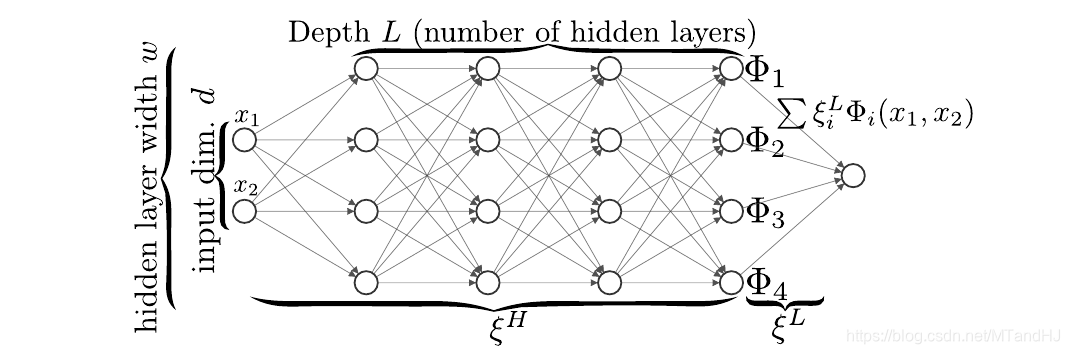
\arg \min_{\xi^L \xi^H} \sum_{k=1}^K \epsilon_k \|\mathcal{L}_k[u] - \sum_i \xi_i^L \mathcal{L}_k [\Phi_i(x, \xi^H)]\|^2_{\ell_2(\mathcal{X}_k)}.
\]
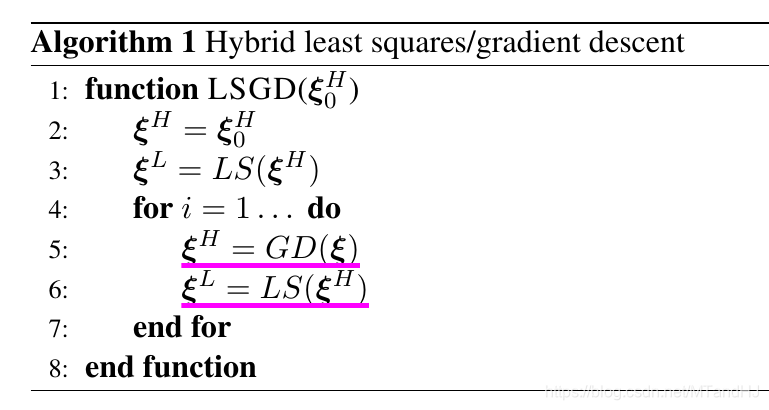
LSGD
固定\(\xi^H, \mathcal{X}_k\), 并令\(\epsilon_k=1\), 则问题(6)退化为一个最小二乘问题
\]
其中\(b_i = \mathcal{L}[u](x_i)\), \(A_{ij}=\mathcal{L} [\Phi_j (x_i, \xi^H)]\), \(x_i \in \mathcal{X}, i=1,\ldots, N, j=1, \ldots, w\).
所以算法如下
Box 初始化
该算法期望使得feature-rich,但是我不知道这个rich从何而来.
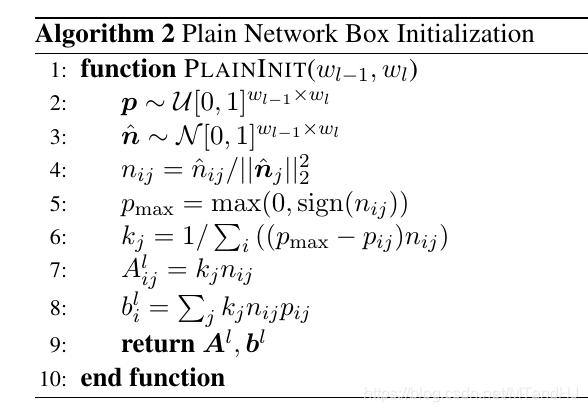
假设第\(l\)层的输入为\(x \in \mathbb{R}^{d_1}\), 输出为\(y \in \mathbb{R}^{d_2}\), 则该层的权重矩阵\(W \in \mathbb{R}^{d_2 \times d_1}\). 我们逐行地定义\(W\):
- 采样\(p\), \(p\sim U[0 ,1]^{d_1}\);
- 采样\(n\), \(n \sim \mathcal{N}(0,I_{d_1})\), 并令\(n=n/\|n\|\);
- 求参数\(k\)使得
\]
- \(W\)第\(i\)行\(w_i=kn^T\), \(b_i=-kp \cdot n\).
其中\(\sigma\)表示激活函数, 文中指的是ReLU.
求解参数\(k\):
- \(p_{max} = \max (0, \mathrm{sign}(n))\);
- \(k=\frac{1}{(p_{max}-p) \cdot n}\)
此\(k\)即为所需\(k\), 只需证明\(p_{max}\)是最大化
\]
的解. 最大化上式, 可以分解为
\]
故\(x_i = \max(0, \mathrm{sign}(n_i))\).
这个初始化有什么好处呢, 可以发现, 输入\(x \in[0,1]^{d_1}\)满足, 则输出\(y \in [0, 1]^{d_2}\), 保证二者的"值域"范围一致, 以此类推整个网络节点值范围近似.
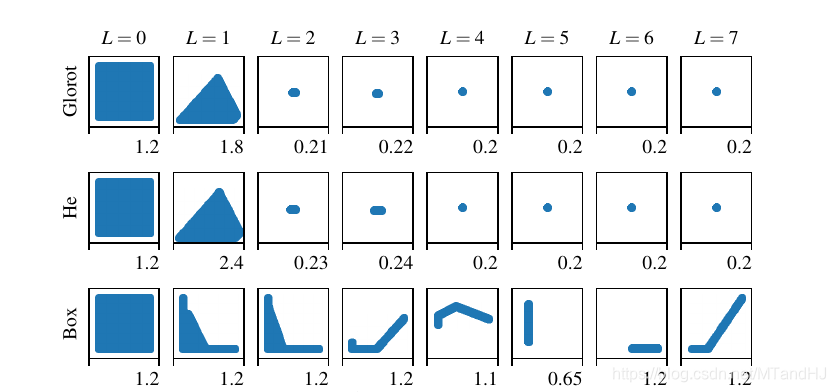
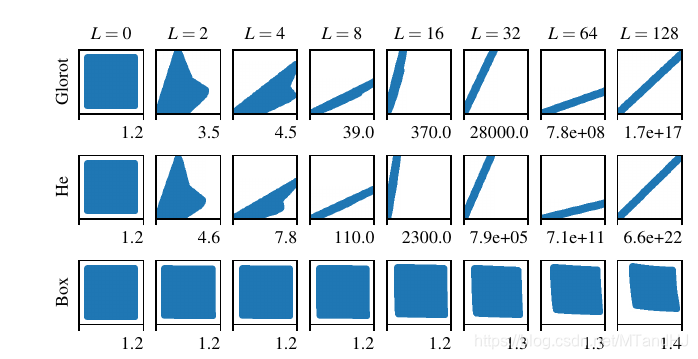
如果, 作者构建了一个2-2-2-2-2-2-2-2的网络, 可以发现, Xavier 和 Kaiming的初始化方法经过一定层数后, 就会塌缩在某个点, 而Box初始化方法能够缓解这一现象.
下面是文中列出的算法(与这里的符号有一点点不同, 另外\(b\)作者应该是遗漏了负号).
Box for Resnet
因为Resnet特殊的结构,
\]
假设\(x \in [0,m]^{d_1}\), 则:
- 采样\(p\), \(p\sim U[0 ,m]^{d_1}\);
- 采样\(n\), \(n \sim \mathcal{N}(0,I_{d_1})\), 并令\(n=n/\|n\|\);
- 求参数\(k\)使得
\]
- \(W\)第\(i\)行\(w_i=kn^T\), \(b_i=-kp \cdot n\).
\]
若第一层输入\(x_i \in [0,1]\), 去\(\delta=1/L\), 其中\(L\)为总的层数, 则
\]
代码
'''

initialization.py

'''

import torch

import torch.nn as nn

import warnings

def generate(size, m, delta):

    p = torch.rand(size) * m

    n = torch.randn(size)

    temp = 1 / torch.norm(n, p=2, dim=1, keepdim=True)

    n = temp * n

    pmax = nn.functional.relu(torch.sign(n)) * m

    temp = (pmax - p) * n

    k = (m * delta) / temp.sum(dim=1, keepdim=True)

    w = k * n

    b = -(w * p).sum(dim=1)

    return w, b

def box_init(module, m=1, delta=1):

    if isinstance(module, nn.Linear):

        w, b = generate(module.weight.shape, m, delta)

        try:

            module.weight.data = w

            module.bias.data = b

        except AttributeError as e:

            s = "Error: \n" + str(e) + "\n stops the initialization" \

                                       " for this module: {}".format(module)

            warnings.warn(s)

    elif isinstance(module, nn.Conv2d):

        outc, inc, h, w = module.weight.size()

        w, b = generate((outc, inc * h * w), m, delta)

        try:

            module.weight.data = w.reshape(module.weight.size())

            module.bias.data = b

        except AttributeError as e:

            s = "Error: \n" + str(e) + "\n stops the initialization" \

                                       " for this module: {}".format(module)

            warnings.warn(s)

    else:

        pass
"""config.py"""

nums = 10

layers = 6

method = "kaiming"  #box/xavier/kaiming

net = "Net"  #Net/ResNet
"""

测试

"""

import torch

import torch.nn as nn

import config

from initialization import box_init

class Net(nn.Module):

    def __init__(self, l):

        super(Net, self).__init__()

        self.linears = []

        for i in range(l):

            name = "linear" + str(i)

            self.__setattr__(name, nn.Sequential(nn.Linear(2, 2),

                                                 nn.ReLU()))

            self.linears.append(self.__getattr__(name))

        if config.method == 'box':

            self.box_init()

        elif config.method == "xavier":

            self.xavier_init()

        else:

            self.kaiming_init()

    def box_init(self):

        for module in self.modules():

            box_init(module)

    def xavier_init(self):

        for module in self.modules():

            if isinstance(module, (nn.Conv2d, nn.Linear)):

                nn.init.xavier_normal_(module.weight)

    def kaiming_init(self):

        for module in self.modules():

            if isinstance(module, (nn.Conv2d, nn.Linear)):

                nn.init.kaiming_normal_(module.weight)

    def forward(self, x):

        out = []

        temp = x

        for linear in self.linears:

            temp = linear(temp)

            out.append(temp)

        return out

class ResNet(nn.Module):

    def __init__(self, l):

        super(ResNet, self).__init__()

        self.linears = []

        for i in range(l):

            name = "linear" + str(i)

            self.__setattr__(name, nn.Sequential(nn.Linear(2, 2),

                                                 nn.ReLU()))

            self.linears.append(self.__getattr__(name))

        if config.method == 'box':

            self.box_init(l)

        elif config.method == "xavier":

            self.xavier_init()

        else:

            self.kaiming_init()

    def box_init(self, layers):

        delta = 1 / layers

        m = 1. + delta

        l = 0

        for module in self.modules():

            if isinstance(module, (nn.Linear)):

                if l == 0:

                    box_init(module, 1, 1)

                else:

                    box_init(module, m ** l, delta)

                l += 1

    def xavier_init(self):

        for module in self.modules():

            if isinstance(module, (nn.Conv2d, nn.Linear)):

                nn.init.xavier_normal_(module.weight)

    def kaiming_init(self):

        for module in self.modules():

            if isinstance(module, (nn.Conv2d, nn.Linear)):

                nn.init.kaiming_normal_(module.weight)

    def forward(self, x):

        out = []

        temp = x

        for linear in self.linears:

            temp = linear(temp) + temp

            out.append(temp)

        return out

if config.net == "Net":

    net = Net(config.layers)

else:

    net = ResNet(config.layers)

x = torch.linspace(0, 1, config.nums)

y = torch.linspace(0, 1, config.nums)

grid_x, grid_y = torch.meshgrid(x, y)

x = grid_x.flatten()

y = grid_y.flatten()

data = torch.stack((x, y), dim=1)

outs = net(data)

import  matplotlib.pyplot as plt

def axplot(x, y, ax):

    x = x.detach().numpy()

    y = y.detach().numpy()

    ax.scatter(x, y)

def plot(x, y, outs):

    fig, axs = plt.subplots(1, config.layers+1, sharey=True, figsize=(12, 2))

    axs[0].scatter(x, y)

    axs[0].set(title="layer0")

    for i in range(config.layers):

        ax = axs[i+1]

        out = outs[i]

        x = out[:, 0]

        y = out[:, 1]

        axplot(x, y, ax)

        ax.set(title="layer"+str(i+1))

    plt.tight_layout()

    plt.savefig("C:/Users/pkavs/Desktop/fig.png")

    #plt.show()

plot(x, y, outs)
[Box] Robust Training and Initialization of Deep Neural Networks: An Adaptive Basis Viewpoint的更多相关文章
- Training Deep Neural Networks
http://handong1587.github.io/deep_learning/2015/10/09/training-dnn.html //转载于 Training Deep Neural ...
- Coursera Deep Learning 2 Improving Deep Neural Networks: Hyperparameter tuning, Regularization and Optimization - week1, Assignment(Initialization)
声明:所有内容来自coursera,作为个人学习笔记记录在这里. Initialization Welcome to the first assignment of "Improving D ...
- Training (deep) Neural Networks Part: 1
Training (deep) Neural Networks Part: 1 Nowadays training deep learning models have become extremely ...
- Exploring Architectural Ingredients of Adversarially Robust Deep Neural Networks
目录 概 主要内容 深度 宽度 代码 Huang H., Wang Y., Erfani S., Gu Q., Bailey J. and Ma X. Exploring architectural ...
- [C4] Andrew Ng - Improving Deep Neural Networks: Hyperparameter tuning, Regularization and Optimization
About this Course This course will teach you the "magic" of getting deep learning to work ...
- (转)Understanding, generalisation, and transfer learning in deep neural networks
Understanding, generalisation, and transfer learning in deep neural networks FEBRUARY 27, 2017 Thi ...
- On Explainability of Deep Neural Networks
On Explainability of Deep Neural Networks « Learning F# Functional Data Structures and Algorithms is ...
- Classifying plankton with deep neural networks
Classifying plankton with deep neural networks The National Data Science Bowl, a data science compet ...
- Must Know Tips/Tricks in Deep Neural Networks
Must Know Tips/Tricks in Deep Neural Networks (by Xiu-Shen Wei) Deep Neural Networks, especially C ...
随机推荐
- 学习java 7.26
学习内容: 进度条是图形界面中广浅个较大的文件时,操作系统会显示一个进度条,用于标识复制操作完成的比例:当启动Eclipse等程序时,因为需要加载较多的资源,故而启动速度较慢,程序也会在启动过程中显示 ...
- Spark(十)【RDD的读取和保存】
目录 一.文件类型 1.Text文件 2.Json文件 3.对象文件 4.Sequence文件 二.文件系统 1. MySQL 2. Hbase 一.文件类型 1.Text文件 读写 读取 scala ...
- struct vs class in C++
在C++中,除了以下几点外,struct和class是相同的. (1)class的成员的默认访问控制是private,而struct的成员的默认访问权限是public. 例如,program 1会编译 ...
- Linux 网卡配置文件,命令详细设置
1.配置文件/etc/hosts(本地主机ip地址映射,可以有多个别名)./etc/services(端口号与标准服务之间的对应关系)./etc/sysconfig/network(设置主机名,网关, ...
- XML名命空间
XML的名命空间就类似于java的包,命名空间定义:xmlns:***="URI",默认命名空间定义:xmlns="URI" 引号中的URl内容用来唯一标识命名 ...
- 【Java】面向类与对象
一.面向对象 对象封装:私有变量+公共方法 方法与构造方法 this变量 Animal.java public class Animal { String name; int age; void mo ...
- 设计模式和java实现
三种工厂模式:https://www.cnblogs.com/toutou/p/4899388.html 适配器模式:https://www.cnblogs.com/V1haoge/p/6479118 ...
- YC-Framework版本更新:V1.0.3
分布式微服务框架:YC-Framework版本更新V1.0.3!!! 本次版本V1.0.3更新 集成分布式事务Seata: 集成分布式事务Tx-LCN: 集成Kafka: 集成RocketMQ: 集成 ...
- 筛选Table.SelectRows-文本与数值(Power Query 之 M 语言)
数据源: 包含文本与数值的任意数据 目标: 对文本和数值进行筛选 M公式: = Table.SelectRows( 表, 筛选条件) 筛选条件: 等于:each [指定列] = "指定值&q ...
- 36、有效的数独 | 算法(leetode,附思维导图 + 全部解法)300题
零 标题:算法(leetode,附思维导图 + 全部解法)300题之(36)有效的数独 前言 1)码农三少 ,一个致力于 编写极简.但齐全题解(算法) 的博主. 2)文末附赠 价值上百美刀 资料. 一 ...