
【DKNN】Distilling the Knowledge in a Neural Network 第一次提出神经网络的知识蒸馏概念
原文链接 小样本学习与智能前沿 。 在这个公众号后台回复“DKNN”,即可获得课件电子资源。

文章已经表明,对于将知识从整体模型或高度正则化的大型模型转换为较小的蒸馏模型,蒸馏非常有效。在MNIST上,即使用于训练蒸馏模型的迁移集缺少一个或多个类别的任何示例,蒸馏也能很好地工作。对于Android语音搜索所用模型的一种深层声学模型,我们已经表明,通过训练一组深层神经网络实现的几乎所有改进都可以提炼成相同大小的单个神经网络,部署起来容易得多。
对于非常大的神经网络,甚至训练一个完整的集成也是不可行的,但是我们已经表明,通过学习大量的专家网络,可以对经过长时间训练的单个非常大的网络的性能进行显着改善。每个网络都学会在高度易混淆的群集中区分类别。我们尚未表明我们可以将专家网络的知识提炼回单个大型网络中。
@
论文: https://arxiv.org/pdf/1503.02531.pdf
Bibtex: @misc{hinton2015distilling,
title={Distilling the Knowledge in a Neural Network},
author={Geoffrey Hinton and Oriol Vinyals and Jeff Dean},
year={2015},
eprint={1503.02531},
archivePrefix={arXiv},
primaryClass={stat.ML}
}
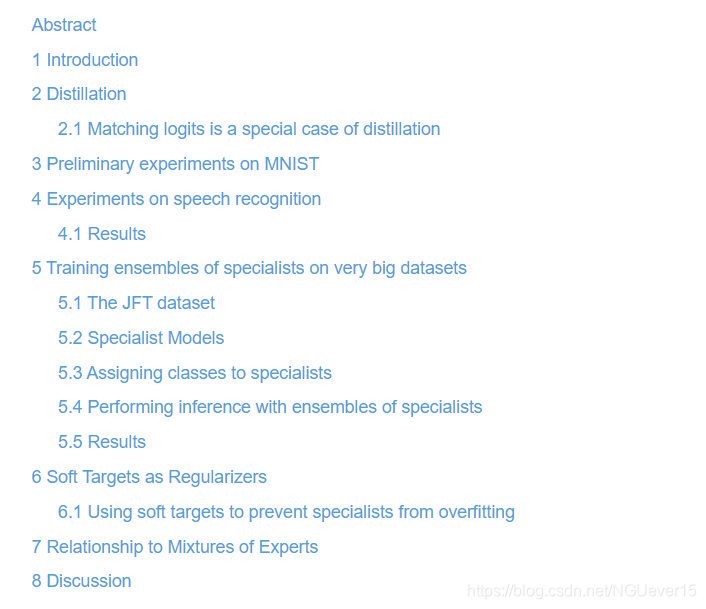
Abstract
We achieve some surprising results on MNIST and we show that we can significantly improve the acoustic model of a heavily used commercial system by distilling the knowledge in an ensemble of models into a single model.
We also introduce a new type of ensemble composed of one or more full models and many specialist models which learn to distinguish fine-grained classes that the full models confuse. Unlike a mixture of experts, these specialist models can be trained rapidly and in parallel.
1 Introduction
In large-scale machine learning, we typically use very similar models for the training stage and the deployment stage despite their very different requirements。
Once the cumbersome model has been trained, we can then use a different kind of training, which we call “distillation” to transfer the knowledge from the cumbersome model to a small model that is more suitable for deployment.
we tend to identify the knowledge in a trained model with the learned parameter values and this makes it hard to see how we can change the form of the model but keep the same knowledge.
A more abstract view of the knowledge, that frees it from any particular instantiation, is that it is a learned mapping from input vectors to output vectors.
When we are distilling the knowledge from a large model into a small one, however, we can train the small model to generalize in the same way as the large model.
An obvious way to transfer the generalization ability of the cumbersome model to a small model is to use the class probabilities produced by the cumbersome model as “soft targets” for training the
small model.
When the cumbersome model is a large ensemble of simpler models, we can use an arithmetic or geometric mean of their individual predictive distributions as the soft targets
When the soft targets have high entropy, they provide much more information per training case than hard targets and much less variance in the gradient between training cases, so the small model can often be trained on much less data than the original cumbersome model and using a much higher learning rate.
This is valuable information that defines a rich similarity structure over the data (i. e. it says which 2’s look like 3’s and which look like 7’s) but it has very little influence on the cross-entropy cost function during the transfer stage because the probabilities are so close to zero.
Caruana and his collaborators circumvent this problem by using the logits (the inputs to the final softmax) rather than the probabilities produced by the softmax as the targets for learning the small model and they minimize the squared difference between the logits produced by the cumbersome model and the logits produced by the small model.
Our more general solution, called “distillation”, is to raise the temperature of the final softmax until the cumbersome model produces a suitably soft set of targets. We then use the same high temperature when training the small model to match these soft targets. We show later that matching the logits of the cumbersome model is actually a special\ case of distillation.
The transfer set that is used to train the small model could consist entirely of unlabeled data [1] or we could use the original training set.
2 Distillation
Neural networks typically produce class probabilities by using a “softmax” output layer that converts the logit, \(z_i\) , computed for each class into a probability,\(q_i\), by comparing \(z_i\) with the other logits.

where \(T\) is a temperature that is normally set to 1. Using a higher value for \(T\) produces a softer
probability distribution over classes.
!!!! In the simplest form of distillation, knowledge is transferred to the distilled model by training it on
a transfer set and using a soft target distribution for each case in the transfer set that is produced by
using the cumbersome model with a high temperature in its softmax. The same high temperature is used when training the distilled model, but after it has been trained it uses a temperature of 1.
When the correct labels are known for all or some of the transfer set, this method can be significantly improved by also training the distilled model to produce the correct labels.
也就是半监督情况
One way to do this is to use the correct labels to modify the soft targets, but we found that a better way is to simply use a weighted average of two different objective functions.
- The first objective function is the cross entropy with the soft targets and this cross entropy is computed using the same high temperature in the softmax of the distilled model as was used for generating the soft targets from the cumbersome model.
- The second objective function is the cross entropy with the correct labels.
We found that the best results were generally obtained by using a condiderably lower weight on the second objective function.
2.1 Matching logits is a special case of distillation
The softmax of this type of specialist can be made much smaller by combining all of the classes it does not care about into a single dustbin class.
After training, we can correct for the biased training set by incrementing the logit of the dustbin class by the log of the proportion by which the specialist class is oversampled.
3 Preliminary experiments on MNIST
4 Experiments on speech recognition
4.1 Results
5 Training ensembles of specialists on very big datasets
5.1 The JFT dataset
5.2 Specialist Models
5.3 Assigning classes to specialists
5.4 Performing inference with ensembles of specialists
5.5 Results
6 Soft Targets as Regularizers
6.1 Using soft targets to prevent specialists from overfitting
7 Relationship to Mixtures of Experts
8 Discussion
We have shown that distilling works very well for transferring knowledge from an ensemble or from a large highly regularized model into a smaller, distilled model. On MNIST distillation works remarkably well even when the transfer set that is used to train the distilled model lacks any examples of one or more of the classes. For a deep acoustic model that is version of the one used by Android voice search, we have shown that nearly all of the improvement that is achieved by training an ensemble of deep neural nets can be distilled into a single neural net of the same size which is far easier to deploy.
For really big neural networks, it can be infeasible even to train a full ensemble, but we have shown that the performance of a single really big net that has been trained for a very long time can be significantly improved by learning a large number of specialist nets, each of which learns to discriminate between the classes in a highly confusable cluster. We have not yet shown that we can distill the knowledge in the specialists back into the single large net.
【DKNN】Distilling the Knowledge in a Neural Network 第一次提出神经网络的知识蒸馏概念的更多相关文章
- Distilling the Knowledge in a Neural Network
url: https://arxiv.org/abs/1503.02531 year: NIPS 2014   简介 将大模型的泛化能力转移到小模型的一种显而易见的方法是使用由大模型产生的类概率作 ...
- 【论文考古】知识蒸馏 Distilling the Knowledge in a Neural Network
论文内容 G. Hinton, O. Vinyals, and J. Dean, "Distilling the Knowledge in a Neural Network." 2 ...
- Python -- machine learning, neural network -- PyBrain 机器学习 神经网络
I am using pybrain on my Linuxmint 13 x86_64 PC. As what it is described: PyBrain is a modular Machi ...
- Recurrent Neural Network(递归神经网络)
递归神经网络(RNN),是两种人工神经网络的总称,一种是时间递归神经网络(recurrent neural network),另一种是结构递归神经网络(recursive neural network ...
- 【RS】Automatic recommendation technology for learning resources with convolutional neural network - 基于卷积神经网络的学习资源自动推荐技术
[论文标题]Automatic recommendation technology for learning resources with convolutional neural network ( ...
- 1503.02531-Distilling the Knowledge in a Neural Network.md
原来交叉熵还有一个tempature,这个tempature有如下的定义: \[ q_i=\frac{e^{z_i/T}}{\sum_j{e^{z_j/T}}} \] 其中T就是tempature,一 ...
- deep_learning_初学neural network
神经网络——最易懂最清晰的一篇文章 神经网络是一门重要的机器学习技术.它是目前最为火热的研究方向--深度学习的基础.学习神经网络不仅可以让你掌握一门强大的机器学习方法,同时也可以更好地帮助你理解深度学 ...
- 论文笔记:蒸馏网络(Distilling the Knowledge in Neural Network)
Distilling the Knowledge in Neural Network Geoffrey Hinton, Oriol Vinyals, Jeff Dean preprint arXiv: ...
- 论文笔记之:Progressive Neural Network Google DeepMind
Progressive Neural Network Google DeepMind 摘要:学习去解决任务的复杂序列 --- 结合 transfer (迁移),并且避免 catastrophic f ...
随机推荐
- Flask 中的MTV架构之Views
Flask 中的MTV架构之Views 1.MVC与MTV 1.1 MVC M:model,模型,数据模型 V:view,视图,负责数据展示 C:controller,控制器,负责业务逻辑 ...
- 2020年的UWP(3)——UWP和desktop extension的简单交互
上一篇<2020年的UWP(2)--In Process App Service>中我们了解了UWP和Desktop Extension可以通过AppService进行数据交互.本篇我们就 ...
- Python学习笔记1:基础
1.编码 默认情况下,Python 3 源码文件以 UTF-8 编码,所有字符串都是 unicode 字符串. 你也可以为源文件指定不同的字符编码.在 #! 行(首行)后插入至少一行特殊的注释行来定义 ...
- git引入_版本控制介绍
八个字形容git技术: 公司必备,一定要会 一.git概念: git是一个免费的,开源的分布式版本控制系统,可以快速高效的处理从小型到大型的项目 二.什么是版本控制: 版本控制是一种一个记录一个或若个 ...
- linux命令查看日志
首先介绍几个日志查看种常用的简单命令: 1.tail tail 命令可用于查看文件的内容,有一个常用的参数 -f 常用于查阅正在改变的日志文件. tail -f filename 会把 filenam ...
- python实战GUI界面+mysql
前言 前面用tkinter做了一个巨丑的GUI界面,今天想把它变漂亮起来,重新找回page做了一个界面,它也是基于tkinter开发的所见即所得的界面编辑器,前面因为代码搞不明白没用上,现在重新研究一 ...
- dm-crypt加密磁盘
dm-cry加密方式密码与文件 与其它创建加密文件系统的方法相比,dm-crypt系统有着无可比拟的优越性:它的速度更快,易用性更强.除此之外,它的适用面也很广,能够运行在各种块设备上,即使这些设备使 ...
- day93:flask:
目录 1.HTTP的会话控制 2.Cookie 3.Session 4.请求钩子 5.捕获错误 6.上下文:context 7.Flask-Script 1.HTTP的会话控制 1.什么是会话控制? ...
- Qiskit 安装指南
内容参考官方文档 https://qiskit.org/documentation/install.html conda create -n name_of_my_env python=3 创建虚拟环 ...
- Python基础数据类型与for循环
数据类型:int,bool,str,list, tuple元组,dict字典. 1.数字:12,3,4 在使用print打印数字时,在终端界面中无法判断出打印的是什么类型,当我们需要知道一个值是什么类 ...