
HashMap代码解析
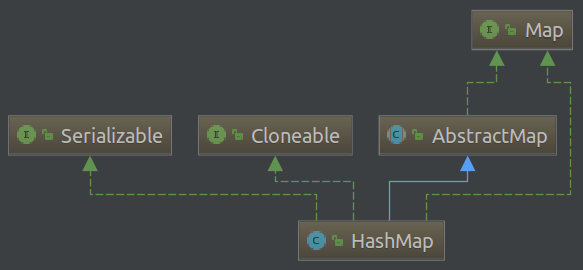
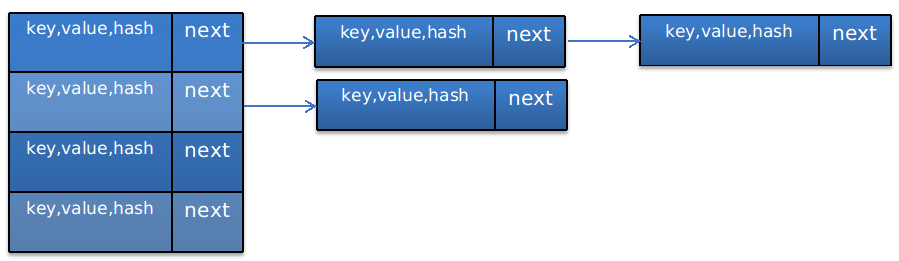
hashmap (jdk 1.7)使用 “数组-链表” 方式进行存储,图形化表示如下:

即,前面是一个数组,后面跟一个链表,那么数据结构这个对应到HashMap的代码里面是什么样子的呢?
在HashMap中定义了一个类型为Entry<K,V>的数组table,上图就是显示了这个table。
    /**

     * The table, resized as necessary. Length MUST Always be a power of two.

     */

    transient Entry<K,V>[] table = (Entry<K,V>[]) EMPTY_TABLE;
类型Entry<K,V>的定义如下:
static class Entry<K,V> implements Map.Entry<K,V> {

        final K key;

        V value;

        Entry<K,V> next;

        int hash;

        // 省略构造/get/set等函数

}
由Entry<K,V>的定义可知,上图每个节点中其实存了4个变量:
key表示键,即存入map的键值
value表示值,即存入map的值
next表示下一个Entry节点
hash表示key的哈希值。
那么上图准确表示应该是:
对于HashMap,最常用的莫过于直接使用默认构造函数创建一个Map对象了
Map<int, String> map = new HashMap<>();
这里HashMap调用了
    /**

     * Constructs an empty <tt>HashMap</tt> with the default initial capacity

     * (16) and the default load factor (0.75).

     */

    public HashMap() {

        this(DEFAULT_INITIAL_CAPACITY, DEFAULT_LOAD_FACTOR);

    }
其中,DEFAULT_INITIAL_CAPACITY是
    /**

     * The default initial capacity - MUST be a power of two.

     */

    static final int DEFAULT_INITIAL_CAPACITY = 1 << 4; // aka 16
DEFAULT_LOAD_FACTOR是
    /**

     * The load factor used when none specified in constructor.

     */

    static final float DEFAULT_LOAD_FACTOR = 0.75f;
this()调用的是
    /**

     * Constructs an empty <tt>HashMap</tt> with the specified initial

     * capacity and load factor.

     *

     * @param  initialCapacity the initial capacity

     * @param  loadFactor      the load factor

     * @throws IllegalArgumentException if the initial capacity is negative

     *         or the load factor is nonpositive

     */

    public HashMap(int initialCapacity, float loadFactor) {

        if (initialCapacity < 0)

            throw new IllegalArgumentException("Illegal initial capacity: " +

                                               initialCapacity);

        if (initialCapacity > MAXIMUM_CAPACITY)

            initialCapacity = MAXIMUM_CAPACITY;

        if (loadFactor <= 0 || Float.isNaN(loadFactor))

            throw new IllegalArgumentException("Illegal load factor: " +

                                               loadFactor);

        this.loadFactor = loadFactor;

        threshold = initialCapacity;

        init();

    }
了解了基本结构之后,看一下HashMap的put()和get()方法是如何实现的。
首先,看put()方法,再了解put()方法之前,先了解几个put()方法会调用的几个辅助方法:
1. inflateTable(),给表充气 or 让表膨胀?原来table对象是空的,所以需要将table对象初始化
    /**

     * Inflates the table.

     */

    private void inflateTable(int toSize) {

        // Find a power of 2 >= toSize

        // capacity 表示HashpMap的容量,必须是2的倍数

        int capacity = roundUpToPowerOf2(toSize);

        // threshold 表示需要resize的阈值

        threshold = (int) Math.min(capacity * loadFactor, MAXIMUM_CAPACITY + 1);

        // 初始化大小为capacity的table对象

        table = new Entry[capacity];

        // 初始化 hashSeed

        initHashSeedAsNeeded(capacity);

    }
2. putForNullKey()
    /**

     * Offloaded version of put for null keys

     */

    private V putForNullKey(V value) {

        // 遍历table[0],如果已经有key为null的元素,直接返回对应的value

        for (Entry<K,V> e = table[0]; e != null; e = e.next) {

            if (e.key == null) {

                V oldValue = e.value;

                e.value = value;

                e.recordAccess(this);

                return oldValue;

            }

        }

        // 如果没有key为null的元素,

        // 将HashMap的修改次数+1

        modCount++;

        // 将key为null的元素添加到HashMap中

        addEntry(0, null, value, 0);

        return null;

    }
疑问:key为null的元素的hash值一定为0吗?
3. hash(),求对象的hash值
    /**

     * Retrieve object hash code and applies a supplemental hash function to the

     * result hash, which defends against poor quality hash functions.  This is

     * critical because HashMap uses power-of-two length hash tables, that

     * otherwise encounter collisions for hashCodes that do not differ

     * in lower bits. Note: Null keys always map to hash 0, thus index 0.

     */

    final int hash(Object k) {

        int h = hashSeed;

        if (0 != h && k instanceof String) {

            return sun.misc.Hashing.stringHash32((String) k);

        }

        h ^= k.hashCode();

        // This function ensures that hashCodes that differ only by

        // constant multiples at each bit position have a bounded

        // number of collisions (approximately 8 at default load factor).

        h ^= (h >>> 20) ^ (h >>> 12);

        return h ^ (h >>> 7) ^ (h >>> 4);

    }
4. indexFor(),根据对象的hash值以及HashMap table的长度,寻找该对象的索引位置
    /**

     * Returns index for hash code h.

     */

    static int indexFor(int h, int length) {

        // assert Integer.bitCount(length) == 1 : "length must be a non-zero power of 2";

        return h & (length-1);

    }
这里没有使用hash值h对长度length取余,而是使用的位运算?其实两者结果是一样的,h % length == h & (length -1)
5. addEntry()
/**

     * Adds a new entry with the specified key, value and hash code to

     * the specified bucket.  It is the responsibility of this

     * method to resize the table if appropriate.

     *

     * Subclass overrides this to alter the behavior of put method.

     */

    void addEntry(int hash, K key, V value, int bucketIndex) {

        // size是HashMap中元素的个数

        // threshhold = capacity * load factor,表示需要扩容resize的阈值

        // 如果size > threshold,并且table在当前索引处有元素,不为null,则需要扩容HashMap,并从新计算索引值

        if ((size >= threshold) && (null != table[bucketIndex])) {

            resize(2 * table.length);

            hash = (null != key) ? hash(key) : 0;

            bucketIndex = indexFor(hash, table.length);

        }

        // 将元素加入到HashMap

        createEntry(hash, key, value, bucketIndex);

    }
6. createEntry()
    /**

     * Like addEntry except that this version is used when creating entries

     * as part of Map construction or "pseudo-construction" (cloning,

     * deserialization).  This version needn't worry about resizing the table.

     *

     * Subclass overrides this to alter the behavior of HashMap(Map),

     * clone, and readObject.

     */

    void createEntry(int hash, K key, V value, int bucketIndex) {

        // 这里是获取某个链表的第一个节点e,

        // 因为每次插入都是往链表的头部插入的,因此e就作为了新节点的next值

        Entry<K,V> e = table[bucketIndex];

        // e作为新节点的next值

        table[bucketIndex] = new Entry<>(hash, key, value, e);

        // HashMap的size加1

        size++;

    }
7. resize()
    /**

     * Rehashes the contents of this map into a new array with a

     * larger capacity.  This method is called automatically when the

     * number of keys in this map reaches its threshold.

     *

     * If current capacity is MAXIMUM_CAPACITY, this method does not

     * resize the map, but sets threshold to Integer.MAX_VALUE.

     * This has the effect of preventing future calls.

     *

     * @param newCapacity the new capacity, MUST be a power of two;

     *        must be greater than current capacity unless current

     *        capacity is MAXIMUM_CAPACITY (in which case value

     *        is irrelevant).

     */

    void resize(int newCapacity) {

        Entry[] oldTable = table;

        int oldCapacity = oldTable.length;

        // 如果HashMap中table的长度(这里是指table数组的长度,不是链表的长度)

        // 已经达到了MAXIMUN_CAPACITY = 1 << 30,直接将阈值threshold设置为Integer的最大值。

        // 不在扩容HashMap

        if (oldCapacity == MAXIMUM_CAPACITY) {

            threshold = Integer.MAX_VALUE;

            return;

        }

     // newCapacity是原table数组长度的2倍

        Entry[] newTable = new Entry[newCapacity];

        // 将原table中的值迁移到扩容后的newTable中

        transfer(newTable, initHashSeedAsNeeded(newCapacity));

        // 更新table和阈值threshold

        table = newTable;

        threshold = (int)Math.min(newCapacity * loadFactor, MAXIMUM_CAPACITY + 1);

    }
8. transfer(), 将原HashMap中的元素迁移到扩容后的HashMap中
    /**

     * Transfers all entries from current table to newTable.

     */

    void transfer(Entry[] newTable, boolean rehash) {

        int newCapacity = newTable.length;

        // 遍历table数组

        for (Entry<K,V> e : table) {

            // 这里e是table数组某个链表的第一个元素,后面e会依次指向链表中所有的元素

            // 如果table数组的元素不为null

            while(null != e) {

                Entry<K,V> next = e.next;

                if (rehash) {

                    // 如果e.key是null,hash值是0

                    e.hash = null == e.key ? 0 : hash(e.key);

                }

                // 获取元素e在新table中的索引值

                int i = indexFor(e.hash, newCapacity);

                // 将e的next指向新table的第一个元素(这里还是要记住,插入链表是从头部插入的)

                // newTable[i]是链表的第一个元素

                e.next = newTable[i];

                // 将e赋值给链表的第一个元素newTable[i],这样e就取代了链表原来的第一个元素,作为链表新的第一个元素,引领链表!

                newTable[i] = e;

                e = next;

            }

        }

    }
了解了上述n个方法之后,是时候看一下HashMap的put()方法的真面目了!
    /**

     * Associates the specified value with the specified key in this map.

     * If the map previously contained a mapping for the key, the old

     * value is replaced.

     *

     * @param key key with which the specified value is to be associated

     * @param value value to be associated with the specified key

     * @return the previous value associated with <tt>key</tt>, or

     *         <tt>null</tt> if there was no mapping for <tt>key</tt>.

     *         (A <tt>null</tt> return can also indicate that the map

     *         previously associated <tt>null</tt> with <tt>key</tt>.)

     */

    public V put(K key, V value) {

        // 如果table是空的,需要初始化table

        if (table == EMPTY_TABLE) {

            inflateTable(threshold);

        }

        // 如果key是null,调用putForNullKey方法插入元素

        if (key == null)

            return putForNullKey(value);

        // 求key的hash值

        int hash = hash(key);

        // 根据key的hash值和table的长度求元素在table中的索引

        int i = indexFor(hash, table.length);

        // 遍历table[i]引领的链表

        // 如果已经存在了相同的key,则更新value并返回old value,否则插入新元素

        for (Entry<K,V> e = table[i]; e != null; e = e.next) {

            Object k;

            // key已经存在,更新value,返回old value

            if (e.hash == hash && ((k = e.key) == key || key.equals(k))) {

                V oldValue = e.value;

                e.value = value;

                e.recordAccess(this);

                return oldValue;

            }

        }

        // HashMap的修改次数加1,modCount是modified times

        modCount++;

        // 插入新元素

        addEntry(hash, key, value, i);

        // 如果key没有重复,返回值是null

        return null;

    }
其次,看一下get()方法,再了解get()方法之前,同样先了解几个get()方法会调用的几个辅助方法:
1. getForNullKey()
    /**

     * Offloaded version of get() to look up null keys.  Null keys map

     * to index 0.  This null case is split out into separate methods

     * for the sake of performance in the two most commonly used

     * operations (get and put), but incorporated with conditionals in

     * others.

     */

    private V getForNullKey() {

        if (size == 0) {

            return null;

        }

        for (Entry<K,V> e = table[0]; e != null; e = e.next) {

            if (e.key == null)

                return e.value;

        }

        return null;

    }
2. getEntry()
    /**

     * Returns the entry associated with the specified key in the

     * HashMap.  Returns null if the HashMap contains no mapping

     * for the key.

     */

    final Entry<K,V> getEntry(Object key) {

        if (size == 0) {

            return null;

        }

        int hash = (key == null) ? 0 : hash(key);

        for (Entry<K,V> e = table[indexFor(hash, table.length)]; e != null; e = e.next) {

            Object k;

            if (e.hash == hash &&

                ((k = e.key) == key || (key != null && key.equals(k))))

                return e;

        }

        return null;

    }
了解了上述2个方法之后,get()方法就比较简单了
    /**

     * Returns the value to which the specified key is mapped,

     * or {@code null} if this map contains no mapping for the key.

     *

     * <p>More formally, if this map contains a mapping from a key

     * {@code k} to a value {@code v} such that {@code (key==null ? k==null :

     * key.equals(k))}, then this method returns {@code v}; otherwise

     * it returns {@code null}.  (There can be at most one such mapping.)

     *

     * <p>A return value of {@code null} does not <i>necessarily</i>

     * indicate that the map contains no mapping for the key; it's also

     * possible that the map explicitly maps the key to {@code null}.

     * The {@link #containsKey containsKey} operation may be used to

     * distinguish these two cases.

     *

     * @see #put(Object, Object)

     */

    public V get(Object key) {

        if (key == null)

            return getForNullKey();

        Entry<K,V> entry = getEntry(key);

        return null == entry ? null : entry.getValue();

    }
最后,再学习一下remove()方法的实现
    /**

     * Removes the mapping for the specified key from this map if present.

     *

     * @param  key key whose mapping is to be removed from the map

     * @return the previous value associated with <tt>key</tt>, or

     *         <tt>null</tt> if there was no mapping for <tt>key</tt>.

     *         (A <tt>null</tt> return can also indicate that the map

     *         previously associated <tt>null</tt> with <tt>key</tt>.)

     */

    public V remove(Object key) {

        Entry<K,V> e = removeEntryForKey(key);

        return (e == null ? null : e.value);

    }

    /**

     * Removes and returns the entry associated with the specified key

     * in the HashMap.  Returns null if the HashMap contains no mapping

     * for this key.

     */

    final Entry<K,V> removeEntryForKey(Object key) {

        if (size == 0) {

            return null;

        }

        // 找到hash值

        int hash = (key == null) ? 0 : hash(key);

        // 求索引位置

        int i = indexFor(hash, table.length);

        Entry<K,V> prev = table[i];

        Entry<K,V> e = prev;

        while (e != null) {

            Entry<K,V> next = e.next;

            Object k;

            // 寻找到key的位置,是当前的e

            if (e.hash == hash && ((k = e.key) == key || (key != null && key.equals(k)))) {

                // HashMap的修改次数加1

                modCount++;

                // HashMap的size减1

                size--;

                // 如果是链表的第一个元素,next是null,直接将table[i]设置为null

                if (prev == e)

                    table[i] = next;

                else

                    // prev的next是e,next是e.next,即[prev]-> [e] -> [next]

                    // prev.next = next,即[prev] -> [next],直接将元素e移除掉了

                    prev.next = next;

                e.recordRemoval(this);

                return e;

            }

            prev = e;

            e = next;

        }

        return e;

    }
HashMap代码解析的更多相关文章
- java集合框架之java HashMap代码解析
java集合框架之java HashMap代码解析 文章Java集合框架综述后,具体集合类的代码,首先以既熟悉又陌生的HashMap开始. 源自http://www.codeceo.com/arti ...
- Kakfa揭秘 Day8 DirectKafkaStream代码解析
Kakfa揭秘 Day8 DirectKafkaStream代码解析 今天让我们进入SparkStreaming,看一下其中重要的Kafka模块DirectStream的具体实现. 构造Stream ...
- 【原创】大数据基础之Spark(4)RDD原理及代码解析
一 简介 spark核心是RDD,官方文档地址:https://spark.apache.org/docs/latest/rdd-programming-guide.html#resilient-di ...
- java代码解析二维码
java代码解析二维码一般步骤 本文采用的是google的zxing技术进行解析二维码技术,解析二维码的一般步骤如下: 一.下载zxing-core的jar包: 二.创建一个BufferedImage ...
- VBA常用代码解析
031 删除工作表中的空行 如果需要删除工作表中所有的空行,可以使用下面的代码. Sub DelBlankRow() DimrRow As Long DimLRow As Long Dimi As L ...
- [nRF51822] 12、基础实验代码解析大全 · 实验19 - PWM
一.PWM概述: PWM(Pulse Width Modulation):脉冲宽度调制技术,通过对一系列脉冲的宽度进行调制,来等效地获得所需要波形. PWM 的几个基本概念: 1) 占空比:占空比是指 ...
- [nRF51822] 11、基础实验代码解析大全 · 实验16 - 内部FLASH读写
一.实验内容: 通过串口发送单个字符到NRF51822,NRF51822 接收到字符后将其写入到FLASH 的最后一页,之后将其读出并通过串口打印出数据. 二.nRF51822芯片内部flash知识 ...
- [nRF51822] 10、基础实验代码解析大全 · 实验15 - RTC
一.实验内容: 配置NRF51822 的RTC0 的TICK 频率为8Hz,COMPARE0 匹配事件触发周期为3 秒,并使能了TICK 和COMPARE0 中断. TICK 中断中驱动指示灯D1 翻 ...
- [nRF51822] 9、基础实验代码解析大全 · 实验12 - ADC
一.本实验ADC 配置 分辨率:10 位. 输入通道:5,即使用输入通道AIN5 检测电位器的电压. ADC 基准电压:1.2V. 二.NRF51822 ADC 管脚分布 NRF51822 的ADC ...
随机推荐
- Redis Pubsub命令用法
一.什么是pub/sub及实现Pub/Sub功能(means Publish, Subscribe)即发布及订阅功能. Redis通过publish和subscribe命令实现订阅和发布的功能. 订阅 ...
- JAVA中值类型和引用类型的不同(面试常考)
转载:https://www.cnblogs.com/1ming/p/5227944.html 1. JAVA中值类型和引用类型的不同? [定义] 引用类型表示你操作的数据是同一个,也就是说当你传一个 ...
- ClassLoader家族
DexClassLoader可以加载外部的dex,而PathClassLoader只能加载内部的dex 双亲委托 ClassLoader(ClassLoader parentLoader,boolea ...
- 1402 后缀数组 (hash+二分)
描述 后缀数组 (SA) 是一种重要的数据结构,通常使用倍增或者DC3算法实现,这超出了我们的讨论范围.在本题中,我们希望使用快排.Hash与二分实现一个简单的 O(n log^2n ) 的后缀数组 ...
- HDU 5178 pairs【二分】||【尺取】
<题目链接> 题目大意: 给定一个整数序列,求出绝对值小于等于k的有序对个数. 解题分析: $O(nlong(n))$的二分很好写,这里就不解释了.本题尺取$O(n)$也能做,并且效率很不 ...
- HDU2255 奔小康赚大钱 (最大权完美匹配) 模板题【KM算法】
<题目链接> 奔小康赚大钱 Problem Description 传说在遥远的地方有一个非常富裕的村落,有一天,村长决定进行制度改革:重新分配房子.这可是一件大事,关系到人民的住房问题啊 ...
- IDEA快速入门(Mac版)
[持续更新]一篇今年年头的老文章顺道发布了,大家有任何问题可以留言沟通.当时刚刚加入团团,愿大家有机会还是购买一台MAC,确实能给大家的效率赋能,虽然在一开始会有一些艰难!⛽️ 望借着换工作的东风,好 ...
- Linux系统开发之路-上
本节内容主要介绍Linux操作系统的主要特性,包括Linux与Windows操作系统的主要区别:Linux系统的分类:开发环境的推荐:Linux操作系统的安装:Linux系统下开发环境的安装和配置. ...
- 《重回耶路撒冷——犹太人的三千年》(Return to Jerusalem)读后感
写在前面 书名:<重回耶路撒冷——犹太人的三千年>(Return to Jerusalem) 作者:张力升 来源:长清图书馆 阅读用时:其实年前拿到书,本来想寒假在家看的,但是在家一点儿都 ...
- Android异步消息传递机制源码分析
1.Android异步消息传递机制有以下两个方式:(异步消息传递来解决线程通信问题) handler 和 AsyncTask 2.handler官方解释的用途: 1).定时任务:通过handler.p ...