
How to Use Rsync to Sync New or Changed/Modified Files in Linux
As a system administrator or Linux power user, you may have probably come across or even on several occasions, used the versatile Linux Rsync tool, which enables users to expeditiously copy or synchronize files locally and remotely. It is as well a great tool popularly used for backup operations and mirroring.
Some of its eminent features and advantages include; it is exceptionally versatile in that, it can copy locally, to/from a remote shell or remote rsync, it is also remarkably flexible, allowing users to specify any number of files to copy.
Suggested Read: 10 Practical Examples of Rsync Command in Linux
Furthermore, it permits copying of links, devices, file or directory owner, groups and the permissions. It also supports usage without root privileges coupled with many more.
One imperative differential of rsync in comparison to other file-coying commands in Linux is its use of the remote-update protocol, to transfer only the difference between files or directory content.
Therefore, in this article, we shall examine how rsync can help us only sync new or changed files or directory content while making backups and beyond in Linux.
To start with, you need remember that the conventional and simplest form of using rsync is as follows:
# rsync options source destination
That said, let us dive into some examples to uncover how the concept above actually works.
Syncing Files Locally Using Rsync
Using the command below, am able to copy files from my Documents directory to /tmp/documentsdirectory locally:
$ rsync -av Documents/* /tmp/documents
In the command above, the option:
-a– means archive mode-v– means verbose, showing details of ongoing operations
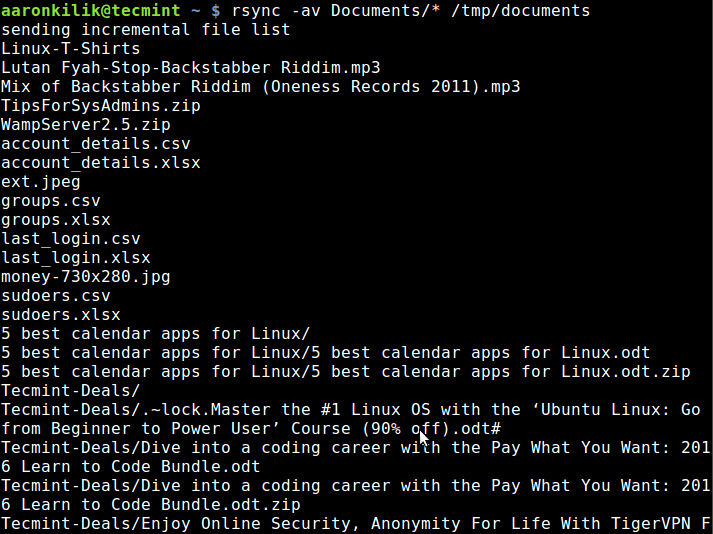
Sync Files Locally
By default, rsync only copies new or changed files from a source to destination, when I add a new file into myDocuments directory, this is what happens after running the same command second time:
$ rsync -av Documents/* /tmp/documents
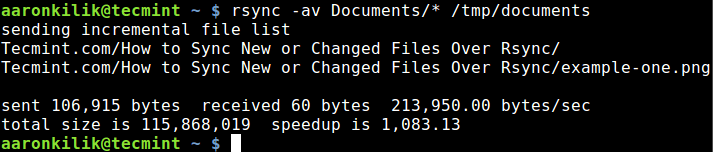
Sync New Updated Files
As you can observe and notice from the output of the command, only the new file is copied to the destination directory.
Suggested Read: How to Sync Two Apache Web Servers/Websites Using Rsync
The --update or -u option allows rsync to skip files that are still new in the destination directory, and one important option, --dry-run or -n enables us to execute a test operation without making any changes. It shows us what files are to be copied.
$ rsync -aunv Documents/* /tmp/documents
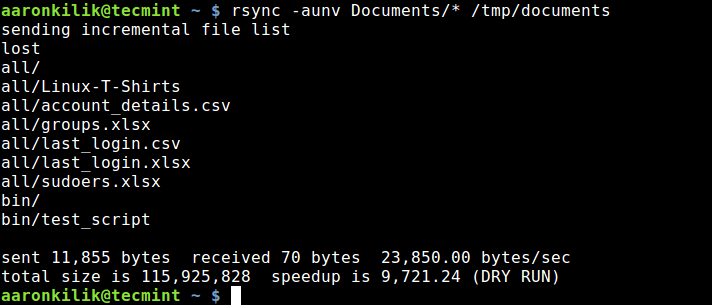
Dry Run Rsync Before Syncing Files
After executing a test run, we can then do away with the -n and perform a real operation:
$ rsync -auv Documents/* /tmp/documents
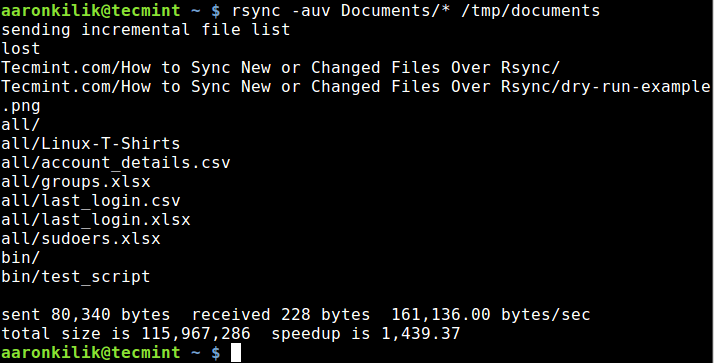
Sync Updated Files
Syncing Files From Local to Remote Linux
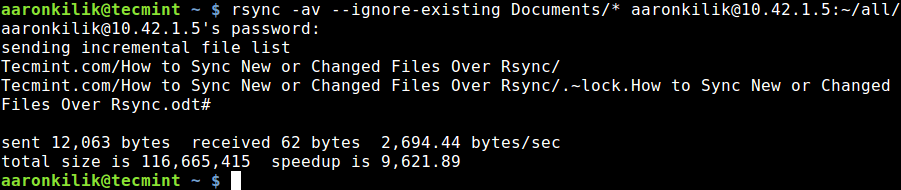
In the example below, I am copying files from my local machine to a remote sever with the IP address –10.42.1.5. So as to only sync new files on the local machine, that do not exist on the remote machine, we can include the --ignore-existing option:
$ rsync -av --ignore-existing Documents/* aaronkilik@10.42.1.5:~/all/
Sync Files Local to Remote Linux
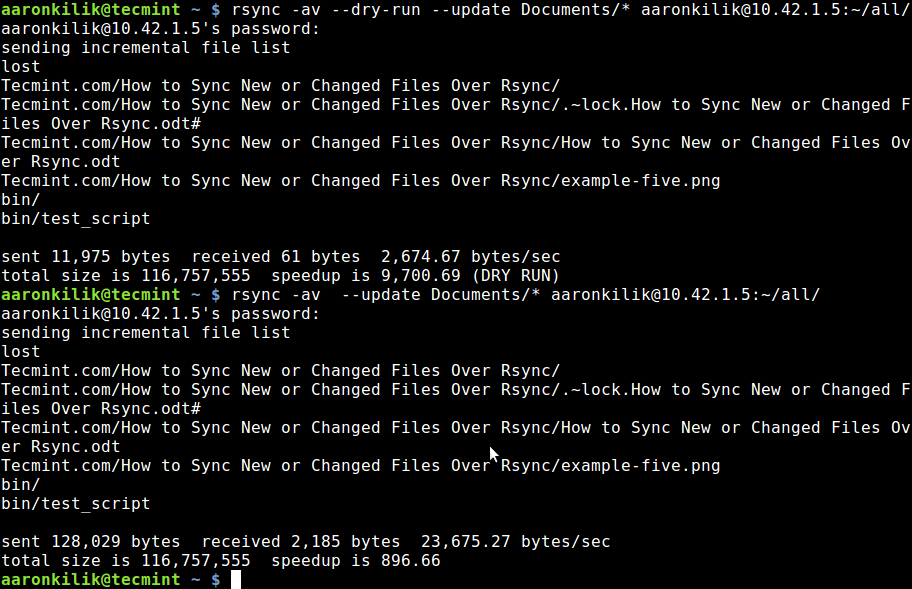
Subsequently, to sync only updated or modified files on the remote machine that have changed on the local machine, we can perform a dry run before copying files as below:
$ rsync -av --dry-run --update Documents/* aaronkilik@10.42.1.5:~/all/

$ rsync -av --update Documents/* aaronkilik@10.42.1.5:~/all/
Check Sync Only Updated Files
To update existing files and prevent creation of new files in the destination, we utilize the --existing option.
You can run through the rsync man page to discover additionally useful options for advanced usage, as I had mentioned earlier on, rsync is a very powerful and versatile Linux tool and many System Administrator and Linux power users know just how advantageous it is.
Most importantly, you can as well share your view on the examples we have covered here or even better still, offer us valuable tips on using this vital command line tool through the comment section below.
How to Use Rsync to Sync New or Changed/Modified Files in Linux的更多相关文章
- External file changes sync may be slow: Project files cannot be watched (are they under network mount?)
if some files are on a mounted disk: go to Settings | Notifications | File Watcher Messages and tune ...
- Linux命令——rsync
参考:Rsync (Remote Sync): 10 Practical Examples of Rsync Command in Linux How to Sync Files/Directorie ...
- 【转载】CentOS 6.3下rsync服务器的安装与配置
一.rsync 简介 Rsync(remote synchronize)是一个远程数据同步工具,可通过LAN/WAN快速同步多台主机间的文件,也可以使用 Rsync 同步本地硬盘中的不同目录. Rsy ...
- CentOS 6.3下rsync服务器的安装与配置
一.rsync 简介 Rsync(remote synchronize)是一个远程数据同步工具,可通过LAN/WAN快速同步多台主机间的文件,也可以使用 Rsync 同步本地硬盘中的不同目录. Rsy ...
- CentOS6 下rsync服务器配置
一.rsync 简介 Rsync(remote synchronize)是一个远程数据同步工具,可通过LAN/WAN快速同步多台主机间的文件,也可以使用 Rsync 同步本地硬盘中的不同目录. Rsy ...
- Server Data Synchronization Via Linux rsync、rsync+inotify Between Load Balance Server
目录 . 远程文件同步的应用场景 . rsync+crontab . rsync+inotify 1. 远程文件同步的应用场景 在负载均衡集群的应用场景中,往往在多台web server的前端有一个提 ...
- rsync 使用示例
导读 Rsync(remote sync) 是用于同步某一位置文件和目录到另一位置的有效方法.备份的位置可以在本地服务器或远程服务器.本站之前亦有介绍rsync的安装配置和教程,详看<rsync ...
- linux服务之rsync
http://www.cnblogs.com/itech/archive/2010/06/13/1757952.html rsync与mfs好像有点类似,都是传输块的chunk,chunk的 1)软件 ...
- rsync常用命令及格式
rsync在同步文件夹内容这个工作上应用非常广泛,但是rsync本身命令还是比较复杂,本文总结一下: rsync = remote sync的简称 ,它 被用于在linux/unix系统中执行备份操作 ...
随机推荐
- [转]C语言文件输入/输出ACM改进版(freopen函数)
C语言文件输入/输出ACM改进版(freopen函数) 2009年5月27日 10:379,457 浏览数发表评论阅读评论 文章作者:姜南(Slyar) 文章来源:Slyar Home (www. ...
- 跟SAP系统集成的Android应用
首先吐槽一点,这是我的第一个Android应用,很糙. 这个应用适合于上了SAP系统的企业内部使用,并且限于制造型MTO模式,需要针对生产订单报工操作的场景,因为此应用主要的一个目的,就是用来方便报工 ...
- github命令
git push origin master //把本地源码库push到Github上 git pull origin master //从Github上pull到本地源码库
- jquery,extjs中的extend用法小结
在jquery中,extend其实在做插件时还是用的比较多的,今天同时小结jquery和ext js中 的extend用法,先来看jquery中的. 1) extend(dest,src1,src2 ...
- EasyUI-右键菜单变灰不可用效果
使用过EasyUI的朋友想必都知道疯狂秀才写的后台界面吧,作为一个初学者我不敢妄自评论它的好坏,不过它确实给我们提供了一个很好框架,只要在它的基础上进行修改,基本上都可以满足我们开发的需要. 知道“疯 ...
- 【JavaScript】JavaScript Promise 探微
http://www.html-js.com/article/Promise-translation-JavaScript-Promise-devil-details 原文链接:JavaScript ...
- j2ee项目后置类代码实现跳出iframe页面跳转
response.getWriter().write("<script>top.location.href='../admin/login';</script>&qu ...
- TOJ3649欧拉回路
欧拉回路 Time Limit(Common/Java):1000MS/3000MS Memory Limit:65536KByte Total Submit: 35 ...
- GridView编辑删除操作
第一种:使用DataSource数据源中自带的编辑删除方法,这样的不经常使用,在这里就不加说明了. 另外一种:使用GridView的三种事件:GridView1_RowEditing(编辑).Grid ...
- Java模式(适配器模式)
今天看了下Java中的适配器模式,下面就来小做下总结和谈谈感想,以便日后使用. 首先,先来先讲讲适配器.适配就是由“源”到“目标”的适配,而其中链接两者的关系就是适配器.它负责把“源”过度到“目标”. ...