
shiro简单入门介绍
shiro是apache的一个java安全框架
可以完成认证,授权,加密,会话管理,基于web继承,缓存等
功能简介:
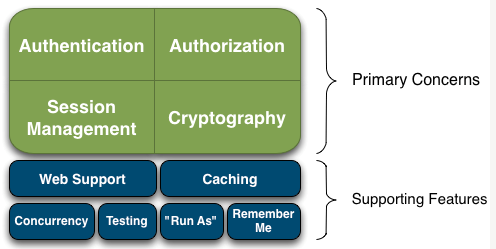
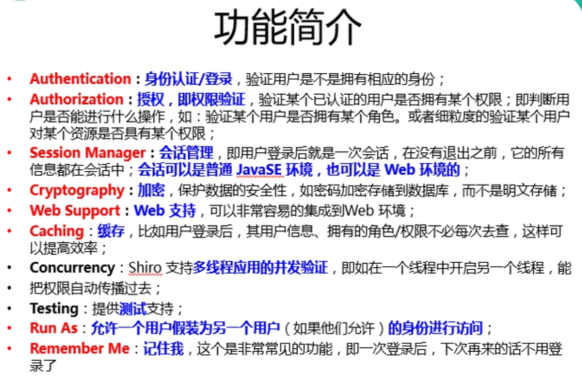
从外部来看:

shiro架构
Subject:主体,代表了当前“用户”,这个用户不一定是一个具体的人,与当前应用交互的任何东西都是Subject,如网络爬虫,机器人等;即一个抽象概念;所有Subject都绑定到SecurityManager,与Subject的所有交互都会委托给SecurityManager;可以把Subject认为是一个门面;SecurityManager才是实际的执行者;
从内部看:
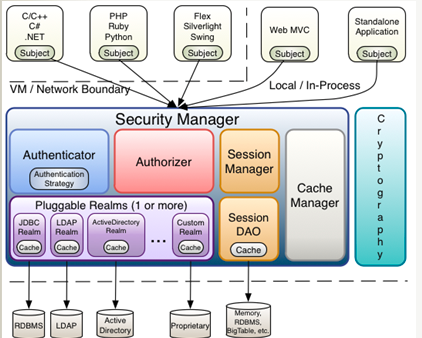
Subject:主体,可以看到主体可以是任何可以与应用交互的“用户”;
下载地址:
http://shiro.apache.org/download.html
HellowWord:

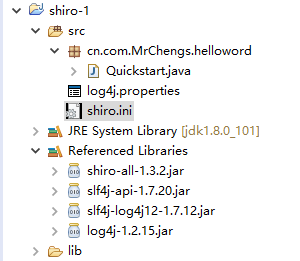
package cn.com.MrChengs.helloword;

/*

* Licensed to the Apache Software Foundation (ASF) under one

* or more contributor license agreements.  See the NOTICE file

* distributed with this work for additional information

* regarding copyright ownership.  The ASF licenses this file

* to you under the Apache License, Version 2.0 (the

* "License"); you may not use this file except in compliance

* with the License.  You may obtain a copy of the License at

*

*     http://www.apache.org/licenses/LICENSE-2.0

*

* Unless required by applicable law or agreed to in writing,

* software distributed under the License is distributed on an

* "AS IS" BASIS, WITHOUT WARRANTIES OR CONDITIONS OF ANY

* KIND, either express or implied.  See the License for the

* specific language governing permissions and limitations

* under the License.

*/

import org.apache.shiro.SecurityUtils;

import org.apache.shiro.authc.*;

import org.apache.shiro.config.IniSecurityManagerFactory;

import org.apache.shiro.mgt.SecurityManager;

import org.apache.shiro.session.Session;

import org.apache.shiro.subject.Subject;

import org.apache.shiro.util.Factory;

import org.slf4j.Logger;

import org.slf4j.LoggerFactory;

/**

* Simple Quickstart application showing how to use Shiro's API.

*

* @since 0.9 RC2

*/

public class Quickstart {

    private static final transient Logger log = LoggerFactory.getLogger(Quickstart.class);

    public static void main(String[] args) {

        // The easiest way to create a Shiro SecurityManager with configured

        // realms, users, roles and permissions is to use the simple INI config.

        // We'll do that by using a factory that can ingest a .ini file and

        // return a SecurityManager instance:

        // Use the shiro.ini file at the root of the classpath

        // (file: and url: prefixes load from files and urls respectively):

        Factory<SecurityManager> factory = new IniSecurityManagerFactory("classpath:shiro.ini");

        SecurityManager securityManager = factory.getInstance();

        // for this simple example quickstart, make the SecurityManager

        // accessible as a JVM singleton.  Most applications wouldn't do this

        // and instead rely on their container configuration or web.xml for

        // webapps.  That is outside the scope of this simple quickstart, so

        // we'll just do the bare minimum so you can continue to get a feel

        // for things.

        SecurityUtils.setSecurityManager(securityManager);

        // Now that a simple Shiro environment is set up, let's see what you can do:

        // get the currently executing user:

        //获取当前的subject

        //调用SecurityUtils.getSubject();

        Subject currentUser = SecurityUtils.getSubject();

        // Do some stuff with a Session (no need for a web or EJB container!!!)

        //测试使用session

        //首先获取session:currentUser.getSession();

        //

        Session session = currentUser.getSession();

        session.setAttribute("someKey", "aValue");

        String value = (String) session.getAttribute("someKey");

        if (value.equals("aValue")) {

            log.info("--->Retrieved the correct value! [" + value + "]");

        }

        // let's login the current user so we can check against roles and permissions:

        //测试当前用户是否已经被认证,即是否已经登陆

        //调用subject的isAuthenticated()

        if (!currentUser.isAuthenticated()) {

            //把用户名和密码封装为UsernamePasswordToken对象

            UsernamePasswordToken token = new UsernamePasswordToken("lonestarr", "vespa");

            token.setRememberMe(true);

            try {

                //执行登陆

                currentUser.login(token);

            }

            //若没有指定的消息,则shiro会抛出UnknownAccountException异常

            catch (UnknownAccountException uae) {

                log.info("There is no user with username of " + token.getPrincipal());

            }

            //若账户存在,但是密码不匹配则抛出IncorrectCredentialsException

            catch (IncorrectCredentialsException ice) {

                log.info("Password for account " + token.getPrincipal() + " was incorrect!");

            }

            //用户被锁定的异常

            catch (LockedAccountException lae) {

                log.info("The account for username " + token.getPrincipal() + " is locked.  " +

                        "Please contact your administrator to unlock it.");

            }

            // ... catch more exceptions here (maybe custom ones specific to your application?

            //所有认证时的异常父类

            catch (AuthenticationException ae) {

                //unexpected condition?  error?

            }

        }

        //say who they are:

        //print their identifying principal (in this case, a username):

        log.info("User [" + currentUser.getPrincipal() + "] logged in successfully.");

        //test a role:

        //测试是否有某一个角色

        if (currentUser.hasRole("schwartz")) {

            log.info("May the Schwartz be with you!");

        } else {

            log.info("Hello, mere mortal.");

        }

        //test a typed permission (not instance-level)

        //测试是否具有某一个行为

        if (currentUser.isPermitted("lightsaber:weild")) {

            log.info("You may use a lightsaber ring.  Use it wisely.");

        } else {

            log.info("Sorry, lightsaber rings are for schwartz masters only.");

        }

        //a (very powerful) Instance Level permission:

        //测试用户是否具备某一个行为

        if (currentUser.isPermitted("winnebago:drive:eagle5")) {

            log.info("You are permitted to 'drive' the winnebago with license plate (id) 'eagle5'.  " +

                    "Here are the keys - have fun!");

        } else {

            log.info("Sorry, you aren't allowed to drive the 'eagle5' winnebago!");

        }

        //all done - log out!

        //执行登出

        currentUser.logout();

}
运行即可体验shiro的简单功能....
shiro简单入门介绍的更多相关文章
- 权限框架 - shiro 简单入门实例
前面的帖子简单的介绍了基本的权限控制,可以说任何一个后台管理系统都是需要权限的 今天开始咱们来讲讲Shiro 首先引入基本的jar包 <!-- shiro --> <dependen ...
- EVE-NG简单入门介绍
此篇文章简单的介绍下模拟器EVE-NG的使用,具体包括Dynamips设备导入与运行,IOL设备的导入与运行,QEMU设备的导入与运行,客户端软件的安装,物理网络与虚拟网络的结合等. 一.导入镜像 D ...
- mybatis简单入门介绍
mybatis入门 简介 什么是mybatis? MyBatis 是一款优秀的持久层框架,它支持定制化 SQL.存储过程以及高级映射.MyBatis 避免了几乎所有的 JDBC 代码和手动设置参数以及 ...
- SpringDataRedis简单入门介绍
1:问题引入 在实际开发中,开发的每一个项目,每天都有大量的人访问,对数据库造成很大的访问压力,甚至是瘫痪.那如何解决呢?我们通常的做法有两种:一种是数据缓存.一种是网页静态化.我们今天讨论第一种解决 ...
- qing-automation简单入门介绍
1.相关文档:http://www.51testing.com/html/50/category-catid-250.html 2.进行Qing automation相关操作之前,必须安装好jdk跟a ...
- Apache shiro集群实现 (一) shiro入门介绍
近期在ITOO项目中研究使用Apache shiro集群中要解决的两个问题,一个是Session的共享问题,一个是授权信息的cache共享问题,官网上给的例子是Ehcache的实现,在配置说明上不算很 ...
- shiro的简单入门使用
这里只是测试登录认证,没有web模块,没有连接数据库,用户密码放在shiro.ini配置中,密码没有加密处理,简单入门. 基于maven 先看目录结构 测试结果 pom.xml <?xml ve ...
- [原创]MYSQL的简单入门
MYSQL简单入门: 查询库名称:show databases; information_schema mysql test 2:创建库 create database 库名 DEFAULT CHAR ...
- 初识Hadoop入门介绍
初识hadoop入门介绍 Hadoop一直是我想学习的技术,正巧最近项目组要做电子商城,我就开始研究Hadoop,虽然最后鉴定Hadoop不适用我们的项目,但是我会继续研究下去,技多不压身. < ...
随机推荐
- [转]How can I install the VS2017 version of msbuild on a build server without installing the IDE?
本文转自:http://stackoverflow.com/questions/42696948/how-can-i-install-the-vs2017-version-of-msbuild-on- ...
- 第八章使用java实现面向对象-File I/O
java.io.File类用于表示文件(目录) File类只用于表示文件(目录)的信息(名称.大小等),不能用于文件内容的访问 RandomAccessFile java提供的对文件内容的访问,既可以 ...
- out参数
out参数: 参数在方法的内部必须为其赋值:可以同时返回不同类型的值: 在Main方法里定义,在方法里赋值: 输 ...
- IEnumerable Except
// // 摘要: // 通过使用默认的相等比较器对值进行比较生成两个序列的差集. // // 参数: // first: // 一个 System.Collections.Generic.IEnum ...
- 在 Azure 上创建和链接 MySQL 数据库
本快速入门介绍了如何使用 Azure 门户创建并连接 MySQL 数据库.在本教程中完成的所有操作均符合 1 元试用条件. 开始之前如果您还没有 Azure 账户,可以申请 1 元试用账户 步骤1:创 ...
- Effective C++ .44 typename和class的不同
在C++模板中的类型参数一般可以使用typename和class,两者没有什么不同.但是typename比class多项功能: “任何时候当你想要在template中指涉一个嵌套从属类型名称,就必须在 ...
- express的proxy实现前后端分离
var express = require('express') var proxy = require('http-proxy-middleware') var app = express() ap ...
- IntelliJ IDEA 16创建Web项目
首先要理解一个概念:在IntelliJ IDEA中“new Project”相当于eclipse中的工作空间(Workspace),而“new Module”相当于eclipse中的工程(Projec ...
- GeoJSON相关操作
简介 本文主要介绍GEOJSON相关的操作 环境 gt-geojson-.jar,jts-1.8.jar 直接上代码 代码 wkt格式的geometry转成json格式 public String e ...
- 第四次作业——第一次scrum冲刺
1.小组第一次冲刺任务 对Github上的HUSTOJ开源项目进行Fork,搭建基本环境 2.用户需求 (1)部分基本功能显示在首页 (2)能够提交题目并判题,并对自己所提交的题目正确性进行反馈,能够 ...