
SQL操作Json数据
转载自: http://blog.csdn.net/yapingxin/article/details/16913275
有小改动..
支持复杂结构的使用..
使用Parent_ID来对应Object_ID产生关系就好..
实现对Json数据的从文字到表变量的转换..
例:
[

    {

        "FieldName": "DateKey",

        "Title": "汇总后日期",

        "Description": "",

        "DataType": 4,

        "DataGroup": 0,

        "SumMethod": 0,

        "DataSumField": "",

        "MaxLenght": 100,

        "IsAllowNull": false,

        "UnionFieldName": "",

        "SortID": -99,

        "IsSourceField": true,

        "IsLabelSearch": true,

        "IsPartition": true,

        "IsSQLBSumField": true

    },

    {

        "FieldName": "MemberNumber",

        "Title": "会员卡编号",

        "Description": "",

        "DataType": 2,

        "DataGroup": 0,

        "SumMethod": 0,

        "DataSumField": "",

        "MaxLenght": 100,

        "IsAllowNull": false,

        "UnionFieldName": "",

        "SortID": 0,

        "IsSourceField": true,

        "IsLabelSearch": false,

        "IsPartition": false,

        "IsSQLBSumField": true

    },

    {

        "FieldName": "PageNo",

        "Title": "频道页编号",

        "Description": "",

        "DataType": 2,

        "DataGroup": 0,

        "SumMethod": 0,

        "DataSumField": "",

        "MaxLenght": 100,

        "IsAllowNull": false,

        "UnionFieldName": "",

        "SortID": 1,

        "IsSourceField": true,

        "IsLabelSearch": true,

        "IsPartition": false,

        "IsSQLBSumField": true

    }

]
Declare @str nvarchar(max)

set @str='上边的Json字符串'

Select * from parseJSON(@str)
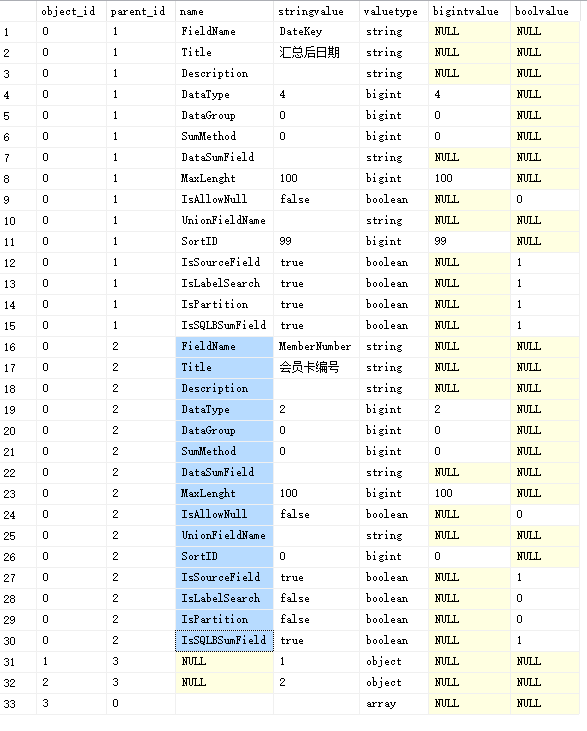
--下边的函数..执行就好..

SET ANSI_NULLS ON;

SET QUOTED_IDENTIFIER ON;

GO

IF NOT EXISTS(

    select * from sys.objects where

    object_id = OBJECT_ID(N'dbo.ParseJSON') AND

    type in (N'FN', N'IF', N'TF', N'FS', N'FT', N'F'))

BEGIN

    EXEC('CREATE FUNCTION dbo.ParseJSON() RETURNS @hierarchy table( id int ) AS BEGIN RETURN END;');

    PRINT 'FUNCTION dbo.ParseJSON is created.';

END

GO

ALTER FUNCTION [dbo].[ParseJSON]( @json nvarchar(max) )

RETURNS @hierarchy table

(

object_id int NOT NULL, /* [0 -- Not an object] each list or object has an object id. This ties all elements to a parent. Lists are treated as objects here */

parent_id int NOT NULL, /* [0 -- Root] if the element has a parent then it is in this column. The document is the ultimate parent, so you can get the structure from recursing from the document */

name nvarchar(2000), /* the name of the object */

stringvalue nvarchar(4000) NOT NULL, /*the string representation of the value of the element. */

valuetype nvarchar(100) NOT NULL, /* the declared type of the value represented as a string in stringvalue*/

bigintvalue bigint,

boolvalue bit

)

AS

BEGIN

DECLARE

@firstobject int, --the index of the first open bracket found in the JSON string

@opendelimiter int, --the index of the next open bracket found in the JSON string

@nextopendelimiter int,--the index of subsequent open bracket found in the JSON string

@nextclosedelimiter int,--the index of subsequent close bracket found in the JSON string

@type nvarchar(10),--whether it denotes an object or an array

@nextclosedelimiterChar CHAR(1),--either a '}' or a ']'

@contents nvarchar(MAX), --the unparsed contents of the bracketed expression

@start int, --index of the start of the token that you are parsing

@end int,--index of the end of the token that you are parsing

@param int,--the parameter at the end of the next Object/Array token

@endofname int,--the index of the start of the parameter at end of Object/Array token

@token nvarchar(4000),--either a string or object

@value nvarchar(MAX), -- the value as a string

@name nvarchar(200), --the name as a string

@parent_id int,--the next parent ID to allocate

@lenjson int,--the current length of the JSON String

@characters NCHAR(62),--used to convert hex to decimal

@result BIGINT,--the value of the hex symbol being parsed

@index SMALLINT,--used for parsing the hex value

@escape int; --the index of the next escape character

/* in this temporary table we keep all strings, even the names of the elements, since they are 'escaped'

* in a different way, and may contain, unescaped, brackets denoting objects or lists. These are replaced in

* the JSON string by tokens representing the string

*/

DECLARE @strings table

(

string_id int IDENTITY(1, 1),

stringvalue nvarchar(MAX)

)

/* initialise the characters to convert hex to ascii */

SET @characters = '0123456789abcdefghijklmnopqrstuvwxyzABCDEFGHIJKLMNOPQRSTUVWXYZ';

SET @parent_id = 0;

/* firstly we process all strings. This is done because [{} and ] aren't escaped in strings, which complicates an iterative parse. */

WHILE 1 = 1 /* forever until there is nothing more to do */

BEGIN

SET @start = PATINDEX('%[^a-zA-Z]["]%', @json collate SQL_Latin1_General_CP850_Bin); /* next delimited string */

IF @start = 0 BREAK; /*no more so drop through the WHILE loop */

IF SUBSTRING(@json, @start+1, 1) = '"'

BEGIN /* Delimited name */

SET @start = @start+1;

SET @end = PATINDEX('%[^\]["]%', RIGHT(@json, LEN(@json+'|')-@start) collate SQL_Latin1_General_CP850_Bin);

END

IF @end = 0 /*no end delimiter to last string*/

BREAK; /* no more */

SELECT @token = SUBSTRING(@json, @start+1, @end-1)

/* now put in the escaped control characters */

SELECT @token = REPLACE(@token, from_string, to_string)

FROM

(

SELECT '\"' AS from_string, '"' AS to_string

UNION ALL

SELECT '\\', '\'

UNION ALL

SELECT '\/', '/'

UNION ALL

SELECT '\b', CHAR(08)

UNION ALL

SELECT '\f', CHAR(12)

UNION ALL

SELECT '\n', CHAR(10)

UNION ALL

SELECT '\r', CHAR(13)

UNION ALL

SELECT '\t', CHAR(09)

) substitutions;

SET @result = 0;

SET @escape = 1;

/*Begin to take out any hex escape codes*/

WHILE @escape > 0

BEGIN

/* find the next hex escape sequence */

SET @index = 0;

SET @escape = PATINDEX('%\x[0-9a-f][0-9a-f][0-9a-f][0-9a-f]%', @token collate SQL_Latin1_General_CP850_Bin);

IF @escape > 0 /* if there is one */

BEGIN

WHILE @index < 4 /* there are always four digits to a \x sequence */

BEGIN

/* determine its value */

SET @result = @result + POWER(16, @index) * (CHARINDEX(SUBSTRING(@token, @escape + 2 + 3 - @index, 1), @characters) - 1);

SET @index = @index + 1;

END

/* and replace the hex sequence by its unicode value */

SET @token = STUFF(@token, @escape, 6, NCHAR(@result));

END

END

/* now store the string away */

INSERT INTO @strings (stringvalue) SELECT @token;

/* and replace the string with a token */

SET @json = STUFF(@json, @start, @end + 1, '@string' + CONVERT(nvarchar(5), @@identity));

END

/* all strings are now removed. Now we find the first leaf. */

WHILE 1 = 1 /* forever until there is nothing more to do */

BEGIN

SET @parent_id = @parent_id + 1;

/* find the first object or list by looking for the open bracket */

SET @firstobject = PATINDEX('%[{[[]%', @json collate SQL_Latin1_General_CP850_Bin); /*object or array*/

IF @firstobject = 0 BREAK;

IF (SUBSTRING(@json, @firstobject, 1) = '{')

SELECT @nextclosedelimiterChar = '}', @type = 'object';

ELSE

SELECT @nextclosedelimiterChar = ']', @type = 'array';

SET @opendelimiter = @firstobject;

WHILE 1 = 1 --find the innermost object or list...

BEGIN

SET @lenjson = LEN(@json+'|') - 1;

/* find the matching close-delimiter proceeding after the open-delimiter */

SET @nextclosedelimiter = CHARINDEX(@nextclosedelimiterChar, @json, @opendelimiter + 1);

/* is there an intervening open-delimiter of either type */

SET @nextopendelimiter = PATINDEX('%[{[[]%',RIGHT(@json, @lenjson-@opendelimiter) collate SQL_Latin1_General_CP850_Bin); /*object*/

IF @nextopendelimiter = 0 BREAK;

SET @nextopendelimiter = @nextopendelimiter + @opendelimiter;

IF @nextclosedelimiter < @nextopendelimiter BREAK;

IF SUBSTRING(@json, @nextopendelimiter, 1) = '{'

SELECT @nextclosedelimiterChar = '}', @type = 'object';

ELSE

SELECT @nextclosedelimiterChar = ']', @type = 'array';

SET @opendelimiter = @nextopendelimiter;

END

/* and parse out the list or name/value pairs */

SET @contents = SUBSTRING(@json, @opendelimiter+1, @nextclosedelimiter-@opendelimiter - 1);

SET @json = STUFF(@json, @opendelimiter, @nextclosedelimiter - @opendelimiter + 1, '@' + @type + CONVERT(nvarchar(5), @parent_id));

WHILE (PATINDEX('%[A-Za-z0-9@+.e]%', @contents collate SQL_Latin1_General_CP850_Bin)) < > 0

BEGIN /* WHILE PATINDEX */

IF @type = 'object' /*it will be a 0-n list containing a string followed by a string, number,boolean, or null*/

BEGIN

SET @end = CHARINDEX(':', ' '+@contents); /*if there is anything, it will be a string-based name.*/

SET @start = PATINDEX('%[^A-Za-z@][@]%', ' ' + @contents collate SQL_Latin1_General_CP850_Bin); /*AAAAAAAA*/

SET @token = SUBSTRING(' '+@contents, @start + 1, @end - @start - 1);

SET @endofname = PATINDEX('%[0-9]%', @token collate SQL_Latin1_General_CP850_Bin);

SET @param = RIGHT(@token, LEN(@token)-@endofname + 1);

SET @token = LEFT(@token, @endofname - 1);

SET @contents = RIGHT(' ' + @contents, LEN(' ' + @contents + '|') - @end - 1);

SELECT @name = stringvalue FROM @strings WHERE string_id = @param; /*fetch the name*/

END

ELSE

BEGIN

SET @name = null;

END

SET @end = CHARINDEX(',', @contents); /*a string-token, object-token, list-token, number,boolean, or null*/

IF @end = 0

SET @end = PATINDEX('%[A-Za-z0-9@+.e][^A-Za-z0-9@+.e]%', @contents+' ' collate SQL_Latin1_General_CP850_Bin) + 1;

SET @start = PATINDEX('%[^A-Za-z0-9@+.e][A-Za-z0-9@+.e]%', ' ' + @contents collate SQL_Latin1_General_CP850_Bin);

/*select @start,@end, LEN(@contents+'|'), @contents */

SET @value = RTRIM(SUBSTRING(@contents, @start, @end-@start));

SET @contents = RIGHT(@contents + ' ', LEN(@contents+'|') - @end);

IF SUBSTRING(@value, 1, 7) = '@object'

INSERT INTO @hierarchy (name, parent_id, stringvalue, object_id, valuetype)

SELECT @name, @parent_id, SUBSTRING(@value, 8, 5), SUBSTRING(@value, 8, 5), 'object';

ELSE

IF SUBSTRING(@value, 1, 6) = '@array'

INSERT INTO @hierarchy (name, parent_id, stringvalue, object_id, valuetype)

SELECT @name, @parent_id, SUBSTRING(@value, 7, 5), SUBSTRING(@value, 7, 5), 'array';

ELSE

IF SUBSTRING(@value, 1, 7) = '@string'

INSERT INTO @hierarchy (name, parent_id, stringvalue, valuetype, object_id)

SELECT @name, @parent_id, stringvalue, 'string', 0

FROM @strings

WHERE string_id = SUBSTRING(@value, 8, 5);

ELSE

IF @value IN ('true', 'false')

INSERT INTO @hierarchy (name, parent_id, stringvalue, valuetype, object_id, boolvalue)

SELECT @name, @parent_id, @value, 'boolean', 0, CASE @value WHEN 'true' THEN 1 ELSE 0 END;

ELSE

IF @value = 'null'

INSERT INTO @hierarchy (name, parent_id, stringvalue, valuetype, object_id)

SELECT @name, @parent_id, @value, 'null', 0;

ELSE

IF PATINDEX('%[^0-9]%', @value collate SQL_Latin1_General_CP850_Bin) > 0

INSERT INTO @hierarchy (name, parent_id, stringvalue, valuetype, object_id)

SELECT @name, @parent_id, @value, 'real', 0;

ELSE

INSERT INTO @hierarchy (name, parent_id, stringvalue, valuetype, object_id, bigintvalue)

SELECT @name, @parent_id, @value, 'bigint', 0, CONVERT(BIGINT,@value);

END /* WHILE PATINDEX */

END /* WHILE 1=1 forever until there is nothing more to do */

INSERT INTO @hierarchy (name, parent_id, stringvalue, object_id, valuetype)

SELECT '', 0, '', @parent_id - 1, @type;

RETURN;

END

GO

PRINT 'FUNCTION dbo.ParseJSON is modified.';

GO
SQL操作Json数据的更多相关文章
- js中如何操作json数据
一.要想熟练的操作json数据,就先要了解json数据的结构,json有两种结构:对象和数组. 1.对象 一个对象以“{”开始,“}”结束.每个“名称”后跟一个“:”:“‘名称/值’ 对”之间使用“, ...
- Jquery重新学习之五[操作JSON数据]
Jquery操作Json格式的数据在我们平时的项目中也经常运用:最近看Jquery权威指南中就有一章节是对这方面的整理总结:最后通过一个Asp.net结合一般处理程序ashx的实例,基本上能满足项目中 ...
- Java操作JSON数据(4,end)--Jackson操作JSON数据
Jackson是SpringBoot默认使用的JSON处理库,它可以轻松的将Java对象转换成JSON对象,同样也可以将JSON转换成Java对象.本文介绍下Jackson的基本使用方法,包括序列化和 ...
- Java操作JSON数据(3)--fastjson操作JSON数据
fastjson是阿里巴巴的开源JSON解析库,它可以解析JSON格式的字符串,支持将Java Bean序列化为JSON字符串,也可以从JSON字符串反序列化到JavaBean.本文介绍下fastjs ...
- Java操作JSON数据(2)--Gson操作JSON数据
Gson是Google公司发布的一个开发源码的Java库,可用于将Java对象转换为JSON字符串,也可用于将JSON字符串转换为对应的Java对象.本介绍下Gson的基本使用方法,包括序列化和反序列 ...
- Java操作JSON数据(1)--JSON-lib操作JSON数据
JSON-lib是一个java库,用于将bean.映射.集合.java数组和XML转换为JSON,或将JSON转为beans和DynaBeans.JSON-lib最后的版本是2.4,更新时间是2010 ...
- js之操作JSON数据
JSON(JavaScript Object Notation) 是一种轻量级的数据交换格式,采用完全独立于语言的文本格式,是理想的数据交换格式.同时,JSON是 JavaScript 原生格式,这意 ...
- Android(java)学习笔记208:Android中操作JSON数据(Json和Jsonarray)
1.Json 和 Xml JSON(JavaScript Object Notation) 是一种轻量级的数据交换格式.它基于ECMAScript的一个子集. JSON采用完全独立于语言的 ...
- [转] jQuery 操作 JSON 数据
jquery下json数组的操作用法实例: jquery中操作JSON数组的情况中遍历方法用的比较多,但用添加移除这些好像就不是太多了. 试过json[i].remove(),json.remove( ...
随机推荐
- Linq学习<四> linq to XML
LINQ to XML并不打算替代标准的XML API,例如,XML DOM(Document Object Model).Path.XQuery和XSLT等.如果熟悉这些API或当前需要使用或学习它 ...
- 五)使用 easyui-tabs 遭遇错误 Unexpected Exception caught setting '_' on
十月 10, 2015 3:08:35 下午 com.opensymphony.xwork2.interceptor.ParametersInterceptor error 严重: Developer ...
- review一个javascript功能函数
近半年来一直觉得自己在技术上好像左右挣扎,技术没啥提升,看书看不进,自学还挺慢.写出来的东西,自己都觉得不满意.让自己也用庸人自扰的感觉. 最近,在工作中,有一个小小的功能需要实现,这个功能非常简单, ...
- 编写高质量代码改善C#程序的157个建议——建议123:程序集不必与命名空间同名
建议123:程序集不必与命名空间同名 程序集一般会和命名空间同名,但这并不是必须的.事实上,不同名的命名空间和程序集是很常见的. 程序集表示的是一种物理上的分组,而命名空间是逻辑上的分组,两者没有必然 ...
- Web环境中Spring的启动过程
1.spring不但可以在JavaSE环境中应用,在Web环境中也可以广泛应用,Spring在web环境中应用时,需要在应用的web.xml文件中添加如下的配置: …… <context-par ...
- Maven整理笔记のMaven仓库
Maven坐标和依赖是任何一个构件在Maven世界中的逻辑表示方式:而构件的物理表示方式是文件,Maven通过仓库来统一管理这些文件. Maven仓库 在Maven的世界中,任何一个依赖.插件或者项 ...
- python的reflect反射方法
核心内容专自:http://www.liujiangblog.com/course/python/48 在自动化测试的时候,需要从excel中读取关键字,此关键字对应一个方法,如何使用该关键字去调用真 ...
- js 日期加一天或者减一天,最简单方法
通过计算一天的时间戳是多少进行换算:(new Date(new Date().getTime()-86400000)).Format("yyyy-MM-dd hh:mm:ss")
- 【windows】dos命令查看某个文件夹下所有文件目录列表
dos命令 dir展示一个目录中的文件夹和文件列表 /a代表显示隐藏目录
- ZKEACMS 的两种发布方式
前言 如果你还不知道ZKEACMS,不妨先了解一下. ASP.NET MVC 开源建站系统 ZKEACMS 推荐,从此网站“拼”起来 官方地址:http://www.zkea.net/zkeacms ...