
关于C++中vector和set使用sort方法进行排序
C++中vector和set都是非常方便的容器,
sort方法是algorithm头文件里的一个标准函数,能进行高效的排序,默认是按元素从小到大排序
将sort方法用到vector和set中能实现多种符合自己需求的排序
首先sort方法可以对静态的数组进行排序
 #include<iostream>

 using namespace std;

 int main(){

     int a[] = { , , , , , , , , ,  };

     sort(a, a +);

     for (int i = ; i < ; i++)

         cout << a[i] << endl;

     return ;

 }
运行结果:
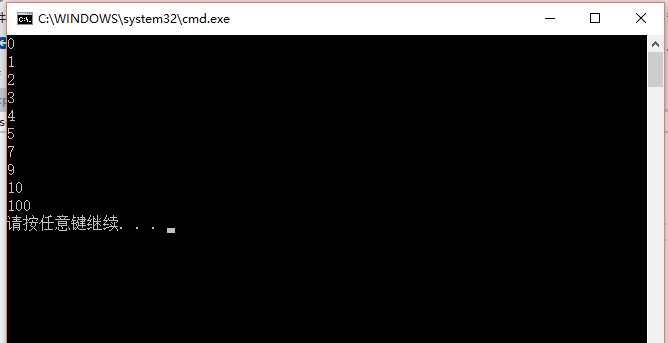
这里可以看到是sort(a,a+10),但是数组a一共只有9个元素,为什么是a+10而不是a+9呢?
因为sort方法实际上最后一位地址对应的数是不取的,
而且vector,set,map这些容器的end()取出来的值实际上并不是最后一个值,而end的前一个才是最后一个值!
需要用prev(xxx.end()),才能取出容器中最后一个元素。
对vector使用sort函数:
第一种情形:基本类型,如vector<int>,vector<double>,vector<string>也是可以的
 #include<iostream>

 #include<vector>

 #include<algorithm>

 using namespace std;

 int main(){

     vector<int> a;

     int n = ;

     while (n--){

         int score;

         cin >> score;

         a.push_back(score);

     }

     //cout <<" a.end()"<< *a.end() << endl;       执行这句话会报错!

     cout << " prev(a.end)" << *prev(a.end()) << endl;

     sort(a.begin(), a.end());

     for (vector<int>::iterator it = a.begin(); it != a.end(); it++){

         cout << *it << endl;

     }

     return ;

 }
执行结果:

看到了吗,实际上end的前一个指针指向的元素才是插入时的最后一个值!
排序后从小大大。
第二种情形:用自定义的结构体进行sort算法,
这时候需要自己定义个比较函数,因为sort算法是基于容器中的元素是可以两两比较的,然后从小到大排序,所以要自定义怎么样才是小于('<')
 #include<iostream>

 #include<vector>

 #include<set>

 #include<string>

 #include<algorithm>

 using namespace std;

 struct student{

     char name[];

     int score;

 };

 //自定义“小于”

 bool comp(const student &a, const student &b){

     return a.score < b.score;

 }

 int main(){

     vector<student> vectorStudents;

     int n = ;

     while (n--){

         student oneStudent;

         string name;

         int score;

         cin >> name >> score;

         strcpy(oneStudent.name, name.c_str());

         oneStudent.score = score;

         vectorStudents.push_back(oneStudent);

     }

     cout << "===========排序前================" << endl;

     for (vector<student>::iterator it = vectorStudents.begin(); it != vectorStudents.end(); it++){

         cout << "name: " << it->name << " score: " << it->score << endl;

     }

     sort(vectorStudents.begin(),vectorStudents.end(),comp);

     cout << "===========排序后================" << endl;

     for (vector<student>::iterator it = vectorStudents.begin(); it != vectorStudents.end(); it++){

         cout << "name: " << it->name << " score: " << it->score << endl;

     }

     return ;

 }
运行结果:

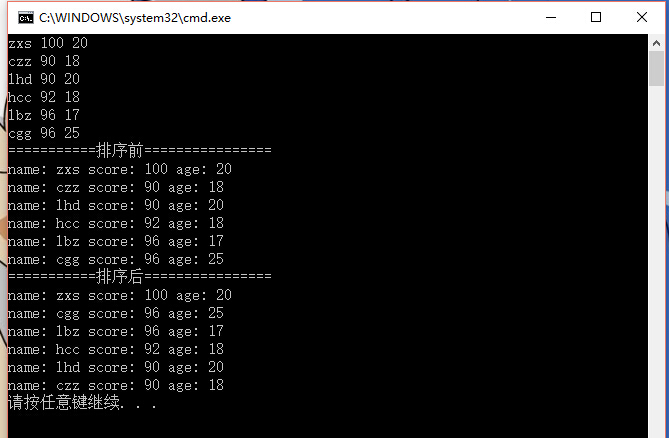
不过有时候一个排序条件不够,比如要求学生按分数从高到低排序,如果分数相同,则按照年龄从大到小排序
就需要在comp自定义函数里面修改一下判断了,原来是直接return a.score < b.score
现在就需要判断
if (a.score > b.score)

   return true;

else if (a.score == b.score  && a.age > b.age)
   return true;

else

   return false;

这里一定要记得else return false!!!有一次比赛的时候写到这个函数,有三个判断条件,结果忘了这茬,总是报错,
到后来有点着急了就自己手动实现了一下写了三个比较函数,调用了三次sort函数!!!!!
 #include<iostream>

 #include<vector>

 #include<set>

 #include<string>

 #include<algorithm>

 using namespace std;

 struct student{

     char name[];

     int score;

     int age;

 };

 //自定义“小于”

 bool comp(const student &a, const student &b){

     if (a.score > b.score)

         return true;

     else if (a.score == b.score  && a.age > b.age)

         return true;

     else                ///这里的else return false非常重要!!!!!

         return false;

 }

 int main(){

     vector<student> vectorStudents;

     /*set<student> setStudents;*/

     //int n = 5;

     int n = ;

     while (n--){

         student oneStudent;

         string name;

         int score;

         int age;

         cin >> name >> score>>age;

         strcpy(oneStudent.name, name.c_str());

         oneStudent.score = score;

         oneStudent.age = age;

         vectorStudents.push_back(oneStudent);

     }

     cout << "===========排序前================" << endl;

     for (vector<student>::iterator it = vectorStudents.begin(); it != vectorStudents.end(); it++){

         cout << "name: " << it->name << " score: " << it->score << " age: "<<it->age<<endl;

     }

     sort(vectorStudents.begin(), vectorStudents.end(), comp);

     //sort(setStudents.begin(), setStudents.end());

     cout << "===========排序后================" << endl;

     for (vector<student>::iterator it = vectorStudents.begin(); it != vectorStudents.end(); it++){

         cout << "name: " << it->name << " score: " << it->score << " age: " << it->age << endl;

     }

     return ;

 }
运行结果如下:
接下来,对于set做类似的操作。
set是一个集合,内部的元素不会重复,同时它会自动进行排序,也是从小到大
而且set的insert方法没有insert(a,cmp)这种重载,所以如果要把结构体插入set中,我们就要重载'<'运算符。
set方法在插入的时候也是从小到大的,那么我们重载一下<运算符让它从大到小排序
 #include<iostream>

 #include<vector>

 #include<set>

 #include<string>

 #include<algorithm>

 using namespace std;

 struct student{

     char name[];

     int score;

 };

 //自定义“小于”

 bool comp(const student &a, const student &b){

     return a.score < b.score;

 }

 bool operator < (const student & stu1,const student &stu2){

     return stu1.score > stu2.score;

 }

 int main(){

     //vector<student> vectorStudents;

     set<student> setStudents;

     //int n = 5;

     int n = ;

     while (n--){

         student oneStudent;

         string name;

         int score;

         cin >> name >> score;

         strcpy(oneStudent.name, name.c_str());

         oneStudent.score = score;

         setStudents.insert(oneStudent);

     }

     cout << "===========排序前================" << endl;

     for (set<student>::iterator it = setStudents.begin(); it != setStudents.end(); it++){

         cout << "name: " << it->name << " score: " << it->score << endl;

     }

     //sort(setStudents.begin(), setStudents.end(), comp);

     //cout << "===========排序后================" << endl;

     //for (set<student>::iterator it = setStudents.begin(); it != setStudents.end(); it++){

     //    cout << "name: " << it->name << " score: " << it->score << endl;

     //}

     return ;

 }
运行结果:

我们可以看到,set内元素不会重复,而且它按照它所认为的“从小到大”进行了排序
关于C++中vector和set使用sort方法进行排序的更多相关文章
- 回调函数及数组中sort()方法实现排序的原理
1.回调函数:把一个方法A当一个参数值传递到另外一个函数B中,在B执行的过程当中我们随时根据需求让A方法执行: 什么是回调 :它是异步编程基本的方法,需要异步处理的时候一般采用后续传递的方式,将后 ...
- 定义一个数组,并对这个数组进行动态初始化,使用sort方法进行排序后,再将数组中的元素倒置过来。
Sort方法,生序排序 package com.fs.array; import java.util.Arrays; public class ArraySort { public static vo ...
- 论C++11 中vector的N种遍历方法
随着C++11标准的出现,C++标准添加了许多有用的特性,C++代码的写法也有比较多的变化. vector是经常要使用到的std组件,对于vector的遍历,本文罗列了若干种写法. (注:本文中代码为 ...
- C++11中vector的几种遍历方法
假设有这样的一个vector: vector<int> line={1,2,3,4,5,6,7,8,9}; 需要输出vector里的每个元素,主函数如下: void showvec(con ...
- Java中使用Collections.sort()方法对数字和字符串泛型的LIst进行排序
在List的排序中常用的是Collections.sort()方法,可以对String类型和Integer类型泛型的List集合进行排序. 首先演示sort()方法对Integer类型泛型的List排 ...
- .NET中string[]数组和List<string>泛型的相互转换以及Array类的Sort()方法(转)
从string[]转List<string>: " }; List<string> list = new List<string>(str); 从List ...
- 你真的会用JavaScript中的sort方法吗
在平时的业务开发中,数组(Array) 是我们经常用到的数据类型,那么对数组的排序也很常见,除去使用循环遍历数组的方法来排列数据,使用JS数组中原生的方法 sort 来排列(没错,比较崇尚JS原生 ...
- python中sort和sorted排序的相关方法
Python list内置sort()方法用来排序,也可以用python内置的全局sorted()方法来对可迭代的序列排序生成新的序列. 1)排序基础 简单的升序排序是非常容易的.只需要调用sorte ...
- Array类的Sort()方法
刚复习了Array类的sort()方法, 这里列举几个常用的,和大家一起分享. Array类实现了数组中元素的冒泡排序.Sort()方法要求数组中的元素实现IComparable接口.如System. ...
随机推荐
- 指定路径下建立Access数据库并插入数据
今天刚刚开通博客,想要把我这几天完成小任务的过程,记录下来.我从事软件开发的时间不到1年,写的不足之处,还请前辈们多多指教. 上周四也就是2016-04-14号上午,部门领导交给我一个小任务,概括来讲 ...
- 为什么Java中的String类是不可变的?
String类是Java中的一个不可变类(immutable class). 简单来说,不可变类就是实例在被创建之后不可修改. 在<Effective Java> Item 15 中提到了 ...
- GitHub使用(四) - 关于分支Branch
1. 什么是分支Branch? 我初步的理解为:GitHub仓库默认有一个master的分支,当我们在master分支开发过程中接到一个新的功能需求,我们就可以新建一个分支同步开发而互不影响,开发完成 ...
- Raspiberry Camera详解+picamera库+Opencv控制
使用树莓派的摄像头,将树莓派自身提供的picamera的API数据转换为Python Oencv可用图像数据: # import the necessary packages from picamer ...
- VC++:创建,调用Win32动态链接库
VC++:创建,调用Win32动态链接库 概述 DLL(Dynamic Linkable Library)动态链接库,Dll可以看作一种仓库,仓库中包含了可以直接使用的变量,函数或类.仓库的发展史经历 ...
- 【ASP.NET MVC】jqGrid 增删改查详解
1 概述 本篇文章主要是关于JqGrid的,主要功能包括使用JqGrid增删查改,导入导出,废话不多说,直接进入正题. 2 Demo相关 2.1 Demo展示 第一部分 第二部分 2.2 ...
- FPGA在其他领域的应用(三)
广播领域: 专业的A/V(音频/视频),和演播室行业正在经历着激动人心的变化,例如,UHD/8K (超高清)视频.多平台内容交付.IP网络传输和云计算.2016里约奥运会使用4K分辨率视频播放,而日本 ...
- FPGA在AD采集中的应用
AD转换,也叫模数转换,是将模拟信号转换为数字信号.目前包括电脑CPU,ARM,FPGA,处理的信号都只能是数字信号,所以数据信号在进入处理芯片前必须要进行AD转换. 在高速的AD转换中,FPGA以其 ...
- C# XML序列化方法和常用特性
/* C#对象XML序列化(一):序列化方法和常用特性 .Net Framework提供了对应的System.Xml.Seriazliation.XmlSerializer负责把对象序列化到XML,和 ...
- JavaScript实现模糊推荐的input框(类似百度搜索框)
如何用JS实现一个类似百度搜索框的输入框呢,再填充完失去焦点时,自动填充配置项,最终效果如下图: 实现很简单,但是易用性会上升一大截,需要用到的有jquery-ui的autocomplete,jque ...