
关于C++中vector和set使用sort方法进行排序
C++中vector和set都是非常方便的容器,
sort方法是algorithm头文件里的一个标准函数,能进行高效的排序,默认是按元素从小到大排序
将sort方法用到vector和set中能实现多种符合自己需求的排序
首先sort方法可以对静态的数组进行排序
 #include<iostream>

 using namespace std;

 int main(){

     int a[] = { , , , , , , , , ,  };

     sort(a, a +);

     for (int i = ; i < ; i++)

         cout << a[i] << endl;

     return ;

 }
运行结果:
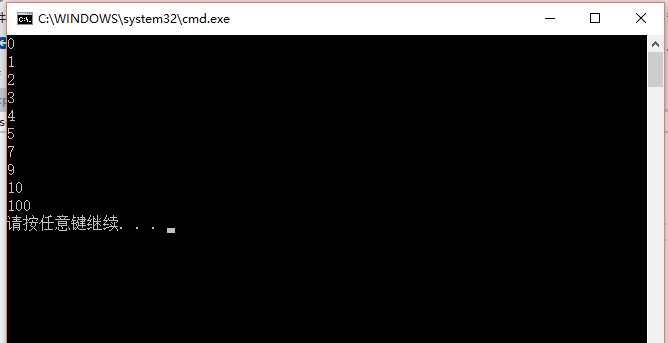
这里可以看到是sort(a,a+10),但是数组a一共只有9个元素,为什么是a+10而不是a+9呢?
因为sort方法实际上最后一位地址对应的数是不取的,
而且vector,set,map这些容器的end()取出来的值实际上并不是最后一个值,而end的前一个才是最后一个值!
需要用prev(xxx.end()),才能取出容器中最后一个元素。
对vector使用sort函数:
第一种情形:基本类型,如vector<int>,vector<double>,vector<string>也是可以的
 #include<iostream>

 #include<vector>

 #include<algorithm>

 using namespace std;

 int main(){

     vector<int> a;

     int n = ;

     while (n--){

         int score;

         cin >> score;

         a.push_back(score);

     }

     //cout <<" a.end()"<< *a.end() << endl;       执行这句话会报错!

     cout << " prev(a.end)" << *prev(a.end()) << endl;

     sort(a.begin(), a.end());

     for (vector<int>::iterator it = a.begin(); it != a.end(); it++){

         cout << *it << endl;

     }

     return ;

 }
执行结果:

看到了吗,实际上end的前一个指针指向的元素才是插入时的最后一个值!
排序后从小大大。
第二种情形:用自定义的结构体进行sort算法,
这时候需要自己定义个比较函数,因为sort算法是基于容器中的元素是可以两两比较的,然后从小到大排序,所以要自定义怎么样才是小于('<')
 #include<iostream>

 #include<vector>

 #include<set>

 #include<string>

 #include<algorithm>

 using namespace std;

 struct student{

     char name[];

     int score;

 };

 //自定义“小于”

 bool comp(const student &a, const student &b){

     return a.score < b.score;

 }

 int main(){

     vector<student> vectorStudents;

     int n = ;

     while (n--){

         student oneStudent;

         string name;

         int score;

         cin >> name >> score;

         strcpy(oneStudent.name, name.c_str());

         oneStudent.score = score;

         vectorStudents.push_back(oneStudent);

     }

     cout << "===========排序前================" << endl;

     for (vector<student>::iterator it = vectorStudents.begin(); it != vectorStudents.end(); it++){

         cout << "name: " << it->name << " score: " << it->score << endl;

     }

     sort(vectorStudents.begin(),vectorStudents.end(),comp);

     cout << "===========排序后================" << endl;

     for (vector<student>::iterator it = vectorStudents.begin(); it != vectorStudents.end(); it++){

         cout << "name: " << it->name << " score: " << it->score << endl;

     }

     return ;

 }
运行结果:

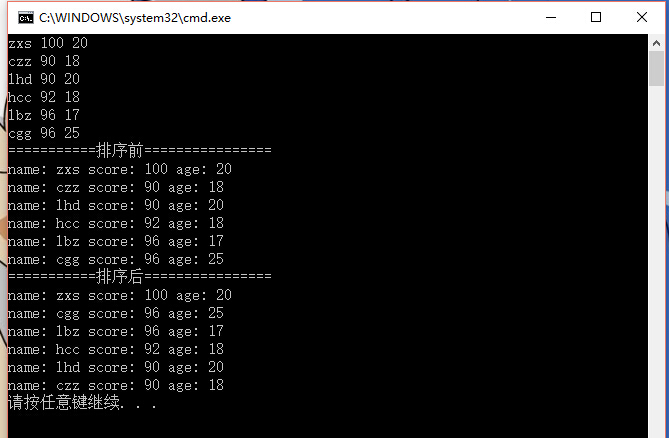
不过有时候一个排序条件不够,比如要求学生按分数从高到低排序,如果分数相同,则按照年龄从大到小排序
就需要在comp自定义函数里面修改一下判断了,原来是直接return a.score < b.score
现在就需要判断
if (a.score > b.score)

   return true;

else if (a.score == b.score  && a.age > b.age)
   return true;

else

   return false;

这里一定要记得else return false!!!有一次比赛的时候写到这个函数,有三个判断条件,结果忘了这茬,总是报错,
到后来有点着急了就自己手动实现了一下写了三个比较函数,调用了三次sort函数!!!!!
 #include<iostream>

 #include<vector>

 #include<set>

 #include<string>

 #include<algorithm>

 using namespace std;

 struct student{

     char name[];

     int score;

     int age;

 };

 //自定义“小于”

 bool comp(const student &a, const student &b){

     if (a.score > b.score)

         return true;

     else if (a.score == b.score  && a.age > b.age)

         return true;

     else                ///这里的else return false非常重要!!!!!

         return false;

 }

 int main(){

     vector<student> vectorStudents;

     /*set<student> setStudents;*/

     //int n = 5;

     int n = ;

     while (n--){

         student oneStudent;

         string name;

         int score;

         int age;

         cin >> name >> score>>age;

         strcpy(oneStudent.name, name.c_str());

         oneStudent.score = score;

         oneStudent.age = age;

         vectorStudents.push_back(oneStudent);

     }

     cout << "===========排序前================" << endl;

     for (vector<student>::iterator it = vectorStudents.begin(); it != vectorStudents.end(); it++){

         cout << "name: " << it->name << " score: " << it->score << " age: "<<it->age<<endl;

     }

     sort(vectorStudents.begin(), vectorStudents.end(), comp);

     //sort(setStudents.begin(), setStudents.end());

     cout << "===========排序后================" << endl;

     for (vector<student>::iterator it = vectorStudents.begin(); it != vectorStudents.end(); it++){

         cout << "name: " << it->name << " score: " << it->score << " age: " << it->age << endl;

     }

     return ;

 }
运行结果如下:
接下来,对于set做类似的操作。
set是一个集合,内部的元素不会重复,同时它会自动进行排序,也是从小到大
而且set的insert方法没有insert(a,cmp)这种重载,所以如果要把结构体插入set中,我们就要重载'<'运算符。
set方法在插入的时候也是从小到大的,那么我们重载一下<运算符让它从大到小排序
 #include<iostream>

 #include<vector>

 #include<set>

 #include<string>

 #include<algorithm>

 using namespace std;

 struct student{

     char name[];

     int score;

 };

 //自定义“小于”

 bool comp(const student &a, const student &b){

     return a.score < b.score;

 }

 bool operator < (const student & stu1,const student &stu2){

     return stu1.score > stu2.score;

 }

 int main(){

     //vector<student> vectorStudents;

     set<student> setStudents;

     //int n = 5;

     int n = ;

     while (n--){

         student oneStudent;

         string name;

         int score;

         cin >> name >> score;

         strcpy(oneStudent.name, name.c_str());

         oneStudent.score = score;

         setStudents.insert(oneStudent);

     }

     cout << "===========排序前================" << endl;

     for (set<student>::iterator it = setStudents.begin(); it != setStudents.end(); it++){

         cout << "name: " << it->name << " score: " << it->score << endl;

     }

     //sort(setStudents.begin(), setStudents.end(), comp);

     //cout << "===========排序后================" << endl;

     //for (set<student>::iterator it = setStudents.begin(); it != setStudents.end(); it++){

     //    cout << "name: " << it->name << " score: " << it->score << endl;

     //}

     return ;

 }
运行结果:

我们可以看到,set内元素不会重复,而且它按照它所认为的“从小到大”进行了排序
关于C++中vector和set使用sort方法进行排序的更多相关文章
- 回调函数及数组中sort()方法实现排序的原理
1.回调函数:把一个方法A当一个参数值传递到另外一个函数B中,在B执行的过程当中我们随时根据需求让A方法执行: 什么是回调 :它是异步编程基本的方法,需要异步处理的时候一般采用后续传递的方式,将后 ...
- 定义一个数组,并对这个数组进行动态初始化,使用sort方法进行排序后,再将数组中的元素倒置过来。
Sort方法,生序排序 package com.fs.array; import java.util.Arrays; public class ArraySort { public static vo ...
- 论C++11 中vector的N种遍历方法
随着C++11标准的出现,C++标准添加了许多有用的特性,C++代码的写法也有比较多的变化. vector是经常要使用到的std组件,对于vector的遍历,本文罗列了若干种写法. (注:本文中代码为 ...
- C++11中vector的几种遍历方法
假设有这样的一个vector: vector<int> line={1,2,3,4,5,6,7,8,9}; 需要输出vector里的每个元素,主函数如下: void showvec(con ...
- Java中使用Collections.sort()方法对数字和字符串泛型的LIst进行排序
在List的排序中常用的是Collections.sort()方法,可以对String类型和Integer类型泛型的List集合进行排序. 首先演示sort()方法对Integer类型泛型的List排 ...
- .NET中string[]数组和List<string>泛型的相互转换以及Array类的Sort()方法(转)
从string[]转List<string>: " }; List<string> list = new List<string>(str); 从List ...
- 你真的会用JavaScript中的sort方法吗
在平时的业务开发中,数组(Array) 是我们经常用到的数据类型,那么对数组的排序也很常见,除去使用循环遍历数组的方法来排列数据,使用JS数组中原生的方法 sort 来排列(没错,比较崇尚JS原生 ...
- python中sort和sorted排序的相关方法
Python list内置sort()方法用来排序,也可以用python内置的全局sorted()方法来对可迭代的序列排序生成新的序列. 1)排序基础 简单的升序排序是非常容易的.只需要调用sorte ...
- Array类的Sort()方法
刚复习了Array类的sort()方法, 这里列举几个常用的,和大家一起分享. Array类实现了数组中元素的冒泡排序.Sort()方法要求数组中的元素实现IComparable接口.如System. ...
随机推荐
- 多线程简单实例(1)真的需要synchronized么?
说道多线程的安全问题,很多人想到就就是加锁.用到synchronized关键字. 那就要先说说synchronized问什么能够保证线程安全了. 首先要了解线程的工作方式:线程工作分为工作内存和主内存 ...
- Ubuntu升级出现/boot空间不足解决
经常升级Linux内核,导致更新时警告/boot分区空间不足.这是以为多次升级内核后,导致内核版本太多,清理一下没用的内核文件就行了.命令如下: zht@zht-Ubuntu:~$ dpkg -l ' ...
- WinForm事件中的Object sender和EventArgs e参数
Windows程序有一个事件机制.用于处理用户事件. 在WinForm中我们经常需要给控件添加事件.例如给一个Button按钮添加一个Click点击事件.给TextBox文本框添加一个KeyPress ...
- 【转】HTTP Header 详解
HTTP(HyperTextTransferProtocol)即超文本传输协议,目前网页传输的的通用协议.HTTP协议采用了请求/响应模型,浏览器或其他客户端发出请求,服务器给与响应.就整个网络资源传 ...
- vim环境设置(应用于python编程)
1. 安装完整的vim # apt-get install vim-gnome 2. 安装ctags,ctags用于支持taglist,必需! # apt-get install ctags 3. 安 ...
- Druid源码阅读之连接池
概述 Druid是阿里巴巴开源的一个数据库连接池 源码地址.下面简单分析一下连接池是怎么实现的 怎么开始阅读 如果使用过Druid连接池的都只要在Spring配置中配置jdbc的时候配置Driver是 ...
- 用C#实现字符串相似度算法(编辑距离算法 Levenshtein Distance)
在搞验证码识别的时候需要比较字符代码的相似度用到"编辑距离算法",关于原理和C#实现做个记录. 据百度百科介绍: 编辑距离,又称Levenshtein距离(也叫做Edit Dist ...
- TreeViewItem实现整行选中 (两种用法)
用法一 <ResourceDictionary xmlns="http://schemas.microsoft.com/winfx/2006/xaml/presentation&quo ...
- NOIP初赛 之 哈夫曼树
哈夫曼树 种根据我已刷的初赛题中基本每套的倒数第五或第六个不定项选择题就有一个关于哈夫曼树及其各种应用的题,占:0-1.5分:然而我针对这个类型的题也多次不会做,so,今晚好好研究下哈夫曼树: 概念: ...
- 第九章 MySQL中LIMIT和NOT IN案例
第九章 MySQL中LIMIT和NOT IN案例 一.案例的项目 1.创建数据库语句: #创建数据库 CREATE DATABASE `schoolDB`; USE `schoolDB`; #创建学生 ...