
Coursera Algorithms Programming Assignment 5: Kd-Trees (98分)
题目地址:http://coursera.cs.princeton.edu/algs4/assignments/kdtree.html
分析:
Brute-force implementation. 蛮力实现的方法比较简单,就是逐个遍历每个point进行比较,实现下述API就可以了,没有什么难度。

 import java.util.ArrayList;

 import java.util.TreeSet;

 import edu.princeton.cs.algs4.Point2D;

 import edu.princeton.cs.algs4.RectHV;

 import edu.princeton.cs.algs4.StdDraw;

 /**

  * @author evasean www.cnblogs.com/evasean/

  */

 public class PointSET {

     private TreeSet<Point2D> points;

     public PointSET() {

         // construct an empty set of points

         points = new TreeSet<Point2D>();

     }

     public boolean isEmpty() {

         // is the set empty?

         return points.isEmpty();

     }

     public int size() {

         // number of points in the set

         return points.size();

     }

     public void insert(Point2D p) {

         // add the point to the set (if it is not already in the set)

         if(p==null)

             throw new IllegalArgumentException("Point2D p is not illegal!");

         if(!points.contains(p))

             points.add(p);

     }

     public boolean contains(Point2D p) {

         // does the set contain point p?

         if(p==null)

             throw new IllegalArgumentException("Point2D p is not illegal!");

         return points.contains(p);

     }

     public void draw() {

         // draw all points to standard draw

         for (Point2D p : points) {

             p.draw();

         }

         StdDraw.show();

     }

     public Iterable<Point2D> range(RectHV rect) {

         // all points that are inside the rectangle (or on the boundary)

         if(rect==null)

             throw new IllegalArgumentException("RectHV rect is not illegal!");

         ArrayList<Point2D> list = new ArrayList<Point2D>();

         for(Point2D point : points){

             if(rect.contains(point)) list.add(point);

         }

         return list;

     }

     public Point2D nearest(Point2D p) {

         // a nearest neighbor in the set to point p; null if the set is empty

         if(p==null)

             throw new IllegalArgumentException("Point2D p is not illegal!");

         if(points.size() == 0) return null;

         double neareatDistance = Double.POSITIVE_INFINITY;

         Point2D nearest = null;

         for(Point2D point : points){

             double tmp = p.distanceTo(point);

             if(Double.compare(neareatDistance, tmp) == 1){

                 neareatDistance = tmp;

                 nearest = point;

             }

         }

         return nearest;

     }

     public static void main(String[] args) {

         // unit testing of the methods (optional)

     }

 }
2d-tree implementation.
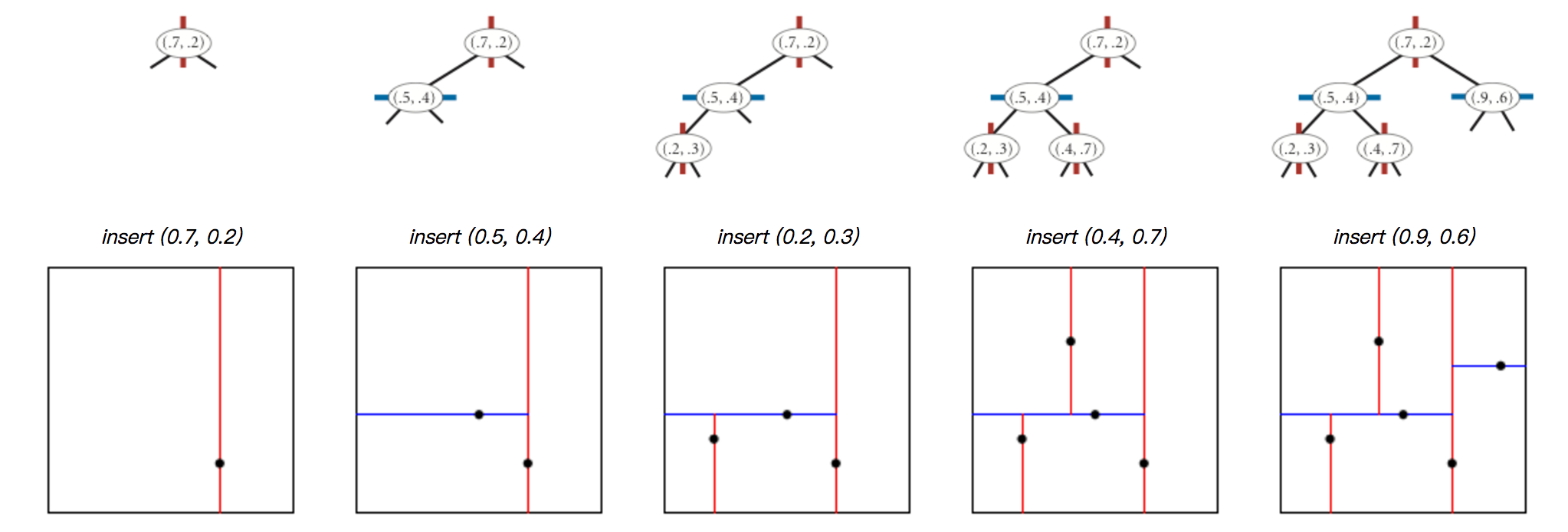
kd-tree插入时要交替以x坐标和y坐标作为判断依据,比如root节点处比较依据为x坐标,那么当要查找或插入一个新节点point时,比较root节点的x坐标和point的x坐标,如果后者比前者小,那么下一次要比较的就是root->left, 相反下一次要比较的就是root->right。进入下一层级之后,就要使用y坐标作为比较依据。示例如下图:
区域搜索:查找落在给定矩阵区域范围内的所有points。从root开始递归查找,如果给定的矩阵不与当前节点的相关矩阵相交,那么就没有必要继续查找该节点及其子树了。
最近节点搜索:查找与给定point距离最近的节点。从root开始递归查找其左右子树,如果给定节点point和已经查找到的最近节点的距离比该point与当前遍历节点的相关矩阵距离还近,那么就没必要遍历这个当前节点及其子树了。
 import java.util.ArrayList;

 import edu.princeton.cs.algs4.Point2D;

 import edu.princeton.cs.algs4.RectHV;

 import edu.princeton.cs.algs4.StdDraw;

 /**

  * @author evasean www.cnblogs.com/evasean/

  */

 public class KdTree {

     private Node root;

     private class Node {

         private Point2D p;

         /*

          * 节点的value就是包含该节点的矩形空间 其左右子树的矩形空间,就是通过该节点进行水平切分或垂直切分的两个子空间

          */

         private RectHV rect;

         private Node left, right;

         private int size;

         private boolean xCoordinate; // 标识该节点是否是以x坐标垂直切分

         public Node(Point2D point, RectHV rect, int size, boolean xCoordinate) {

             this.p = point;

             this.rect = rect;

             this.size = size;

             this.xCoordinate = xCoordinate;

         }

     }

     public KdTree() {

         // construct an empty set of points

     }

     public boolean isEmpty() {

         // is the set empty?

         return size() == 0;

     }

     public int size() {

         // number of points in the set

         return size(root);

     }

     private int size(Node x) {

         if (x == null)

             return 0;

         else

             return x.size;

     }

     public void insert(Point2D p) {

         // add the point to the set (if it is not already in the set)

         if (p == null)

             throw new IllegalArgumentException("Point2D p is not illegal!");

         if (root == null)

             root = new Node(p, new RectHV(0.0, 0.0, 1.0, 1.0), 1, true);

         else

             insert(root, p);

         // System.out.println("size="+root.size);

     }

     private void insert(Node x, Point2D p) {

         if (x.xCoordinate == true) { // x的切分标志是x坐标

             int cmp = Double.compare(p.x(), x.p.x());

             if (cmp == -1) {

                 if (x.left != null)

                     insert(x.left, p);

                 else {

                     RectHV parent = x.rect;

                     // 将节点x的矩形空间进行垂直切分后的左侧部分

                     double newXmin = parent.xmin();

                     double newYmin = parent.ymin();

                     double newXmax = x.p.x();

                     double newYmax = parent.ymax();

                     x.left = new Node(p, new RectHV(newXmin, newYmin, newXmax, newYmax), 1, false);

                 }

             } else if (cmp == 1) {

                 if (x.right != null)

                     insert(x.right, p);

                 else {

                     RectHV parent = x.rect;

                     // 将节点x的矩形空间进行垂直切分后的右侧部分

                     double newXmin = x.p.x();

                     double newYmin = parent.ymin();

                     double newXmax = parent.xmax();

                     double newYmax = parent.ymax();

                     x.right = new Node(p, new RectHV(newXmin, newYmin, newXmax, newYmax), 1, false);

                 }

             } else { // x.key.x() 与 p.x() 相等

                 int cmp2 = Double.compare(p.y(), x.p.y());

                 if (cmp2 == -1) {

                     if (x.left != null)

                         insert(x.left, p);

                     else {

                         x.left = new Node(p, x.rect, 1, false);

                     }

                 } else if (cmp2 == 1) {

                     if (x.right != null)

                         insert(x.right, p);

                     else {

                         x.right = new Node(p, x.rect, 1, false);

                     }

                 }

             }

         } else { // x的切分标志是y坐标

             int cmp = Double.compare(p.y(), x.p.y());

             if (cmp == -1) {

                 if (x.left != null)

                     insert(x.left, p);

                 else {

                     RectHV parent = x.rect;

                     // 将节点x的矩形空间进行垂直切分后的左侧部分

                     double newXmin = parent.xmin();

                     double newYmin = parent.ymin();

                     double newXmax = parent.xmax();

                     double newYmax = x.p.y();

                     x.left = new Node(p, new RectHV(newXmin, newYmin, newXmax, newYmax), 1, true);

                 }

             } else if (cmp == 1) {

                 if (x.right != null)

                     insert(x.right, p);

                 else {

                     RectHV parent = x.rect;

                     // 将节点x的矩形空间进行垂直切分后的左侧部分

                     double newXmin = parent.xmin();

                     double newYmin = x.p.y();

                     double newXmax = parent.xmax();

                     double newYmax = parent.ymax();

                     x.right = new Node(p, new RectHV(newXmin, newYmin, newXmax, newYmax), 1, true);

                 }

             } else { // x.key.y() 与 p.y()相等

                 int cmp2 = Double.compare(p.x(), x.p.x());

                 if (cmp2 == -1) {

                     if (x.left != null)

                         insert(x.left, p);

                     else {

                         x.left = new Node(p, x.rect, 1, true);

                     }

                 } else if (cmp2 == 1) {

                     if (x.right != null)

                         insert(x.right, p);

                     else {

                         x.right = new Node(p, x.rect, 1, true);

                     }

                 }

             }

         }

         x.size = 1 + size(x.left) + size(x.right);

     }

     public boolean contains(Point2D p) {

         // does the set contain point p?

         if (p == null)

             throw new IllegalArgumentException("Point2D p is not illegal!");

         return contains(root, p);

     }

     private boolean contains(Node x, Point2D p) {

         if(x == null ) return false;

         if (x.p.equals(p))

             return true;

         else {

             if(x.xCoordinate == true){

                 int cmp = Double.compare(p.x(), x.p.x());

                 if(cmp == -1) return contains(x.left,p);

                 else if(cmp == 1 ) return contains(x.right,p);

                 else{

                     int cmp2 = Double.compare(p.y(), x.p.y());

                     if(cmp2 == -1) return contains(x.left,p);

                     else if(cmp2 == 1 ) return contains(x.right,p);

                     else return true;

                 }

             }else{

                 int cmp = Double.compare(p.y(), x.p.y());

                 if(cmp == -1) return contains(x.left,p);

                 else if(cmp == 1 ) return contains(x.right,p);

                 else{

                     int cmp2 = Double.compare(p.x(), x.p.x());

                     if(cmp2 == -1) return contains(x.left,p);

                     else if(cmp2 == 1 ) return contains(x.right,p);

                     else return true;

                 }

             }

         }

     }

     public void draw() {

         // draw all points to standard draw

         StdDraw.setXscale(0, 1);

         StdDraw.setYscale(0, 1);

         draw(root);

     }

     private void draw(Node x) {

         if (x == null)

             return;

         StdDraw.setPenColor(StdDraw.BLACK);

         StdDraw.setPenRadius(0.01);

         x.p.draw();

         if (x.xCoordinate == true) {

             StdDraw.setPenColor(StdDraw.RED);

             StdDraw.setPenRadius();

             Point2D start = new Point2D(x.p.x(), x.rect.ymin());

             Point2D end = new Point2D(x.p.x(), x.rect.ymax());

             start.drawTo(end);

         } else {

             StdDraw.setPenColor(StdDraw.BLUE);

             StdDraw.setPenRadius();

             Point2D start = new Point2D(x.rect.xmin(), x.p.y());

             Point2D end = new Point2D(x.rect.xmax(), x.p.y());

             start.drawTo(end);

         }

         draw(x.left);

         draw(x.right);

     }

     public Iterable<Point2D> range(RectHV rect) {

         // all points that are inside the rectangle (or on the boundary)

         if (rect == null)

             throw new IllegalArgumentException("RectHV rect is not illegal!");

         if (root != null)

             return range(root, rect);

         else

             return new ArrayList<Point2D>();

     }

     private ArrayList<Point2D> range(Node x, RectHV rect) {

         ArrayList<Point2D> points = new ArrayList<Point2D>();

         if (x.rect.intersects(rect)) {

             if (rect.contains(x.p))

                 points.add(x.p);

             if (x.left != null)

                 points.addAll(range(x.left, rect));

             if (x.right != null)

                 points.addAll(range(x.right, rect));

         }

         return points;

     }

     public Point2D nearest(Point2D p) {

         // a nearest neighbor in the set to point p; null if the set is empty

         if (p == null)

             throw new IllegalArgumentException("Point2D p is not illegal!");

         if (root != null)

             return nearest(root, p, root.p);

         return null;

     }

     /**

      * 作业提交提示nearest的时间复杂度偏高,导致作业只有98分,我觉得这样写比较清晰明了,就懒得继续优化

      * @param x

      * @param p

      * @param currNearPoint

      * @return

      */

     private Point2D nearest(Node x, Point2D p, Point2D currNearPoint) {

         if(x.p.equals(p)) return x.p;

         double currMinDistance = currNearPoint.distanceTo(p);

         if (Double.compare(x.rect.distanceTo(p), currMinDistance) >= 0)

             return currNearPoint;

         else {

             double distance = x.p.distanceTo(p);

             if (Double.compare(x.p.distanceTo(p), currMinDistance) == -1) {

                 currNearPoint = x.p;

                 currMinDistance = distance;

             }

             if (x.left != null)

                 currNearPoint = nearest(x.left, p, currNearPoint);

             if (x.right != null)

                 currNearPoint = nearest(x.right, p, currNearPoint);

         }

         return currNearPoint;

     }

     public static void main(String[] args) {

         // unit testing of the methods (optional)

     }

 }
Coursera Algorithms Programming Assignment 5: Kd-Trees (98分)的更多相关文章
- Coursera Algorithms Programming Assignment 1: Percolation(100分)
题目来源http://coursera.cs.princeton.edu/algs4/assignments/percolation.html 作业分为两部分:建立模型和仿真实验. 最关键的部分就是建 ...
- Coursera Algorithms Programming Assignment 3: Pattern Recognition (100分)
题目原文详见http://coursera.cs.princeton.edu/algs4/assignments/collinear.html 程序的主要目的是寻找n个points中的line seg ...
- Coursera Algorithms Programming Assignment 4: 8 Puzzle (100分)
题目原文:http://coursera.cs.princeton.edu/algs4/assignments/8puzzle.html 题目要求:设计一个程序解决8 puzzle问题以及该问题的推广 ...
- Coursera Algorithms Programming Assignment 2: Deque and Randomized Queue (100分)
作业原文:http://coursera.cs.princeton.edu/algs4/assignments/queues.html 这次作业与第一周作业相比,稍微简单一些.有三个编程练习:双端队列 ...
- Algorithms : Programming Assignment 3: Pattern Recognition
Programming Assignment 3: Pattern Recognition 1.题目重述 原题目:Programming Assignment 3: Pattern Recogniti ...
- Algorithms: Design and Analysis, Part 1 - Programming Assignment #1
自我总结: 1.编程的思维不够,虽然分析有哪些需要的函数,但是不能比较好的汇总整合 2.写代码能力,容易挫败感,经常有bug,很烦心,耐心不够好 题目: In this programming ass ...
- Coursera课程 Programming Languages, Part A 总结
Coursera CSE341: Programming Languages 感谢华盛顿大学 Dan Grossman 老师 以及 Coursera . 碎言碎语 这只是 Programming La ...
- 课程一(Neural Networks and Deep Learning),第三周(Shallow neural networks)—— 3.Programming Assignment : Planar data classification with a hidden layer
Planar data classification with a hidden layer Welcome to the second programming exercise of the dee ...
- Programming Assignment 4: Boggle
编程作业四 作业链接:Boggle & Checklist 我的代码:BoggleSolver.java 问题简介 Boggle 是一个文字游戏,有 16 个每面都有字母的骰子,开始随机将它们 ...
随机推荐
- jenkins自动部署测试环境
构建脚本如下: echo "当前目录":$(pwd)echo "当前时间":$(date +%Y-%m-%d_%H:%M)find ./ -type f -na ...
- @ExceptionHandler和@ControllerAdvice统一处理异常
//@ExceptionHandler和@ControllerAdvice统一处理异常//统一处理异常的controller需要放在和普通controller同级的包下,或者在ComponentSca ...
- A useful logger function in C project.
#cat log.c #include <stdio.h> #include <stdlib.h> #include <string.h> #include < ...
- 学习SpringBoot中遇见的坑
1. 在搭建SpringBoot HelloWorld 时项目结构应该这样: 而不能这样: 否则访问时出现错误页面: 原因:此时还不知道,先记录下来. --已解决2018/12/11,因为Spring ...
- (C/C++学习)20.基于C++改进的单目标遗传算法
说明:在学习生活中,经常会遇到各种各样的最优问题,其中最常见的就是求某个多维(多个自变量)函数在各个自变量各取何值时的最大值或最小值:例如求函数 f(x) = (x-5)2+(y-6)2+(z-7)2 ...
- html option选中 回显 取值
1.html <select class="form-control" id="sex"> <option value="-1&qu ...
- 戏说云计算之PaaS,IaaS,SaaS
最近我们聊到"CRM系统PAAS化",有些可能就不了解,到底什么是PAAS.云计算还有IaaS,SaaS概念,这三者之间有什么区别?今天智云通CRM系统小编用通俗易懂的例子跟大家分 ...
- Maven学习总结(30)——Maven项目通用三级版本号说明
项目版本号说明 当前版本号:1.0.0-SNAPSHOT 本项目采用通用的三级版本号,版本号格式是[主版本号].[副版本号].[修复版本号]-[稳定状态],如:1.0.0-SNAPS ...
- MongoDB怎么快速的删除数据库数据?
我的mongodb里有10+数据库.现在需要重置这个环境,得到干净的没有数据的MongoDB.怎么快速安全的删除这些数据库数据呢? 记得首先备份你的数据库mongodump -o bakfolder ...
- hdu 3804树链剖分+离线操作
/* 树链刨分+离线操作 题意:给你一棵树,和询问x,y 从节点x--节点1的小于等于y的最大值. 解:先建一个空树,将树的边权值从小到大排序,将询问y按从小到大排序 对于每次询问y将小于等于y的边权 ...