
URAL1099 Work Scheduling —— 一般图匹配带花树
题目链接:https://vjudge.net/problem/URAL-1099
1099. Work Scheduling
Memory limit: 64 MB
Input
Output
Sample
| input | output |
|---|---|
3 |
2 |
题解:
一般图匹配带花树的模板题。还是看不太懂,以后有时间再看看。
有关怎么找到奇环:
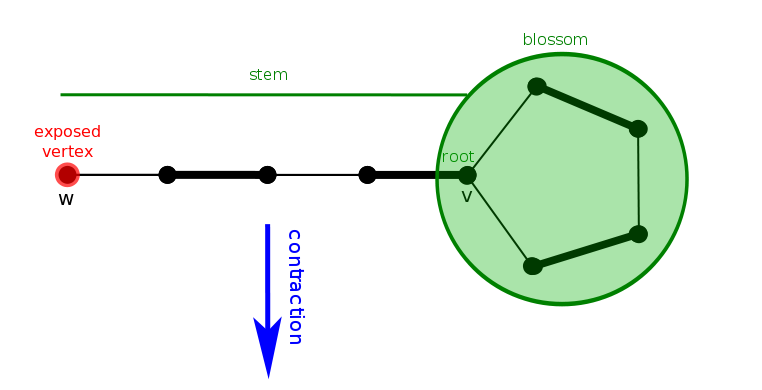
其中可以把最右边两个点看成是找到奇环时的两个点,其中root为他们的LCA。
疑问1:什么要把花上的边的方向取反?
疑问2:为什么在找奇环时要特判 v==start ?
代码如下:
 #include <iostream>

 #include <cstdio>

 #include <cstring>

 #include <cstdlib>

 #include <string>

 #include <vector>

 #include <map>

 #include <set>

 #include <queue>

 #include <sstream>

 #include <algorithm>

 using namespace std;

 const int INF = 2e9;

 const int MOD = 1e9+;

 const int MAXM = +;

 const int MAXN = 2e3+;

 int N;

 bool graph[MAXN][MAXN];

 int match[MAXN];

 bool inque[MAXN], inpath[MAXN], inblos[MAXN];

 queue<int>q;

 int start, finish;

 int newbase, fa[MAXN], base[MAXN];

 int FindCommonAncester(int u, int v)   //仅仅是找LCA,并不修改任何值

 {

     memset(inpath, false, sizeof(inpath));

     while(true)

     {

         u = base[u];

         inpath[u] = true;

         if(u==start) break;

         u = fa[match[u]];

     }

     while(true)

     {

         v = base[v];

         if(inpath[v]) break;

         v = fa[match[v]];

     }

     return v;

 }

 void ResetTrace(int u)  //把fa的方向取反

 {

     int v;

     while(base[u]!=newbase) //匹配边、非匹配边交替出现

     {

         v = match[u];   //u--match[u]匹配边

         inblos[base[u]] = inblos[base[v]] = true;

         u = fa[v];      //v--fa[v]非匹配边

         if(base[u]!=newbase) fa[u] = v;

     }

 }

 void BloosomContract(int u, int v)

 {

     newbase = FindCommonAncester(u, v);

     memset(inblos, false, sizeof(inblos));

     ResetTrace(u);   //把u到LCA上的边取反

     ResetTrace(v);   //把v到LCA上的边取反

     if(base[u]!=newbase) fa[u] = v; //看不懂

     if(base[v]!=newbase) fa[v] = u;

     for(int tu = ; tu<=N; tu++)

     if(inblos[base[tu]])

     {

         base[tu] = newbase;     //设置它属于的集合

         if(!inque[tu]) q.push(tu);  //在花中的点加入队列,因为与花中点相连的点还可以找增广路

     }

 }

 void FindAugmentingPath()

 {

     memset(inque, false, sizeof(inque));

     memset(fa, , sizeof(fa));

     for(int i = ; i<=N; i++)

         base[i] = i;

     while(!q.empty()) q.pop();

     q.push(start);

     finish = ;

     while(!q.empty())

     {

         int u = q.front(); q.pop();

         for(int v = ; v<=N; v++)  //fa[u]--u是匹配边, u--v是未匹配边。

         if(graph[u][v] && base[u]!=base[v] && match[u]!=v )

         {

             //为什么要特判 v==start ?

             if( (v==start) || (match[v]> && fa[match[v]]>))   //找到奇环。

                 BloosomContract(u, v);

             else if(fa[v]==)   //v点在这次找增广路时没有被访问

             {

                 fa[v] = u;

                 if(match[v]>)  //如果已经匹配了,则加入他的匹配点,继续找增广路。

                     q.push(match[v]);

                 else    //如果没有匹配,则找到了增广路。

                 {

                     finish = v;

                     return;

                 }

             }

         }

     }

 }

 void AugmentPath()

 {

     int u, v, w;

     u = finish;

     while(u>)  //沿着增广路往回走,把匹配边和非匹配边取反

     {

         v = fa[u];

         w = match[v];

         match[v] = u;

         match[u] = v;

         u = w;

     }

 }

 void Edmonds()

 {

     memset(match, , sizeof(match));

     for(int u = ; u<=N; u++)

     if(match[u]==)

     {

         start = u;

         FindAugmentingPath();

         if(finish>) AugmentPath();

     }

 }

 int main()

 {

     scanf("%d", &N);

     memset(graph, false, sizeof(graph));

     int u, v;

     while(scanf("%d%d", &u, &v)!=EOF)

         graph[u][v] = graph[v][u] = true;

     Edmonds();

     int sum = ;

     for(int u = ; u<=N; u++)

         if(match[u]>) sum++;

     printf("%d\n", sum);

     for(int u = ; u<=N; u++)

         if(u<match[u])

             printf("%d %d\n", u, match[u]);

     return ;

 }
URAL1099 Work Scheduling —— 一般图匹配带花树的更多相关文章
- URAL 1099. Work Scheduling (一般图匹配带花树)
1099. Work Scheduling Time limit: 0.5 secondMemory limit: 64 MB There is certain amount of night gua ...
- kuangbin带你飞 匹配问题 二分匹配 + 二分图多重匹配 + 二分图最大权匹配 + 一般图匹配带花树
二分匹配:二分图的一些性质 二分图又称作二部图,是图论中的一种特殊模型. 设G=(V,E)是一个无向图,如果顶点V可分割为两个互不相交的子集(A,B),并且图中的每条边(i,j)所关联的两个顶点i和j ...
- HDU 4687 Boke and Tsukkomi (一般图匹配带花树)
Boke and Tsukkomi Time Limit: 3000/3000 MS (Java/Others) Memory Limit: 102400/102400 K (Java/Othe ...
- URAL1099. Work Scheduling(一般图匹配带花树开花算法)
1099. Work Scheduling Time limit: 0.5 second Memory limit: 64 MB There is certain amount of night gu ...
- HDU 4687 Boke and Tsukkomi 一般图匹配,带花树,思路,输出注意空行 难度:4
http://acm.hdu.edu.cn/showproblem.php?pid=4687 此题求哪些边在任何一般图极大匹配中都无用,对于任意一条边i,设i的两个端点分别为si,ti, 则任意一个极 ...
- HDOJ 4687 Boke and Tsukkomi 一般图最大匹配带花树+暴力
一般图最大匹配带花树+暴力: 先算最大匹配 C1 在枚举每一条边,去掉和这条边两个端点有关的边.....再跑Edmonds得到匹配C2 假设C2+2==C1则这条边再某个最大匹配中 Boke and ...
- ZOJ 3316 Game 一般图最大匹配带花树
一般图最大匹配带花树: 建图后,计算最大匹配数. 假设有一个联通块不是完美匹配,先手就能够走那个没被匹配到的点.后手不论怎么走,都必定走到一个被匹配的点上.先手就能够顺着这个交错路走下去,最后一定是后 ...
- 【learning】一般图最大匹配——带花树
问题描述 对于一个图\(G(V,E)\),当点对集\(S\)满足任意\((u,v)\in S\),均有\(u,v\in V,(u,v)\in E\),且\(S\)中没有点重复出现,我们称\(S\) ...
- UOJ #79 一般图最大匹配 带花树
http://uoj.ac/problem/79 一般图和二分图的区别就是有奇环,带花树是在匈牙利算法的基础上对奇环进行缩点操作,复杂度似乎是O(mn)和匈牙利一样. 具体操作是一个一个点做类似匈牙利 ...
随机推荐
- JQuery中如何查找某种类型的所有元素&选择器
更多的是,有关于选择器的内容. 背景:查找某控件中所有的input元素,代码如下: $("#div1").find("input").each(function ...
- 单机安装hadoop集群
一 .安装前准备 1.VMware虚拟内容 2.Linux系统 (CentOS-6.9-min) 镜像文件http://vault.centos.org/ 3.jdk 1.8 rpm或bin文件 ht ...
- Python MySQLdb 查询中文出现问号的解决方法
在连接数据库的时候设置如下即可: db = MySQLdb.connect('localhost','root','×××××','test',use_unicode=True,charset=&qu ...
- 【shell】通过shell编写ping包及arp的监控并发送短信
1 #!/bin/bash 2 NOW="`date +%Y%m%d-%H:%M:%S`" 3 PHONES=15134567893 4 IP=10.100.8.78 5 GATE ...
- POJ 1159 字符串匹配问题
题目大意: 问至少添加几个字符才能保证这个字符串是个回文串 一开始想也想不到字符串匹配上,因为是找回文串,我们可以把已给字符串逆向得到一个新的字符串,然后比较两者得到最大匹配长度,最后总长度减去最大匹 ...
- 洛谷P1432 倒水问题
题目背景 In the movie "Die Hard 3", Bruce Willis and Samuel L. Jackson were confronted with th ...
- hdu 1689 求奇环bfs关键是层次图
#include<stdio.h> #include<string.h> #include<stdlib.h> #include<queue> usin ...
- C++动态特性和C++对象模型——《高质量程序设计12章》
1.动态特性 静态特性和动态特性,编译时和运行时 虚函数 (1)虚函数的叫覆盖,虚函数不是实现多态的唯一手段(其他语言也可能采用别的方法). 抽象基类: (1)如果将基类的虚函数声明为纯虚函数,则基类 ...
- msp430项目编程13
msp430中项目---温湿度检测系统 1.dht11工作原理 2.电路原理说明 3.代码(显示部分) 4.代码(功能实现) 5.项目总结 msp430项目编程 msp430入门学习
- asterisk 通道变量
${ACCOUNTCODE}: 用户计费帐号 sip.conf 里的 account=XXXX ${ANSWEREDTIME}: 通话时长(秒) ${BLINDTRANSFER}: 通道是否为转接类型 ...