
【Tensorflow】tf.nn.depthwise_conv2d如何实现深度卷积?
实验环境:tensorflow版本1.2.0,python2.7
介绍
depthwise_conv2d来源于深度可分离卷积:
Xception: Deep Learning with Depthwise Separable Convolutions
tf.nn.depthwise_conv2d(input,filter,strides,padding,rate=None,name=None,data_format=None)- 1
除去name参数用以指定该操作的name,data_format指定数据格式,与方法有关的一共五个参数:
input:
指需要做卷积的输入图像,要求是一个4维Tensor,具有[batch, height, width, in_channels]这样的shape,具体含义是[训练时一个batch的图片数量, 图片高度, 图片宽度, 图像通道数]filter:
相当于CNN中的卷积核,要求是一个4维Tensor,具有[filter_height, filter_width, in_channels, channel_multiplier]这样的shape,具体含义是[卷积核的高度,卷积核的宽度,输入通道数,输出卷积乘子],同理这里第三维in_channels,就是参数value的第四维strides:
卷积的滑动步长。padding:
string类型的量,只能是”SAME”,”VALID”其中之一,这个值决定了不同边缘填充方式。rate:
这个参数的详细解释见【Tensorflow】tf.nn.atrous_conv2d如何实现空洞卷积?
结果返回一个Tensor,shape为[batch, out_height, out_width, in_channels * channel_multiplier],注意这里输出通道变成了in_channels * channel_multiplier
实验
为了形象的展示depthwise_conv2d,我们必须要建立自定义的输入图像和卷积核
img1 = tf.constant(value=[[[[1],[2],[3],[4]],[[1],[2],[3],[4]],[[1],[2],[3],[4]],[[1],[2],[3],[4]]]],dtype=tf.float32)

img2 = tf.constant(value=[[[[1],[1],[1],[1]],[[1],[1],[1],[1]],[[1],[1],[1],[1]],[[1],[1],[1],[1]]]],dtype=tf.float32)

img = tf.concat(values=[img1,img2],axis=3)
filter1 = tf.constant(value=0, shape=[3,3,1,1],dtype=tf.float32)
filter2 = tf.constant(value=1, shape=[3,3,1,1],dtype=tf.float32)
filter3 = tf.constant(value=2, shape=[3,3,1,1],dtype=tf.float32)
filter4 = tf.constant(value=3, shape=[3,3,1,1],dtype=tf.float32)
filter_out1 = tf.concat(values=[filter1,filter2],axis=2)
filter_out2 = tf.concat(values=[filter3,filter4],axis=2)
filter = tf.concat(values=[filter_out1,filter_out2],axis=3)建立好了img和filter,就可以做卷积了
out_img = tf.nn.conv2d(input=img, filter=filter, strides=[1,1,1,1], padding='VALID')- 1
好了,用一张图来详细展示这个过程 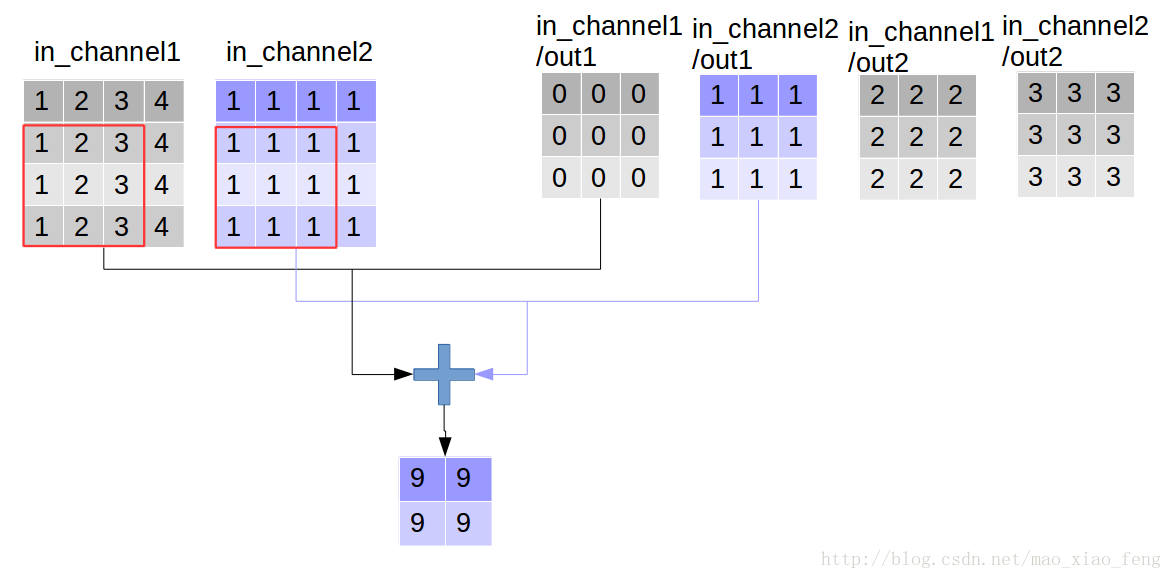
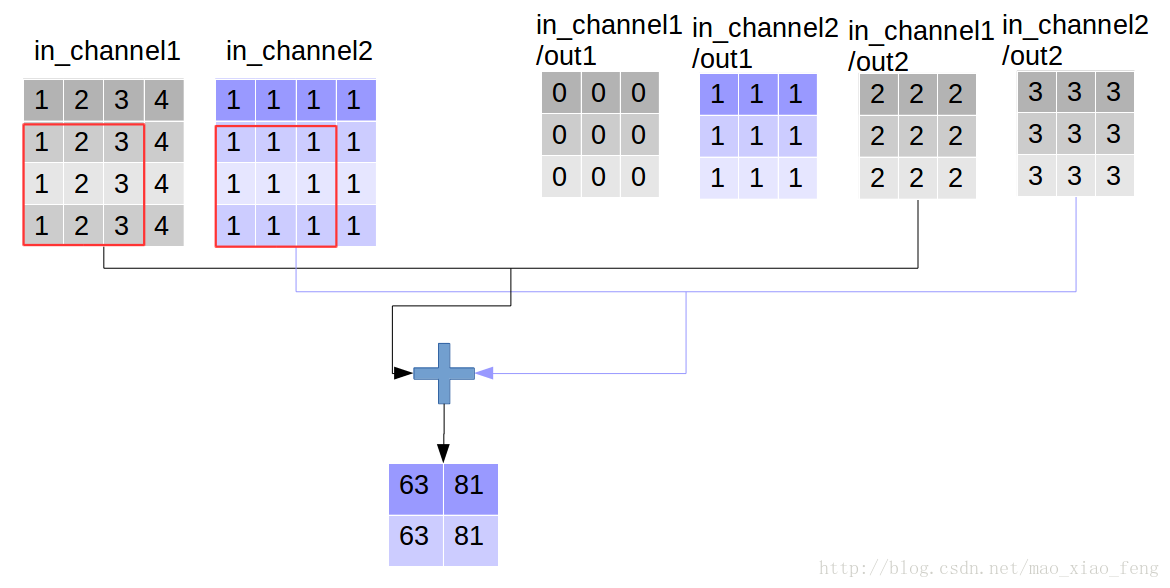
这是普通的卷积过程,我们再来看深度卷积。
out_img = tf.nn.depthwise_conv2d(input=img, filter=filter, strides=[1,1,1,1], rate=[1,1], padding='VALID')- 1
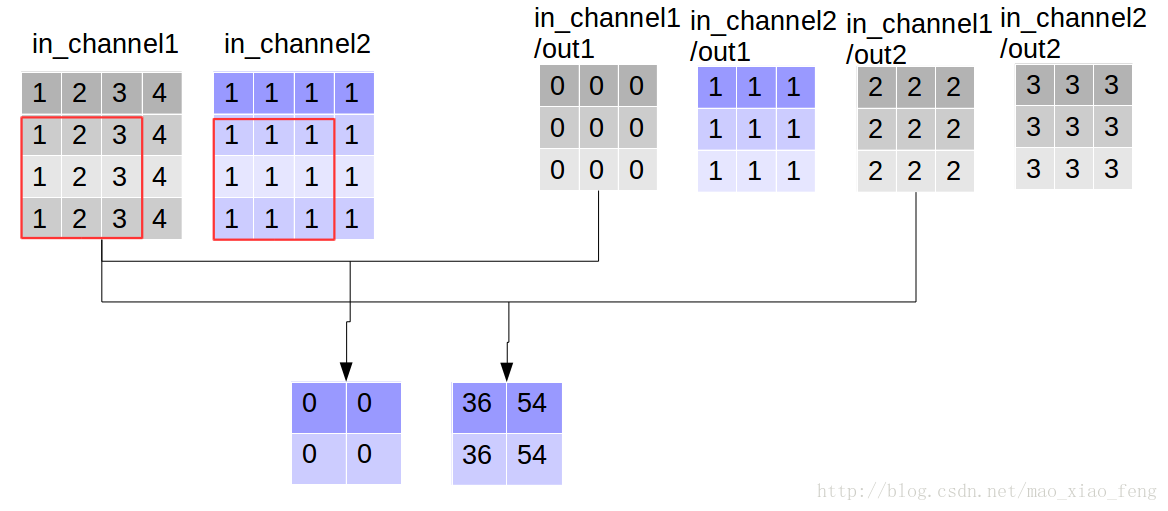
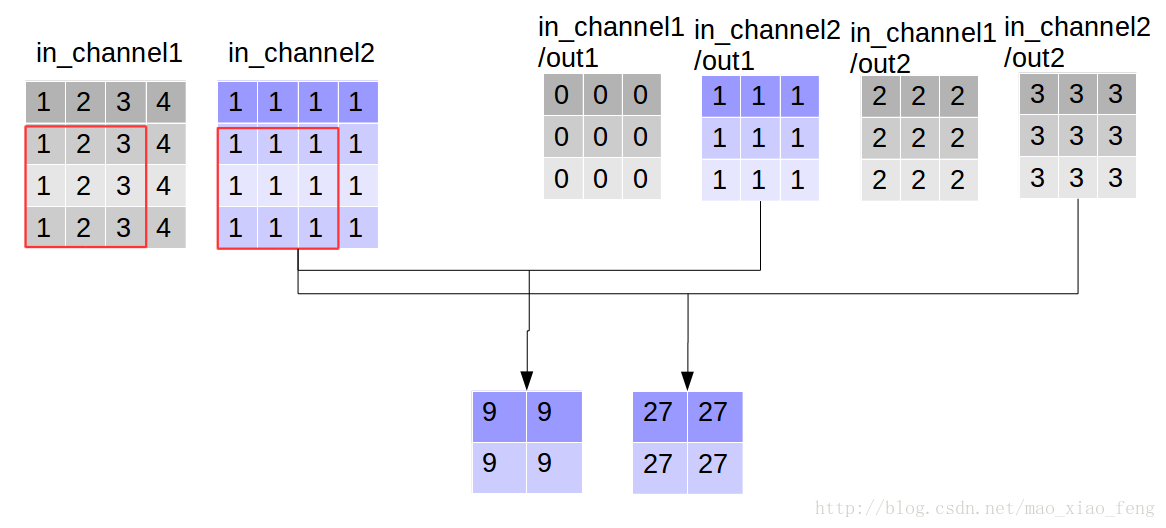
现在我们可以形象的解释一下depthwise_conv2d卷积了。看普通的卷积,我们对卷积核每一个out_channel的两个通道分别和输入的两个通道做卷积相加,得到feature map的一个channel,而depthwise_conv2d卷积,我们对每一个对应的in_channel,分别卷积生成两个out_channel,所以获得的feature map的通道数量可以用in_channel* channel_multiplier来表达,这个channel_multiplier,就可以理解为卷积核的第四维。
代码清单
import tensorflow as tf
img1 = tf.constant(value=[[[[1],[2],[3],[4]],[[1],[2],[3],[4]],[[1],[2],[3],[4]],[[1],[2],[3],[4]]]],dtype=tf.float32)
img2 = tf.constant(value=[[[[1],[1],[1],[1]],[[1],[1],[1],[1]],[[1],[1],[1],[1]],[[1],[1],[1],[1]]]],dtype=tf.float32)
img = tf.concat(values=[img1,img2],axis=3)
filter1 = tf.constant(value=0, shape=[3,3,1,1],dtype=tf.float32)

filter2 = tf.constant(value=1, shape=[3,3,1,1],dtype=tf.float32)

filter3 = tf.constant(value=2, shape=[3,3,1,1],dtype=tf.float32)

filter4 = tf.constant(value=3, shape=[3,3,1,1],dtype=tf.float32)

filter_out1 = tf.concat(values=[filter1,filter2],axis=2)

filter_out2 = tf.concat(values=[filter3,filter4],axis=2)

filter = tf.concat(values=[filter_out1,filter_out2],axis=3)
out_img = tf.nn.depthwise_conv2d(input=img, filter=filter, strides=[1,1,1,1], rate=[1,1], padding='VALID')输出:
rate=1, VALID mode result:

[[[[  0.  36.   9.  27.]

   [  0.  54.   9.  27.]]

  [[  0.  36.   9.  27.]

   [  0.  54.   9.  27.]]]]
【Tensorflow】tf.nn.depthwise_conv2d如何实现深度卷积?的更多相关文章
- tensorflow 之tf.nn.depthwise_conv2d and separable_conv2d实现及原理
Depthwise Separable Convolution 1.简介 Depthwise Separable Convolution 是谷歌公司于2017年的CVPR中在论文”Xception: ...
- tf.nn.depthwise_conv2d 卷积
tf.nn.depthwise_conv2d( input, filter, strides, padding, rate=None, name=None, data_format=None ) 参数 ...
- 【Tensorflow】tf.nn.atrous_conv2d如何实现空洞卷积?膨胀卷积
介绍关于空洞卷积的理论可以查看以下链接,这里我们不详细讲理论: 1.Long J, Shelhamer E, Darrell T, et al. Fully convolutional network ...
- 【TensorFlow】tf.nn.conv2d是怎样实现卷积的?
tf.nn.conv2d是TensorFlow里面实现卷积的函数,参考文档对它的介绍并不是很详细,实际上这是搭建卷积神经网络比较核心的一个方法,非常重要 tf.nn.conv2d(input, fil ...
- tf入门-tf.nn.conv2d是怎样实现卷积的?
转自:https://blog.csdn.net/mao_xiao_feng/article/details/78004522 实验环境:tensorflow版本1.2.0,python2.7 介绍 ...
- [TensorFlow] tf.nn.softmax_cross_entropy_with_logits的用法
在计算loss的时候,最常见的一句话就是tf.nn.softmax_cross_entropy_with_logits,那么它到底是怎么做的呢? 首先明确一点,loss是代价值,也就是我们要最小化的值 ...
- 深度学习原理与框架-图像补全(原理与代码) 1.tf.nn.moments(求平均值和标准差) 2.tf.control_dependencies(先执行内部操作) 3.tf.cond(判别执行前或后函数) 4.tf.nn.atrous_conv2d 5.tf.nn.conv2d_transpose(反卷积) 7.tf.train.get_checkpoint_state(判断sess是否存在
1. tf.nn.moments(x, axes=[0, 1, 2]) # 对前三个维度求平均值和标准差,结果为最后一个维度,即对每个feature_map求平均值和标准差 参数说明:x为输入的fe ...
- 第三节,TensorFlow 使用CNN实现手写数字识别(卷积函数tf.nn.convd介绍)
上一节,我们已经讲解了使用全连接网络实现手写数字识别,其正确率大概能达到98%,这一节我们使用卷积神经网络来实现手写数字识别, 其准确率可以超过99%,程序主要包括以下几块内容 [1]: 导入数据,即 ...
- 【TensorFlow】tf.nn.max_pool实现池化操作
max pooling是CNN当中的最大值池化操作,其实用法和卷积很类似 有些地方可以从卷积去参考[TensorFlow]tf.nn.conv2d是怎样实现卷积的? tf.nn.max_pool(va ...
随机推荐
- IDEA 导入Module,多个Module在同一个Project 下显示
之前导入过,隔断时间就忘记了,干脆记下来,免得后续找的麻烦 此文章转载自: https://blog.csdn.net/yyym520/article/details/77527976 1.打开IDE ...
- 使用虹软ArcFac,java 离线SDK 进行人脸识别
公司项目需要人脸识别登录,需要支持离线识别,所以无法使用在线的人脸识别的API,于是使用到了离线SDK来对比识别人脸相识度. 获取人脸抓拍的图片需要对接设备,这里不做记录,假设我们已经获取到了人脸图片 ...
- 60 分钟极速入门 PyTorch
2017 年初,Facebook 在机器学习和科学计算工具 Torch 的基础上,针对 Python 语言发布了一个全新的机器学习工具包 PyTorch. 因其在灵活性.易用性.速度方面的优秀表现,经 ...
- 「资料分享」理解uboot要看哪些书
最开始是看的韦东山老师的视频,确实很不错,不过总感觉是不够深入扎实,还是想自己看看书,就总结搜罗下,以供参考 学习交流可以添加 微信读者交流①群 (添加微信:coderAllen) 程序员技术交流①群 ...
- 一些带dga域名的恶意软件
04/02/2019 06:17下午 6,488,759 f4f242a50ba9efa1593beba6208a2508_PWS.win32.Simda_1250_DGADNS.pcap Simda ...
- 微信支付之获取openid
一.准备工具 不管开发什么,官方的文档应该是第一个想到的这里把官方文档贴出来:微信网页授权文档除此之外,我们还需要一个内网穿透的工具在开发环境下让微信能访问到我们的域名.我使用的是natapp.此类工 ...
- collections.defaultdict()
https://www.cnblogs.com/herbert/archive/2013/01/09/2852843.html >>> import collections > ...
- 实验八 《Coderxiaoban团队》团队作业4:基于原型的团队项目需求调研与分析
实验八 <Coderxiaoban团队>团队作业4:基于原型的团队项目需求调研与分析 项目 内容 这个作业属于哪个课程 任课教师博客主页链接 这个作业的要求在哪里 实验八 团队作业4:基于 ...
- 字节序 —— Big Endian 和 Little Endian
一.字节序 字节序指的是多字节的数据在内存中的存放顺序 内存有高地址端与低地址端.其中,低地址端既可以存放高位字节,也可以存放低位字节. Big Endian 是指低地址端 存放 高位字节. Litt ...
- Linux中的CentOS 6克隆之后修改
Centos6 克隆后的简单的网络配置 第一步:修改主机名 $ vi /etc/sysconfig/network 第二步: $ vi /etc/udev/rules.d/70-persis ...