
重新整理.net core 计1400篇[九] (.net core 中的依赖注入的服务的消费)
前言
包含服务注册信息IServiceCollection 集合最终被用来创建作为依赖注入容器的IServiceProvider 对象。
当需要创建某个服务实例的时候(服务消费),我们通过指定服务类型调用IServiceProvider 接口GetService 方法即可。
那么来看下和IServiceProvider 相关的东西吧。
IServiceProvider
这里面只有一个提供服务的方法:
/// <summary>Defines a mechanism for retrieving a service object; that is, an object that provides custom support to other objects.</summary>

public interface IServiceProvider

{

	/// <summary>Gets the service object of the specified type.</summary>

	/// <param name="serviceType">An object that specifies the type of service object to get.</param>

	/// <returns>A service object of type <paramref name="serviceType">serviceType</paramref>.

	///  -or-

	///  null if there is no service object of type <paramref name="serviceType">serviceType</paramref>.</returns>

	object GetService(Type serviceType);

}
在创建IServiceProvider的对象创建上,有三个构造函数:
public static class ServiceCollectionContainerBuilderExtensions

{

	/// <summary>

	/// Creates a <see cref="T:Microsoft.Extensions.DependencyInjection.ServiceProvider" /> containing services from the provided <see cref="T:Microsoft.Extensions.DependencyInjection.IServiceCollection" />.

	/// </summary>

	/// <param name="services">The <see cref="T:Microsoft.Extensions.DependencyInjection.IServiceCollection" /> containing service descriptors.</param>

	/// <returns>The <see cref="T:Microsoft.Extensions.DependencyInjection.ServiceProvider" />.</returns>

	public static ServiceProvider BuildServiceProvider(this IServiceCollection services)

	{

		return services.BuildServiceProvider(ServiceProviderOptions.Default);

	}

	/// <summary>

	/// Creates a <see cref="T:Microsoft.Extensions.DependencyInjection.ServiceProvider" /> containing services from the provided <see cref="T:Microsoft.Extensions.DependencyInjection.IServiceCollection" />

	/// optionally enabling scope validation.

	/// </summary>

	/// <param name="services">The <see cref="T:Microsoft.Extensions.DependencyInjection.IServiceCollection" /> containing service descriptors.</param>

	/// <param name="validateScopes">

	/// <c>true</c> to perform check verifying that scoped services never gets resolved from root provider; otherwise <c>false</c>.

	/// </param>

	/// <returns>The <see cref="T:Microsoft.Extensions.DependencyInjection.ServiceProvider" />.</returns>

	public static ServiceProvider BuildServiceProvider(this IServiceCollection services, bool validateScopes)

	{

		return services.BuildServiceProvider(new ServiceProviderOptions

		{

			ValidateScopes = validateScopes

		});

	}

	/// <summary>

	/// Creates a <see cref="T:Microsoft.Extensions.DependencyInjection.ServiceProvider" /> containing services from the provided <see cref="T:Microsoft.Extensions.DependencyInjection.IServiceCollection" />

	/// optionally enabling scope validation.

	/// </summary>

	/// <param name="services">The <see cref="T:Microsoft.Extensions.DependencyInjection.IServiceCollection" /> containing service descriptors.</param>

	/// <param name="options">

	/// Configures various service provider behaviors.

	/// </param>

	/// <returns>The <see cref="T:Microsoft.Extensions.DependencyInjection.ServiceProvider" />.</returns>

	public static ServiceProvider BuildServiceProvider(this IServiceCollection services, ServiceProviderOptions options)

	{

		//IL_0008: Unknown result type (might be due to invalid IL or missing references)

		//IL_0016: Unknown result type (might be due to invalid IL or missing references)

		if (services == null)

		{

			throw new ArgumentNullException("services");

		}

		if (options == null)

		{

			throw new ArgumentNullException("options");

		}

		return new ServiceProvider((IEnumerable<ServiceDescriptor>)services, options);

	}

}
我们看到无论其如何构造,那么都有一个ServiceProviderOptions配置类。
这个配置我前面8中解释过,就是对注入服务的范围检测。
那么还有一个重要的问题,难道我们只能根据getservice 去获取服务对象?来看看获取服务的扩展。
查看ServiceProviderServiceExtensions类:
里面有一些:
public static T GetService<T>(this IServiceProvider provider)

{

	//IL_0008: Unknown result type (might be due to invalid IL or missing references)

	if (provider == null)

	{

		throw new ArgumentNullException("provider");

	}

	return (T)provider.GetService(Type.GetTypeFromHandle(typeof(T).TypeHandle));

}

/// <summary>

/// Get service of type <paramref name="serviceType" /> from the <see cref="T:System.IServiceProvider" />.

/// </summary>

/// <param name="provider">The <see cref="T:System.IServiceProvider" /> to retrieve the service object from.</param>

/// <param name="serviceType">An object that specifies the type of service object to get.</param>

/// <returns>A service object of type <paramref name="serviceType" />.</returns>

/// <exception cref="T:System.InvalidOperationException">There is no service of type <paramref name="serviceType" />.</exception>

public static object GetRequiredService(this IServiceProvider provider, Type serviceType)

{

	//IL_0008: Unknown result type (might be due to invalid IL or missing references)

	//IL_001c: Unknown result type (might be due to invalid IL or missing references)

	//IL_0044: Unknown result type (might be due to invalid IL or missing references)

	if (provider == null)

	{

		throw new ArgumentNullException("provider");

	}

	if (serviceType == (Type)null)

	{

		throw new ArgumentNullException("serviceType");

	}

	ISupportRequiredService supportRequiredService = provider as ISupportRequiredService;

	if (supportRequiredService != null)

	{

		return supportRequiredService.GetRequiredService(serviceType);

	}

	object service = provider.GetService(serviceType);

	if (service == null)

	{

		throw new InvalidOperationException(Resources.FormatNoServiceRegistered(serviceType));

	}

	return service;

}

/// <summary>

/// Get service of type <typeparamref name="T" /> from the <see cref="T:System.IServiceProvider" />.

/// </summary>

/// <typeparam name="T">The type of service object to get.</typeparam>

/// <param name="provider">The <see cref="T:System.IServiceProvider" /> to retrieve the service object from.</param>

/// <returns>A service object of type <typeparamref name="T" />.</returns>

/// <exception cref="T:System.InvalidOperationException">There is no service of type <typeparamref name="T" />.</exception>

public static T GetRequiredService<T>(this IServiceProvider provider)

{

	//IL_0008: Unknown result type (might be due to invalid IL or missing references)

	if (provider == null)

	{

		throw new ArgumentNullException("provider");

	}

	return (T)provider.GetRequiredService(Type.GetTypeFromHandle(typeof(T).TypeHandle));

}

/// <summary>

/// Get an enumeration of services of type <typeparamref name="T" /> from the <see cref="T:System.IServiceProvider" />.

/// </summary>

/// <typeparam name="T">The type of service object to get.</typeparam>

/// <param name="provider">The <see cref="T:System.IServiceProvider" /> to retrieve the services from.</param>

/// <returns>An enumeration of services of type <typeparamref name="T" />.</returns>

public static IEnumerable<T> GetServices<T>(this IServiceProvider provider)

{

	//IL_0008: Unknown result type (might be due to invalid IL or missing references)

	if (provider == null)

	{

		throw new ArgumentNullException("provider");

	}

	return provider.GetRequiredService<IEnumerable<T>>();

}
其余的可以自己去查看。
服务的创建
我们知道服务的创建一般都是ioc自动选择的,那么假如我们一个class 里面有多个构造函数,那么会选择哪一个呢?
public interface IFoo { }

public interface IBar { }

public interface IBaz { }

public interface IQux { }

public class Foo : IFoo { }

public class Bar : IBar { }

public class Baz : IBaz { }

public class Qux : IQux

{

	public Qux(IFoo foo) => Console.WriteLine("Selected constructor: Qux(IFoo)");

	public Qux(IFoo foo, IBar bar) => Console.WriteLine("Selected constructor: Qux(IFoo, IBar)");

	public Qux(IFoo foo, IBar bar, IBaz baz) => Console.WriteLine("Selected constructor: Qux(IFoo, IBar, IBaz)");

}

static void Main()

{

	new ServiceCollection()

		.AddTransient<IFoo, Foo>()

		.AddTransient<IBar, Bar>()

		.AddTransient<IQux, Qux>()

		.BuildServiceProvider()

		.GetServices<IQux>();

	Console.ReadKey();

}
上面Qux有三个控制类,那么选择哪一个呢?
看下结果:
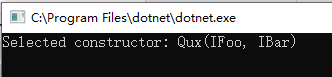
那么为什么会是这一个呢?
第一:IBaz类型没有注册,那么会排除掉Qux(IFoo foo, IBar bar, IBaz baz)
第二就是里面的一个规则:每一个候选构造参数类型的集合都是这个构造函数参数类型的子集。
好的,那么好了,剩下:Qux(IFoo foo, IBar bar) 包含了Qux(IFoo foo) 那么就是Qux(IFoo foo, IBar bar),如果没有包含全部子集的那么就会报错。
Qux(IFoo foo, IBar bar) 也就是超集的意思。
改一下:
public interface IFoo { }

public interface IBar { }

public interface IBaz { }

public interface IQux { }

public class Foo : IFoo { }

public class Bar : IBar { }

public class Baz : IBaz { }

public class Qux : IQux

{

	public Qux(IFoo foo, IBaz baz) => Console.WriteLine("Selected constructor: Qux(IFoo, IBar)");

	public Qux(IFoo foo, IBar bar) => Console.WriteLine("Selected constructor: Qux(IFoo, IBar, IBaz)");

}

static void Main()

{

	new ServiceCollection()

		.AddTransient<IFoo, Foo>()

		.AddTransient<IBar, Bar>()

		.AddTransient<IBaz,Baz>()

		.AddTransient<IQux, Qux>()

		.BuildServiceProvider()

		.GetServices<IQux>();

	Console.ReadKey();

}
这时候报错为:
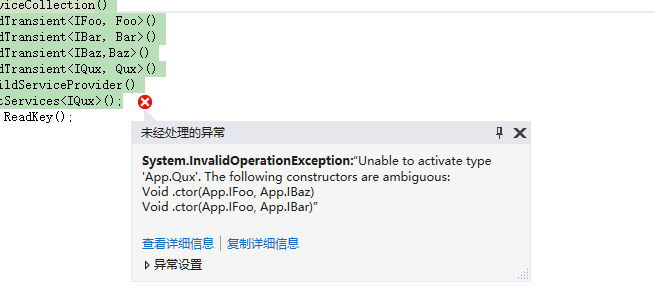
下一节
服务的生命周期
重新整理.net core 计1400篇[九] (.net core 中的依赖注入的服务的消费)的更多相关文章
- ASP.NET CORE MVC 2.0 如何在Filter中使用依赖注入来读取AppSettings,及.NET Core控制台项目中读取AppSettings
问: ASP.NET CORE MVC 如何在Filter中使用依赖注入来读取AppSettings 答: Dependency injection is possible in filters as ...
- 在.NET Core控制台程序中使用依赖注入
之前都是在ASP.NET Core中使用依赖注入(Dependency Injection),昨天遇到一个场景需要在.NET Core控制台程序中使用依赖注入,由于对.NET Core中的依赖注入机制 ...
- ASP.NET Core中的依赖注入(2):依赖注入(DI)
IoC主要体现了这样一种设计思想:通过将一组通用流程的控制从应用转移到框架之中以实现对流程的复用,同时采用"好莱坞原则"是应用程序以被动的方式实现对流程的定制.我们可以采用若干设计 ...
- ASP.NET Core中的依赖注入(5): ServiceProvider实现揭秘 【解读ServiceCallSite 】
通过上一篇的介绍我们应该对实现在ServiceProvider的总体设计有了一个大致的了解,但是我们刻意回避一个重要的话题,即服务实例最终究竟是采用何种方式提供出来的.ServiceProvider最 ...
- NET Core 中的依赖注入
NET Core 中的依赖注入 [共7篇] 一.控制反转(IoC) ASP.NET Core在启动以及后续针对每个请求的处理过程中的各个环节都需要相应的组件提供相应的服务,为了方便对这些组件进行定制, ...
- .NET CORE——Console中使用依赖注入
我们都知道,在 ASP.NET CORE 中通过依赖注入的方式来使用服务十分的简单,而在 Console 中,其实也只是稍微绕了个小弯子而已.不管是内置 DI 组件或者第三方的 DI 组件(如Auto ...
- Asp.net core中的依赖注入
使用服务 在Asp.net core的Controller中,可以通过如下两种方式获取系统注入的服务: 构造函数 可以直接在构造函数中传入所依赖的服务,这是非常常见的DI注入方式. public Va ...
- ASP.NET Core Web 应用程序系列(一)- 使用ASP.NET Core内置的IoC容器DI进行批量依赖注入(MVC当中应用)
在正式进入主题之前我们来看下几个概念: 一.依赖倒置 依赖倒置是编程五大原则之一,即: 1.上层模块不应该依赖于下层模块,它们共同依赖于一个抽象. 2.抽象不能依赖于具体,具体依赖于抽象. 其中上层就 ...
- 第10章 带有依赖注入的服务配置(ASP.NET Core in Action, 2nd Edition)
第2部分 构建完整的应用程序 我们在第一部分中讨论了很多内容.您看到了ASP.NET Core应用程序是如何由中间件组成的,我们主要关注RazorPages框架.您了解了如何使用Razor语法构建传统 ...
- ASP.NET Core 中文文档 第四章 MVC(3.8)视图中的依赖注入
原文:Dependency injection into views 作者:Steve Smith 翻译:姚阿勇(Dr.Yao) 校对:孟帅洋(书缘) ASP.NET Core 支持在视图中使用 依赖 ...
随机推荐
- Java 异常处理(1) :try-catch-finally的使用
1 package com.bytezero.throwable; 2 3 import java.io.File; 4 import java.io.FileInputStream; 5 impor ...
- Java 子类对象实例化的全过程
2 /* 3 * 子类对象实例化的全过程 4 * 5 *1.结果上来看:(继承性) 6 * 子类继承父类以后,就获取了父类中声明的属性或方法 7 * 创建子类的对象,在堆空间中,就会加载所有父类声明的 ...
- C++ //STL---常用算法 //常用遍历 for_each //transform
1 //STL---常用算法 2 //常用遍历 for_each 3 //transform 4 #include<iostream> 5 #include<string> 6 ...
- 【Flink入门修炼】2-2 Flink State 状态
什么是状态?状态有什么作用? 如果你来设计,对于一个流式服务,如何根据不断输入的数据计算呢? 又如何做故障恢复呢? 一.为什么要管理状态 流计算不像批计算,数据是持续流入的,而不是一个确定的数据集.在 ...
- 在vue3中使用openlayers3实现track轨迹动画
网上太多资料代码,抄来抄去,而且版本也是v5.x版本的,部分API已经弃用 基础知识不多说,直接讲重点 三个关键变量 // 记录开始动画的时间 const startTime = ref(0); // ...
- Java浮点数内存存储
转自: [解惑]剖析float型的内存存储和精度丢失问题 1.小数的二进制表示问题 首先我们要搞清楚下面两个问题: (1) 十进制整数如何转化为二进制数 算法很简单.举个例子,11表示成二进制数: ...
- HDU 2045:不容易系列之(3)—— LELE的RPG难题(动态规划)
一.原题链接 Problem - 2045 (hdu.edu.cn) 二.题面 人称"AC女之杀手"的超级偶像LELE最近忽然玩起了深沉,这可急坏了众多"Cole&quo ...
- nginx location块
location块在server块中使用,它的作用是根据客户端请求URL去定位不同的应用. 匹配格式 作用 location = /uri = 表示精确匹配,只有完全匹配上才能生效 location ...
- Circle Loss:从统一的相似性对的优化角度进行深度特征学习 | CVPR 2020 Oral
论文提出了Circle loss,不仅能够对类内优化和类间优化进行单独地处理,还能根据不同的相似度值调整对应的梯度.总体而言,Circle loss更灵活,而且优化目标更明确,在多个实验上都有较好的表 ...
- jsonb操作符
json类型以文本方式存储json对象,把输入的数据原封不动的存放到数据库中,会保留多余的空格,保留重复的Key,保留Key的顺序. jsonb类型转换文本格式json对象为二进制格式,不保留多余的空 ...