
C++ class with pointer member(s)
- 正如标题所示:这篇复习带有指针类型成员的class
设计类
考虑到会有以下操作,来设计类
 {

     String s1();

     String s2("hello");

     String s3(s1);

     cout << s3 << endl;

     s3 = s2;

     cout << s3 << endl;

 }
函数体内第二行和第三行都是构造函数,一个含参数,一个不含参数。第四行创建一个以s1为初值的对象s3,是一个拷贝的动作,需要一个拷贝构造函数,之后会讲到;下一行是输出,需要一个操作符重载。第六行是一个赋值的操作,是一个拷贝的动作,这样第四行和第六行都是拷贝动作,所以这两个操作需要的是不同的函数,第六行需要的是拷贝赋值操作。如果,我们自己不写,编译器会给出默认的这两个操作函数,像上个复数的例子,就使用编译器给的,而这个string的例子,使用默认的就会出现不好的,想象一下,我们现在有个指针对象,指向一个地址,现在又创建一个新的对象,若只是拷贝,把指针拷贝过来,指向了同一个地方去,这并不是真正的拷贝,所以,只要class中含有带指针的成员,就不要使用默认的拷贝构造函数和拷贝赋值操作。so,string类的大致设计如下:
 class String {

 public:

     String(const char* cstr = );//construct func

     //if only the calss with pointer pamater(s),we need design two functions as follow

     String(const String& str);//copy construct func,the parameter type is itsown type

     String& operator=(const String& str);//copy assign,the parameter is itsown type

     ~String();

     char* get_c_str()const { return m_data; }

 private:

     char* m_data;//因为字符串长度不定,所以设置成动态的数组-指针

 };
设计类内函数
构造函数和析构函数
 inline

 String::String(const char* cstr = )

 {

     if (cstr) {//有初值

         m_data = new char[strlen(cstr + )];

         strcpy(m_data, cstr);

     }

     else {

         m_data = new char[];

         *m_data = '\0';

     }

 }

 inline

 String::~String()

 {

     delete[] m_data;//clean up

 }
使用上述函数
{

String s1();

    String s2("hello");

    String* p = new String("hello");

    delete p;//离开前,释放掉

}
前面两个,离开时会自动释放掉,也是调用析构函数,所以上述函数作用域内离开时会调用三次析构函数
先前的复数类,不需要清理,因为它们本来就要死亡了,所以不必要,但是,这里是动态分配内存,如果不释放的,就是内存泄漏了。so ,Note:如果class中含指针成员,多半要动态分配内存,那么对象死亡之前,就是析构函数调用时,将动态分配的内存释放掉
拷贝构造函数和拷贝赋值操作
class with pointer member(s),一定要这样做,看下面的图片(来源于侯捷老师的课件)
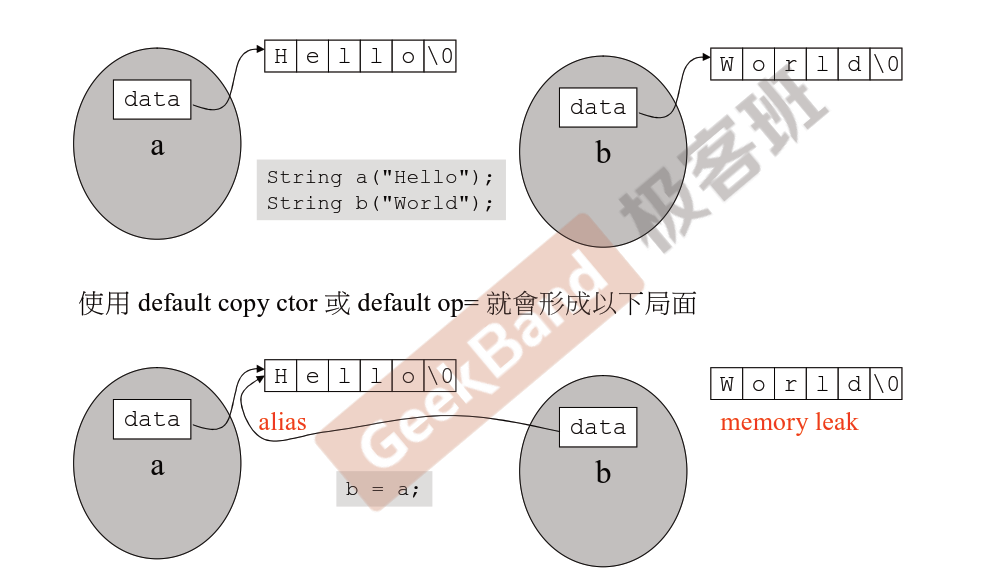
首先,看第一种情况(第二幅图),使用default copy construct function,对象的data是指针,至于指针中的内容(‘hello’)是不属于这个指针的,在做copy动作的时候,b也也只是指针,所以两个指针指向同一块内容了。虽然a和b 也有相同内容了,但是b中内容,没有指针指向它了,而此处‘hello‘’所在的内存块,有两个指针同时指向它了,将来若改变a,b指向的内容也会被改变。,着就是浅拷贝;与之对应的就是深拷贝,就是我们自己写的函数要做的操作.下面看看什么是深拷贝
//copy construct fuction

inline

String::String(const String& str)

{

    m_data = new char[strlen(str.m_data) + ];

    strcpy(m_data, str.m_data);

}
使用:
String s3(s1);
这里s3也是新创建出来的对象,就要调用构造函数,先开辟足够的空间,然后将要拷贝的内容拷贝进来,这就是深拷贝,如果使用编译器默认的拷贝构造函数,只是把指针拷贝过来
拷贝赋值操作操作
要把右边的东西赋值给左边(Note:左右都有东西),正常思路就是先把左边清空,然后创建出与右边一样大的空间,再将右边内容拷贝给左边,so,实现如下:
inline

String& String::operator=(const String& str)

{

    if (this == &str)//self assignment or not

        return *this;

    delete[] m_data;//kill

    m_data = new char[strlen(str.m_data) + ];

    strcpy(m_data, str.m_data);

    return *this;

}

//使用

String s4=s1;
output 函数
#include <iostream>

#include "string.h"

using namespace std;

ostream& operator<<(ostream& os, const String& str)

{

    os << str.get_c_str();

    return os;

}

//使用

String s1("Hello");

cout<<s1;
output 函数,必须为全域函数,这样才能保证是左边调用“<<”
总结
下面,我们回顾一下String 类的设计,设计一个class,首先,我们考虑class中需要什么样的数据,这里是字符串,我们字符串中会存放很多字符,当然,我们很容易想到使用数组存放,但是,对于设计字符串却不是一个好的选择,因为,数组声明时必须要指定数组大小,所以,我们选择指针,将来放多大的内容,使用new的方式动态分配大小,在32位系统中,一个指针占4个byte,所以不管字符串多大,字符串这个对象本身就是4byte;Then,考虑设计哪些函数,构造函数,前面讲过了,这里不多讲;上面讲过了,因为成员是指针,所以需要设计拷贝构造函数、拷贝赋值操作函数,析构函数(Big Three),设计完这三个函数后,再思考还需要设计哪些函数,由于,我们需要输出字符串,即需要cout,,所以,我们需要取出m_data中的字符,cout是可以接收这种东西的,所以,设计 char* get_c_str() const {return m_data;} ,只是返回,不改变,所以设计成const型的。
下面是完整的String类的设计的头文件
 #pragma once

 #ifndef __STRING__

 #define __STRING__

 #include <cstring>

 class String {

 public:

     String(const char* cstr = );//construct func

     //if only the calss with pointer pamater(s),we need design two functions as follow

     String(const String& str);//copy construct func,the parameter type is itsown type

     String& operator=(const String& str);//copy assign,the parameter is itsown type

     ~String();

     char* get_c_str()const { return m_data; }

 private:

     char* m_data;//因为字符串长度不定,所以设置成动态的数组-指针

 };

 inline

 String::String(const char* cstr = )

 {

     if (cstr) {//有初值

         m_data = new char[strlen(cstr + )];

         strcpy(m_data, cstr);

     }

     else {

         m_data = new char[];

         *m_data = '\0';

     }

 }

 inline

 String::~String()

 {

     delete[] m_data;//clean up

 }

 //copy construct fuction

 inline

 String::String(const String& str)

 {

     m_data = new char[strlen(str.m_data) + ];

     strcpy(m_data, str.m_data);

 }

 inline

 String& String::operator=(const String& str)//String&:& is reference

 {

     if (this == &str)//self assignment or not,&str:& is getting address

         return *this;

     delete[] m_data;//kill

     m_data = new char[strlen(str.m_data) + ];

     strcpy(m_data, str.m_data);

     return *this;

 }

 #endif
C++ class with pointer member(s)的更多相关文章
- 漫谈C++:良好的编程习惯与编程要点
以良好的方式编写C++ class 假设现在我们要实现一个复数类complex,在类的实现过程中探索良好的编程习惯. ① Header(头文件)中的防卫式声明 complex.h: # ifndef ...
- CLR via C# 3rd - 04 - Type Fundamentals
1. System.Object The runtime requires every type to ultimately be derived from the System.Obj ...
- 《深度探索C++对象模型(Inside The C++ Object Model )》学习笔记
转载:http://dsqiu.iteye.com/blog/1669614 第一章 关于对象 使用class封装之后的布局成本: class并没有增加成本,data members直接内含在每一个c ...
- c语言实现面向对象OOC
这种问题比较锻炼思维,同时考察c和c++的掌握程度.如果你遇到过类似问题,此题意义自不必说.如果用c实现c++,主要解决如何实现封装,继承和多态三大问题,本文分两块说. 1.封装 // Example ...
- C++ 表达式
<C++ Primer 4th>读书摘要 C++ 提供了丰富的操作符,并定义操作数为内置类型时,这些操作符的含义.除此之外,C++ 还支持操作符重载,允许程序员自定义用于类类型时操作符的含 ...
- iOS:消除项目中警告
引言: 在iOS开发过程中, 我们可能会碰到一些系统方法弃用, weak.循环引用.不能执行之类的警告. 有代码洁癖的孩子们很想消除他们, 今天就让我们来一次Fuck 警告!! 首先学会基本的语句: ...
- 4、Type fundamentals
1.All Types Are Derived from System.Object The CLR requires all objects to be created using the new ...
- 【转】clang warning 警告清单(备查,建议直接command + F 速查 )
Warning Message -WCFString-literal input conversion stopped due to an input byte that does not belon ...
- 使用#pragma阻止一些warnings
这篇博客的内容都是记的网上的.是流水账.只是记录下来以便日后之有,避免每次重新google. #pragma除了可以用来把不同功能的代码进行分隔组织外还可以用来disable一些warnings.这在 ...
随机推荐
- 03-书城bean类中的id缺少get属性
错误:id属性不可读 解决方法: 测试了删除的整个流程,dao-service-servlet ,数据库也能正常测试 想不出来为什么会bean类报错 后来仔细一看id的get属性不知道什么时候被误删了 ...
- CI 框架批量添加数据(如果数据库有就更新数据)
model: public function insert_select($values) { $sql = 'INSERT INTO ' . $this->_table_name . '(ar ...
- finalize()
本文介绍的是Java里一个内建的概念,Finalizer.你可能对它对数家珍,但也可能从未听闻过,这得看你有没有花时间完整地看过一遍java.lang.Object类了.在java.lang.Obje ...
- 移动端 vue + mintUI 实现头部页签切换,按需加载~
记录~记录~~有时候,我们会遇到一个页面有两个页签切换需求,但是为了避免同时加载两个页面,我们要做到的就是当前进入的是那个页面,就先加载哪一个页面,并且也不会造成浏览器地址的变化.一开始我使用的方法是 ...
- Codeforce 977E Cyclic Components
dfs判断图的连通块数量~ #include<cstdio> #include<algorithm> #include<vector> #include<cs ...
- Q - Saruman's Army POJ - 3069
Saruman the White must lead his army along a straight path from Isengard to Helm's Deep. To keep tra ...
- CSS水平垂直居中常见方法总结2
1.文本水平居中line-height,text-align:center(文字)元素水平居中 margin:0 auo 方案1:position 元素已知宽度 父元素设置为:position: re ...
- pdf.js的使用(1) 站在巨人的肩膀上纯干货分享,没有华丽的词藻
以下是我在实际项目开发中的过程分享 前端是:vue+jsp 1.首先下载pdf.js(怎么下可以去百度),实在不会就私我,我发给你 1.1展示一哈我下载下来的pdf.js的目录结构 1.2接下来可 ...
- 洛谷P1192台阶问题(DP)
题目描述 有NNN级的台阶,你一开始在底部,每次可以向上迈最多KKK级台阶(最少111级),问到达第NNN级台阶有多少种不同方式. 输入格式 两个正整数N,K. 输出格式 一个正整数,为不同方式数,由 ...
- 杭电 2013 猴子吃桃 递归解法&循环解法
题目估计看到过3次不止了,所以还是想复习下递归的运用. 奉上递归代码: #include <iostream> #include<math.h> #include <io ...