
Paper Review: Epigenetic Landscape, Cell Differentiation 01
Today, I'll share a review papers about Epigenetic Landscape, the Epigenetic Landscape is related to cell differentiation. It comes from Current Biology, published in 2012.
Bistability, Bifurcations, and Waddington’s Epigenetic Landscape [1]
This paper mainly introduces a different bifurcation theory, which is related to the cell-fate decision. This method is the saddle-node bifurcation, it's different from the supercritical pitchfork bifurcation in the Waddington's original picture.
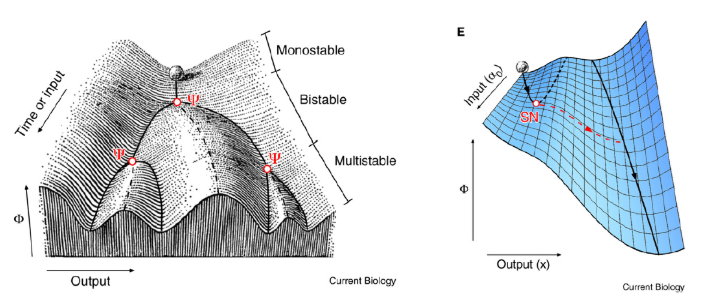
The left figure is supercritical pitchfork bifurcation and the right figure is the saddle-node bifurcation. The former is corresponding to the appearance of new valleys, but the latter is corresponding to the disappearance of valleys. Specifically, for the latter theory, if the ball goes into the right valley, the previous left valley will vanish, which provides intrinsic irreversibility to the process of differentiation, but this type of irreversibility is missing from the Waddington's original picture.
In the following, they examine models of two important developmental processes, cell-fate induction and lateral inhibition (a symmetrical cell-cell competition process). The cell-fate induction supports the saddle-node bifurcation theory, and lateral inhibition corresponds better to Waddington’s picture.
P.S.: Additional background information on the dynamical systems theory used here can be found in chapter 2 of Strogatz’s textbook [2]. Further information on cell-fate induction and cell-cell competition can be found in chapter 3 of Gilbert’s textbook [3].
Glossary:
Stable steady states VS. Unstable steady states (The following figure comes from this link):

Attractor: Stable steady states are attractors.
Positive feedback: The gene regulation part of the biology section.

Bifurcation: A splitting of one thing into two. For one-variable systems, there are three classes of bifurcations: saddle-node bifurcations, pitchfork bifurcations, and transcritical bifurcations.
Bistability: Having two stable steady states or two potential wells.
Hill function:
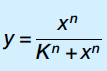

For n > 1 the Hill function yields a sigmoidal curve. The parameter K is the concentration of x at which the response is half-maximal. The exponent n determines how switch-like the response is. The Hill function usually provides a simple, reasonably accurate approximation for these sigmoidal responses. (Biological response functions are often well-approximated by Hill functions. So, the feedback component in Equation 1 consists of a Hill function.)
Potential: Compared with the real life, a vector field of forces can be calculated from a scalar field of potentials by taking derivatives. For biochemical reactions one begins with a field of velocities rather than a field of forces, and one can define the potential as a function which, when differentiated, yields this velocity field.
Cell-Fate Induction:
In cell-fate induction, a cell or a group of cells produces an inductive stimulus that causes another cell to adopt a new phenotype.

The mathematical model (single variable): basal rate of x synthesis + a feedback-dependent component of x synthesis
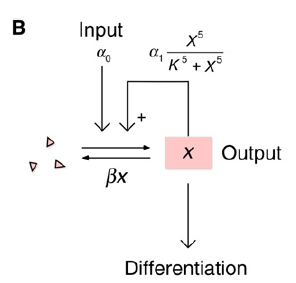
x: some differentiation regulator promotes its own synthesis via a positive feedback loop;
α0: some basal rate of x synthesis;
α1: maximum rate of feedback-dependent synthesis of x;
K: concentration of x;


From Equation 1 and 2, we can get:

To visualize functions of x’s rates of production and degradation:

Steady states are found where the production and degradation rates are equal and the two curves intersect. Two of the intersections correspond to stable steady states, one with x = 0 and the other with x≈1.7, and the middle one corresponds to an unstable steady state.
Next the steady states are depicted in a Waddington-like potential framework. The potential Φ is defined as a function whose derivative dΦ/dx yields the speed at which x moves toward its steady state. (dx/dt can be seen as the speed, so Φ as the corresponding integral form.)

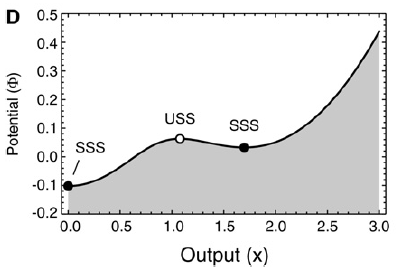
In the case of biochemical reaction networks, however, dΦ/dx determines x’s velocity rather than acceleration, so that a ball rolling down a constant slope would travel at a constant speed. When the ball reached the bottom of a potential well, it would not just stop accelerating, it would stop moving.
Furthermore, the steepness of the valley walls, or the canalization of the cell fate, in Waddington’s terminology, is determined by the nonlinearity of the positive feedback: the higher the Hill coefficient, the steeper the valley walls, making the cell fate more robust with respect to perturbations in x.
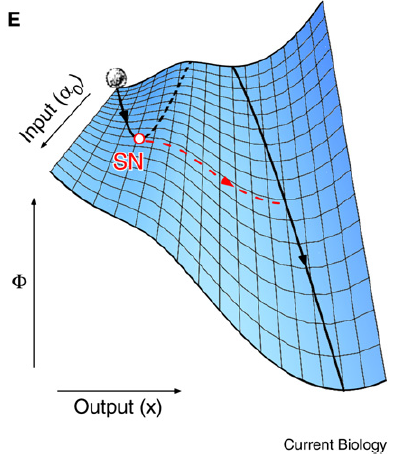
Different with Waddington's epigenetic landscape model, the model here (Saddle-Node Landscape) in cell-fate induction eliminates valleys rather than creating new valleys. The cell leaves the uninduced cell fate and adopts the induced cell fate, because the valley corresponding to the uninduced cell fate no longer exists.
Other differences between the Saddle-Node Landscape and Waddington’s Epigenetic Landscape: (1)The Instability of Intermediate States. (2)The Irreversibility of Cell-Fate Commitment (saddle is irreversibility and Waddington is reversibility). (3)The Narrowing of Developmental Potential during Differentiation (Both models. but Waddington narrowed by the ridge, and saddle narrowed by the disappearance of the valley).
Lateral Inhibition:
a process where new fates are created through cell-cell competition.
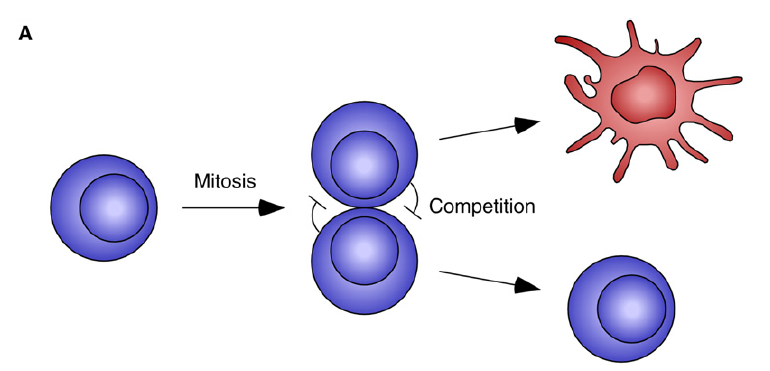
The mathematical model (a simple model of mutual inhibition)
x: In the mother cell the Delta protein;
α: basal production rate;
β: degraded rate;

After cell division, x -> x1 and x2, then assume x1 and x1 inhibits each other (Using an inhibitory Hill function to describe this interaction).
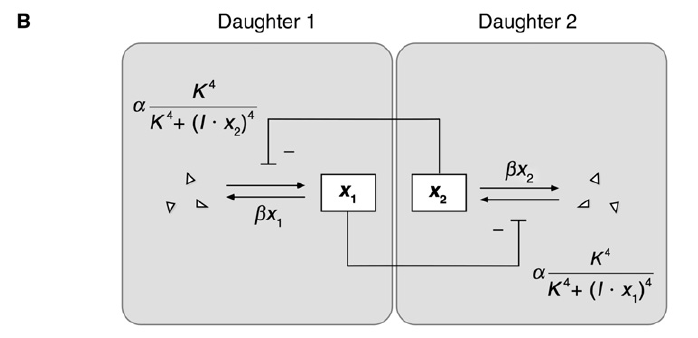
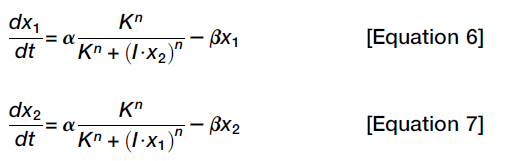

This system has gone through a pitchfork bifurcation, the key here is that the system is symmetrical (The key to the pitchfork bifurcation is the symmetry of the ruler). In addition, it's reversible, but some scholars adding some feedback loops in order to making it irreversible.
Thus, the type of bifurcation depends both upon how the system is wired and how the stimulus affects the system.
Sum up:
1. proposing that differentiation mainly involves the disappearance of valleys from the landscape, not the appearance of new valleys;
2. proposing that the disappearance of the valleys occurs through saddle-node bifurcations, which provide an intrinsic irreversibility to the process of differentiation, a type of irreversibility missing from Waddington’s original picture.
3. the processes depicted on Waddington’s original landscape correspond to intrinsically reversible pitchfork bifurcations, which could correspond to symmetry-breaking, intrinsically reversible developmental events like the generation of new cell fates through cell– cell competition.
Few experience: For a system to be bistable or multistable, it must include positive or double-negative feedback loops [1]; Biological response functions are often well-approximated by Hill functions[1];
Ref:
[1]. Ferrell Jr J E. Bistability, bifurcations, and Waddington's epigenetic landscape[J]. Current biology, 2012, 22(11): R458-R466.
[2]. Strogatz, S.H. (1994). Nonlinear Dynamics and Chaos: With Applications to Physics, Biology, Chemistry, and Engineering (Cambridge MA: Westview Press).
[3]. Gilbert, S.F. (2010). Developmental Biology, Ninth Edition (Sunderland MA: Sinauer Associates).
Paper Review: Epigenetic Landscape, Cell Differentiation 01的更多相关文章
- Paper Review: Epigenetic Landscape, Cell Differentiation 02
I'll share another review paper about Epigenetic Landscape, it comes from Nature Review, published i ...
- (转)CVPR 2016 Visual Tracking Paper Review
CVPR 2016 Visual Tracking Paper Review 本文摘自:http://blog.csdn.net/ben_ben_niao/article/details/52072 ...
- How to transform the day time images to night time ? A series of paper review and some thinkings about this point.
How to transform the day time images to night time ? A series of paper review and some thinkings ab ...
- Cancer Cell | 肿瘤微环境渐进式调控AML治疗抵抗的分子机制
急性髓系白血病 ( acute myeloid leukemia, AML ) 是成年人常见的血液系统恶性肿瘤之一,主要表现为髓系原始细胞克隆性恶性增殖及正常造血细胞功能抑制.在AML基因突变图谱中, ...
- lncRNA研究
------------------------------- Long noncoding RNAs are rarely translated in two human cell lines. ( ...
- Omnibus test
sklearn实战-乳腺癌细胞数据挖掘(博客主亲自录制视频教程) https://study.163.com/course/introduction.htm?courseId=1005269003&a ...
- 基于基因调控网络(Hopfield network)构建沃丁顿表观遗传景观
基因调控网络的概念在之前已经简要介绍过:https://www.cnblogs.com/pear-linzhu/p/12313951.html 沃丁顿表观遗传景观(The Waddington's e ...
- single-cell RNA-seq 工具大全
[怪毛匠子-整理] awesome-single-cell List of software packages (and the people developing these methods) fo ...
- TCGA收官之作—27篇重磅文献绘制“泛癌图谱”
TCGA的关键数字:图片来源<细胞> 由美国政府发起的癌症和肿瘤基因图谱(Cancer Genome Atlas,TCGA)计划于2006年联合启动,目前已经收录了来自1万多例病人的33种 ...
随机推荐
- 洛谷 P1934 封印
题目传送门 解题思路: f[i]表示打到第i层的最小值 AC代码: #include<iostream> #include<cstdio> using namespace st ...
- 《新标准C++程序设计》3.6-3.7(C++学习笔记9)
一.成员对象和封闭类 (1)定义 一个类的成员变量如果是另一个类的对象,就称之为“成员对象”. 包含成员对象的类叫封闭类. (2)封闭类构造函数的初始化列表 在构造函数中添加初始化列表的写法: 类名: ...
- 第二阶段scrum-9
1.整个团队的任务量: 2.任务看板: 会议照片: 产品状态: 消息收发在制作
- css mix-blend-mode 颜色滤镜混合模式
CSS3混合模式种类 在CSS3混合模式中,目前仅有16种:normal,multiply,screen,overlay,darken,lighten,color-dodge,color-burn,h ...
- sql ,类型转换,日期截取格式
字符型 转换成整型 CONVERT(int ,字段) 只取年月日格式 CONVERT(varchar(10), ZB.drive_time, 120 ) SELECT CONVERT(VARCHAR, ...
- 大数据之虚拟机配置和环境准备及hadoop集群搭建
一.VMnet1和VMnet8路由器 VMware-workstation软件选择默认安装时,会自动创建VMnet1和VMnet8路由器设备.(安装失败使用CCleaner清理vm软件) VMnet1 ...
- 【剑指Offer】面试题05.替换空格
题目 请实现一个函数,把字符串 s 中的每个空格替换成"%20". 示例 1: 输入:s = "We are happy." 输出:"We%20are ...
- 二十八、CI框架之自己写分页类,符合CI的路径规范
一.参照了CSDN上某个前辈写的一个CI分页类,自己删删改改仿写了一个类似的分页类,代码如下: 二.我们在模型里面写2个数据查询的函数,一个用于查询数据数量,一个用于查询出具体数据 三.我们在控制器里 ...
- gogs 小团队使用 2
gogs 团队使用第二种方法如下, 前面办法参考前面的方法: 由 root 用户新建 organization, 比如说建立 hardware,然后把团队的 技术负责人拉到 owners 这个 tea ...
- Windows添加远程访问用户
Windows远程访问 命令:mstsc ------------------------------------------------------------------------------- ...