
Sightseeing(dijlstar) 计算最短路和次短路的条数
| Time Limit: 2000MS | Memory Limit: 65536K | |
| Total Submissions: 10004 | Accepted: 3523 |
Description
Tour operator Your Personal Holiday organises guided bus trips across the Benelux. Every day the bus moves from one city S to another city F. On this way, the tourists in the bus can see the sights alongside the route travelled. Moreover, the bus makes a number of stops (zero or more) at some beautiful cities, where the tourists get out to see the local sights.
Different groups of tourists may have different preferences for the sights they want to see, and thus for the route to be taken from S to F. Therefore, Your Personal Holiday wants to offer its clients a choice from many different routes. As hotels have been booked in advance, the starting city S and the final city F, though, are fixed. Two routes from S to F are considered different if there is at least one road from a city A to a city B which is part of one route, but not of the other route.
There is a restriction on the routes that the tourists may choose from. To leave enough time for the sightseeing at the stops (and to avoid using too much fuel), the bus has to take a short route from S to F. It has to be either a route with minimal distance, or a route which is one distance unit longer than the minimal distance. Indeed, by allowing routes that are one distance unit longer, the tourists may have more choice than by restricting them to exactly the minimal routes. This enhances the impression of a personal holiday.
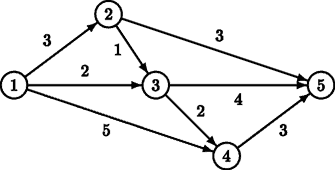
For example, for the above road map, there are two minimal routes from S = 1 to F = 5: 1 → 2 → 5 and 1 → 3 → 5, both of length 6. There is one route that is one distance unit longer: 1 → 3 → 4 → 5, of length 7.
Now, given a (partial) road map of the Benelux and two cities S and F, tour operator Your Personal Holiday likes to know how many different routes it can offer to its clients, under the above restriction on the route length.
Input
The first line of the input file contains a single number: the number of test cases to follow. Each test case has the following format:
One line with two integers N and M, separated by a single space, with 2 ≤ N ≤ 1,000 and 1 ≤ M ≤ 10, 000: the number of cities and the number of roads in the road map.
M lines, each with three integers A, B and L, separated by single spaces, with 1 ≤ A, B ≤ N, A ≠ B and 1 ≤ L ≤ 1,000, describing a road from city A to city B with length L.
The roads are unidirectional. Hence, if there is a road from A to B, then there is not necessarily also a road from B to A. There may be different roads from a city A to a city B.
One line with two integers S and F, separated by a single space, with 1 ≤ S, F ≤ N and S ≠ F: the starting city and the final city of the route.
There will be at least one route from S to F.
Output
For every test case in the input file, the output should contain a single number, on a single line: the number of routes of minimal length or one distance unit longer. Test cases are such, that this number is at most 109 = 1,000,000,000.
Sample Input
2

5 8

1 2 3

1 3 2

1 4 5

2 3 1

2 5 3

3 4 2

3 5 4

4 5 3

1 5

5 6

2 3 1

3 2 1

3 1 10

4 5 2

5 2 7

5 2 7

4 1
Sample Output
3

这题我主要用来学习如何写dijkstar  我习惯写spfa但是容易被卡
这题主要是改变松弛
更新最短路径的适合顺便更新次短路径
 #include <cstdio>

 #include <cstring>

 #include <algorithm>

 #include <queue>

 #include <stack>

 using namespace std;

 typedef long long LL;

 const int maxn = 1e5 + ;

 const int mod = 1e9 + ;

 const int INF = 2e9 + ;

 int t, n, m, tot;

 int head[], d[][], cnt[][], vis[][];

 struct node {

     int v, w, next;

 } edge[maxn];

 void init() {

     tot = ;

     memset(head, -, sizeof(head));

 }

 void add(int u, int v, int w) {

     edge[tot].v = v;

     edge[tot].w = w;

     edge[tot].next = head[u];

     head[u] = tot++;

 }

 struct node1 {

     int v, p, d;

     node1(int v, int d, int p): v(v), d(d), p(p) {}

     bool operator <(const node1 & a ) const {

         return d>a.d;

     }

 };

 void dijkstar(int st) {

     memset(vis, , sizeof(vis));

     memset(cnt, , sizeof(cnt));

     for (int i =  ; i <= n ; i++) d[i][] = d[i][] = INF;

     priority_queue<node1>q;

     d[st][] = , cnt[st][] = ;

     q.push(node1(st, , ));

     while(!q.empty()) {

         node1 t = q.top();

         q.pop();

         int u = t.v, p = t.p;

         if (vis[u][p]) continue;

         vis[u][p] = ;

         for (int i = head[u] ; ~i ; i = edge[i].next) {

             int v = edge[i].v, w = edge[i].w;

             if (d[v][] > d[u][p] + w) {

                 d[v][] = d[v][];

                 cnt[v][] = cnt[v][];

                 d[v][] = d[u][p] + w;

                 cnt[v][] = cnt[u][p];

                 q.push(node1(v, d[v][], ));

                 q.push(node1(v, d[v][], ));

             } else if (d[v][] == d[u][p] + w) cnt[v][] += cnt[u][p];

             else if (d[v][] > d[u][p] + w) {

                 d[v][] = d[u][p] + w;

                 cnt[v][] = cnt[u][p];

                 q.push(node1(v,d[v][],));

             } else if (d[v][] == d[u][p] + w) cnt[v][] += cnt[u][p];

         }

     }

 }

 int main() {

     scanf("%d", &t);

     while(t--) {

         init();

         scanf("%d%d", &n, &m);

         for (int i =  ; i < m ; i++) {

             int u, v, w;

             scanf("%d%d%d", &u, &v, &w);

             add(u, v, w);

         }

         int st, ed;

         scanf("%d%d", &st, &ed);

         dijkstar(st);

         if (d[ed][] +  == d[ed][]) printf("%d\n", cnt[ed][] + cnt[ed][]);

         else printf("%d\n", cnt[ed][]);

     }

     return ;

 }
Sightseeing(dijlstar) 计算最短路和次短路的条数的更多相关文章
- 最短路和次短路的条数(dijstra算法或spfa算法)POJ3463
http://poj.org/problem?id=3463 Sightseeing Time Limit: 2000MS Memory Limit: 65536K Total Submissio ...
- hdu1688(dijkstra求最短路和次短路)
题目链接:http://acm.hdu.edu.cn/showproblem.php?pid=1688 题意:第k短路,这里要求的是第1短路(即最短路),第2短路(即次短路),以及路径条数,最后如果最 ...
- HDU 1688 Sightseeing&HDU 3191 How Many Paths Are There(Dijkstra变形求次短路条数)
Sightseeing Time Limit: 3000/1000 MS (Java/Others) Memory Limit: 32768/32768 K (Java/Others) Tota ...
- poj 3463 Sightseeing( 最短路与次短路)
http://poj.org/problem?id=3463 Sightseeing Time Limit: 2000MS Memory Limit: 65536K Total Submissio ...
- POJ---3463 Sightseeing 记录最短路和次短路的条数
Sightseeing Time Limit: 2000MS Memory Limit: 65536K Total Submissions: 9247 Accepted: 3242 Descr ...
- POJ 3463 Sightseeing 【最短路与次短路】
题目 Tour operator Your Personal Holiday organises guided bus trips across the Benelux. Every day the ...
- POJ - 3463 Sightseeing 最短路计数+次短路计数
F - Sightseeing 传送门: POJ - 3463 分析 一句话题意:给你一个有向图,可能有重边,让你求从s到t最短路的条数,如果次短路的长度比最短路的长度多1,那么在加上次短路的条数. ...
- poj 3463 Sightseeing(次短路+条数统计)
/* 对dij的再一次理解 每个点依旧永久标记 只不过这里多搞一维 0 1 表示最短路还是次短路 然后更新次数相当于原来的两倍 更新的时候搞一下就好了 */ #include<iostream& ...
- HDU 1688 Sightseeing 【输出最短路+次短路条数】
题目链接:http://acm.hdu.edu.cn/showproblem.php?pid=1688 题目大意:给n个点,m条有向边.再给出起点s, 终点t.求出s到t的最短路条数+次短路条数. 思 ...
随机推荐
- leetcode-颜色分类
颜色分类 给定一个包含红色.白色和蓝色,一共 n 个元素的数组,原地对它们进行排序,使得相同颜色的元素相邻,并按照红色.白色.蓝色顺序排列. 此题中,我们使用整数 0. 1 和 2 分别表示 ...
- Java学习 · 初识 面向对象基础一
面向对象基础 1.1面向过程与面向对象的区别 面向过程和面向对象二者都是思考问题的方式,再简单的事物时,可以线性思考时使用面向过程,但当事物较为复杂时,只能使用面向对象设计.但二者并不是对立的,在解决 ...
- 孤荷凌寒自学python第七十八天开始写Python的第一个爬虫8
孤荷凌寒自学python第七十八天开始写Python的第一个爬虫8 (完整学习过程屏幕记录视频地址在文末) 今天在上一天的基础上继续完成对我的第一个代码程序的书写. 到今天止基本完成了对docx模块针 ...
- 已有海外版Office365,如何开通相同Tenant的Azure
下面这个步骤是开通海外版Azure的测试账号,请了解! 翻到如图位置 点击免费开始 下一步 输入验证代码,此页没截图 使用信用卡,需要visa或master 下一步认证完就可以使用,没有继续截图
- Apache--Override参数详解
1 AuthConfig 允许使用所有的权限指令,他们包括AuthDBMGroupFile AuthDBMUserFile AuthGroupFile AuthName AuthTypeAut ...
- 今日头条 2018 AI Camp 5 月 26 日在线笔试编程题第一道——最佳路径
题目 给定一个 n*m 的矩阵 A ,矩阵中每一个元素为一个十六进制数.寻找一条从左上角都右下角的路径,每次只能向右或者向下移动, 使得路径上所有数字之积在 16 进制下的后缀 0 最少. 输入描述: ...
- The Activation Function in Deep Learning 浅谈深度学习中的激活函数
原文地址:http://www.cnblogs.com/rgvb178/p/6055213.html 版权声明:本文为博主原创文章,未经博主允许不得转载. 激活函数的作用 首先,激活函数不是真的要去激 ...
- codeforces 301D Yaroslav and Divisors(树状数组)
Yaroslav has an array p = p1, p2, ..., pn (1 ≤ pi ≤ n), consisting of n distinct integers. Also, he ...
- II 3.1 连接到服务器
II 3.1 连接到服务器 package socket; import java.io.IOException; import java.io.InputStream; import java.ne ...
- Java内存区域划分和GC机制
Java 内存区域和GC机制 目录 Java垃圾回收概况 Java内存区域 Java对象的访问方式 Java内存分配机制 Java GC机制 垃圾收集器 Java垃圾回收概况 Java GC(Ga ...