
How Kafka’s Storage Internals Work
In this post I’m going to help you understand how Kafka stores its data.
I’ve found understanding this useful when tuning Kafka’s performance and for context on what each broker configuration actually does. I was inspired by Kafka’s simplicity and used what I learned to start implementing Kafka in Golang.
So how does Kafka’s storage internals work?
Kafka’s storage unit is a partition
A partition is an ordered, immutable sequence of messages that are appended to. A partition cannot be split across multiple brokers or even multiple disks.

The retention policy governs how Kafka retains messages
You specify how much data or how long data should be retained, after which Kafka purges messages in-order—regardless of whether the message has been consumed.
Partitions are split into segments
So Kafka needs to regularly find the messages on disk that need purged. With a single very long file of a partition’s messages, this operation is slow and error prone. To fix that (and other problems we’ll see), the partition is split into segments.
When Kafka writes to a partition, it writes to a segment — the active segment. If the segment’s size limit is reached, a new segment is opened and that becomes the new active segment.
Segments are named by their base offset. The base offset of a segment is an offset greater than offsets in previous segments and less than or equal to offsets in that segment.
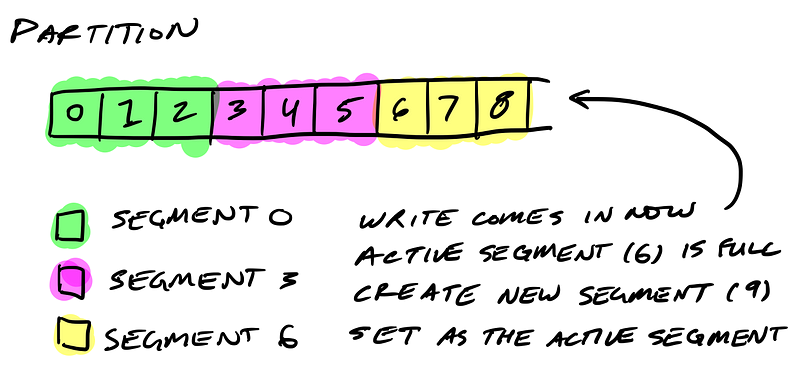
On disk a partition is a directory and each segment is an index file and a log file.
$ tree kafka | head -n 6
kafka
├── events-1
│ ├── 00000000003064504069.index
│ ├── 00000000003064504069.log
│ ├── 00000000003065011416.index
│ ├── 00000000003065011416.log
Segments logs are where messages are stored
Each message is its value, offset, timestamp, key, message size, compression codec, checksum, and version of the message format.
The data format on disk is exactly the same as what the broker receives from the producer over the network and sends to its consumers. This allows Kafka to efficiently transfer data with zero copy.
$ bin/kafka-run-class.sh kafka.tools.DumpLogSegments --deep-iteration --print-data-log --files /data/kafka/events-1/00000000003065011416.log | head -n 4
Dumping /data/kafka/appusers-1/00000000003065011416.log
Starting offset: 3065011416
offset: 3065011416 position: 0 isvalid: true payloadsize: 2820 magic: 1 compresscodec: NoCompressionCodec crc: 811055132 payload: {"name": "Travis", msg: "Hey, what's up?"}
offset: 3065011417 position: 1779 isvalid: true payloadsize: 2244 magic: 1 compresscodec: NoCompressionCodec crc: 151590202 payload: {"name": "Wale", msg: "Starving."}
Segment indexes map message offsets to their position in the log
The segment index maps offsets to their message’s position in the segment log.
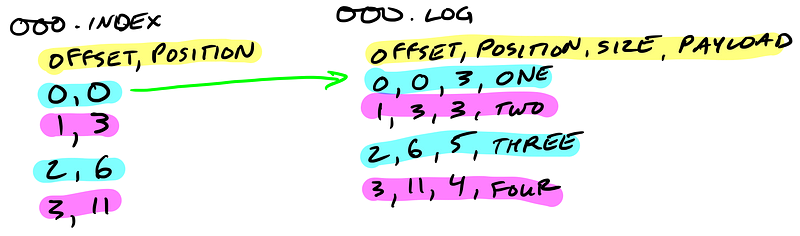
The index file is memory mapped, and the offset look up uses binary search to find the nearest offset less than or equal to the target offset.
The index file is made up of 8 byte entries, 4 bytes to store the offset relative to the base offset and 4 bytes to store the position. The offset is relative to the base offset so that only 4 bytes is needed to store the offset. For example: let’s say the base offset is 10000000000000000000, rather than having to store subsequent offsets 10000000000000000001 and 10000000000000000002 they are just 1 and 2.
Kafka wraps compressed messages together
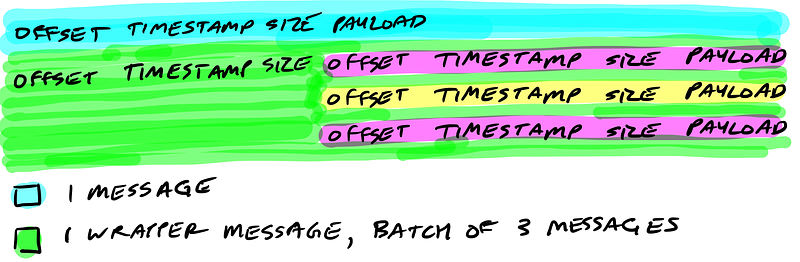
Producers sending compressed messages will compress the batch together and send it as the payload of a wrapped message. And as before, the data on disk is exactly the same as what the broker receives from the producer over the network and sends to its consumers.
Let’s Review
Now you know how Kafka storage internals work:
- Partitions are Kafka’s storage unit
- Partitions are split into segments
- Segments are two files: its log and index
- Indexes map each offset to their message’s position in the log, they’re used to look up messages
- Indexes store offsets relative to its segment’s base offset
- Compressed message batches are wrapped together as the payload of a wrapper message
- The data stored on disk is the same as what the broker receives from the producer over the network and sends to its consumers
Implementing Kafka in Golang
I’m writing an implementation of Kafka in Golang, Jocko. So far I’ve implemented reading and writing to segments on a single broker and am working on making it distributed. Follow along and give me a hand.
How Kafka’s Storage Internals Work的更多相关文章
- Error when sending message to topic test with key: null, value: 2 bytes with error: (org.apache.kafka.clients.producer.internals.ErrorLoggingCallback)
windows下使用kafka遇到这个问题: Error when sending message to topic test with key: null, value: 2 bytes with ...
- Kafka遇到30042ms has passed since batch creation plus linger time at org.apache.kafka.clients.producer.internals.FutureRecordMetadata.valueOrError(FutureRecordMetadata.java:94)
问题描述: 运行生产者线程的时候显示如下错误信息: Expiring 1 record(s) for XXX-0: 30042 ms has passed since batch creation p ...
- Kafka Offset Storage
1.概述 目前,Kafka 官网最新版[0.10.1.1],已默认将消费的 offset 迁入到了 Kafka 一个名为 __consumer_offsets 的Topic中.其实,早在 0.8.2. ...
- 《Pro SQL Server Internals, 2nd edition》的CHAPTER 1 Data Storage Internals中的Data Pages and Data Rows(翻译)
数据页和数据行 数据库中的空间被划分为逻辑8KB的页面.这些页面是以0开始的连续编号,并且可以通过指定文件ID和页号来引用它们.页面编号都是连续的,这样当SQL Server增长数据库文件时,从文件中 ...
- Kafka Internals: Consumers
Check out my last article, Kafka Internals: Topics and Partitions to learn about Kafka storage inter ...
- kafka学习指南(总结版)
版本介绍 从使用上来看,以0.9为分界线,0.9开始不再区分高级/低级消费者API. 从兼容性上来看,以0.8.x为分界线,0.8.x不兼容以前的版本. 总体拓扑架构 从上可知: 1.生产者不需要访问 ...
- Kafka官方文档V2.7
1.开始 1.1 简介 什么是事件流? 事件流相当于人体的中枢神经系统的数字化.它是 "永远在线 "世界的技术基础,在这个世界里,业务越来越多地被软件定义和自动化,软件的用户更是软 ...
- Kafka 消费者解析
一.消费者相关概念 1.1 消费组&消费者 消费者: 消费者从订阅的主题消费消息,消费消息的偏移量保存在Kafka的名字是__consumer_offsets的主题中 消费者还可以将⾃⼰的偏移 ...
- Kafka 0.9+Zookeeper3.4.6集群搭建、配置,新Client API的使用要点,高可用性测试,以及各种坑 (转载)
Kafka 0.9版本对java client的api做出了较大调整,本文主要总结了Kafka 0.9在集群搭建.高可用性.新API方面的相关过程和细节,以及本人在安装调试过程中踩出的各种坑. 关于K ...
随机推荐
- CentOS 6.x 系统安装选项说明
在安装CentOS 6.x的过程中会出现以下界面: 这些选项有什么区别呢?转载一位网友的描述: Desktop:基本的桌面系统,包括常用的桌面软件,如文档查看工具 Minimal Desktop:基本 ...
- [Android] ListView中如何让onClick和onItemClick事件共存
ListView中如何使用Button,让onClick和onItemClick事件共存 假如ListView的一条记录包含一个TextView文本框,一个Button按钮,怎样能让点击按钮有事件响应 ...
- Match:Period(POJ 1961)
Period 题目大意:给定一个字符串,要你找到前缀重复了多少次 思路,就是kmp的next数组的简单应用,不要修正next的距离就好了,直接就可以跳转了 PS:喝了点酒用递归实现除法和取余了...结 ...
- form、iframe实现异步上传文件
转载自:http://blog.csdn.net/sunjing21/article/details/4779321 实现主要功能: 页面提供一个上传图片的input file选择框,用于上传某一类型 ...
- 【linux】linux脚本中#!/bin/sh的含义
来源:百度知道 #! /bin/sh 是指此脚本使用,/bin/sh来解释执行,#!是特殊的表示符,其后面根的是此解释此脚本的shell的路径.
- HDU 5884 Sort -2016 ICPC 青岛赛区网络赛
题目链接 #include <iostream> #include <math.h> #include <stdio.h> #include<algorith ...
- python数据库(mysql)操作
http://fantefei.blog.51cto.com/2229719/1282443
- JAVA addShutdownHook测试
public static void main(String[] args) { System.out.println("1111111111"); try { Thread.sl ...
- sql 查询最近30分钟或者自定义时间数据
) FROM dual; 30分钟或者自定义
- SQL TO LINQ(Linqer神器)
此软件可以把SQL语句转换成LINQ语句 首先把Linqer下载到本地, 1.在VS中创建.dbml文件和.cs文件 打开VS,创建一个控制台项目即可,再添加一个dbml项目 2.添加连接数据库 3. ...