
golang的interface剖析
type MyInt int

var i int

var j MyInt
var r io.Reader
var r io.Reader

tty, err := os.OpenFile("/dev/tty", os.O_RDWR, 0)

if err != nil {

    return nil, err

}

r = tty
到这里,r的类型是什么?r的类型仍然是interface io.Reader,只是r = tty这一句,隐含了一个类型转换,将tty转成了io.Reader。
type Binary uint64

func (i Binary) String() string {

    return strconv.Uitob64(i.Get(), 2)

}

func (i Binary) Get() uint64 {

    return uint64(i)

}
.png)
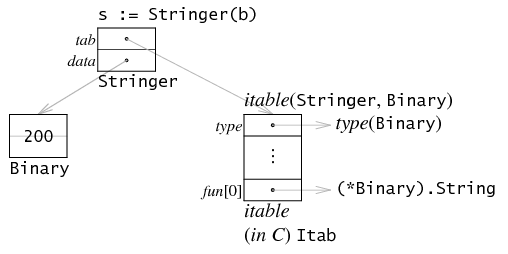
var w io.Writer
    switch v := any.(type) {

    case int:

        return strconv.Itoa(v)

    case float:

        return strconv.Ftoa(v, 'g', -1)

    }
1   var any interface{}  // initialized elsewhere

2   s := any.(Stringer)  // dynamic conversion

3   for i := 0; i < 100; i++ {

4       fmt.Println(s.String())

5   }
143 type iface struct {

144     tab  *itab     // 指南itable

145     data unsafe.Pointer     // 指向真实数据

146 }
617 type itab struct {

618     inter  *interfacetype

619     _type  *_type

620     link   *itab

621     bad    int32

622     unused int32

623     fun    [1]uintptr // variable sized

624 }
310 type imethod struct {

311     name nameOff

312     ityp typeOff

313 }

314

315 type interfacetype struct {

316     typ     _type

317     pkgpath name

318     mhdr    []imethod

319 }

320
 28 type _type struct {

 29     size       uintptr

 30     ptrdata    uintptr // size of memory prefix holding all pointers

 31     hash       uint32

 32     tflag      tflag

 33     align      uint8

 34     fieldalign uint8

 35     kind       uint8

 36     alg        *typeAlg

 37     // gcdata stores the GC type data for the garbage collector.

 38     // If the KindGCProg bit is set in kind, gcdata is a GC program.

 39     // Otherwise it is a ptrmask bitmap. See mbitmap.go for details.

 40     gcdata    *byte

 41     str       nameOff

 42     ptrToThis typeOff

 43 }
 22 func itabhash(inter *interfacetype, typ *_type) uint32 {

 23     // compiler has provided some good hash codes for us.

 24     h := inter.typ.hash

 25     h += 17 * typ.hash

 26     // TODO(rsc): h += 23 * x.mhash ?

 27     return h % hashSize

 28 }
 44     h := itabhash(inter, typ)

 45

 46     // look twice - once without lock, once with.

 47     // common case will be no lock contention.

 48     var m *itab

 49     var locked int

 50     for locked = 0; locked < 2; locked++ {

 51         if locked != 0 {

 52             lock(&ifaceLock)

 53         }

 54         for m = (*itab)(atomic.Loadp(unsafe.Pointer(&hash[h]))); m != nil; m = m.link {

 55             if m.inter == inter && m._type == typ {

 71                 return m    // 找到了前面计算过的itab

 72             }

 73         }

 74     }

 75    // 没有找到,生成一个,并加入到itab的hash中。

 76     m = (*itab)(persistentalloc(unsafe.Sizeof(itab{})+uintptr(len(inter.mhdr)-1)*sys.PtrSize, 0, &memstats.other_sys))

 77     m.inter = inter

 78     m._type = typ

 79     additab(m, true, canfail)
 13 const (

 14     hashSize = 1009

 15 )

 16

 17 var (

 18     ifaceLock mutex // lock for accessing hash

 19     hash      [hashSize]*itab

 20 )
 92     // both inter and typ have method sorted by name,

 93     // and interface names are unique,

 94     // so can iterate over both in lock step;

 95     // the loop is O(ni+nt) not O(ni*nt).       // 按name排序过的,因此这里的匹配只需要O(ni+nt)

 99     j := 0

100     for k := 0; k < ni; k++ {

101         i := &inter.mhdr[k]

102         itype := inter.typ.typeOff(i.ityp)

103         name := inter.typ.nameOff(i.name)

104         iname := name.name()

109         for ; j < nt; j++ {

110             t := &xmhdr[j]

111             tname := typ.nameOff(t.name)

112             if typ.typeOff(t.mtyp) == itype && tname.name() == iname {

118                     if m != nil {

119                         ifn := typ.textOff(t.ifn)

120                         *(*unsafe.Pointer)(add(unsafe.Pointer(&m.fun[0]), uintptr(k)*sys.PtrSize)) = ifn // 找到匹配,将实际类型的方法填入itab的fun

121                     }

122                     goto nextimethod

123                 }

124             }

125         }

135     nextimethod:

136     }

140     h := itabhash(inter, typ)             //插入上面的全局hash

141     m.link = hash[h]

142     atomicstorep(unsafe.Pointer(&hash[h]), unsafe.Pointer(m))

143 }
到这里,interface的数据结构的框架。
golang的interface剖析的更多相关文章
- Golang 源码剖析:log 标准库
Golang 源码剖析:log 标准库 原文地址:Golang 源码剖析:log 标准库 日志 输出 2018/09/28 20:03:08 EDDYCJY Blog... 构成 [日期]<空格 ...
- Golang的Interface是个什么鬼
问题概述 Golang的interface,和别的语言是不同的.它不需要显式的implements,只要某个struct实现了interface里的所有函数,编译器会自动认为它实现了这个interfa ...
- golang 关于 interface 的学习整理
Golang-interface(四 反射) go语言学习-reflect反射理解和简单使用 为什么在Go语言中要慎用interface{} golang将interface{}转换为struct g ...
- Golang 的 `[]interface{}` 类型
Golang 的 []interface{} 类型 我其实不太喜欢使用 Go 语言的 interface{} 类型,一般情况下我宁愿多写几个函数:XxxInt, XxxFloat, XxxString ...
- Golang接口(interface)三个特性(译文)
The Laws of Reflection 原文地址 第一次翻译文章,请各路人士多多指教! 类型和接口 因为映射建设在类型的基础之上,首先我们对类型进行全新的介绍. go是一个静态性语言,每个变量都 ...
- Golang-interface(四 反射)
github:https://github.com/ZhangzheBJUT/blog/blob/master/reflect.md 一 反射的规则 反射是程序执行时检查其所拥有的结构.尤其是类型的一 ...
- golang之interface
一.概述 接口类型是对 "其他类型行为" 的抽象和概况:因为接口类型不会和特定的实现细节绑定在一起:很多面向对象都有类似接口概念,但Golang语言中interface的独特之处在 ...
- golang将interface{}转换为struct
项目中需要用到golang的队列,container/list,需要放入的元素是struct,但是因为golang中list的设计,从list中取出时的类型为interface{},所以需要想办法把i ...
- Golang-interface(二 接口与nil)
github: https://github.com/ZhangzheBJUT/blog/blob/master/nil.md 一 接口与nil 前面解说了go语言中接口的基本用法,以下将说一说nil ...
随机推荐
- treap学习笔记
treap是个很神奇的数据结构. 给你一个问题,你可以解决它吗? 这个问题需要treap这个数据结构. 众所周知,二叉查找树的查找效率低的原因是不平衡,而我们又不希望用各种奇奇怪怪的旋转来使它平衡,那 ...
- Literal 字面值 字面量 的理解
Literal 字面值 字面量 Literal, 在程序语言中,指表示某种数据值的符码.如,123 是整数值符码, 3.14 是浮点值符码,abcd 是字串值符码,True, False, 是逻辑值符 ...
- odoo学习之弹框显示
按条件隐藏: <xpath expr="//group[1]" position="attributes"> <attribute name= ...
- Luogu P3177 [HAOI2015]树上染色
一道有机结合了计数和贪心这一DP两大考点的神仙题,不得不说做法是很玄妙. 首先我们很容易想到DP,设\(f_{i,j}\)表示在以\(i\)为根节点的子树中选\(j\)个黑色节点的最大收益值. 然后我 ...
- [Oracle]如何查看 10046 trace 中的 tim= ... 的具体时刻
可以在 Linux 下,用下列方式: 如10046 trace 文件中如果有如下的内容:... tim = 1503032923 可以用 date 命令加 option 来看它的时刻: date - ...
- 记一次艰难的jquery easy-ui ajax post 体验
分享的经验和教训是: 1.jquery easy-ui ajax post 复杂的Json给后端解析,后端如果接收和解析 2.asp.net webform jquery easy-ui datagr ...
- ASS字幕制作
虽然不常做视频,但正因为是偶尔用到,所以总是记不牢,特此笔记. Name 字体名称?Fontname 字体名称(\fn冬青黑体简体中文 W3)(\fnVogueSans)(例:\N{\fn冬青黑体简体 ...
- Centos下分布式跟踪工具Pinpoint的完整部署记录
一.Pinpoint简单介绍Pinpoint是一款对Java编写的大规模分布式系统的APM工具,有些人也喜欢称呼这类工具为调用链系统.分布式跟踪系统.一般来说,前端向后台发起一个查询请求,后台服务可能 ...
- 牛客训练赛25-A-因数个数
题目链接https://www.nowcoder.com/acm/contest/158/A 无语...这题很迷啊,原谅我的菜,刚开始想用预处理欧拉筛和前缀和,可是这题太血崩了,这样一样要遍历,1-e ...
- mysql 多列索引的生效规则,生成1000w数据的存储过程
https://www.cnblogs.com/codeAB/p/6387148.html