
Extensible File System
An extensible file system format for portable storage media is provided. The extensible file system format includes the specification of primary and secondary directory entry types that may be custom defined. The primary and secondary directory entry types can be further classified as critical and benign directory entries.
BACKGROUND
Generally described, there are a number of portable computing devices, such as digital still cameras, digital video cameras, media players, mobile phones, mobile computing devices, personal digital assistants, and the like that maintain data on a storage media, such as a portable storage media. The continued development of more complex portable computing devices and larger storage capacity portable storage media places a greater demand for flexibility on the file system format used on the storage media. Current file system format approaches can become deficient in that they may provide adequate flexibility for increasing storage size capacities and/or storage media applications.
SUMMARY
An extensible file system format for portable storage media is provided. The extensible file system format includes the specification of primary and secondary directory entry types that may be custom defined. The primary and secondary directory entry types can be further classified as critical and benign directory entries.
In accordance with an aspect of the present invention, a computer-readable medium having computer-executable components for storing data is provided. The computer-readable components can include a boot parameters component for specifying boot parameters for a file system. The computer-readable components also include a file allocation table component for defining a file allocation table associated with the file system. Additionally, the computer-readable components include a primary directory entry component for specifying data in a root directory of the file system. Still further, the computer-readable components include at least one secondary entry component corresponding to the primary directory entry component. The secondary entry component defines defining meta data associated with the primary directory entry component. The primary and secondary directory entry components can be further classified as critical or benign.
In accordance with another aspect of the present invention, a computer-readable medium having computer-executable components for storing data is provided. The computer-readable components include a boot parameters component for specifying boot parameters for a file system. The computer-readable components also include a file allocation table component for defining a file allocation table associated with the file system. Still further, the computer-readable components include a root directory component for specifying data in a root directory of the file system. Additionally, the computer-readable components include at least extensible one meta data component corresponding to the root directory entry component. The meta data component defines meta data associated with the root directory component.
In an illustrative embodiment, a file system will not mount a volume for a critical primary or root directory entry that is not recognized. The file system can ignore benign primary directory entries, critical secondary directory entries and benign secondary directory entries that are not recognized.
This summary is provided to introduce a selection of concepts in a simplified form that are further described below in the Detailed Description. This summary is not intended to identify key features of the claimed subject matter, nor is it intended to be used as an aid in determining the scope of the claimed subject matter.
DETAILED DESCRIPTION
Generally described, the present invention relates to an extensible file system format and various processes associated with the extensible file system format. In an illustrative embodiment, the extensible file system format corresponds to an extensible file system format for portable storage media and various processes associated with the extensible file system format on the portable storage media. Although the present invention will be described with regard to a portable storage media file system format, one skilled in the relevant art will appreciate that the disclosed embodiments are illustrative in nature and should not be construed as limiting. Additionally, one skilled in the relevant art will appreciate that the data structures and data layouts used in the illustrative examples may require additional information related to performance, security, and the like.
FIGS. 1A-1C are block diagrams illustrative of various operating environments 100 for the extensible file system format of the present invention. With reference to FIG. 1A, in an illustrative embodiment, the extensible file system format is utilized to store data from a computing device, such as a mobile computing device 102, and a storage media, such as a portable storage media 104. In an illustrative embodiment, the mobile computing device 102 can correspond to any one of a variety of computing devices, including but not limited to, portable computing devices, mobile telephones, personal digital assistants, music players, media players. The portable storage media can also include, but is not limited to, hard drives, flash media, micro-drives and other storage media. In an illustrative embodiment, the extensible file system on the portable storage media104 does not have to include any type of executable or readable software components, such as an operating environment, utilized by the mobile computing device 102. Alternatively, the extensible file system on the portable storage media 104 may include executable or readable software components used by the mobile device 102.
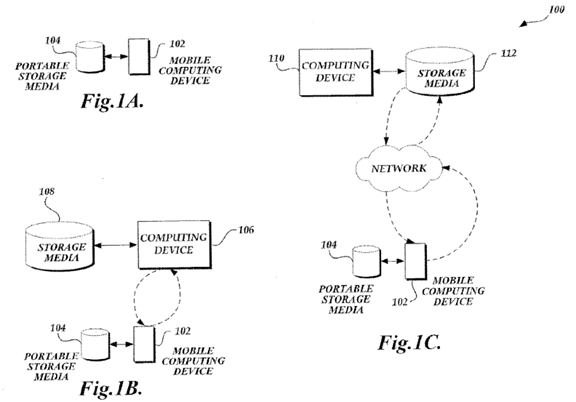
In an illustrative embodiment, the mobile computing device 102 may be in communication with other computing devices for collecting/exchanging data to be stored on the portable storage media 104. With reference to FIG. 1B, the mobile computing device 102 may be in direct communication with another computing device 106 and storage media 108. In an illustrative embodiment, the direct communication can correspond to various wired and wireless communication methods. In an illustrative embodiment, the other storage media 108 is not required to be formatted in accordance with the extensible file system format of the present invention. With reference to FIG. 1C, in a similar manner, the mobile computing device 102may also be in communication with another computing device 110 and storage media 112, via a network connection. In an illustrative embodiment, the network connection can correspond to local area network (LAN) and wide are network (WAN) connections.
With reference now to FIG. 2, an illustrative embodiment volume layout 200 for an extensible file system format will be described. The volume layout 200 includes a boot parameters component 202 that include various information related to a description of the file system parameters of the partition. In an illustrative embodiment, the boot parameters component 202can include code for bootstrapping from a defined partition, fundamental file system parameters for the defined partition, and various error checking information. A data structure for defining at least a portion of the boot parameters will be described below with regard to FIG. 4.
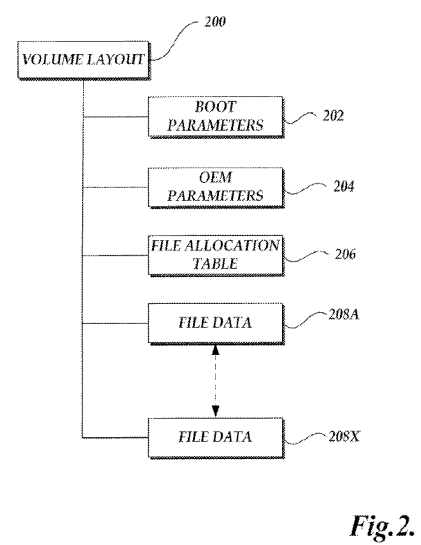
The volume layout 200 also includes an extensible parameters component, designated as OEM parameters 204, that define various additional data structures used in conjunction with the file system. In an illustrative embodiment, an original equipment manufacture (OEM) may specify various extensible data structures, such as performance parameters for a storage medium, that can be defined at time of manufacture. The volume layout 200 can further include a file allocation table component 206 that defines file and directory allocations. In an illustrative embodiment, each entry in the file allocation table component 206 corresponds to a 32-bit entry that represents an allocated cluster, an unallocated cluster or an unusable cluster. The volume layout 200 can still further include series of file data components 208A-208X that correspond to the data stored according to the file system format. Various data structures for defining a portion of the file data components 208A-208X will be defined with regard to FIGS. 3-10.
Turning now to FIG. 3, in one aspect, the file data components 208 may include one or more directory entries according to a directory structure 300. In an illustrative embodiment, directory structure 300 is organized into primary directory entries302 and secondary directory entries 304. Each directory entry in the primary and secondary entries is typed. For example, in an illustrative embodiment, type values for the primary and secondary directory entries can correspond to a range of 1-255. Primary directory entries 302 correspond to the entries in the root directory of the file system. Secondary directory entries 304 follow a primary directory entry and are associated with the primary directory entry. Secondary directory entries extend the metadata associated with the correlated primary directory entry.
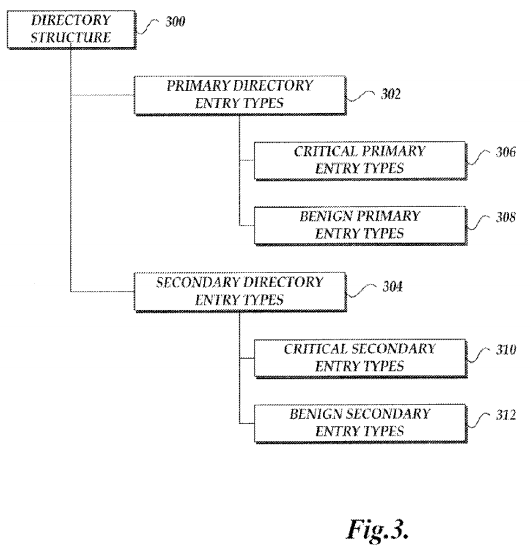
With continued reference to FIG. 3, in an illustrative embodiment, the primary directory entries 302 can be further classified as critical primary directory entries 306 and benign primary directory entries 308. Critical primary directory entries 306 define potentially different formats for each directory entry. In an illustrative embodiment, an operating environment will not mount a volume corresponding to the extensible file system format with an unknown critical primary directory entry, as will be described below. Examples of known primary directory entries 306 can include allocation bitmaps, up-case tables, volume labels, encryption keys, and normal directory entries. Benign primary directory entries 308 also define potential different formats for each directory entry, but can be ignored by the file system if a particular benign primary directory entry is not understood. Benign primary directory entries 308 can be associated with another cluster chain the volume. Additionally, benign primary directory entries 308 can also be associated a number of secondary directory entries 304.
In a manner similar to primary directory entries 302, secondary directory entries 304 may also be further classified as critical secondary directory entries 310 and benign secondary directory entries 312. As described above, the critical secondary directory entries 310 and benign secondary directory entries 312 are associated with a benign primary directory entry and extend the metadata associated with the primary directory entry. Both the critical secondary directory entries 310 and the benign secondary directory entries 312 can be associated with another cluster chain the volume.
To mount a volume corresponding to the extensible file system format, the file system implements a mount volume procedure. In an illustrative embodiment, the mount volume procedure attempts to look at a version number for the volume. If the version number is not understood (e.g., the version number is higher), the volume will not be mounted. During a normal directory enumeration, any critical primary directory entries not known by the file system will prevent the volume from being mounted. Thereafter, various user-initiated processes, such as a file open, will cause the file system to enumerate the secondary directory entries. If the critical secondary directory entries 310 are not known by a file system, the entire directory entry will be skipped. Additionally, if benign secondary directory entries 312 are not known by the file system, the particular unknown benign secondary directory entry will be ignored.
With reference now to FIG. 4, a block diagram illustrative of data components 400 for implementing a boot process block in the boot parameters component 202 (FIG. 2) will be described. The data components 400 include an OEM name component402 for specifying a name for the file system format of the storage media. The data components 400 also include a data size descriptor component 404 for specifying various characteristics of the data stored in the file system. For example, the data size descriptor component 404 can specify a count of bytes per sector, a number of sectors per allocation unit, a FAT table offset, and a count of sectors for all data structures. The data components include an active FAT flags component 406 for specifying a number of active FATs on the file system. In an illustrative embodiment, a file system may support multiple FATs for utilization with some operating system environments. The data components 400 can further include a volume identification component 408 for identifying a volume serial number and/or version number. Still further, the data components 400 can include a file system type for specifying the file system format for the file system. One skilled in the relevant art will appreciate that the data components 400 can include a number of additional/alternative rows for implementing the above-identified components 402-410 and additional components.
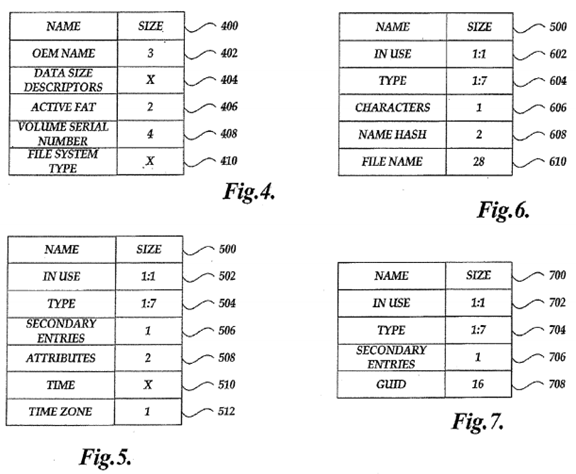
Turning now to FIG. 5, a block diagram illustrative of data components 500 for implementing directory entries in an extensible file system format will be described. The data components 500 include an in use component 502 for specifying whether the particular directory entry is in use. In an illustrative embodiment, the high bit of the data components will be set to "1" if the directory entry is in use. The data components 500 further include a type designation component 504 for specifying that the directory entry is associated with a normal directory entry. The data components 500 further include a secondary directory entries component 504 for specifying a number of secondary entries associated with the normal directory entry. The data components 500 also include a file attributes component 508 for specifying various file system attributes for the directory entry. Still further, the data components 500 include a time component 510 for specifying various time information such as a creation timestamp, modification time stamp and other time information. Additionally, the data components 500 further include a time zone component 512 for specifying a time zone for the last created time stamp. One skilled in the relevant art will appreciate that the data components 500 can include a number of additional/alternative rows for implementing the above-identified components 502-512 and additional components.
Turning now to FIG. 6, a block diagram data components 600 for implementing a file name and extensions will be described. The data components 600 include an in use component 602 for specifying whether the particular directory entry is in use. In an illustrative embodiment, the high bit of the data components will be set to "1" if the directory entry is in use. The data components 600 further include a type designation component 604 for specifying that the directory entry is associated with a file system name. The data components further include a file name length component 606 and a file name has component608. The utilization of the file name hash component 608 will be described below. The data components 600 also include a file name component 610 for specifying the file name. One skilled in the relevant art will appreciate that the data components600 can include a number of additional/alternative rows for implementing the above-identified components 602-610 and additional components. Additionally, file name directory entries may be extended by secondary directory entries.
Turning now to FIG. 7, a block diagram illustrative of data components 700 for implementing a volume identifier in an extensible file system format is provided. The data components 700 include an in use component 702 for specifying whether the particular directory entry is in use. In an illustrative embodiment, the high bit of the data components will be set to "1" if the directory entry is in use. The data components 700 further include a type designation component 704 for specifying that the directory entry is associated with a volume identifier. The data components 700 further include a secondary directory entries component 706 for specifying a number of secondary entries associated with the volume identifier. The data components 700 also include a volume identifier 708, such as a global unique identifier. One skilled in the relevant art will appreciate that the data components 700 can include a number of additional/alternative rows for implementing the above-identified components 702-708 and additional components. Additionally, in an illustrative embodiment, the data components700 correspond to a benign directory entry that can be ignored by a file system that does not support volume identifiers.
With reference now to FIGS. 8 and 9, in an illustrative embodiment, parties, such as an OEM, may be able to define specific benign primary directory entry types 308 and benign secondary directory entry types 312. As discussed above, in the event the file system would not recognize or understand either the specific benign primary directory entry types 308 or benign secondary directory entry types 312, the file system could ignore the defined directory entry types.
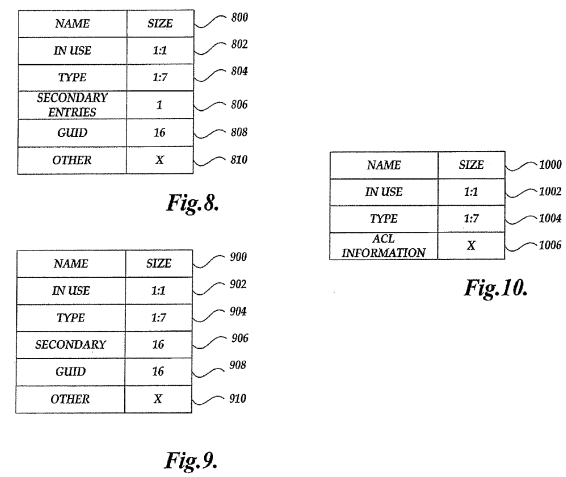
With reference to FIG. 8, a block diagram illustrative of data components 800 for implementing an extensible benign primary directory entry 308 in an extensible file system format will be described. The data components 800 include an in use component 802 for specifying whether the particular directory entry is in use. In an illustrative embodiment, the high bit of the data components will be set to "1" if the directory entry is in use. The data components 800 further include a type designation component 804 for specifying that the directory entry is a benign primary directory entry. The data components800 further include a secondary directory entries component 806 for specifying a number of secondary entries associated with the volume identifier. The data components 800 also include a volume identifier 808, such as a global unique identifier. The data components 800 can further include additional information 810, such as verification information and a starting cluster. One skilled in the relevant art will appreciate that the data components 800 can include a number of additional/alternative rows for implementing the above-identified components 802-506 and additional components.
With reference to FIG. 9, a block diagram illustrative of data components 900 for implementing a benign secondary directory entry in an extensible file system format will be described. The data components 900 include an in use component902 for specifying whether the particular directory entry is in use. In an illustrative embodiment, the high bit of the data components will be set to "1" if the directory entry is in use. The data components 900 further include a type designation component 904 for specifying that the directory entry is a benign primary directory entry. The data components 900 further include a secondary directory entries component 906 for specifying a number of secondary entries associated with the volume identifier. The data components 900 also include a volume identifier 908, such as a global unique identifier. The data components 900 can further include additional information 910, such as verification information and a starting cluster. One skilled in the relevant art will appreciate that the data components 900 can include a number of additional/alternative rows for implementing the above-identified components 902-906 and additional components.
In an illustrative embodiment, a benign primary directory entry and/or secondary directory entries may be associated with access control list (ACL) information. FIG. 10 is a block diagram illustrative of data components 1000 for implementing an access control list in an extensible file system format. The data components 1000 include an in use component 1002 for specifying whether the particular directory entry is in use. In an illustrative embodiment, the high bit of the data components will be set to "1" if the directory entry is in use. The data components 1000 further include a type designation component1004 for specifying that the directory entry is an ACL directory entry. The data components 1000 further include a number of ACL fields 1006, such as ACL flags, pointers to ACL databases, and the like. One skilled in the relevant art will appreciate that the data components 1000 can include a number of additional/alternative rows for implementing the above-identified components 1002-1006 and additional components.
With reference now to FIG. 11, a file name creation routine 1100 for an extensible file system format will be described. At block 1102, a file system obtains a request to create a directory entry with a specific file name. In an illustrative embodiment, the specific file name can correspond to a naming convention, such as a digital camera picture naming convention. At block 1104, the file system generates a target name hash. At block 1106, an iterative loop is begun by examining the next directory entry hash value. An illustrative directory entry type for storing directory entry hash values is described above with regard to data components 600 (FIG. 6).
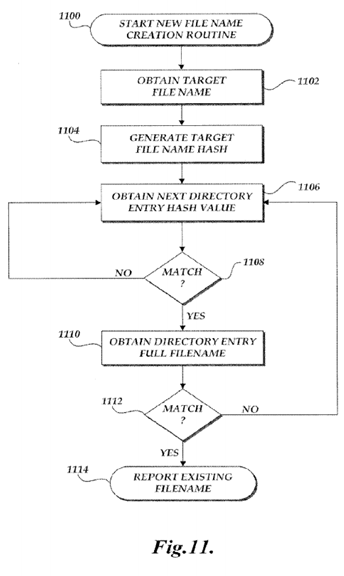
At decision block 1108, a test is conducted to determine whether the target hash value matches the current directory entry hash value. If they do not match, the routine 1100 returns to block 1106 (until all the directory entries have been examined). If the hash values match at decision block 1108, at block 1110, the file system obtains the full file name for the potentially matching directory entry. An illustrative directory entry type for storing directory entry full file names is described above with regard to data components 600 (FIG. 6). At decision block 1112, a test is conducted to determine whether the target file name matches the full file name of the potentially matching directory entry. If so, the routine 1100 terminates by reporting a conflict and the file system will be required to select a new file name. If the full file does not match, the routine 1100 will return to block 1106 to continue checking hash values for all the directory entries in the file system.
In accordance with an aspect of the present invention, various additional functionality may be added through the specification of specific directory types. For example, name streams may be supported by specifying a name stream directory entry. Additionally, on-disk encryption may also be supported through the utilization of specific encryption algorithms and key exchanges. Still further, time zone conversions may be associated with directory entries to automatically convert a current time zone with a time zone with the directory entry was made.
While illustrative embodiments have been illustrated and described, it will be appreciated that various changes can be made therein without departing from the spirit and scope of the invention.
SRC=https://www.google.com/patents/US20140067885
Extensible File System的更多相关文章
- Parallel file system processing
A treewalk for splitting a file directory is disclosed for parallel execution of work items over a f ...
- 安装linux 报错(initramfs) Unable to find a medium containing a live file system
如题,linux 安装报错:(initramfs) Unable to find a medium containing a live file system 我是用UItraISO做的启动盘遇到这个 ...
- Design and Implementation of the Sun Network File System
Introduction The network file system(NFS) is a client/service application that provides shared file ...
- 乌版图 read-only file system
今天在启动虚拟机的时候,运行命令svn up的时候,提示lock,并且read-only file system,这个....我是小白啊,怎么办?前辈在专心写代码,不好打扰,果断找度娘啊 于是乎,折腾 ...
- File system needs to be upgraded. You have version null and I want version 7
安装hbase时候报错: File system needs to be upgraded. You have version null and I want version 7 注: 我安装的hba ...
- Linux系统启动错误 contains a file system with errors, check forced解决方法
/dev/sda1 contains a file system with errors, check forced./dev/sda1: Inodes that were part of a cor ...
- Linux 执行partprobe命令时遇到Unable to open /dev/sr0 read-write (Read-only file system)
在使用fdisk创建分区时,我们会使用partprobe命令可以使kernel重新读取分区信息,从而避免重启系统,但是有时候会遇到下面错误信息"Warning: Unable to open ...
- 磁盘、分区及Linux文件系统 [Disk, Partition, Linux File System]
1.磁盘基础知识 1.1 物理结构 硬盘的物理结构一般由磁头与碟片.电动机.主控芯片与排线等部件组成:当主电动机带动碟片旋转时,副电动机带动一组(磁头)到相对应的碟片上并确定读取正面还是反面的碟面,磁 ...
- Linux File System
目录 . Linux文件系统简介 . 通用文件模型 . VFS相关数据结构 . 处理VFS对象 . 标准函数 1. Linux文件系统简介 Linux系统由数以万计的文件组成,其数据存储在硬盘或者其他 ...
随机推荐
- Apache的.htaccess项目根文件夹伪静态设置规则
watermark/2/text/aHR0cDovL2Jsb2cuY3Nkbi5uZXQv/font/5a6L5L2T/fontsize/400/fill/I0JBQkFCMA==/dissolve/ ...
- GMTC2019会后:做一场冷门的技术专场是什么体验
上周四(6.20)GMTC2019大会的第一天,很荣幸作为「UI与图形渲染」专场出品人获得了与图形领域几位技术专家同场交流的机会. 图形技术在前端范畴内是一个相对小众的话题,虽然前端工程师几乎每天都在 ...
- Android之怎样用代码使编辑框等组件显示为圆角
圆角button实现 圆角button大家很常见.有时候你可能会使用ps来加工圆角图片来实现想要的效果, 今天通过简短的代码来达到这样的效果.(由于这个跟project无关.仅仅是一种效果,所以我就单 ...
- trident原理及编程指南
目录 trident原理及编程指南 一.理论介绍 1.trident是什么? 2.trident处理单位 3.事务类型 二.编程指南 1.定义输入流 2.统计单词数量 3.输出统计结果 4.split ...
- js实现点击不同的按钮后各自返回被点击的次数
js实现点击不同的按钮后各自返回被点击的次数 一.总结 1.注意:返回的不是三个按钮总的点击数,而是每一个的 2.用全局变量的话每一个按钮要多一个函数,用闭包就很方便 二.js实现点击不同的按钮后各自 ...
- 【Codeforces Round #439 (Div. 2) A】The Artful Expedient
[链接] 链接 [题意] [题解] 暴力 [错的次数] 在这里输入错的次数 [反思] 在这里输入反思 [代码] #include <bits/stdc++.h> using namespa ...
- 借助gdb实现pstack
pstack.sh: #! /bin/sh if [ -z $1 ] then echo "gdb script for print stack" echo "usage ...
- jquery 无刷新上传的小function
function zll_up(click_id,up_url,text_id,show_id){ this.create = function(){} //当点击指定元素时,创建iframe for ...
- Call to a member function assign() on a non-object;thinkphp中报错
这个在自己写的类中 需要function __construct(){parent::__construct();}继承父类构造函数 当发生这个错误的时候,需要在构造函数中集成父类构造
- NavMesh动态碰撞
今天遇到一个问题,就是怎样处理一些动态的障碍物. NavMesh是能够躲避静态的障碍物.NavMeshObstacle的作用就是动态添加障碍. 可是有个问题,NavMeshObstacle是圆,连椭圆 ...