
Comparable与Comparator源码分析
package java.lang;
import java.util.*; /**
* This interface imposes a total ordering on the objects of each class that
* implements it. This ordering is referred to as the class's <i>natural
* ordering</i>, and the class's <tt>compareTo</tt> method is referred to as
* its <i>natural comparison method</i>.<p>
*
* Lists (and arrays) of objects that implement this interface can be sorted
* automatically by {@link Collections#sort(List) Collections.sort} (and
* {@link Arrays#sort(Object[]) Arrays.sort}). Objects that implement this
* interface can be used as keys in a {@linkplain SortedMap sorted map} or as
* elements in a {@linkplain SortedSet sorted set}, without the need to
* specify a {@linkplain Comparator comparator}.<p>
*
* The natural ordering for a class <tt>C</tt> is said to be <i>consistent
* with equals</i> if and only if <tt>e1.compareTo(e2) == 0</tt> has
* the same boolean value as <tt>e1.equals(e2)</tt> for every
* <tt>e1</tt> and <tt>e2</tt> of class <tt>C</tt>. Note that <tt>null</tt>
* is not an instance of any class, and <tt>e.compareTo(null)</tt> should
* throw a <tt>NullPointerException</tt> even though <tt>e.equals(null)</tt>
* returns <tt>false</tt>.<p>
*
* It is strongly recommended (though not required) that natural orderings be
* consistent with equals. This is so because sorted sets (and sorted maps)
* without explicit comparators behave "strangely" when they are used with
* elements (or keys) whose natural ordering is inconsistent with equals. In
* particular, such a sorted set (or sorted map) violates the general contract
* for set (or map), which is defined in terms of the <tt>equals</tt>
* method.<p>
*
* For example, if one adds two keys <tt>a</tt> and <tt>b</tt> such that
* {@code (!a.equals(b) && a.compareTo(b) == 0)} to a sorted
* set that does not use an explicit comparator, the second <tt>add</tt>
* operation returns false (and the size of the sorted set does not increase)
* because <tt>a</tt> and <tt>b</tt> are equivalent from the sorted set's
* perspective.<p>
*
* Virtually all Java core classes that implement <tt>Comparable</tt> have natural
* orderings that are consistent with equals. One exception is
* <tt>java.math.BigDecimal</tt>, whose natural ordering equates
* <tt>BigDecimal</tt> objects with equal values and different precisions
* (such as 4.0 and 4.00).<p>
*
* For the mathematically inclined, the <i>relation</i> that defines
* the natural ordering on a given class C is:<pre>
* {(x, y) such that x.compareTo(y) <= 0}.
* </pre> The <i>quotient</i> for this total order is: <pre>
* {(x, y) such that x.compareTo(y) == 0}.
* </pre>
*
* It follows immediately from the contract for <tt>compareTo</tt> that the
* quotient is an <i>equivalence relation</i> on <tt>C</tt>, and that the
* natural ordering is a <i>total order</i> on <tt>C</tt>. When we say that a
* class's natural ordering is <i>consistent with equals</i>, we mean that the
* quotient for the natural ordering is the equivalence relation defined by
* the class's {@link Object#equals(Object) equals(Object)} method:<pre>
* {(x, y) such that x.equals(y)}. </pre><p>
*
* This interface is a member of the
* <a href="{@docRoot}/../technotes/guides/collections/index.html">
* Java Collections Framework</a>.
*
* @param <T> the type of objects that this object may be compared to
*
* @author Josh Bloch
* @see java.util.Comparator
* @since 1.2
*/
public interface Comparable<T> {
public int compareTo(T o);
}
实现这个接口的类的集合或数组将会被自动排序通过Collections.sort或者Arrays.sort。同时,这个对象也可以被用来做Map或者Set的键值,而不需要另外制定一个比较器。
废话不多说了,直接举例子。
package object;

public class Person implements Comparable<Object>{

    private String name;

    private int age;

    Person(String name,int age){

        this.name=name;

        this.age=age;

    }

    public int getAge() {

        return age;

    }

    public void setAge(int age) {

        this.age = age;

    }

    public String getName() {

        return name;

    }

    public void setName(String name) {

        this.name = name;

    }

    @Override

    public String toString() {

        return "姓名:"+this.name +";年龄: " + this.age;

    }

    @Override

    public int compareTo(Object o) {

        Person temp =null;

        if(o instanceof Person )

            temp = (Person)(o);

        return this.age - temp.age;

    }

}
测试类:
public class Test{

    @org.junit.Test

    public void test(){

        Person[] people = {new Person("tom",21),new Person("jerry",18),new Person("dog",17)};

        System.out.println("排序前");

        for(Person p:people)

            System.out.println(p);

        System.out.println("排序后");

        java.util.Arrays.sort(people);

        for(Person p:people)

            System.out.println(p);

    }

}
结果:
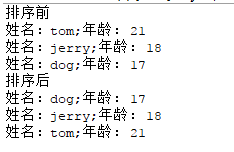
大家可以看到,这个排序方法是放到排序的对象类里面的,但是如果我们已经设计好了某类,而且不想改变其数据结构,就这可以用到比较器Comparator。用 Comparator 是策略模式,就是不改变对象自身,而用一个策略对象来改变它的行为。
package java.util;

import java.io.Serializable;

import java.util.function.Function;

import java.util.function.ToIntFunction;

import java.util.function.ToLongFunction;

import java.util.function.ToDoubleFunction;

import java.util.Comparators;

@FunctionalInterface

public interface Comparator<T> {

    int compare(T o1, T o2);

    boolean equals(Object obj);

}
Comparator里面只有两个无实现体的接口方法,其它的方法有实现体,好像是新特性,暂时未用到。这里的equals与Object的equals方法类似。所以对于实现这个接口的类不必实现equals方法,也不会报错。
下面的例子我用的是匿名函数。
package object;

public class Person{

    private String name;

    private int age;

    Person(String name,int age){

        this.name=name;

        this.age=age;

    }

    public int getAge() {

        return age;

    }

    public void setAge(int age) {

        this.age = age;

    }

    public String getName() {

        return name;

    }

    public void setName(String name) {

        this.name = name;

    }

    @Override

    public String toString() {

        return "姓名:"+this.name +";年龄: " + this.age;

    }

}
测试类:
public class Test{

    @org.junit.Test

    public void test(){

        Person[] people = {new Person("tom",21),new Person("jerry",18),new Person("dog",17)};

        System.out.println("排序前");

        for(Person p:people)

            System.out.println(p);

        System.out.println("排序后");

        Arrays.sort(people, new Comparator<Person>() {

            public int compare(Person o1, Person o2) {

                return o1.getAge()-o2.getAge();};

        });

        for(Person p:people)

            System.out.println(p);

    }

}
结果:

总结:
用Comparable 简单, 只要实现Comparable 接口的对象直接就成为一个可以比较的对象,但是需要修改源代码,用Comparator 的好处是不需要修改源代码,而是另外实现一个比较器,当某个自定义的对象需要作比较的时候,把比较器和对象一起传递过去就可以比大小了,并且在Comparator 里面用户可以自己实现复杂的可以通用的逻辑,使其可以匹配一些比较简单的对象,那样就可以节省很多重复劳动了。
Comparable与Comparator源码分析的更多相关文章
- 【集合框架】JDK1.8源码分析之Comparable && Comparator(九)
一.前言 在Java集合框架里面,各种集合的操作很大程度上都离不开Comparable和Comparator,虽然它们与集合没有显示的关系,但是它们只有在集合里面的时候才能发挥最大的威力.下面是开始我 ...
- java中Comparator比较器顺序问题,源码分析
提示: 分析过程是个人的一些理解,如有不对的地方,还请大家见谅,指出错误,共同学习. 源码分析过程中由于我写的注释比较啰嗦.比较多,导致文中源代码不清晰,还请一遍参照源代码,一遍参照本文进行阅读. 原 ...
- HashMap与TreeMap源码分析
1. 引言 在红黑树--算法导论(15)中学习了红黑树的原理.本来打算自己来试着实现一下,然而在看了JDK(1.8.0)TreeMap的源码后恍然发现原来它就是利用红黑树实现的(很惭愧学了Ja ...
- 【集合框架】JDK1.8源码分析之TreeMap(五)
一.前言 当我们需要把插入的元素进行排序的时候,就是时候考虑TreeMap了,从名字上来看,TreeMap肯定是和树是脱不了干系的,它是一个排序了的Map,下面我们来着重分析其源码,理解其底层如何实现 ...
- 【集合框架】JDK1.8源码分析之Collections && Arrays(十)
一.前言 整个集合框架的常用类我们已经分析完成了,但是还有两个工具类我们还没有进行分析.可以说,这两个工具类对于我们操作集合时相当有用,下面进行分析. 二.Collections源码分析 2.1 类的 ...
- 【JUC】JDK1.8源码分析之ConcurrentSkipListMap(二)
一.前言 最近在做项目的同时也在修复之前项目的一些Bug,所以忙得没有时间看源代码,今天都完成得差不多了,所以又开始源码分析之路,也着笔记录下ConcurrentSkipListMap的源码的分析过程 ...
- Java中Comparable和Comparator接口区别分析
Java中Comparable和Comparator接口区别分析 来源:码农网 | 时间:2015-03-16 10:25:20 | 阅读数:8902 [导读] 本文要来详细分析一下Java中Comp ...
- Java集合源码分析(六)TreeSet<E>
TreeSet简介 TreeSet 是一个有序的集合,它的作用是提供有序的Set集合.它继承于AbstractSet抽象类,实现了NavigableSet<E>, Cloneable, j ...
- Java集合类源码分析
常用类及源码分析 集合类 原理分析 Collection List Vector 扩充容量的方法 ensureCapacityHelper很多方法都加入了synchronized同步语句,来保 ...
随机推荐
- RunLoop相关知识
RunLoop,翻译过来是运行环路.我们在创建命令行项目和创建ios项目时,发现命令行项目当最后一行代码执行完后项目就自动退出了,而ios项目确可以一直运行,知道用户手动点击退出按钮.这就是因为ios ...
- Mysql正则
摘自:http://www.runoob.com/mysql/mysql-regexp.html 模式 描述 ^ 匹配输入字符串的开始位置.如果设置了 RegExp 对象的 Multiline 属性, ...
- Vue双向数据绑定实现原理
https://zendq1998.github.io/2018/04/12/vue%E5%8F%8C%E5%90%91%E6%95%B0%E6%8D%AE%E7%BB%91%E5%AE%9A%E5% ...
- golang入门-defer
package main import "fmt" func main() { i := 5 tmap := make(map[string]int, 5) tmap[" ...
- HDU 5729 Rigid Frameworks (联通块计数问题)
题目传送门 通过看题解画图可以发现: 不论怎么转,一列里的横边/一行里的竖边始终平行 当我们加固一个格子时,会让它所在的这一行的竖边和这一列的横边保证垂直 而我们的目标是求所有竖边和横边都保证垂直的方 ...
- 算法工程师首先是工程师系列01 - 服务器篇 - 物理服务器安装centos7
尤其在互联网公司中,如果不是分工特别明确的独立业务组,通常需要自己处理很多东西,例如一个算法工程师,虽然不要求你装机,但是和负责部署服务的同事对接口,总不能连json是啥都不知道(工作中遇到过一个ET ...
- Linux—Ubuntu14.0.5安装gitlab
1.下载gitlab-ce,到该连接选择版本 https://mirror.tuna.tsinghua.edu.cn/gitlab-ce/ubuntu/pool/trusty/main/g/git ...
- 渗透实战(周一):VMmare Fusion安装Kali Linux和win7虚拟机
高配笔记本电脑i5/8G/265G .VMware Fusion .Kali Linux镜像 .Win7镜像 第一:下载软件 1.如果你是苹果系统,建议下载最新VMware Fusion 11.0. ...
- 1 java开发工具IDEA的使用
IntelliJ IDEA 2017.1汉化破解版安装图文教程(附汉化补丁) 注册码:http://idea.lanyus.com/ 点击在线生成 IntelliJ IDEA 2017.1正式版发布 ...
- JavaSE 学习笔记之Java语法基础(二)
1,关键字:其实就是某种语言赋予了特殊含义的单词. 保留字:其实就是还没有赋予特殊含义,但是准备日后要使用过的单词. 2,标示符:其实就是在程序中自定义的名词.比如类名,变量名,函数名.包含 0-9. ...