
机器学习之决策树熵&信息增量求解算法实现
此文不对理论做相关阐述,仅涉及代码实现:
1.熵计算公式:
P为正例,Q为反例
Entropy(S) = -PLog2(P) - QLog2(Q);
2.信息增量计算:
Gain(S,Sv) = Entropy(S) - (|Sv|/|S|)ΣEntropy(Sv);
举例:
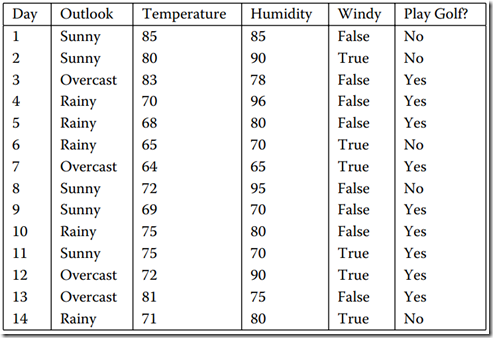
转化数据输入:
 5  14

 Outlook       Sunny  Sunny  Overcast  Rain  Rain    Rain    Overcast  Sunny  Sunny    Rain    Sunny   Overcast   Overcast    Rain

 Temperature   Hot    Hot    Hot       Mild  Cool    Cool        Cool   Mild  Cool     Mild    Mild    Mild       Hot         Mild

 Humidity      High   High   High      High  Normal  Normal  Normal     High  Normal   Normal  Normal  High       Normal      High

 Wind          Weak   Strong Weak      Weak  Weak    Strong  Strong    Weak   Weak     Weak    Strong  Strong     Weak        Strong

 PlayTennis    No     No     Yes       Yes   Yes     No      Yes       No     Yes      Yes     Yes     Yes        Yes         No

 Outlook Temperature Humidity Wind PlayTennis
 package com.qunar.data.tree;

 /**

  * *********************************************************

  * <p/>

  * Author:     XiJun.Gong

  * Date:       2016-09-02 15:28

  * Version:    default 1.0.0

  * Class description:

  * <p>统计该类型出现的次数</p>

  * <p/>

  * *********************************************************

  */

 public class CountMap<T> {

     private T key;     //类型

     private int value;   //出现的次数

     public CountMap() {

         this(null, 0);

     }

     public CountMap(T key, int value) {

         this.key = key;

         this.value = value;

     }

     public T getKey() {

         return key;

     }

     public void setKey(T key) {

         this.key = key;

     }

     public int getValue() {

         return value;

     }

     public void setValue(int value) {

         this.value = value;

     }

 }
 package com.qunar.data.tree;

 import com.google.common.collect.ArrayListMultimap;

 import com.google.common.collect.Maps;

 import com.google.common.collect.Multimap;

 import com.google.common.collect.Sets;

 import java.util.*;

 /**

  * *********************************************************

  * <p/>

  * Author:     XiJun.Gong

  * Date:       2016-09-02 14:24

  * Version:    default 1.0.0

  * Class description:

  * <p>决策树</p>

  * <p/>

  * *********************************************************

  */

 public class DecisionTree<T, K> {

     private static String positiveExampleType = "Yes";

     private static String counterExampleType = "No";

     public double pLog2(final double p) {

         if (0 == p) return 0;

         return p * (Math.log(p) / Math.log(2));

     }

     /**

      * 熵计算

      *

      * @param positiveExample 正例个数

      * @param counterExample  反例个数

      * @return 熵值

      */

     public double entropy(final double positiveExample, final double counterExample) {

         double total = positiveExample + counterExample;

         double positiveP = positiveExample / total;

         double counterP = counterExample / total;

         return -1d * (pLog2(positiveP) + pLog2(counterP));

     }

     /**

      * @param features 特征列表

      * @param results  对应结果

      * @return 将信息整合成新的格式

      */

     public Multimap<T, CountMap<K>> merge(final List<T> features, final List<T> results) {

         //数据转化

         Multimap<T, CountMap<K>> InfoMap = ArrayListMultimap.create();

         Iterator result = results.iterator();

         for (T feature : features) {

             K res = (K) result.next();

             boolean tag = false;

             Collection<CountMap<K>> countMaps = InfoMap.get(feature);

             for (CountMap countMap : countMaps) {

                 if (countMap.getKey().equals(res)) {

                     /*修改值*/

                     int num = countMap.getValue() + 1;

                     InfoMap.remove(feature, countMap);

                     InfoMap.put(feature, new CountMap<K>(res, num));

                     tag = true;

                     break;

                 }

             }

             if (!tag)

                 InfoMap.put(feature, new CountMap<K>(res, 1));

         }

         return InfoMap;

     }

     /**

      * 信息增益

      *

      * @param infoMap   因素(Outlook,Temperature,Humidity,Wind)对应的结果

      * @param dataTable 输入的数据表

      * @param type      因素中的类型(Outlook{Sunny,Overcast,Rain})

      * @param entropyS  总的熵值

      * @param totalSize 总的样本数

      * @return 信息增益

      */

     public double gain(Multimap<T, CountMap<K>> infoMap,

                        Map<K, List<T>> dataTable,

                        final String type,

                        double entropyS,

                        final int totalSize) {

         //去重

         Set<T> subTypes = Sets.newHashSet();

         subTypes.addAll(dataTable.get(type));

         /*计算*/

         for (T subType : subTypes) {

             Collection<CountMap<K>> countMaps = infoMap.get(subType);

             double subSize = 0;

             double positiveExample = 0;

             double counterExample = 0;

             for (CountMap<K> countMap : countMaps) {

                 subSize += countMap.getValue();

                 if (positiveExampleType.equals(countMap.getKey()))

                     positiveExample = countMap.getValue();

                 else

                     counterExample = countMap.getValue();

             }

             entropyS -= (subSize / totalSize) * entropy(positiveExample, counterExample);

         }

         return entropyS;

     }

     /**

      * 计算

      *

      * @param dataTable  数据表

      * @param types      因素列表{Outlook,Temperature,Humidity,Wind}

      * @param resultType 结果(PlayTennis)

      * @return 返回信息增益集合

      */

     public Map<String, Double> calculate(Map<K, List<T>> dataTable, List<K> types, K resultType) {

         Map<String, Double> answer = Maps.newHashMap();

         List<T> results = dataTable.get(resultType);

         int totalSize = results.size();

         int positiveExample = 0;

         int counterExample = 0;

         double entropyS = 0d;

         for (T ExampleType : results) {

             if (positiveExampleType.equals(ExampleType)) {

                 ++positiveExample;

                 continue;

             }

             ++counterExample;

         }

         /*计算总的熵*/

         entropyS = entropy(positiveExample, counterExample);

         Multimap<T, CountMap<K>> infoMap;

         for (K type : types) {

             infoMap = merge(dataTable.get(type), results);

             double _gain = gain(infoMap, dataTable, (String) type, entropyS, totalSize);

             answer.put((String) type, _gain);

         }

         return answer;

     }

 }  package com.qunar.data.tree;
 import com.google.common.collect.Lists;

 import com.google.common.collect.Maps;

 import java.util.*;

 /**

  * *********************************************************

  * <p/>

  * Author:     XiJun.Gong

  * Date:       2016-09-02 16:43

  * Version:    default 1.0.0

  * Class description:

  * <p/>

  * *********************************************************

  */

 public class Main {

     public static void main(String args[]) {

         Scanner scanner = new Scanner(System.in);

         while (scanner.hasNext()) {

             DecisionTree<String, String> dt = new DecisionTree();

             Map<String, List<String>> dataTable = Maps.newHashMap();

             /*Map<String, List<String>> dataTable = Maps.newHashMap();*/

             List<String> types = Lists.newArrayList();

             String resultType;

             int factorSize = scanner.nextInt();

             int demoSize = scanner.nextInt();

             String type;

             for (int i = 0; i < factorSize; i++) {

                 List<String> demos = Lists.newArrayList();

                 type = scanner.next();

                 for (int j = 0; j < demoSize; j++) {

                     demos.add(scanner.next());

                 }

                 dataTable.put(type, demos);

             }

             for (int i = 1; i < factorSize; i++) {

                 types.add(scanner.next());

             }

             resultType = scanner.next();

             Map<String, Double> ans = dt.calculate(dataTable, types, resultType);

             List<Map.Entry<String, Double>> list = new ArrayList<Map.Entry<String, Double>>(ans.entrySet());

             Collections.sort(list, new Comparator<Map.Entry<String, Double>>() {

                 @Override

                 public int compare(Map.Entry<String, Double> o1, Map.Entry<String, Double> o2) {

                     return (o2.getValue() > o1.getValue() ? 1 : -1);

                 }

             });

             for (Map.Entry<String, Double> iterator : list) {

                 System.out.println(iterator.getKey() + "= " + iterator.getValue());

             }

         }

     }

 }

 /**

  *使用举例:*

  5  14

  Outlook       Sunny  Sunny  Overcast  Rain  Rain    Rain    Overcast  Sunny  Sunny    Rain    Sunny   Overcast   Overcast    Rain

  Temperature   Hot    Hot    Hot       Mild  Cool    Cool        Cool   Mild  Cool     Mild    Mild    Mild       Hot         Mild

  Humidity      High   High   High      High  Normal  Normal  Normal     High  Normal   Normal  Normal  High       Normal      High

  Wind          Weak   Strong Weak      Weak  Weak    Strong  Strong    Weak   Weak     Weak    Strong  Strong     Weak        Strong

  PlayTennis    No     No     Yes       Yes   Yes     No      Yes       No     Yes      Yes     Yes     Yes        Yes         No

  Outlook Temperature Humidity Wind PlayTennis

  */
结果:
Outlook= 0.2467498197744391

Humidity= 0.15183550136234136

Wind= 0.04812703040826927

Temperature= 0.029222565658954647
机器学习之决策树熵&信息增量求解算法实现的更多相关文章
- 机器学习之决策树(ID3)算法与Python实现
机器学习之决策树(ID3)算法与Python实现 机器学习中,决策树是一个预测模型:他代表的是对象属性与对象值之间的一种映射关系.树中每个节点表示某个对象,而每个分叉路径则代表的某个可能的属性值,而每 ...
- 【Machine Learning·机器学习】决策树之ID3算法(Iterative Dichotomiser 3)
目录 1.什么是决策树 2.如何构造一棵决策树? 2.1.基本方法 2.2.评价标准是什么/如何量化评价一个特征的好坏? 2.3.信息熵.信息增益的计算 2.4.决策树构建方法 3.算法总结 @ 1. ...
- 决策树笔记:使用ID3算法
决策树笔记:使用ID3算法 决策树笔记:使用ID3算法 机器学习 先说一个偶然的想法:同样的一堆节点构成的二叉树,平衡树和非平衡树的区别,可以认为是"是否按照重要度逐渐降低"的顺序 ...
- 从决策树学习谈到贝叶斯分类算法、EM、HMM --别人的,拷来看看
从决策树学习谈到贝叶斯分类算法.EM.HMM 引言 最近在面试中,除了基础 & 算法 & 项目之外,经常被问到或被要求介绍和描述下自己所知道的几种分类或聚类算法(当然,这完全 ...
- 从决策树学习谈到贝叶斯分类算法、EM、HMM
从决策树学习谈到贝叶斯分类算法.EM.HMM (Machine Learning & Recommend Search交流新群:172114338) 引言 log ...
- 机器学习实战 -- 决策树(ID3)
机器学习实战 -- 决策树(ID3) ID3是什么我也不知道,不急,知道他是干什么的就行 ID3是最经典最基础的一种决策树算法,他会将每一个特征都设为决策节点,有时候,一个数据集中,某些特征属 ...
- pyhton机器学习入门基础(机器学习与决策树)
//2019.07.26#scikit-learn数据挖掘工具包1.Scikit learn是基于python的数据挖掘和机器学习的工具包,方便实现数据的数据分析与高级操作,是数据分析里面非常重要的工 ...
- 机器学习实战---决策树CART回归树实现
机器学习实战---决策树CART简介及分类树实现 一:对比分类树 CART回归树和CART分类树的建立算法大部分是类似的,所以这里我们只讨论CART回归树和CART分类树的建立算法不同的地方.首先,我 ...
- Python机器学习笔记:奇异值分解(SVD)算法
完整代码及其数据,请移步小编的GitHub 传送门:请点击我 如果点击有误:https://github.com/LeBron-Jian/MachineLearningNote 奇异值分解(Singu ...
随机推荐
- java实现ftp文件的上传与下载
最近在做ftp文件的上传与下载,基于此,整理了一下资料.本来想采用java自带的方法,可是看了一下jdk1.6与1.7的实现方法有点区别,于是采用了Apache下的框架实现的... 1.首先引用3个包 ...
- Android EditText中插入话题模块的删除处理方法
在 EditText 中添加话题 或者是 @某人 时 看起来挺简单,实际操作会有很多坑爹的问题 private String mTopic: //光标保持在话题的末尾 mInputEdit.setOn ...
- C++模拟实现JDK中的ArrayList和LinkedList
Java实现ArrayList和LinkedList的方式采用的是数组和链表.以下是用C++代码的模拟: 声明Collection接口: #ifndef COLLECTION_H_ #define C ...
- Canny边缘检测
1.Canny边缘检测基本原理 (1)图象边缘检测必须满足两个条件:一能有效地抑制噪声:二必须尽量精确确定边缘的位置. (2)根据对信噪比与定位乘积进行测度,得到最优化逼近算子.这 ...
- C语言-循环结构及break、continue
循环结构 --1-- 结构循环 1.1 while循环 1.2 do…while循环 1.3 for循环 --2-- break和continue 2.1 break关键字 2.2 continue关 ...
- apache开启.htaccess及.htaccess的使用方法(转)
apache开启.htaccess及.htaccess的使用方法 作者: 字体:[增加 减小] 类型:转载 时间:2010-12-02 今天本地调试PHP程序,用到了.htaccess,而默认配置里面 ...
- 浪潮 NF5240M3 ,NP5540M3 服务器安装2008 R2
1,服务器系统的安装会出现错误的地方一般都是在Raid 卡驱动 略过Raid 卡配置, 具体 http://jingyan.baidu.com/article/ca41422fddfd201eae99 ...
- item布局里有button之类的子控件时,会截获焦点
需要以上问题时,网上查了很多,结果都是使用android:descendantFocusability属性,设为blocksDescendants就ok了,(具体不详叙述) 可是我给item的根布局设 ...
- 微信小程序-视图事件
事件 什么是事件 事件是视图层到逻辑层的通讯方式. 事件可以将用户的行为反馈到逻辑层进行处理. 事件可以绑定在组件上,当达到触发事件,就会执行逻辑层中对应的事件处理函数. 事件对象可以携带额外信息,如 ...
- 代码性能优化——task
var t1 = Task.Factory.StartNew(delegate { //代码(查接口.数据库) }); 缺点: 不能使用request( HttpContext.Current.Req ...