
(转)Nuts and Bolts of Applying Deep Learning

Nuts and Bolts of Applying Deep Learning
Sep 26, 2016
This weekend was very hectic (catching up on courses and studying for a statistics quiz), but I managed to squeeze in some time to watch the Bay Area Deep Learning School livestream on YouTube. For those of you wondering what that is, BADLS is a 2-day conference hosted at Stanford University, and consisting of back-to-back presentations on a variety of topics ranging from NLP, Computer Vision, Unsupervised Learning and Reinforcement Learning. Additionally, top DL software libraries were presented such as Torch, Theano and Tensorflow.
There were some super interesting talks from leading experts in the field: Hugo Larochelle from Twitter, Andrej Karpathy from OpenAI, Yoshua Bengio from the Université de Montreal, and Andrew Ng from Baidu to name a few. Of the plethora of presentations, there was one somewhat non-technical one given by Andrew that really piqued my interest.
In this blog post, I’m gonna try and give an overview of the main ideas outlined in his talk. The goal is to pause a bit and examine the ongoing trends in Deep Learning thus far, as well as gain some insight into applying DL in practice.
By the way, if you missed out on the livestreams, you can still view them at the following: Day 1 and Day 2.
Table of Contents:
- Major Deep Learning Trends
- End-to-End Deep Learning
- Bias-Variance Tradeoff
- Human-level Performance
- Personal Advice
Major Deep Learning Trends
Why do DL algorithms work so well? According to Ng, with the rise of the Internet, Mobile and IOT era, the amount of data accessible to us has greatly increased. This correlates directly to a boost in the performance of neural network models, especially the larger ones which have the capacity to absorb all this data.
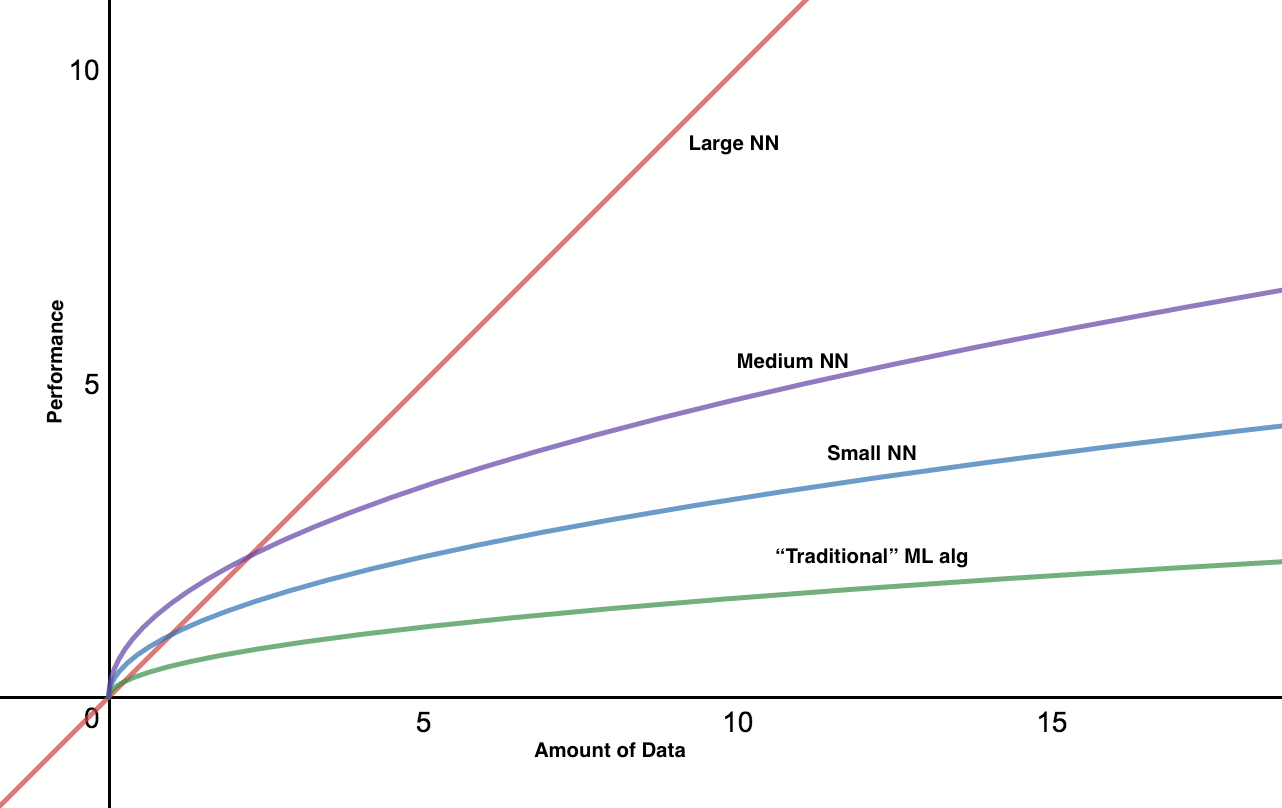
However, in the small data regime (left-hand side of the x-axis), the relative ordering of the algorithms is not that well defined and really depends on who is more motivated to engineer their features better, or refine and tune the hyperparameters of their model.
Thus this trend is more prevalent in the big data realm where hand engineering effectively gets replaced by end-to-end approaches and bigger neural nets combined with a lot of data tend to outperform all other models.
Machine Learning and HPC team. The rise of big data and the need for larger models has started to put pressure on companies to hire a Computer Systems team. This is because some of the HPC (high-performance computing) applications require highly specialized knowledge and it is difficult to find researchers and engineers with sufficient knowledge in both fields. Thus, cooperation from both teams is the key to boosting performance in AI companies.
Categorizing DL models. Work in DL can be categorized in the following 4 buckets:

Most of the value in the industry today is driven by the models in the orange blob (innovation and monetization mostly) but Andrew believes that unsupervised deep learning is a super-exciting field that has loads of potential for the future.
The rise of End-to-End DL
A major improvement in the end-to-end approach has been the fact that outputs are becoming more and more complicated. For example, rather than just outputting a simple class score such as 0 or 1, algorithms are starting to generate richer outputs: images like in the case of GAN’s, full captions with RNN’s and most recently, audio like in DeepMind’s WaveNet.
So what exactly does end-to-end training mean? Essentially, it means that AI practitioners are shying away from intermediate representations and going directly from one end (raw input) to the other end (output) Here’s an example from speech recognition.

Are there any disadvantages to this approach? End-to-end approaches are data hungry meaning they only perform well when provided with a huge dataset of labelled examples. In practice, not all applications have the luxury of large labelled datasets so other approaches which allow hand-engineered information and field expertise to be added into the model have gained the upper hand. As an example, in a self-driving car setting, going directly from the raw image to the steering direction is pretty difficult. Rather, many features such as trajectory and pedestrian location are calculated first as intermediate steps.
The main take-away from this section is that we should always be cautious of end-to-end approaches in applications where huge data is hard to come by.
Bias-Variance Tradeoff
Splitting your data. In most deep learning problems, train and test come from different distributions. For example, suppose you are working on implementing an AI powered rearview mirror and have gathered 2 chunks of data: the first, larger chunk comes from many places (could be partly bought, and partly crowdsourced) and the second, much smaller chunk is actual car data.
In this case, splitting the data into train/dev/test can be tricky. One might be tempted to carve the dev set out of the training chunk like in the first example of the diagram below. (Note that the chunk on the left corresponds to data mined from the first distribution and the one on the right to the one from the second distribution.)

This is bad because we usually want our dev and test to come from the same distribution. The reason for this is that because a part of the team will be spending a lot of time tuning the model to work well on the dev set, if the test set were to turn out very different from the dev set, then pretty much all the work would have been wasted effort.
Hence, a smarter way of splitting the above dataset would be just like the second line of the diagram. Now in practice, Andrew recommends creating dev sets from both data distributions: a train-dev and test-dev set. In this manner, any gap between the different errors can help you tackle the problem more clearly.

Flowchart for working with a model. Given what we have described above, here’s a simplified flowchart of the actions you should take when confronted with training/tuning a DL model.

The importance of data synthesis. Andrew also stressed the importance of data synthesis as part of any workflow in deep learning. While it may be painful to manually engineer training examples, the relative gain in performance you obtain once the parameters and the model fit well are huge and worth your while.
Human-level Performance
One of the very important concepts underlined in this lecture was that of human-level performance. In the basic setting, DL models tend to plateau once they have reached or surpassed human-level accuracy. While it is important to note that human-level performance doesn’t necessarily coincide with the golden bayes error rate, it can serve as a very reliable proxy which can be leveraged to determine your next move when training your model.
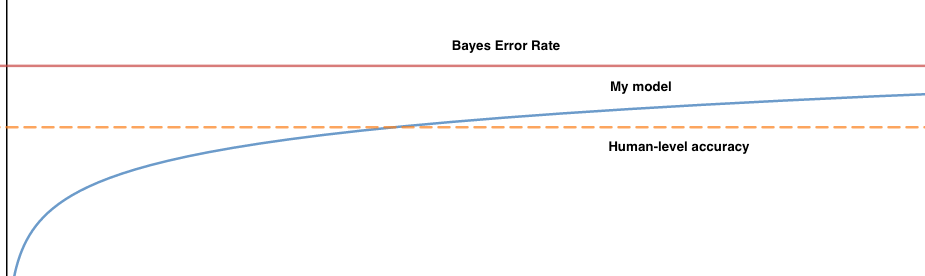
Reasons for the plateau. There could be a theoretical limit on the dataset which makes further improvement futile (i.e. a noisy subset of the data). Humans are also very good at these tasks so trying to make progress beyond that suffers from diminishing returns.
Here’s an example that can help illustrate the usefulness of human-level accuracy. Suppose you are working on an image recognition task and measure the following:
- Train error: 8%
- Dev Error: 10%
If I were to tell you that human accuracy for such a task is on the order of 1%, then this would be a blatant bias problem and you could subsequently try increasing the size of your model, train longer etc. However, if I told you that human-level accuracy was on the order of 7.5%, then this would be more of a variance problem and you’d focus your efforts on methods such as data synthesis or gathering data more similar to the test.
By the way, there’s always room for improvement. Even if you are close to human-level accuracy overall, there could be subsets of the data where you perform poorly and working on those can boost production performance greatly.
Finally, one might ask what is a good way of defining human-level accuracy. For example, in the following image diagnosis setting, ignoring the cost of obtaining data, how should one pick the criteria for human-level accuracy?
- typical human: 5%
- general doctor: 1%
- specialized doctor: 0.8%
- group of specialized doctors: 0.5%
The answer is always the best accuracy possible. This is because, as we mentioned earlier, human-level performance is a proxy for the bayes optimal error rate, so providing a more accurate upper bound to your performance can help you strategize your next move.
Personal Advice
Andrew ended the presentation with 2 ways one can improve his/her skills in the field of deep learning.
- Practice, Practice, Practice: compete in Kaggle competitions and read associated blog posts and forum discussions.
- Do the Dirty Work: read a lot of papers and try to replicate the results. Soon enough, you’ll get your own ideas and build your own models.
(转)Nuts and Bolts of Applying Deep Learning的更多相关文章
- 《Applying Deep Learning to Answer Selection: A Study And an Open Task》文章理解小结
本篇论文是2015年的IBM watson团队的. 论文地址: 这是一篇关于QA问题的一篇论文: 相关论文讲解1.https://www.jianshu.com/p/48024e9f7bb22.htt ...
- Decision Boundaries for Deep Learning and other Machine Learning classifiers
Decision Boundaries for Deep Learning and other Machine Learning classifiers H2O, one of the leading ...
- What are some good books/papers for learning deep learning?
What's the most effective way to get started with deep learning? 29 Answers Yoshua Bengio, ...
- Deep learning:四十九(RNN-RBM简单理解)
前言: 本文主要是bengio的deep learning tutorial教程主页中最后一个sample:rnn-rbm in polyphonic music. 即用RNN-RBM来model复调 ...
- (转)分布式深度学习系统构建 简介 Distributed Deep Learning
HOME ABOUT CONTACT SUBSCRIBE VIA RSS DEEP LEARNING FOR ENTERPRISE Distributed Deep Learning, Part ...
- (转)WHY DEEP LEARNING IS SUDDENLY CHANGING YOUR LIFE
Main Menu Fortune.com E-mail Tweet Facebook Linkedin Share icons By Roger Parloff Illustration ...
- Advice for applying Machine Learning
https://jmetzen.github.io/2015-01-29/ml_advice.html Advice for applying Machine Learning This post i ...
- (转) Deep Learning in a Nutshell: Core Concepts
Deep Learning in a Nutshell: Core Concepts Share: Posted on November 3, 2015by Tim Dettmers 7 Comm ...
- (转)The 9 Deep Learning Papers You Need To Know About (Understanding CNNs Part 3)
Adit Deshpande CS Undergrad at UCLA ('19) Blog About The 9 Deep Learning Papers You Need To Know Abo ...
随机推荐
- WordPress已占全球网站平台18.9%的份额
Automattic创始人马特·穆伦维格(Matt Mullenweg)在旧金山的WordCamp会议上谈到了旗下博客平台WordPress的最新发展情况.WordPress平台已成为全球18.9%网 ...
- android发短信,打电话
//1.进入系统短信列表界面 Intent intent = newIntent(Intent.ACTION_MAIN); intent.addCategory(Intent.CATEGORY_DEF ...
- jquery closest & parent比较
.closest() .parents() 从当前元素开始 从父元素开始 沿 DOM 树向上遍历,直到找到已应用选择器的一个匹配为止. 沿 DOM 树向上遍历,直到文档的根元素为止,将每个祖先元素添加 ...
- [LeetCode] 690. Employee Importance_Easy tag: BFS
You are given a data structure of employee information, which includes the employee's unique id, his ...
- javascript实现unicode与字符互相转换
javascript实现unicode与字符互相转换. <script language="javascript"> //手机检测 function checkMo ...
- BootStrap同时显示多个Modal解决方案
使用BootStrap自带的Modal的时候,如果同时调用多个Modal,那么只能看到背景颜色加深但是看不见新的Modal页面. 问题主要是Modal的z-index有问题,重新计算z-index并赋 ...
- windows 7 中使用命令行创建WiFi热点
就是让你的电脑可以作为WiFi热点,然后供其它支持WiFi的设备上网 首先你的电脑中必须有正常使用的无线网卡 幺幺幺切克闹,开始命令吧,(注:命令是在windows中的命令提示符中运行的) 禁用承载网 ...
- [转]C语言四书五经
我们来说说C语言方面的图书.什么,C语言?有读者奇怪了.没错,这一次的主角就是诞生于1973年如今已经儿孙满堂的C语言.我们之所以要谈及C,不仅仅是因为它的影响深远,这完全可以从C系列语言家族的兴旺发 ...
- cf 459E
cf459E 这题说的是 给定一个n点m条边的带边权的有向图,从中找出一条路径(可以带环),该路径包含的边数最多,并且要求路径中的权值必须严格递增,然后对边进行排序完个后采用dp去解特殊判断一下边权值 ...
- JavaScript: apply 方法 详解(转)——非常好
转载自 http://www.cnblogs.com/KeenLeung/archive/2012/11/19/2778229.html 我在一开始看到javascript的函数apply和call ...