
POJ2676 – Sudoku(数独)—DFS
| Time Limit: 2000MS | Memory Limit: 65536K | |||
| Total Submissions: 24081 | Accepted: 11242 | Special Judge | ||
Description
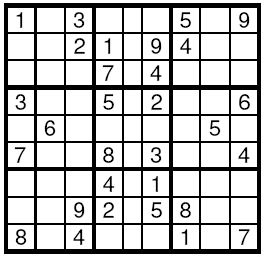
Input
Output
Sample Input
1

103000509

002109400

000704000

300502006

060000050

700803004

000401000

009205800

804000107
Sample Output
143628579

572139468

986754231

391542786

468917352

725863914

237481695

619275843

854396127

题意:就是普通的数独游戏,给出了初始状态的九宫格,让你打印出任意一种解法。
思路:这题用DFS来写。我们运用三个数组进行标记,从而得知每个格子可以放那些数,不可以放哪些数,然后dfs枚举即可。三个标记数组分别为line[][],column[][],block[][],
line:标记每一行哪些数已经被用了,哪些没被用;
column:标记每一列哪些数已经被用了,哪些没被用;
block:标记每一个3*3格子中哪些数被用过,哪些没被用;(判断某个格子为第几个块:3*3的块总共有三行和三列,假设格子索引从1-9,某个格子为第i行,第j列,可以知道它是(i-1)/3行的块,而且是(j-1)/3+1列的列,所以可以知道某个格子为第(i-1)/3*3+(j-1)/3+1块)
然后从第一个需要填数的格子开始,枚举1-9中可以填的所有数,然后将选中的数标记,继续下一个格子,若到达某个格子无数可选,则回溯。
具体看代码,最近在学Java,所以代码是用java写的,但语法基本和C++相同,所以不会java也能看懂。

代码:
 import java.util.Scanner;

 public class Main {

     static boolean line[][]; //标记行的数组,一维的数字表示第几行,二维的数字表示这一行的哪一个数

     static boolean column[][]; //标记列的数组

     static boolean block[][]; //标记块的数组

     public static void main(String[] args) {

         Scanner in = new Scanner(System.in);

         int t = in.nextInt(); //输入t

         while(t-- > 0)

         {

             line = new boolean[15][15]; //数组初始化

             column = new boolean[15][15];

             block = new boolean[15][15];

             int map[][] = new int[15][15];

             int all = 0; //all用来统计有多少个格子需要填数

             for(int i=1; i<10; ++i) {

                 String s = in.next(); //输入字符串

                 for(int j=1; j<10; ++j) {

                     map[i][j] = s.charAt(j-1) - '0'; //将字符串转化为数字存入数组

                     if(map[i][j] == 0) all++; //统计

                     line[i][ map[i][j] ] = true; //标记每一个已经出现的数

                     column[j][ map[i][j] ] = true;

                     int xx = (i-1)/3*3 + (j-1)/3 + 1; //计算这个格子在第几个3*3的块中

                     block[xx][ map[i][j] ] = true;

                 }

             }

             outer:for(int i=1; i<10; ++i) //找到第一个需要填的格子

                 for(int j=1; j<10; ++j) {

                     if(map[i][j] == 0)

                     {

                         DFS(i,j,all,map);

                         break outer; //跳出到循环外

                     }

                 }

             for(int i=1; i<10; ++i)

             {

                 for(int j=1; j<10; ++j)

                 {

                     System.out.print(map[i][j]);

                 }

                 System.out.println();

             }

         }

         in.close();

     }

     static boolean DFS(int x,int y,int all,int[][] map) {

         if(all == 0) { //如果所有的格子都被填满,返回true

             return true;

         }

         int x1=0,y1=0;

         outer:for(int i=x; i<10; ++i) //找到这个格子之后需要填数的第一个格子

             for(int j=1; j<10; ++j)

             {

                 if(i==x && j==y) continue; //跳过目前这个格子

                 if(map[i][j] == 0)

                 {

                     x1 = i;

                     y1 = j;

                     break outer;

                 }

             }

         int xx = (x-1)/3*3 + (y-1)/3 + 1; //计算这个格子为第几个块

         for(int k=1; k<10; ++k) {

             if(!line[x][k] && !column[y][k] && !block[xx][k] ) //若这个数未被标记,表示可选

             {

                 map[x][y] = k; //在这个格子存储这个数

                 line[x][k] = true; //将这个数标记

                 column[y][k] = true;

                 block[xx][k] = true;

                 if(DFS(x1,y1,all-1,map)) //搜索下一个需要填数的格子

                     return true;

                 line[x][k] = false; //能运行到这里,说明填数失败,所以回溯

                 column[y][k] = false;

                 block[xx][k] = false;

             }

         }

         map[x][y] = 0; //若没有一个数满足要求,则回到上一个数,且要把这个数变回0;

         return false;

     }

 }
POJ2676 – Sudoku(数独)—DFS的更多相关文章
- poj2676 Sudoku(DFS)
做了很久还是参考了别人的答案orz,其实也不难啊.我要开始学一下怎么写搜索了... 题目链接:poj2676 Sudoku 题解:暴力搜索,DFS每个空白格子所放数字. #include<cst ...
- POJ 2676 Sudoku (数独 DFS)
Time Limit: 2000MS Memory Limit: 65536K Total Submissions: 14368 Accepted: 7102 Special Judg ...
- POJ2676 Sudoku [数独]
好题,也非常有用,犯了几个错误 1.在枚举赋值的时候,思维有个错误:当当前的赋值不能填完这个数独,应该是继续下一个循环,而不是return false 终止枚举 2.Generic Programin ...
- hdu 1426 Sudoku Killer (dfs)
Sudoku Killer Time Limit: 2000/1000 MS (Java/Others) Memory Limit: 65536/32768 K (Java/Others)Tot ...
- 【POJ - 2676】Sudoku(数独 dfs+回溯)
-->Sudoku 直接中文 Descriptions: Sudoku对数独非常感兴趣,今天他在书上看到了几道数独题: 给定一个由3*3的方块分割而成的9*9的表格(如图),其中一些表格填有1- ...
- POJ Sudoku 数独填数 DFS
题目链接:Sudoku Time Limit: 2000MS Memory Limit: 65536K Total Submissions: 18105 Accepted: 8772 Sp ...
- POJ 2676 - Sudoku - [蓝桥杯 数独][DFS]
题目链接:http://poj.org/problem?id=2676 Time Limit: 2000MS Memory Limit: 65536K Description Sudoku is a ...
- POJ - 2676 Sudoku 数独游戏 dfs神奇的反搜
Sudoku Sudoku is a very simple task. A square table with 9 rows and 9 columns is divided to 9 smalle ...
- POJ2676 Sudoku(dfs)
题目链接. 题目大意: 就是数独游戏.横竖,每一个9宫方块,必须有1~9,且不重复. 分析: 直接DFS.一开始在原图上搜,会TLE.把要补全的空格,放入数组,这样就不用遍历整个图寻找要填的空格了. ...
随机推荐
- linux 下 安装nginx及压力测试
linux 编译安装nginx,配置自启动脚本 下载nginx: wget http://nginx.org/download/nginx-1.8.0.tar.gz下载openssl : wget h ...
- ReentrantLock synchronized
关于互斥锁: 所谓互斥锁, 指的是一次最多只能有一个线程持有的锁. 在jdk1.5之前, 我们通常使用synchronized机制控制多个线程对共享资源的访问. 而现在, Lock提供了比synchr ...
- Mybatis中传入时间值
<if test="search_content2 != null and search_content2 != ''"> AND add_time <![CDA ...
- LocalDateTime json格式化
参考https://www.cnblogs.com/xiaozhang9/p/jackson.html?utm_source=itdadao&utm_medium=referral <d ...
- sibling
sibling 英 ['sɪblɪŋ] 美 ['sɪblɪŋ] 名词. 兄,弟,姐,妹网络. 兄弟,兄弟姐妹,同胞变形. 复数:siblings
- 分割回文串 II · Palindrome Partitioning II
[抄题]: 给定一个字符串s,将s分割成一些子串,使每个子串都是回文. 返回s符合要求的的最少分割次数. [思维问题]: 不知道要用预处理字符串降低复杂度 [一句话思路]: 先把预处理获得s中回文串的 ...
- (重要)LRU cache
[抄题]: [思维问题]: 需要从任何位置访问某数字有没有(重要 ),返回其位置(不重要),所以用hashmap. 需要从任何位置删除,用linkedlist.最终二者结合,用linked hashm ...
- Extjs面板和布局初探
面板相当于一张干净的白纸,如果直接在上面添加内容,将很难控制面板中内容的显示位置,面板元素越多就越显得凌乱,所以需要在面板上划分不同的区域,将面板内容展示到希望的位置上.ExtJS通过提供多种布局类来 ...
- PostgreSQL+pgpool-II复制方案
目录 PostgreSQL+pgpool-II复制方案 1. Pgpool-II介绍 2. pgpool-II安装 2.1 安装pgpool-II yum源,并安装pgpool-II 2.2 添加Pg ...
- 基本控件设置边角图片 drawableleft
btn.setCompoundDrawablesWithIntrinsicBounds(R.drawable.icon_galley_comment, 0, 0,0); 四个参数分别是左上右下四个方向 ...