
使用Lua编写Wireshark插件解析KCP UDP包,解析视频RTP包
前段时间写了一个局域网音视频通话的程序,使用开源 KCP 来实现可靠UDP传输。
通过研究发现KCP在发包时,会在数据包前面加上它自己的头。如果数据包较小,KCP可能会把多个数据包合成一个包发送,提高效率。
如下图所示。
kcp udp 包结构
   28 bytes   4 bytes  4 bytes   len1      28 bytes   4 bytes   4 bytes  len2
├────────────┼────────┬────────┼────────┼────────────┼────────┬────────┼────────┤

│kcp header  │  size1 │msg type│msg data│kcp header  │  size2 │msg type│msg data│ ...

└────────────┴────────┴────────┴────────┴────────────┴────────┴────────┴────────┘

size1 = 8 + len1
size2 = 8 + len2
kcp头后面是程序里自定义的数据包结构,由8字节数据包头和实际发送的数据包组成,8字节数据包头里前4字节是头和数据包的总长度,后4字节是消息类型。
查看kcp代码,由下面两个函数确定kcp头的结构

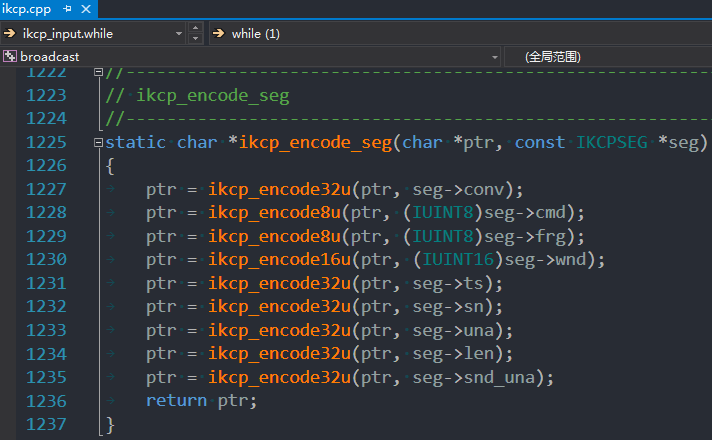
发送视频包时,把 FFmpeg 编码后的视频帧拆成RTP包,先构造8字节头,再加上拆好后的RTP包用KCP发送,程序里视频包的msg type值为4738。
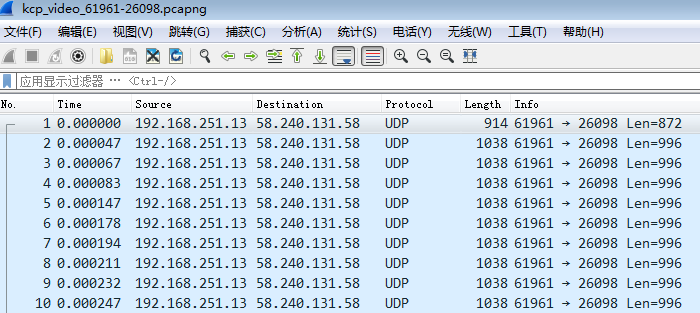
我过滤了一个只有视频包的抓包,直接打开如下:
用Lua实现 KCP 和 RTP 解析器插件后,再次打开效果如下,可以看到 KCP 头和 RTP 头各个字段的信息:
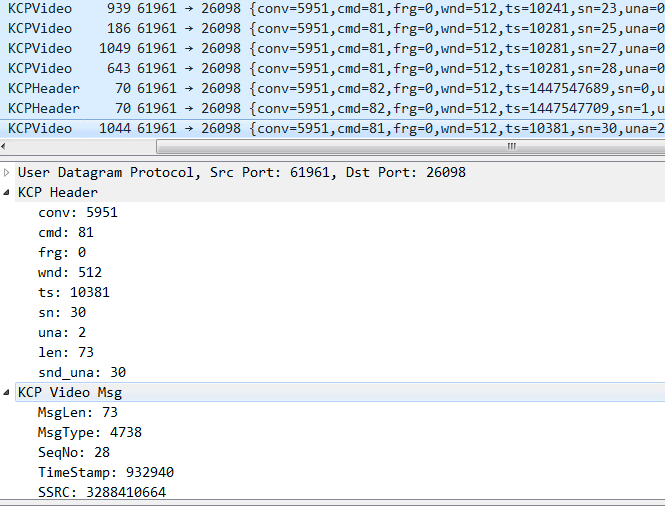
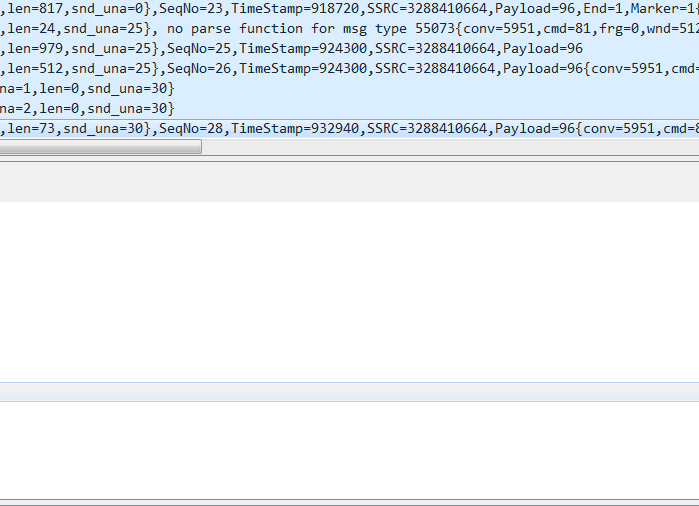
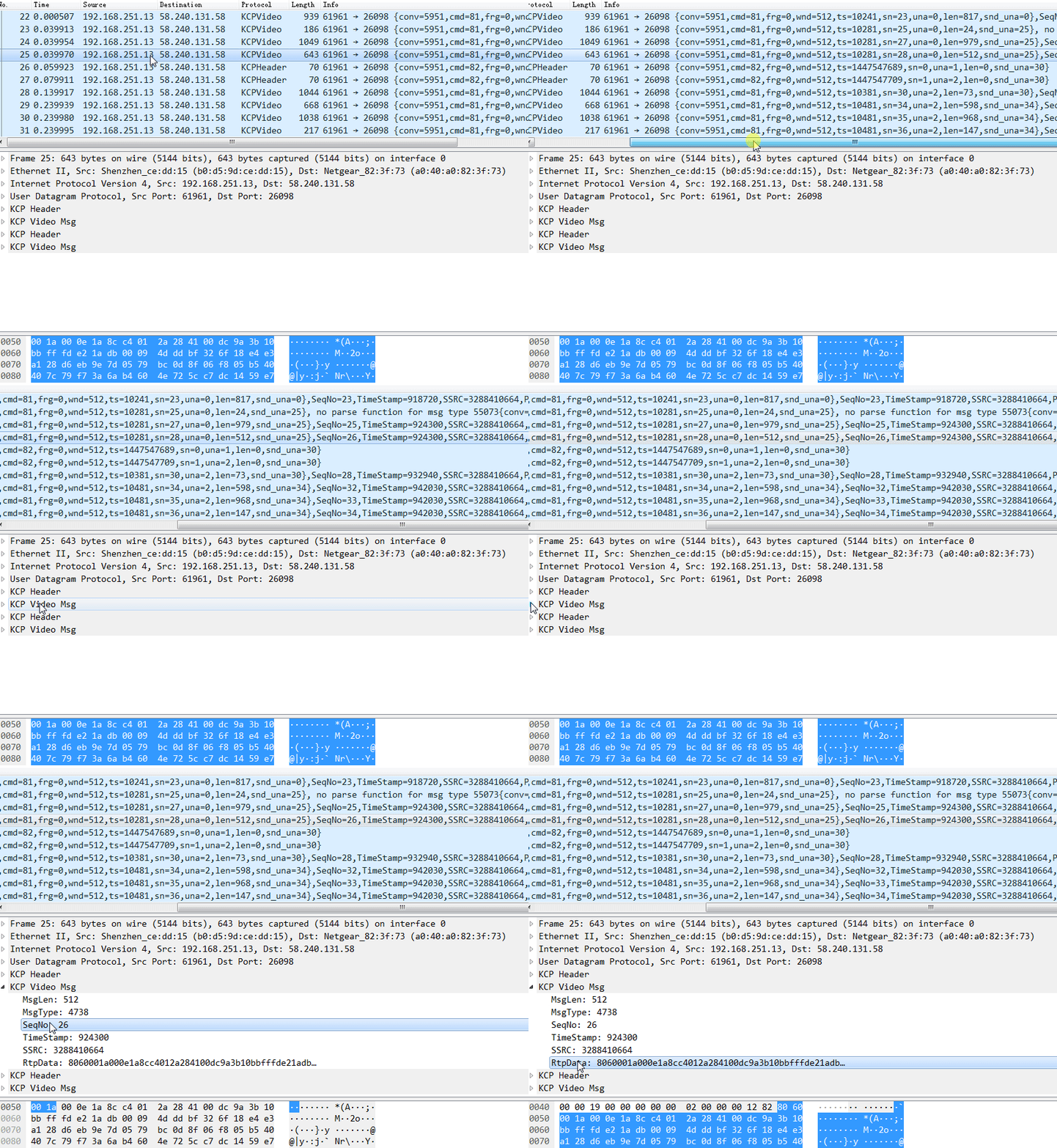
从GitHub kcp_rtp_dissector下载抓包文件和代码。
打开wireshark安装目录下文件 d:\Program Files\WiresharkPortable\App\Wireshark\init.lua:
在最后一行加上 dofile(DATA_DIR.."kcp_dissector.lua")--add this line ,如下图所示
if not running_superuser or run_user_scripts_when_superuser then

    dofile(DATA_DIR.."console.lua")

end

--dofile(DATA_DIR.."dtd_gen.lua")

dofile(DATA_DIR.."kcp_dissector.lua")--add this line
把kcp_dissector.lua复制到init.lua所在目录,直接打开下载的抓包文件kcp_video_61961-26098.pcapng,就能看到上图解析后的KCP 和 RTP包内容。
代码kcp_dissector.lua如下,
 -- author: yinkaisheng@foxmail.com

 -- for decoding kcp udp msg

 require "bit32"

 do

     kcp_parse_table = { }

     msg_header_size =

     function append_str(str, strformat, key, value)

         if string.len(str) ==  or string.sub(str, -, -) == '{' then

             return str .. string.format(strformat, key, value)

         else

             return str .. ',' .. string.format(strformat, key, value)

         end

     end

     function parse_le_uint8(protocol_type_name, start, name, buf, pkt, root, col_str)

         local value = buf(start, ):le_uint()

         col_str = append_str(col_str, '%s=%u', name, value)

         root:add_le(_G[protocol_type_name].fields[name], buf(start, ))

         return start + , col_str

     end

     function parse_le_uint16(protocol_type_name, start, name, buf, pkt, root, col_str)

         local value = buf(start, ):le_uint()

         col_str = append_str(col_str, '%s=%u', name, value)

         root:add_le(_G[protocol_type_name].fields[name], buf(start, ))

         return start + , col_str

     end

     function parse_le_uint32(protocol_type_name, start, name, buf, pkt, root, col_str)

         local value = buf(start, ):le_uint()

         col_str = append_str(col_str, '%s=%u', name, value)

         root:add_le(_G[protocol_type_name].fields[name], buf(start, ))

         return start + , col_str

     end

     function parse_uint8(protocol_type_name, start, name, buf, pkt, root, col_str)

         local value = buf(start, ):uint()

         col_str = append_str(col_str, '%s=%u', name, value)

         root:add(_G[protocol_type_name].fields[name], buf(start, ))

         return start + , col_str

     end

     function parse_int16(protocol_type_name, start, name, buf, pkt, root, col_str)

         local value = buf(start, ):int()

         col_str = append_str(col_str, '%s=%d', name, value)

         root:add(_G[protocol_type_name].fields[name], buf(start, ))

         return start + , col_str

     end

     function parse_int32(protocol_type_name, start, name, buf, pkt, root, col_str)

         local value = buf(start, ):int()

         col_str = append_str(col_str, '%s=%d', name, value)

         root:add(_G[protocol_type_name].fields[name], buf(start, ))

         return start + , col_str

     end

     function parse_uint16(protocol_type_name, start, name, buf, pkt, root, col_str)

         local value = buf(start, ):uint()

         col_str = append_str(col_str, '%s=%u', name, value)

         root:add(_G[protocol_type_name].fields[name], buf(start, ))

         return start + , col_str

     end

     function parse_uint32(protocol_type_name, start, name, buf, pkt, root, col_str)

         local value = buf(start, ):uint()

         col_str = append_str(col_str, '%s=%u', name, value)

         root:add(_G[protocol_type_name].fields[name], buf(start, ))

         return start + , col_str

     end

     -- rtp video

     KCP_VIDEO_RTP_MSG_TYPE =

     kcp_video_protocol_name = 'KCPVideo'

     kcp_video_protocol_desc = 'KCP Video Msg'

     ProtoKCPVideo = Proto(kcp_video_protocol_name, kcp_video_protocol_desc)

     field_kcp_length = ProtoField.uint32('KCP.Length', 'MsgLen', base.DEC)

     field_kcp_msgtype = ProtoField.uint32('KCP.MsgType', 'MsgType', base.DEC)

     field_rtp_payload = ProtoField.uint32('RTP.Payload', 'Payload', base.DEC)

     field_rtp_marker = ProtoField.uint32('RTP.Marker', 'Marker', base.DEC)

     field_rtp_seqno = ProtoField.uint32('RTP.SeqNO', 'SeqNo', base.DEC)

     field_rtp_timestamp = ProtoField.uint32('RTP.TimeStamp', 'TimeStamp', base.DEC)

     field_rtp_ssrc = ProtoField.uint32('HYP.SSRC', 'SSRC', base.DEC)

     field_rtp_data = ProtoField.bytes('RTP.Data', 'RtpData')

     ProtoKCPVideo.fields = {field_kcp_length, field_kcp_msgtype, field_rtp_seqno, field_rtp_timestamp, field_rtp_ssrc, field_rtp_data}

     function parse_udp_video(start, msg_type, kcp_data_len, buf, pkt, root)

         -- kcp_data_len = buf(20,4):le_uint()

         local payload_index = start+msg_header_size +

         local seqno_index = start+msg_header_size +

         local timestamp_index = start+msg_header_size +

         local ssrc_index = start+msg_header_size +

         local indicator_index = start+msg_header_size + --rtp head 12

         local second_byte_value = buf(payload_index, ):uint()

         local rtp_payload = bit32.band(second_byte_value, 0x7F)-- or second_byte_value >> 1 -- require lua 5.3

         local rtp_marker = bit32.rshift(second_byte_value, )-- or second_byte_value & 1 -- require lua 5.3

         local rtp_seqno = buf(seqno_index, ):uint()

         local rtp_timestamp = buf(timestamp_index, ):uint()

         local rtp_ssrc = buf(ssrc_index, ):uint()

         local indicator = buf(indicator_index, ):uint()

         local indicator_type = bit32.band(indicator, 0x1F)

         local fu_start =

         local fu_end =

         if indicator_type ==  then

             local fuheader_index = indicator_index +

             local fuheader = buf(fuheader_index, ):uint()

             fu_start = bit32.rshift(fuheader, )

             fu_end = bit32.band(bit32.rshift(fuheader, ), )

         end

         protocol_name = tostring(pkt.cols.protocol)

         if protocol_name ~= kcp_video_protocol_name then

             pkt.cols.protocol = kcp_video_protocol_name

         end

         local rtp_str = string.format(',SeqNo=%u,TimeStamp=%u,SSRC=%u,Payload=%u', rtp_seqno, rtp_timestamp, rtp_ssrc, rtp_payload)

         if fu_start ==  then

             rtp_str = rtp_str .. ',Start=1'

         end

         if fu_end ==  then

             rtp_str = rtp_str .. ',End=1'

         end

         if rtp_marker ==  then

             rtp_str = rtp_str .. ',Marker=1'

         end

         col_str = tostring(pkt.cols.info) .. rtp_str

         pkt.cols.info = col_str

         local t = root:add(ProtoKCPVideo, buf(start, kcp_data_len))

         t:add(field_kcp_length, buf(start, ))

         t:add(field_kcp_msgtype, buf(start + , ))

         t:add(field_rtp_seqno, buf(seqno_index, ))

         t:add(field_rtp_timestamp, buf(timestamp_index, ))

         t:add(field_rtp_ssrc, buf(ssrc_index, ))

         t:add(field_rtp_data, buf(start + msg_header_size, kcp_data_len - msg_header_size))

         return start + kcp_data_len - msg_header_size, col_str

     end

     kcp_parse_table[KCP_VIDEO_RTP_MSG_TYPE] = parse_udp_video

     -- kcp

     kcp_conv_table = {}

     kcp_head_size =

     kcp_header_protocol_name = 'KCPHeader'

     kcp_header_protocol_desc = 'KCP Header'

     ProtoKCPHeader = Proto(kcp_header_protocol_name, kcp_header_protocol_desc)

     KCPHeaders = {

             {'conv',    ProtoField.uint32, parse_le_uint32, base.DEC}, -- default DEC, can be omitted

             {'cmd',     ProtoField.uint32, parse_le_uint8,  base.DEC},

             {'frg',     ProtoField.uint32, parse_le_uint8,  base.DEC},

             {'wnd',     ProtoField.uint32, parse_le_uint16, base.DEC},

             {'ts',      ProtoField.uint32, parse_le_uint32, base.DEC},

             {'sn',      ProtoField.uint32, parse_le_uint32, base.DEC},

             {'una',     ProtoField.uint32, parse_le_uint32, base.DEC},

             {'len',     ProtoField.uint32, parse_le_uint32, base.DEC},

             {'snd_una', ProtoField.uint32, parse_le_uint32, base.DEC},

         }

     for key, value in pairs(KCPHeaders) do

         local field = value[](kcp_header_protocol_name .. '.' .. value[], value[])

         ProtoKCPHeader.fields[value[]] = field

     end

     function parse_kcp(start, msg_type, kcp_len, buf, pkt, root)

         local buf_len = buf:len()

         protocol_name = tostring(pkt.cols.protocol)

         if protocol_name == 'UDP' then

             pkt.cols.protocol = kcp_header_protocol_name

         end

         local kcp_conv = buf(start, ):le_uint()

         kcp_conv_table[kcp_conv] =

         local tree = root:add(ProtoKCPHeader, buf(start, kcp_head_size))

         col_str = '{'

         for key, value in pairs(KCPHeaders) do

             start, col_str = value[]('ProtoKCPHeader', start, value[], buf, pkt, tree, col_str)

         end

         col_str = col_str .. '}'

         old_str = tostring(pkt.cols.info)

         if string.find(old_str, '{conv') == nil then

             fs, fe = string.find(old_str, ' → ')

             if fe == nil then

                 pkt.cols.info = col_str

             else

                 fs, fe = string.find(old_str, ' ', fe + )

                 if fs == nil then

                     pkt.cols.info = col_str

                 else

                     pkt.cols.info = string.sub(old_str, , fs) .. col_str

                 end

             end

         else

             col_str = old_str .. col_str

             pkt.cols.info = col_str

         end

         if start + msg_header_size <= buf_len then

             local kcp_data_len = buf(start, ):uint()

             msg_type = buf(start + , ):uint()

             if kcp_len == kcp_data_len and start + kcp_data_len <= buf_len then

                 local parse_func = kcp_parse_table[msg_type]

                 if parse_func then

                     start_new, col_str = parse_func(start, msg_type, kcp_data_len, buf, pkt, root)

                 else

                     pkt.cols.info = tostring(pkt.cols.info) .. string.format(', no parse function for msg type %u', msg_type)

                 end

                 start = start + kcp_data_len

                 if start + kcp_head_size <= buf_len then

                     kcp_conv = buf(start, ):le_uint()

                     kcp_len = buf(start + , ):le_uint()

                     if kcp_conv_table[kcp_conv] ==  then

                         parse_kcp(start, , kcp_len, buf, pkt, root)

                     else

                     end

                 end

             else

                 if start + kcp_head_size <= buf_len then

                     kcp_conv = buf(start, ):le_uint()

                     kcp_len = buf(start + , ):le_uint()

                     if kcp_conv_table[kcp_conv] ==  then

                         parse_kcp(start, , kcp_len, buf, pkt, root)

                     else

                     end

                 end

             end

         end

         return start, col_str

     end

     -- protocal

     kcp_protocol_name = 'KCP'

     kcp_protocol_desc = 'KCP Protocol'

     ProtoKCP = Proto(kcp_protocol_name, kcp_protocol_desc)

     -- dissector

     function ProtoKCP.dissector(buf, pkt, root)

         local buf_len = buf:len()

         if buf_len < msg_header_size then

             return

         end

         protocol_name = tostring(pkt.cols.protocol)

         -- pkt.cols.info = tostring(pkt.cols.info) .. '  |' .. protocol_name .. '|'

         -- if 1 then

             -- return

         -- end

         local data_len = buf(, ):uint()

         if buf_len == data_len then

             local msg_type = buf(, ):uint()

             local parse_func = kcp_parse_table[msg_type]

             if parse_func then

                 parse_func(, msg_type, buf_len, buf, pkt, root)

             else

                 pkt.cols.info = tostring(pkt.cols.info) .. string.format(', no parse function for msg id %u', msg_type)

             end

         elseif kcp_head_size +  <= buf_len then

             data_len = buf(, ):le_uint()

             local kcp_data_len = buf(kcp_head_size, ):uint()

             if data_len == kcp_data_len then

                 parse_kcp(, , data_len, buf, pkt, root)

             else

                 local kcp_conv = buf(, ):le_uint()

                 if kcp_conv_table[kcp_conv] ==  then

                     parse_kcp(, , data_len, buf, pkt, root)

                 else

                 end

             end

         elseif kcp_head_size <= buf_len then

             local kcp_conv = buf(, ):le_uint()

             if kcp_conv_table[kcp_conv] ==  then

                 parse_kcp(, , data_len, buf, pkt, root)

             else

             end

         else

         end

     end

     local udp_table = DissectorTable.get('udp.port')

     udp_table:add('', ProtoKCP)

 end
未完待续...
使用Lua编写Wireshark插件解析KCP UDP包,解析视频RTP包的更多相关文章
- Lua编写wireshark插件初探——解析Websocket上的MQTT协议
一.背景 最近在做物联网流量分析时发现, App在使用MQTT协议时往往通过SSL+WebSocket+MQTT这种方式与服务器通信,在使用SSL中间人截获数据后,Wireshark不能自动解析出MQ ...
- 用lua编写wireshark插件分析自己定义的协议
参见: https://yoursunny.com/study/IS409/ScoreBoard.htm https://wiki.wireshark.org/LuaAPI/TreeItem http ...
- 使用 lua 编写 wireshark 协议解析插件
一.平台 操作系统:windows 7 wireshark:1.10.3 lua:5.1 二.准备 lua 语言基本语法,特别是关于表操作和循环 wireshark 文档,包括用户使用文档和开发者文档 ...
- RTP协议解析及H264/H265 音视频RTP打包分析
一 概述 实时传输协议(Real-time Transport Protocol或简写RTP)是一个网络传输协议,它是由IETF的多媒体传输工作小组1996年在RFC 1889中公布的. RTP协议详 ...
- Wireshark插件编写
Wireshark插件编写 在抓包的过程中学习了使用wireshark,同时发现wireshark可以进行加载插件,便在网上学习了一下相应的插件开发技术. 需求编写一个私有协议名为SYC,使用UDP端 ...
- Wireshark Lua: 一个从RTP抓包里导出H.264 Payload,变成264裸码流文件(xxx.264)的Wireshark插件
Wireshark Lua: 一个从RTP抓包里导出H.264 Payload,变成264裸码流文件(xxx.264)的Wireshark插件 在win7-64, wireshark Version ...
- 【babel+小程序】记“编写babel插件”与“通过语法解析替换小程序路由表”的经历
话不多说先上图,简要说明一下干了些什么事.图可能太模糊,可以点svg看看 背景 最近公司开展了小程序的业务,派我去负责这一块的业务,其中需要处理的一个问题是接入我们web开发的传统架构--模块化开发. ...
- Qt 显示透明flash和编写QtWebkit插件
Qt 有两种方法可以显示flash. 1. 通过QAxWidget 调用com形式显示flash, 需要本机安装IE flash插件 2. 直接通过qwebview显示flash, 需要下载webki ...
- 使用Qt编写模块化插件式应用程序
动态链接库技术使软件工程师们兽血沸腾,它使得应用系统(程序)可以以二进制模块的形式灵活地组建起来.比起源码级别的模块化,二进制级别的模块划分使得各模块更加独立,各模块可以分别编译和链接,模块的升级不会 ...
随机推荐
- patch工具的使用
1. 最简用法 patch -p1 < jello.patch
- C# 多线程Thread.IsBackground=True的作用
C#中多线程的线程加.IsBackground = true与不加有什么区别? 按照MSDN上讲:“获取或设置一个值,该值指示某个线程是否为后台线程.” 其实这个解释并不到位,至少应该解释一下后台线程 ...
- [Java复习] 分布式事务 Part 2
分布式事务了解吗?如果解决分布式事务问题的? 面试官心里: 只要聊到你做了分布式系统,必问分布式事务,起码得知道有哪些方案,一般怎么来做,每个方案的优缺点是什么. 为什么要有分布式事务? 分布式事务实 ...
- 002-poi-excel-导出设置单元格数据校验规则、筛选功能
一.数据验证概述 推荐以下操作在2007之后操作 1.1.查看excel的数据验证 1.进入 2.设置规则 通过验证条件允许,可以看到是每个单元格默认只成立一种条件 1.2.POI代码开发-数据验证 ...
- VSCode使用Dart和lutter所需按照的插件
Dart Flutter Flutter Widget Snippets [可快速敲出关联代码] Code Runner: 用于代码运行 Awesome Flutter Snippetsnash
- 阶段5 3.微服务项目【学成在线】_day17 用户认证 Zuul_13-用户退出-前端
调试前端的退出 logout方法 找到路由 退出对应的组件页面 这就是退出的组件 退出的方法 把这两个js的引用,从上面复制到下面引用.因为可能存在js的冲突问题. 资料里面给了一个前端 整个覆盖当前 ...
- spark在windows的配置
在spark-env.cmd添加一行 FOR /F %%i IN ('hadoop classpath') DO @set SPARK_DIST_CLASSPATH=%%i 修改:log4j.prop ...
- jsplumb 流程图,常用功能配置记录
前言: jsplumb 有2个版本一个Toolkit Edition(付费版),另外一个就是Community Edition(社区版本).Toolkit Edition版本功能集成的比较丰富,社区版 ...
- 记录一下我的git连接不上GitHub问题
1.日常操作,提交代码,报错误下: $ git clone git@github.com:hanchao5272/myreflect.git Cloning into 'myreflect'... s ...
- tp3.2判断修改成功
save方法的返回值是影响的记录数,如果返回false则表示更新出错,因此一定要用恒等来判断是否更新失败. 一开始用这种判断, if (!$edit_flag && $edit_fla ...