
再说Java集合,subList之于ArrayList
上一章说了很多ArrayList相关的内容,但还有一块儿内容没说到,那就是subList方法。先看一段代码
public static void testSubList() {

    List<String> stringList = new ArrayList<>();

    stringList.add("牛魔王");

    stringList.add("蛟魔王");

    stringList.add("鹏魔王");

    stringList.add("狮驼王");

    stringList.add("猕猴王");

    stringList.add("禺贼王");

    stringList.add("美猴王");

    List<String> substrings = stringList.subList(3,5);

    System.out.println(substrings.toString());

    System.out.println(substrings.size());

    substrings.set(1, "猪八戒");

    System.out.println(substrings.toString());

    System.out.println(stringList.toString());

}
看看执行结果如何?
[狮驼王, 猕猴王]

2

[狮驼王, 猪八戒]

[牛魔王, 蛟魔王, 鹏魔王, 狮驼王, 猪八戒, 禺贼王, 美猴王]
第一和第二的执行结果,非常容易理解,subList()方法作用就是截取集合stringList中一个范围内的元素。
第三和第四的执行结果都值得分析了,首先截取的字符串集合值为 [狮驼王, 猕猴王] ,但因为猕猴王在大雷音寺被美猴王打死了,我们用猪八戒来代替猕猴王;
因此我们通过substrings.set(1, "猪八戒"),将这个集合中第二个位置的值“猕猴王”设置为“猪八戒”,最终打印出来的结果也正是我们所预期的;但同时我们打印原集合stringList,发现其中的“猕猴王”也变成了“猪八戒”。这就比较奇怪了,两个问题:
1.我们操作的是截取后的集合,为什么原集合会变?
2.我们设置截取后某个位置(如第2个位置)的值,原集合改变的却不是对应位置的值?
一. subList原理初探
接下来我们带着问题寻找答案,我们看一下subList()的源码
/**

 * Returns a view of the portion of this list between the specified

 * {@code fromIndex}, inclusive, and {@code toIndex}, exclusive.  (If

 * {@code fromIndex} and {@code toIndex} are equal, the returned list is

 * empty.)  The returned list is backed by this list, so non-structural

 * changes in the returned list are reflected in this list, and vice-versa.

 * The returned list supports all of the optional list operations.

 *

 * <p>This method eliminates the need for explicit range operations (of

 * the sort that commonly exist for arrays).  Any operation that expects

 * a list can be used as a range operation by passing a subList view

 * instead of a whole list.  For example, the following idiom

 * removes a range of elements from a list:

 * <pre>

 *      list.subList(from, to).clear();

 * </pre>

 * Similar idioms may be constructed for {@link #indexOf(Object)} and

 * {@link #lastIndexOf(Object)}, and all of the algorithms in the

 * {@link Collections} class can be applied to a subList.

 *

 * <p>The semantics of the list returned by this method become undefined if

 * the backing list (i.e., this list) is <i>structurally modified</i> in

 * any way other than via the returned list.  (Structural modifications are

 * those that change the size of this list, or otherwise perturb it in such

 * a fashion that iterations in progress may yield incorrect results.)

 *

 * @throws IndexOutOfBoundsException {@inheritDoc}

 * @throws IllegalArgumentException {@inheritDoc}

 */

public List<E> subList(int fromIndex, int toIndex) {

    subListRangeCheck(fromIndex, toIndex, size);

    return new SubList(this, 0, fromIndex, toIndex);

}
看注释,大概有以下几个意思
- 返回的是原集合在fromIndex和toIndex之间的元素的视图,虽然为视图,但支持集合的所有方法;
- 当fromIndex和toIndex相同时,返回空的视图;
- 任何对截取的视图的操作都会被原集合所取代;
看注释仅能知道我们例子最后的运行结果是正常的,但是对原理也还并不是特别清楚。我们继续看源码。
首先我们在例子中调用subList(3, 5)时,是new了一个SubList,这个SubList是ArrayList内部类,继承了AbstractList
private class SubList extends AbstractList<E> implements RandomAccess {

    private final AbstractList<E> parent;

    private final int parentOffset;

    private final int offset;

    int size;

    SubList(AbstractList<E> parent, int offset, int fromIndex, int toIndex) {

        this.parent = parent;

        this.parentOffset = fromIndex;

        this.offset = offset + fromIndex;

        this.size = toIndex - fromIndex;

        this.modCount = ArrayList.this.modCount;

    }

}
从这个内部类的源码中,我们可以看到:
- SubList并没有像ArrayList一样定义Object[]来存放数据,而定义了一个变量parent来保存传递的原集合;
- 定义了一个offset用于保存进行偏移量,当对SubList修改时,就可以通过偏移量找到parent中对应的位置;
- 定义了size用来表示我们在parent集合中可见范围是多少;
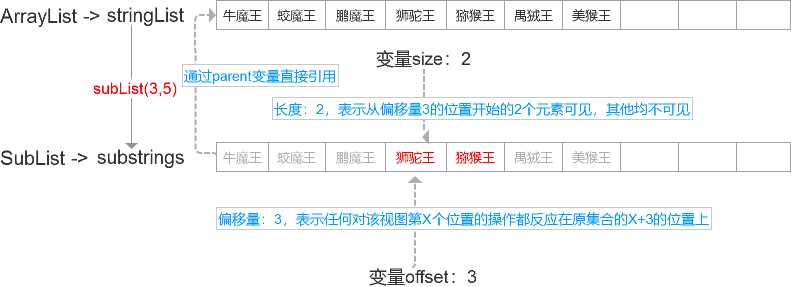
有了上面的说明,其实SubList的原理已经很清晰了,接下来,我们用SubList中常用的方法来印证一下。
二. add(E e)方法
substrings.add("九头蛇");

System.out.println(substrings.toString());

System.out.println(stringList.toString());
接着上面的例子,在substrings中添加“九头蛇”,按照规则,add()方法添加元素会在集合的最后,也就是说substrings的第3个位置(下标为2),对应parent原集合的位置下标就是2+3=5,会在stringList第六个位置插入“九头蛇”。看一下输出的结果
[狮驼王, 猪八戒, 九头蛇]

[牛魔王, 蛟魔王, 鹏魔王, 狮驼王, 猪八戒, 九头蛇, 禺贼王, 美猴王]
可以看到结果的确如此,那么我们在看一下add(E e),在SubList这个内部类里面并没有发现该方法,因此我去父类中找。
在AbstractList中找到了
public boolean add(E e) {

    add(size(), e);

    return true;

}
接下来,我们在SubList中找到了实现方法
public void add(int index, E e) {

    rangeCheckForAdd(index);

    checkForComodification();

    parent.add(parentOffset + index, e);

    this.modCount = parent.modCount;

    this.size++;

}
很明显,源代码和我们开始的分析是一致的,当然在添加之间需要进行空间容量判断,是否足以添加新的元素,扩容规则,我们上一章已经讲过。
三. 其他方法
关于SubList的其他方法,其实和add原理一样,不论是set(int index, E e),get(int index),addAll(Collection<? extends E> c),remove(int index),都是先判断当前传入的位置索引是否正确(如是否大于size,小于0等),再根据规则计算出原集合中的位置下标,最终完成对集合的操作。
四. 总结
本文续接上一章ArrayList原理及使用,对ArrayList中的常用方法subList进行了剖析,从源码的角度对通过subList方法得到的集合和原集合有何关系,有何不同点,从而避免工作中遇到各种坑,若有不对之处,请批评指正,望共同进步,谢谢!
再说Java集合,subList之于ArrayList的更多相关文章
- Java 集合系列03之 ArrayList详细介绍(源码解析)和使用示例
概要 上一章,我们学习了Collection的架构.这一章开始,我们对Collection的具体实现类进行讲解:首先,讲解List,而List中ArrayList又最为常用.因此,本章我们讲解Arra ...
- Java 集合:HashSet 与 ArrayList
Set 集合是无序不可以重复的的.List 集合是有序可以重复的. Java 集合:HashSet 与 hashCode.equals 博客里面已经说到这个问题,但是解释的还是不够清楚. 看一个小例子 ...
- java集合的实现细节--ArrayList和LinkedList
ArrayList和LinkedList的实现差异 List代表一种线性表的数据结构,ArrayList则是一种顺序存储的线性表,ArrayList底层采用动态数组的形式保存每一个集合元素,Link ...
- 【Java集合源代码剖析】ArrayList源代码剖析
版权声明:本文为博主原创文章,未经博主同意不得转载. https://blog.csdn.net/mmc_maodun/article/details/35568011 转载请注明出处:http:// ...
- Java集合系列(二):ArrayList、LinkedList、Vector的使用方法及区别
本篇博客主要讲解List接口的三个实现类ArrayList.LinkedList.Vector的使用方法以及三者之间的区别. 1. ArrayList使用 ArrayList是List接口最常用的实现 ...
- Java集合源码剖析——ArrayList源码剖析
ArrayList简介 ArrayList是基于数组实现的,是一个动态数组,其容量能自动增长,类似于C语言中的动态申请内存,动态增长内存. ArrayList不是线程安全的,只能用在单线程环境下,多线 ...
- 【Java集合】试读ArrayList源码
ArrayList简介 ArrayList 是一个数组队列,相当于 动态数组.与Java中的数组相比,它的容量能动态增长.它继承于AbstractList,实现了List, RandomAccess, ...
- Java 集合系列03之 ArrayList详细介绍
ArrayList做为List接口中最常用的实现类,必须掌握. 一.ArrayList简介 与Java中的数组相比ArrayList的容量可以动态增加.它继承与AbstractList,实现了List ...
- Java集合【8】-- ArrayList源码分析
目录 1. ArrayList 1.1 ArrayList特点介绍 1.2 实现的接口和继承的类 2. 成员变量 3. 构造方法 4. 常用增删改查方法 添加元素 查询元素 更新元素 删除元素 5.自 ...
- 【转】Java 集合系列03之 ArrayList详细介绍(源码解析)和使用示例
原文网址:http://www.cnblogs.com/skywang12345/p/3308556.html 上一章,我们学习了Collection的架构.这一章开始,我们对Collection的具 ...
随机推荐
- 像职业选手样编码:地道Python
Code Like a Pythonista: Idiomatic Python David Goodger goodger@python.org http://python.net/~goodger ...
- windows Hook 消息分类
调用SetWindowsHookEx的DLL的模块实例句柄,它可以经由DllMain入口的第一个参数得到.HHOOK SetWindowsHookEx( int idHook,HOOKPROC lpf ...
- 在Windows系统上以C++打印出当前活动用户的环境变量
在Windows系统上以C++打印出当前活动用户的环境变量,代码如下(QT环境): void getEnvironmentVariables() { DWORD sessionId = WTSGetA ...
- WPF DataTemplateSelector的使用
<Window x:Class="CollectionBinding.MainWindow" xmlns="http://schemas.micros ...
- Android系统adb命令查看CPU与内存使用率
1. 打开终端,进入上述目录,如下图所示: 2. 输入adb shell,打开adb命令行,如 ...
- CSS计数器:counter
最近的需求,明星字体销售排行榜中,需要对字体的销售情况进行排序. 在早期,只有ol和ul可以对子元素li进行排序:如果不使用这两个标签,就由前台开发去手动填写序号. 当然,在这个需求中,数据不是实时更 ...
- 无法删除 NTFS 盘上的文件或文件夹(对Windows文件的各种情况有比较详细的描述)
简介 本文介绍您可能无法删除 NTFS 文件系统卷上的文件或文件夹的原因,以及如何分析造成此问题的不同原因从而解决此问题. 更多信息 注意:在内部,NTFS 将文件夹作为特殊类型的文件进行处理.因此, ...
- 零元学Expression Blend 4 - Chapter 40 Flash做的到的Blend也可以!轻松制作拥有动画的MenuBar!(上)
原文:零元学Expression Blend 4 - Chapter 40 Flash做的到的Blend也可以!轻松制作拥有动画的MenuBar!(上) 一直以来都有人拿Flash的动画问我Blend ...
- WPF用DirectSound播放声音
示例代码: var fileName = @"D:\WindowsLogon.wav"; DevicesCollection sound_devices = new Devices ...
- WPF使用NAudio录音
代码: using NAudio.Wave; using System.Windows; namespace NAudioDemo { /// <summary> /// MainWind ...