
论文解读(DAEGC)《Improved Deep Embedded Clustering with Local Structure Preservation》
Paper Information
Title:《Attributed Graph Clustering: A Deep Attentional Embedding Approach》
Authors:Chun Wang、Shirui Pan、Ruiqi Hu、Guodong Long、Jing Jiang、C. Zhang
Source:2019, IJCAI
Other:96 Citations, 42 References
Paper:Download
Code:Download
Task:Graph Clustering、Graph Embedding、Node Clustering
Abstract
该方法侧重于属性图的构建,并使用 attention network 描述邻居节点对 target node 的重要性。
1 Introduction
目前研究现状:基于图表示学习的方法都是两阶段的方法 。
总结目前研究:重构拓扑结构以及重建节点表示的方法。
研究缺陷:拓扑结构和节点表示融合机制并不完美。
本文模型:$\text{DAEGC}$ [ a goal-directed graph attentional autoencoder based attributed graph clustering framework ]
重建节点表示:采用 $\text{graph attentional autoencoder }$:
- $\text{Encoder}$ 可以同时学习节点内容以及图结构 ;
- $\text{Decoder}$ 重建图拓扑结构 ;
训练模型:自训练模型 [ 高置信度分布指导模型训练 ]
本文模型与传统的 $\text{two-step}$ 方法的比较如 Figure 1 所示:
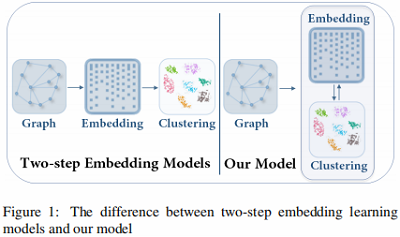
- 本文模型是将 $\text{node embedding}$ 和聚类放在一个统一的框架中学习。
- $\text{Two-step}$ 方法则是先学习 $\text{node embedding}$,然后进行聚类。
本文贡献:
- 第一个提出图注意自编码器;
- 提出了基于 $\text{goal-directed}$ 的图聚类框架;
2 Related Work
2.1 Graph Clustering
阐述早起方法的不顶用,以及感谢深度方法对图聚类的发展。
2.2 Deep Clustering Algorithms
铭记 DEC 深度聚类。
3 Problem Definition and Overall Framework
$\text{Graph basic definition}$ :略。
给定图 $G$,图聚类的目的是将 $G$ 中的节点划分为 $k$ 个不相交 $\text{groups}$: ${G_1、G_2、···、G_k}$,使在同一 $\text{group}$ 的节点满足两个条件:
- 彼此图结构相似 ;[ 社区结构类似 ]
- 节点属性相似 ;
本文模型框架包括两个部分,如 Fig 2 所示 :
- Graph Attentional Autoencoder :AE 以属性值和图结构作为输入,并通过最小化重构损失来学习潜在的 representation ;
- Self-training Clustering :根据学习到的 representation 进行聚类,并根据聚类结果对潜在 representation 进行操作;
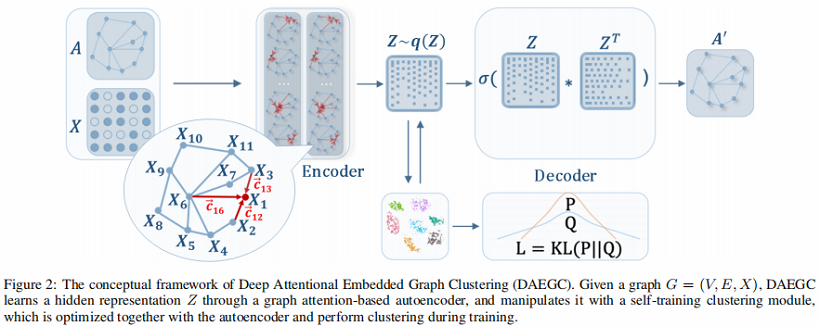
该框架将学习 graph embedding 和执行聚类放在一个统一的框架中,因此可以使每个组件彼此受益。
4 Proposed Method
本节先阐述 graph attentional autoencoder [ 有效的学习图结构和 content information ] 生成 latent representation,然后阐述 self-training module 指导聚类。
4.1 Graph Attentional Autoencoder
Graph Attentional Autoencoder:通过关注每个节点的邻居来学习每个节点的 latent representation ,从而将 attribute values 与图结构信息 融入 latent representation。
首先:衡量 $\text{node}$ $i$ 的邻居 $N_i$ 对于 $\text{node}$ $i$ 的影响,这里考虑的是不同邻居对 $\text{node}$ $i $ 的影响不一样,主要体现在对邻居赋予不同的权重。
$z_{i}^{l+1}=\sigma\left(\sum\limits _{j \in N_{i}} \alpha_{i j} W z_{j}^{l}\right)\quad\quad\quad(1)$
其中:
- $z_{i}^{l+1}$ denotes the output representation of node $i$ ;
- $N_{i}$ denotes the neighbors of $i$ ;
- $\alpha_{i j}$ is the attention coefficient that indicates the importance of neighbor node $j$ to node $i$ ;
- $\sigma$ is a nonlinerity function ;
对于 attention 系数 $\alpha_{i j}$ [ 重要度 ] 主要参考两个方面:
- 属性值(attribute values) ;
- 拓扑距离( topological distance );
Aspact 1:属性值
attention 系数 $\alpha_{i j}$ 可以表示为 由 $x_i$ 和 $x_j$ 拼接形成的单层前馈神经网络:
$c_{i j}=\vec{a}^{T}\left[W x_{i} \| W x_{j}\right]\quad \quad \quad(2)$
其中:
- $\vec{a} \in R^{2 m^{\prime}}$ 是权重向量;
Aspact 2:拓扑距离
在 AE 的 $\text{Encoder}$ 中考虑高阶邻居信息(这里指 $ \text{t-order} $ 邻居),得到 $\text{proximity matrix} $ :
$M=\left(B+B^{2}+\cdots+B^{t}\right) / t\quad \quad\quad(3)$
其中:
- $B$ 是转移矩阵(transition matrix),当 $e_{i j} \in E$ 有边相连,那么 $B_{i j}=1 / d_{i}$ ,否则 $B_{i j}=0$ 。
- $M_{i j}$ 表示 $\text{node}$ $i$ 和 $\text{node}$ $j$ 的 $t$ 阶内的拓扑相关性。这意味着 如果 $\text{node}$ $i$ 和 $\text{node}$ $j$ 存在邻居关系($t$ 阶之内),那么 $M_{i j}>0 $。
通常对每个 $\text{group}$ 中的 $\text{node}$ 做标准化:采用 $\text{softmax function}$
${\large \alpha_{i j}=\operatorname{softmax}_{j}\left(c_{i j}\right)=\frac{\exp \left(c_{i j}\right)}{\sum_{r \in N_{i}} \exp \left(c_{i r}\right)}} \quad \quad \quad(4)$
将 $\text{Eq.2}$ 中 $c_{ij}$ 带入,并添加上 $\text{topological weights }$ $M$ 和激活函数 $\delta$ ,那么 $\text{attention}$ 系数可以表示为:
${\large \alpha_{i j}=\frac{\exp \left(\delta M_{i j}\left(\vec{a}^{T}\left[W x_{i} \| W x_{j}\right]\right)\right)}{\sum_{r \in N_{i}} \exp \left(\delta M_{i r}\left(\vec{a}^{T}\left[W x_{i} \| W x_{r}\right]\right)\right)}} \quad\quad\quad(5)$
其中
- 激活函数 $\delta$ 采用 $LeakyReLU$ ;
- $x_{i}=z_{i}^{0}$ 作为问题的输入 ;
这里我们堆叠 $2$ 个 $\text{graph attention layers}$ :
$z_{i}^{(1)}=\sigma\left(\sum \limits _{j \in N_{i}} \alpha_{i j} W^{(0)} x_{j}\right)\quad \quad \quad (6)$
$z_{i}^{(2)}=\sigma\left(\sum\limits _{j \in N_{i}} \alpha_{i j} W^{(1)} z_{j}^{(1)}\right)\quad \quad\quad(7)$
到这就 Encoder 就编码了 结构信息和属性信息(node attributes),并且我们最终的 $z_{i}=z_{i}^{(2)}$ 。
Inner product decoder
本文采用了简单的 $\text{Inner product decoder}$ [ 输入已经包括了属性值和拓扑结构 ] 去预测节点之间的连接:
其中:
- $\hat{A}$ 是重建后的图结构矩阵;
Reconstruction loss
通过最小化度量 $A$ 和 $\hat{A}$ 重构错误:
$L_{r}=\sum\limits _{i=1}^{n} \operatorname{loss}\left(A_{i, j}, \hat{A}_{i j}\right)\quad\quad \quad (9)$
4.2 Self-optimizing Embedding
除了优化重构误差外,我们还将 hidden embedding 输入一个自优化聚类模块,该模块最小化以下目标:
$L_{c}=K L(P \| Q)=\sum\limits_{i} \sum\limits _{u} p_{i u} \log \frac{p_{i u}}{q_{i u}}\quad\quad\quad(10)$
其中:
- $q_{iu}$度量 node embedding $z_{i}$ 和 cluster center embedding $\mu_{u}$ 之间的相似性,本文通过 Student's t-distribution 度量。同时它可以看作是每个节点的一个软聚类分配分布。;
- $p_{iu}$ 代表着目标分布,由于在Q中,具有高概率的软分配(靠近集群中心的节点)被认为是可信的,所以考虑将 $Q$ 提高到二次方,以增加高可信度;
${\large q_{i u}=\frac{\left(1+\left\|z_{i}-\mu_{u}\right\|^{2}\right)^{-1}}{\sum\limits _{k}\left(1+\left\|z_{i}-\mu_{k}\right\|^{2}\right)^{-1}}} \quad\quad\quad(11)$
${\large p_{i u}=\frac{q_{i u}^{2} / \sum_{i} q_{i u}}{\sum_{k}\left(q_{i k}^{2} / \sum_{i} q_{i k}\right)}}\quad \quad\quad(12) $
聚类损失迫使当前分布 $Q$ 接近目标分布 $P$,从而将这些 “confident assignments” 设置为软标签来监督 $Q$ 的嵌入学习。
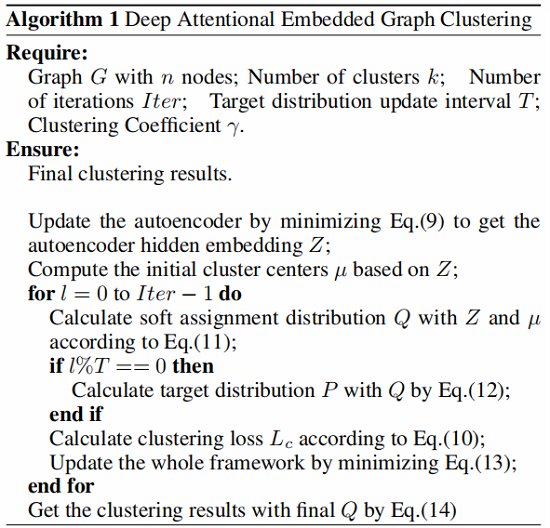
算法概述
- 首先使用没有用 selfoptimize clustering part 的自编码器获得初始 embedding ;
- 其次为计算 Eq.11 ,先使用 $k-means$ 获得初始聚类中心 $\mu$
- 然后根据 $L_c$ 使用 SGD 进行优化更新 $\mu$ 和 $z$ 。
需要注意的是 :$P$ 每 $5$ 个 iteration 更新一次,$Q$ 每个 iteration 更新一次。
算法步骤:
4.3 Joint Embedding and Clustering Optimization
我们联合优化了自动编码器的嵌入和聚类学习,并定义了我们的总目标函数为:
$L=L_{r}+\gamma L_{c}\quad \quad\quad (13)$
其中:
- $L_{r}$ 代表着 reconstruction loss ;
- $L_{c} $ 代表着 clustering loss ;
- $ \gamma \geq 0 $ 控制着 $L_{r}$ 和 $L_{c} $ 的平衡 ;
最终 $v_{i}$ 的 soft label 通过 $Q$ 获得:
$s_{i}=\arg \underset{u}{\text{max}} \; q_{i u}\quad \quad\quad(14)$
我们的算法有以下优点
- Interplay Exploitation :structure and content information ;
- Clustering Specialized Embedding:self-training clustering component ;
- Joint Learning:Jointly optimizes the two parts of the loss functions ;
5 Experiments
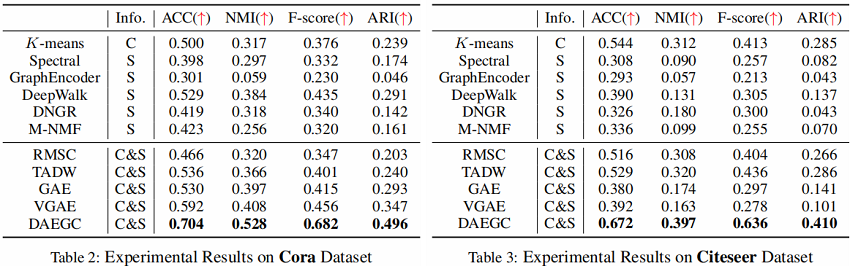
5.1 Results
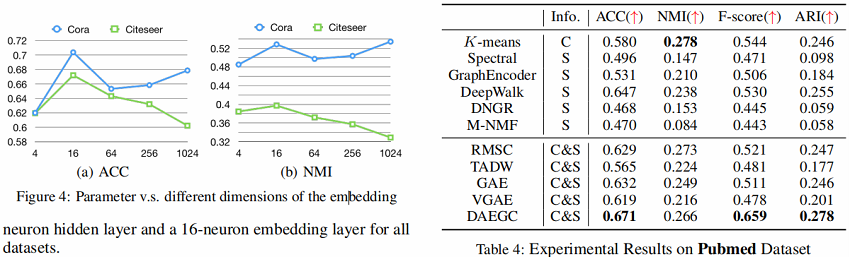

6 Conclusion
在本文中,我们提出了一种无监督的深度注意嵌入算法DAEGC,以在一个统一的框架中联合执行图聚类和学习图嵌入。学习到的图嵌入集成了结构信息和内容信息,专门用于聚类任务。虽然图的聚类任务自然是无监督的,但我们提出了一个自训练的聚类组件,它从“自信的”分配中生成软标签来监督嵌入的更新。对聚类损失和自编码器重构损失进行联合优化,同时得到图嵌入和图聚类结果。将实验结果与各种先进算法的比较,验证了DAEGC的图聚类性能。
论文解读(DAEGC)《Improved Deep Embedded Clustering with Local Structure Preservation》的更多相关文章
- 论文解读(IDEC)《Improved Deep Embedded Clustering with Local Structure Preservation》
Paper Information Title:<Improved Deep Embedded Clustering with Local Structure Preservation>A ...
- 【神经网络】自编码聚类算法--DEC (Deep Embedded Clustering)
1.算法描述 最近在做AutoEncoder的一些探索,看到2016年的一篇论文,虽然不是最新的,但是思路和方法值得学习.论文原文链接 http://proceedings.mlr.press/v48 ...
- 论文解读《Learning Deep CNN Denoiser Prior for Image Restoration》
CVPR2017的一篇论文 Learning Deep CNN Denoiser Prior for Image Restoration: 一般的,image restoration(IR)任务旨在从 ...
- 论文解读DEC《Unsupervised Deep Embedding for Clustering Analysis》
Junyuan Xie, Ross B. Girshick, Ali Farhadi2015, ICML1243 Citations, 45 ReferencesCode:DownloadPaper: ...
- 论文解读(GraphDA)《Data Augmentation for Deep Graph Learning: A Survey》
论文信息 论文标题:Data Augmentation for Deep Graph Learning: A Survey论文作者:Kaize Ding, Zhe Xu, Hanghang Tong, ...
- 论文解读(DFCN)《Deep Fusion Clustering Network》
Paper information Titile:Deep Fusion Clustering Network Authors:Wenxuan Tu, Sihang Zhou, Xinwang Liu ...
- 论文解读(DCN)《Towards K-means-friendly Spaces: Simultaneous Deep Learning and Clustering》
论文信息 论文标题:Towards K-means-friendly Spaces: Simultaneous Deep Learning and Clustering论文作者:Bo Yang, Xi ...
- 论文解读(DCRN)《Deep Graph Clustering via Dual Correlation Reduction》
论文信息 论文标题:Deep Graph Clustering via Dual Correlation Reduction论文作者:Yue Liu, Wenxuan Tu, Sihang Zhou, ...
- 论文解读(GMIM)《Deep Graph Clustering via Mutual Information Maximization and Mixture Model》
论文信息 论文标题:Deep Graph Clustering via Mutual Information Maximization and Mixture Model论文作者:Maedeh Ahm ...
随机推荐
- antd-vue中的form表单label标签for导致点击文字触发输入框解决方案
<a-form-item :label="label+'图片'" :label-col="{ span: 2 }" :wrapper-col=" ...
- 使用Eclipse新建项目
如果图片损坏,点击查看: https://www.toutiao.com/i6496078011538866702/ 出现"新建"对话框,输入mavem 点击创建"简单M ...
- Jsp页面中常见的page指令
注:图片如果损坏,点击文章链接:https://www.toutiao.com/i6513327323628962312/ 1.<JSP页面实际上就是Servlet> 2.<JSP页 ...
- js字符串首字母大写的不同写法
写法一: let name = 'hello' name.charAt(0).toUpperCase() + name.slice(1) 写法二: let name = 'hello' name.sl ...
- Oracle update和select 关联
Oracle update和select 关联 目录 Oracle update和select 关联 1.介绍 2.解决方法 2.1.需求 2.2.错误演示 2.3.解决方法 1.介绍 本文主要向大家 ...
- 嫌Excel VBA执行速度慢,这些建议你一定要看
Excel是办公利器,这无需多言.尤其在办公室,Excel用的熟练与否,会的Excel知识点多不多,很大程度上决定了你工作是否高效,能否按时打卡下班.可我们也时常听到这样的吐槽:Excel好是好,可就 ...
- leetcode 46. 全排列 及 47. 全排列 II
46. 全排列 问题描述 给定一个没有重复数字的序列,返回其所有可能的全排列. 示例: 输入: [1,2,3] 输出: [ [1,2,3], [1,3,2], [2,1,3], [2,3,1], [3 ...
- 微服务架构 | *3.5 Nacos 服务注册与发现的源码分析
目录 前言 1. 客户端注册进 Nacos 注册中心(客户端视角) 1.1 Spring Cloud 提供的规范标准 1.2 Nacos 的自动配置类 1.3 监听服务初始化事件 AbstractAu ...
- 【刷题-LeetCode】238. Product of Array Except Self
Product of Array Except Self Given an array nums of n integers where n > 1, return an array outpu ...
- javascript的AMD规法--esl与requirejs浅介。
AMD规范,全称是Asynchronous Module Definition,即异步模块加载机制.从它的规范描述页面看,AMD很短也很简单,但它却完整描述了模块的定义,依赖关系,引用关系以及加载机制 ...