
【JDK1.8】JDK1.8集合源码阅读——TreeMap(一)
一、前言
在前面两篇随笔中,我们提到过,当HashMap的桶过大的时候,会自动将链表转化成红黑树结构,当时一笔带过,因为我们将留在本章中,针对TreeMap进行详细的了解。
二、TreeMap的继承关系
下面先让我们来看一下TreeMap的继承关系,对它有一个大致的了解:
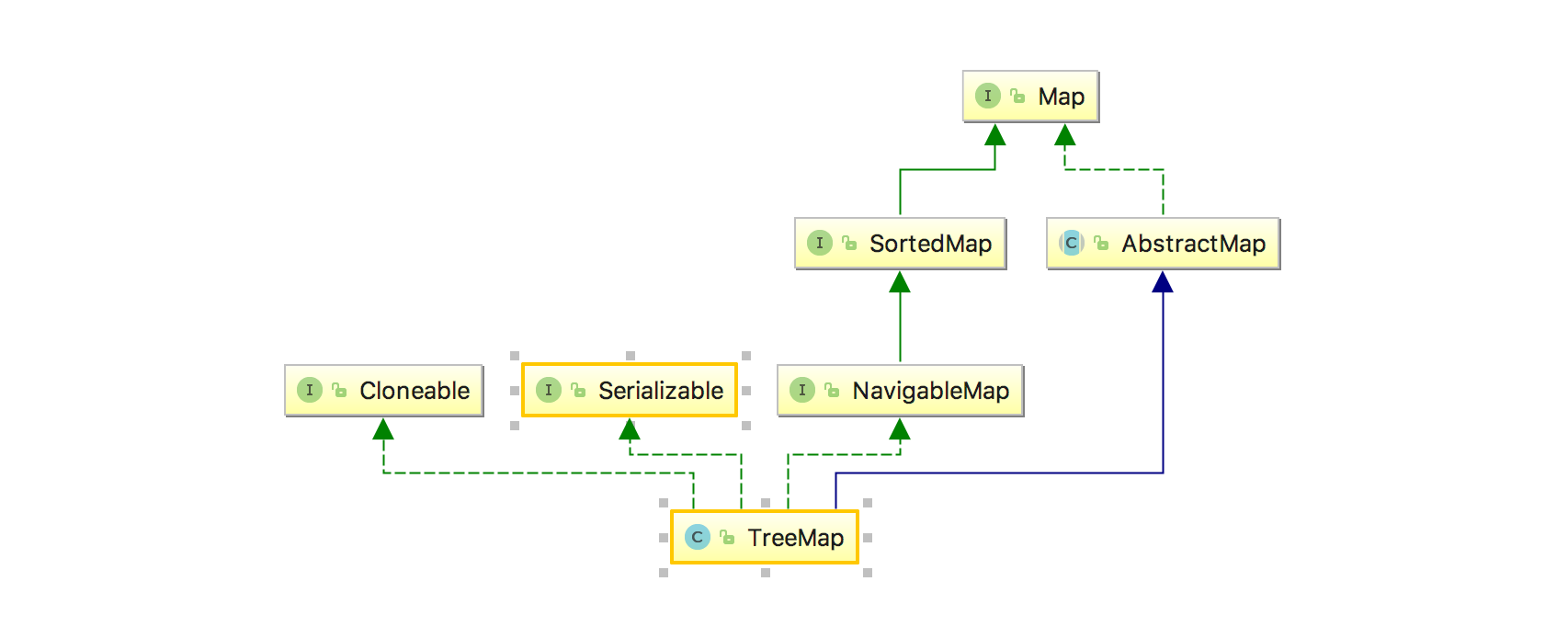
可以看到,除了在之前HashMap里常见的继承类和接口以外,TreeMap实现了NavigableMap接口,而NavigableMap继承自SortedMap,由名字可以看出,只是一个用来实现排序的接口。而这也是为什么TreeMap能够实现排序的原因。由于篇幅关系,将TreeMap的源码解析分为三部分,本章将对接口NavigableMap以及SortedMap进行解析。
三、SortedMap接口源码解析
3.1 SortedMap接口
public interface SortedMap<K,V> extends Map<K,V> {

  //返回用于对键的进行排序的比较器,如果此映射使用其键的自然排序,则为null

  Comparator<? super K> comparator();

  //返回从fromKey(包括)到toKey(不包括)之间的map

  SortedMap<K,V> subMap(K fromKey, K toKey);

  //返回小于toKey的map

  SortedMap<K,V> headMap(K toKey);

  //返回大于或等于fromKey的map

  SortedMap<K,V> tailMap(K fromKey);

  //返回map中第一个(最低)键

  K firstKey();

  //返回map中最后一个(最高)键

  K lastKey();

  Set<K> keySet();

  Collection<V> values();

  Set<Map.Entry<K, V>> entrySet();

}
SortedMap的接口比较简单,没有很特别的地方,唯一比较特别的就是返回Comparator这个接口,可以设想实现排序功能的秘密或许就藏在此处。下面让我们来看一下Comparator和Comparable接口,两者之间有点关联,可以理解为Comparable自带了比较功能,而Comparator是赋予没有比较能力的对象一种比较能力。举个简单例子:面对一道计算题,小明天生口算能力很强,看一眼就能算出来答案。而小李没有这种能力,需要借助计算器才能得出答案。
3.2 Comparable接口
先让我们看下它的代码:
public interface Comparable<T> {

  //如果小于o,返回负数;等于o,返回0;大于o返回正数。

  public int compareTo(T o);

}
对,就是这么简单,里面传入一个泛型T的对象o,对o进行比较。如果小于o,返回负数;等于o,返回0;大于o返回正数。
我们熟悉的很多对象如String,Integer,Double等都实现了这个接口。可以来看一下简单的例子:
public class Item implements Comparable<Item> {

  private String name;

  private int price;

  public Item(String name, int price) {

    this.name = name;

    this.price = price;

  }

  public int getPrice() {

    return price;

  }

  public String getName() {

    return name;

  }

  @Override

  public String toString() {

    return "Item{" +

      "name='" + name + '\'' +

      ", price=" + price +

      '}';

  }

  @Override

  public int compareTo(Item o) {

    if (this.name.compareTo(o.name) < 0) {

      return -1;

    } else if (this.name.compareTo(o.name) > 0) {

      return 1;

    } else {

      return 0;

    }

  }

  public static void main(String[] args) {

    List<Item> items = Arrays.asList(new Item("banana", 200), new Item("apple", 400));

    System.out.println("before:" + items);

    Collections.sort(items);

    System.out.println("after:" + items);

  }

}
上述main函数的输出:
before:[Item{name='banana', price=200}, Item{name='apple', price=400}]

after:[Item{name='apple', price=400}, Item{name='banana', price=200}]
上面的例子中,我们自己实现了Comparable接口,比较了Item的name属性,然后通过Collections.sort对它进行了排序(值得注意的是:没有实现Comparable接口的对象不能使用该方法)。但是,如果我不想用name属性对它进行排序,想对price进行排序呢,或者先对name排序,相同的话在对price进行排序呢,用这个不就没法实现了吗。这就需要提到了下面的Comparator接口
3.3 Comparator接口
照例先来看一下代码:
@FunctionalInterface

public interface Comparator<T> {

  // 核心方法,用来比较两个对象,如果o1小于o2,返回负数;等于o2,返回0;大于o2返回正数

  int compare(T o1, T o2);

  // 好像很少用到,一般都用对象自带的equals

  boolean equals(Object obj);

  /**-----------下面的都是JDK1.8新增的接口,挑几个放进去----------*/

  //返回反向排序比较器

  default Comparator<T> reversed() {

    return Collections.reverseOrder(this);

  }

  //根据名字知道,先进行compare比较后,再进行一次比较

  default Comparator<T> thenComparing(Comparator<? super T> other) {

    Objects.requireNonNull(other);

    return (Comparator<T> & Serializable) (c1, c2) -> {

      int res = compare(c1, c2);

      return (res != 0) ? res : other.compare(c1, c2);

    };

  }

  //对int类型的key进行比较

  public static <T> Comparator<T> comparingInt(ToIntFunction<? super T> keyExtractor) {

    Objects.requireNonNull(keyExtractor);

    return (Comparator<T> & Serializable)

      (c1, c2) -> Integer.compare(keyExtractor.applyAsInt(c1), keyExtractor.applyAsInt(c2));

  }

  //返回正常顺序的比较器

  public static <T extends Comparable<? super T>> Comparator<T> naturalOrder() {

    return (Comparator<T>) Comparators.NaturalOrderComparator.INSTANCE;

  }

}
一起来看一下如何使用,先来看一下JDK1.8以前的用法:
public class SimpleComparator implements Comparator<Item> {

  @Override

  public int compare(Item o1, Item o2) {

    return o1.price - o2.price;

  }

  public static void main(String[] args) {

    List<Item> items = Arrays.asList(new Item("banana", 200), new Item("apple", 400), new Item("Orange", 100));

    Collections.sort(items, new SimpleComparator());

    System.out.println(items);

  }

}
上述main函数的输出是:
[Item{name='Orange', price=100}, Item{name='banana', price=200}, Item{name='apple', price=400}]
JDK1.8以前的用法要自己手动实现Comparator接口,然后调用Collections.sort(),传入实现类来完成排序,非常麻烦,而JDK1.8则相对来说简单了很多:
public static void main(String[] args) {

  List<Item> items = Arrays.asList(new Item("banana", 200), new Item("apple", 400), new Item("Orange", 100));

  Collections.sort(items, (Item a, Item b) -> a.price - b.price);

  System.out.println(items);

}
甚至,我们可以不使用Collections.sort:
public static void main(String[] args) {

  List<Item> items = Arrays.asList(new Item("banana", 100), new Item("Orange", 100), new Item("apple", 400), new Item("Orange", 50));

  items.sort((Item a, Item b) -> a.price - b.price);

  System.out.println(items);

  //使用上面的thenComparing

  items.sort(Comparator.comparing(Item::getName).thenComparing(Comparator.comparingInt(Item::getPrice)));

  System.out.println("after using thenComparing: " + items);

}
上述main函数的输出:
 [Item{name='orange', price=50}, Item{name='banana', price=100}, Item{name='orange', price=100}, Item{name='apple', price=400}]

 after using thenComparing: [Item{name='apple', price=400}, Item{name='banana', price=100}, Item{name='orange', price=50}, Item{name='orange', price=100}]
四、NavigableMap接口源码解析
public interface NavigableMap<K,V> extends SortedMap<K,V> {

  //返回键小于且最接近Key(不包含等于)的键值对,没有返回null

  Map.Entry<K,V> lowerEntry(K key);

  //返回小于且最接近(不包含等于)Key的键,没有返回null

  K lowerKey(K key);

  //返回键小于且最接近(包含等于)Key的键值对,没有返回null

  Map.Entry<K,V> floorEntry(K key);

  //返回小于且最接近(包含等于)Key的键,没有返回null

  K floorKey(K key);

  //返回大于且最接近(包含等于)给定key的键值对,没有返回null

  Map.Entry<K,V> ceilingEntry(K key);

  //同上

  K ceilingKey(K key);

  //返回大于且最接近(不包含等于)给定key的键值对

  Map.Entry<K,V> higherEntry(K key);

  //同上

  K higherKey(K key);

  //返回第一个Entry

  Map.Entry<K,V> firstEntry();

  //返回最后一个Entry

  Map.Entry<K,V> lastEntry();

  //移除并返回第一个Entry

  Map.Entry<K,V> pollFirstEntry();

  //同上

  Map.Entry<K,V> pollLastEntry();

  //返回map中包含的映射关系的逆序视图

  NavigableMap<K,V> descendingMap();

  //返回map中包含的键的NavigableSet视图。 set的迭代器按key的升序

  NavigableSet<K> navigableKeySet();

  //逆序

  NavigableSet<K> descendingKeySet();

  //根据fromKey和toKey来返回子map,两个boolean参数用于是否包含该key

  NavigableMap<K,V> subMap(K fromKey, boolean fromInclusive,

                             K toKey,   boolean toInclusive);

  //返回小于(或等于,根据inclusive)toKey的map

  NavigableMap<K,V> headMap(K toKey, boolean inclusive);

  //返回大于(或等于,根据inclusive)fromKey的map

  NavigableMap<K,V> tailMap(K fromKey, boolean inclusive);

  SortedMap<K,V> subMap(K fromKey, K toKey);

  SortedMap<K,V> headMap(K toKey);

  SortedMap<K,V> tailMap(K fromKey);

}
注意:上述返回的map与原map是相互影响的。
五、总结
本章分析了TreeMap的继承关系,给后面分析TreeMap作为铺垫。SortedMap和NavigableMap的接口中,包含了大量的返回Map的方法,这也是作为排序Map的一大特点吧。最后谢谢各位园友观看,与大家共同进步!
【JDK1.8】JDK1.8集合源码阅读——TreeMap(一)的更多相关文章
- 【JDK1.8】JDK1.8集合源码阅读——TreeMap(二)
一.前言 在前一篇博客中,我们对TreeMap的继承关系进行了分析,在这一篇里,我们将分析TreeMap的数据结构,深入理解它的排序能力是如何实现的.这一节要有一定的数据结构基础,在阅读下面的之前,推 ...
- 【JDK1.8】Java 8源码阅读汇总
一.前言 万丈高楼平地起,相信要想学好java,仅仅掌握基础的语法是远远不够的,从今天起,笔者将和园友们一起阅读jdk1.8的源码,并将阅读重点放在常见的诸如collection集合以及concu ...
- 【JDK1.8】JDK1.8集合源码阅读——IdentityHashMap
一.前言 今天我们来看一下本次集合源码阅读里的最后一个Map--IdentityHashMap.这个Map之所以放在最后是因为它用到的情况最少,也相较于其他的map来说比较特殊.就笔者来说,到目前为止 ...
- java1.7集合源码阅读: Stack
Stack类也是List接口的一种实现,也是一个有着非常长历史的实现,从jdk1.0开始就有了这个实现. Stack是一种基于后进先出队列的实现(last-in-first-out (LIFO)),实 ...
- java1.7集合源码阅读: Vector
Vector是List接口的另一实现,有非常长的历史了,从jdk1.0开始就有Vector了,先于ArrayList出现,与ArrayList的最大区别是:Vector 是线程安全的,简单浏览一下Ve ...
- 【JDK1.8】JDK1.8集合源码阅读——总章
一.前言 今天开始阅读jdk1.8的集合部分,平时在写项目的时候,用到的最多的部分可能就是Java的集合框架,通过阅读集合框架源码,了解其内部的数据结构实现,能够深入理解各个集合的性能特性,并且能够帮 ...
- 【JDK1.8】JDK1.8集合源码阅读——HashMap
一.前言 笔者之前看过一篇关于jdk1.8的HashMap源码分析,作者对里面的解读很到位,将代码里关键的地方都说了一遍,值得推荐.笔者也会顺着他的顺序来阅读一遍,除了基础的方法外,添加了其他补充内容 ...
- 【JDK1.8】JDK1.8集合源码阅读——ArrayList
一.前言 在前面几篇,我们已经学习了常见了Map,下面开始阅读实现Collection接口的常见的实现类.在有了之前源码的铺垫之后,我们后面的阅读之路将会变得简单很多,因为很多Collection的结 ...
- 【JDK1.8】JDK1.8集合源码阅读——LinkedList
一.前言 这次我们来看一下常见的List中的第二个--LinkedList,在前面分析ArrayList的时候,我们提到,LinkedList是链表的结构,其实它跟我们在分析map的时候讲到的Link ...
随机推荐
- Jquery购物车jsorder改进版,支持后台处理程序直接转换成DataTable处理
<!DOCTYPE html> <html> <head> <meta http-equiv="Content-Type" content ...
- python concurrent.futures
python因为其全局解释器锁GIL而无法通过线程实现真正的平行计算.这个论断我们不展开,但是有个概念我们要说明,IO密集型 vs. 计算密集型. IO密集型:读取文件,读取网络套接字频繁. 计算密集 ...
- win10 uwp 九幽图床
本文主要是图片加水印自动上传,代码已经上传github. 图片加水印,我的方法,简单,一个好的方法是毒逆天大神的图片加水印方法或http://daily.zhihu.com/story/8812028 ...
- 最佳时间买入卖出股票 Best Time to Buy and Sell Stock LeetCode
LeetCode 我们有一个股票的数组,数组是每时间的钱,我们只能买入一次和卖出一次,求我们的最大收益. 我们知道了一个数组,那么我们可以在低价买入,然后高价卖出,但是需要知道我们的低价需要在高价之前 ...
- 开始Java8之旅(四) --四大函数接口
前言 Java8中函数接口有很多,大概有几十个吧,具体究竟是多少我也数不清,所以一开始看的时候感觉一脸懵逼,不过其实根本没那么复杂,毕竟不应该也没必要把一个东西设计的很复杂. 几个单词 在学习 ...
- Oracle学习笔记之用户自定义函数
自定义函数语法格式: 用户自定义的函数,可以直接在sql语句中直接调用,并且任何一个funciton都必须有返回值,而且该函数声明后,是保存在数据端的,我们随时可以使用:注意:函数只能有一个返回值 ...
- 【ASP.NET MVC 学习笔记】- 04 依赖注入(DI)
本文参考:http://www.cnblogs.com/willick/p/3223042.html 1.在一个类内部,不通过创建对象的实例而能够获得某个实现了公开接口的对象的引用.这种"需 ...
- LeetCode 342. Power of Four (4的次方)
Given an integer (signed 32 bits), write a function to check whether it is a power of 4. Example:Giv ...
- 正则表达式&常用JS校验
符号 含义 ^ 以什么开头 $ 以什么结束 * 任意个(包括0个) + 至少一个 ? 没有或一个 {a,b} a-b个 {a} 正好a个 {a,} 至少a个 | 或 . 任意字符 [] 方括号内的任意 ...
- 想成为一个高效的Web开发者吗?来看看大牛分享的经验吧~ #精选JAVASCRIPT前端开发
想成为一个高效的Web开发者吗?来看看大牛分享的经验吧~ 作为一个软(ku)件(bi)工(de)程(ma)师(nong),你有没有觉得做什么事都没时间?没时间学习新东西,没时间去回顾.整理原来写的烂代 ...