
Python笔记 #02# Inner workings of lists
源:DataCamp
datacamp 的 DAILY PRACTICE + 日常收集。
List of lists
As a data scientist, you'll often be dealing with a lot of data, and it will make sense to group some of this data.
Instead of creating a flat list containing strings and floats, representing the names and areas of the rooms in your house, you can create a list of lists. The script on the right can already give you an idea.
Don't get confused here: "hallway" is a string, while hall is a variable that represents the float 11.25 you specified earlier.
# area variables (in square meters)

hall = 11.25

kit = 18.0

liv = 20.0

bed = 10.75

bath = 9.50

# house information as list of lists

house = [["hallway", hall],

         ["kitchen", kit],

         ["living room", liv],

         ["bedroom", bed],

         ["bathroom", bath]]

# Print out house

print(house)

# Print out the type of house

print(type(house))
Subset and conquer
一个元素毫无疑问也是一个子集,因此不论是取一段或者随机访问一个元素都叫做 subsetting
# Create the areas list

areas = ["hallway", 11.25, "kitchen", 18.0, "living room", 20.0, "bedroom", 10.75, "bathroom", 9.50]

# Print out second element from areas

print(areas[1])

# Print out last element from areas

print(areas[-1])

# Print out the area of the living room

print(areas[5])
#Subset and calculate
# Create the areas list

areas = ["hallway", 11.25, "kitchen", 18.0, "living room", 20.0, "bedroom", 10.75, "bathroom", 9.50]

# Sum of kitchen and bedroom area: eat_sleep_area

eat_sleep_area = areas[3] + areas[-3]

# Print the variable eat_sleep_area

print(eat_sleep_area)
Slicing and dicing
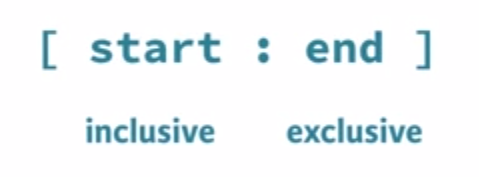
Selecting single values from a list is just one part of the story. It's also possible to slice your list, which means selecting multiple elements from your list. Use the following syntax:
my_list[start:end]
The start index will be included, while the end index is not.
# Create the areas list

areas = ["hallway", 11.25, "kitchen", 18.0, "living room", 20.0, "bedroom", 10.75, "bathroom", 9.50]

# Use slicing to create downstairs

downstairs = areas[0:6]

# Use slicing to create upstairs

upstairs = areas[6:10]

# Print out downstairs and upstairs

print(downstairs)

print(upstairs)
However, it's also possible not to specify these indexes. If you don't specify the begin index, Python figures out that you want to start your slice at the beginning of your list. If you don't specify the end index, the slice will go all the way to the last element of your list.
# Create the areas list

areas = ["hallway", 11.25, "kitchen", 18.0, "living room", 20.0, "bedroom", 10.75, "bathroom", 9.50]

# Alternative slicing to create downstairs

downstairs = areas[:6]

# Alternative slicing to create upstairs

upstairs = areas[6:]
List Manipulation
1、反向选就不用考虑 0 了,数到几就是几
2、如下操作也可以增加元素
In [3]: x

Out[3]: ['a', 'b', 's', 't']

In [4]: x[2:] = ["s", "t", "hi"]

In [5]: x

Out[5]: ['a', 'b', 's', 't', 'hi']
Extend a list
# Create the areas list and make some changes

areas = ["hallway", 11.25, "kitchen", 18.0, "chill zone", 20.0,

         "bedroom", 10.75, "bathroom", 10.50]

# Add poolhouse data to areas, new list is areas_1

areas_1 = areas + ["poolhouse", 24.5]

# Add garage data to areas_1, new list is areas_2

areas_2 = areas_1 + ["garage", 15.45]
Delete list elements
del(areas[-4:-2])
Inner workings of lists
Change the second command, that creates the variable areas_copy, such that areas_copy is an explicit copy of areas
# Create list areas

areas = [11.25, 18.0, 20.0, 10.75, 9.50]

# Create areas_copy

# areas_copy = areas

areas_copy = list(areas)

# Change areas_copy

areas_copy[0] = 5.0

# Print areas

print(areas)
areas_copy = areas[:] 也是可以的!
Python笔记 #02# Inner workings of lists的更多相关文章
- 我的Python笔记02
声明:本文整理借鉴金角大王的Python之路,Day2 - Python基础2,仅供本人学习使用!!! 本节内容 列表.元组操作 字符串操作 字典操作 集合操作 文件操作 字符编码与转码 1. 列表. ...
- python笔记02:列表与元素
本章将引入一个新的概念:数据结构.数据结构是通过某种方式(例如对元素进行编号)组织在一起的数据元素的集合.这些数据元素可以是数字或者字符,甚至可以是其他数据结构.在python中,最基本的数据结构是序 ...
- python笔记02
day02笔记记录 一.今日摘要 循环.字符串格式化.运算符.编码.博客. 二.内容回顾 (一)计算机基础 计算机由硬件和软件组成.传统计算机的硬件一般有输入单元.输出单元,算数逻辑单元.控制单元及记 ...
- python笔记-02
Python基础知识 —————————————— A,B,先把A乘以3,然后加上B,最后在加上列表A A = [1, 2, 3, 4, 5, 6] 赋值 B = [1, 2, 3] 变量 定义一个变 ...
- Python学习02 列表 List
Python学习02 列表 List Python列表 List Python中的列表(List)用逗号分隔,方括号包围(comma-separated values (items) between ...
- python笔记 - day6
python笔记 - day6 参考: http://www.cnblogs.com/wupeiqi/articles/5501365.html 大纲: 利用递归,实现阶乘: Python反射 pyt ...
- guxh的python笔记一:数据类型
1,基本概念 1.1,数据类型 基本数据类型:字符串,数字,布尔等 引用数据类型:相对不可变(元组),可变(列表,字典,集合等) 基本数据类型存放实际值,引用数据类型存放对象的地址(即引用) ==:判 ...
- python笔记-1(import导入、time/datetime/random/os/sys模块)
python笔记-6(import导入.time/datetime/random/os/sys模块) 一.了解模块导入的基本知识 此部分此处不展开细说import导入,仅写几个点目前的认知即可.其 ...
- 机器学习实战(Machine Learning in Action)学习笔记————02.k-邻近算法(KNN)
机器学习实战(Machine Learning in Action)学习笔记————02.k-邻近算法(KNN) 关键字:邻近算法(kNN: k Nearest Neighbors).python.源 ...
随机推荐
- cocos中lua使用shader实例
local prog = cc.GLProgram:create("res/shader/light2d.vsh","res/shader/light2d.fsh&quo ...
- D3D中的渲染状态简介
1). 设置着色模式: SetRenderState(D3DRS_SHADEMODE, D3DSHADE_FLAT) //设置平面着色模式 SetRenderState(D3DRS_SHADEMODE ...
- poj_1258 prim最小生成树
题目大意 给定N个点,以及每两个点之间的路径长度,求出一个连接这N个点的方案,使得连接这N个点的总长度最短,求出该总长度. 题目分析 求最小生成树MST的模板题,直接使用prim算法进行求解. 实现( ...
- 【BZOJ2792】[Poi2012]Well 二分+双指针法
[BZOJ2792][Poi2012]Well Description 给出n个正整数X1,X2,...Xn,可以进行不超过m次操作,每次操作选择一个非零的Xi,并将它减一. 最终要求存在某个k满足X ...
- TCL电视直播软件
升级你的电视系统我的型号46寸 V7300 3D,具体的升级程序在"技术宅"里有下载 找个格式化过的U盘把你的程序拷贝进去,插在电视上,电视会自动升级 当你成功安装V8-0MT32 ...
- QBC检索和本地SQL检索
细说QBC:QBC(Query By Criteria) 查询:这种方式比较面向对象方式,因为是面向对象,所以查询时参数名就是所查询的类的属性名并不是数据库的表的列名重点是有三个描述条件的对象:Res ...
- [genome shell]标题栏优化
参考地址:https://wiki.archlinux.org/index.php/GNOME_(%E7%AE%80%E4%BD%93%E4%B8%AD%E6%96%87)#.E4.BB.8E.E5. ...
- git学习——<四>git版本管理
一.git版本管理的优势 都说git比svn强大,强大在哪呢? 首先,从部署上说:svn.cvs都是集中式的,一台服务器上部署服务,所有客户端编写的代码都要提交到该服务器上.git是分布式的,所有人都 ...
- 使用Standford coreNLP进行中文命名实体识别
因为工作需要,调研了一下Stanford coreNLP的命名实体识别功能. Stanford CoreNLP是一个比较厉害的自然语言处理工具,很多模型都是基于深度学习方法训练得到的. 先附上其官网链 ...
- (2.4)Mysql之SQL基础——下载与使用测试库
(2.4)SQL基础——下载与使用测试库 1.查看与下载测试数据库 2.查看安装向导视图 3.安装 [1]安装:解压后用 mysql 命令安装(记得加上set autocommit=1) [2]核验: ...