
uva-699 Not so Mobile (杠杆,巧妙递归)
| Not so Mobile |
Before being an ubiquous communications gadget, a mobile was just a structure made of strings and wires suspending colourfull things. This kind of mobile is usually found hanging over cradles of small babies.
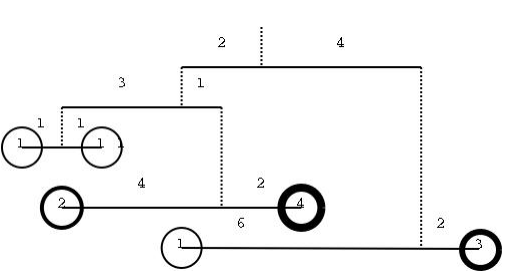
The figure illustrates a simple mobile. It is just a wire, suspended by a string, with an object on each side. It can also be seen as a kind of lever with the fulcrum on the point where the string ties the wire. From the lever principle we know that to balance a simple mobile the product of the weight of the objects by their distance to the fulcrum must be equal. That isWl×Dl = Wr×Dr where Dl is the left distance, Dr is the right distance, Wl is the left weight and Wr is the right weight.
In a more complex mobile the object may be replaced by a sub-mobile, as shown in the next figure. In this case it is not so straightforward to check if the mobile is balanced so we need you to write a program that, given a description of a mobile as input, checks whether the mobile is in equilibrium or not.

Input
The input begins with a single positive integer on a line by itself indicating the number of the cases following, each of them as described below. This line is followed by a blank line, and there is also a blank line between two consecutive inputs.
The input is composed of several lines, each containing 4 integers separated by a single space. The 4 integers represent the distances of each object to the fulcrum and their weights, in the format: Wl Dl Wr Dr
If Wl or Wr is zero then there is a sub-mobile hanging from that end and the following lines define the the sub-mobile. In this case we compute the weight of the sub-mobile as the sum of weights of all its objects, disregarding the weight of the wires and strings. If both Wl and Wr are zero then the following lines define two sub-mobiles: first the left then the right one.
Output
For each test case, the output must follow the description below. The outputs of two consecutive cases will be separated by a blank line.
Write `YES' if the mobile is in equilibrium, write `NO' otherwise.
Sample Input
1

0 2 0 4

0 3 0 1

1 1 1 1

2 4 4 2

1 6 3 2
Sample Output
YES
题解:题意是让求这个杠杆是不是平衡;看了大神的代码,处理的很巧妙,如果当前质量是0,递归输入子天平,每个子天平判断是否平衡,就可以了;
代码:
#include<cstdio>

#include<cstring>

#include<cmath>

#include<algorithm>

#include<queue>

using namespace std;

#define SI(x) scanf("%d",&x)

#define mem(x,y) memset(x,y,sizeof(x))

#define PI(x) printf("%d",x)

#define P_ printf(" ")

const int INF=0x3f3f3f3f;

typedef long long LL;

bool solve(int &w){

	int w1,d1,w2,d2;

	scanf("%d%d%d%d",&w1,&d1,&w2,&d2);

	int temp1=true,temp2=true;

	if(!w1)temp1=solve(w1);

	if(!w2)temp2=solve(w2);

	w=w1+w2;

	if(w1*d1==w2*d2&&temp1&&temp2)return true;

	else return false;

}

int main(){

	int T;

	SI(T);

	while(T--){

		int w;

		if(solve(w))puts("YES");

		else puts("NO");

		if(T)puts("");

	}

	return 0;

}
uva-699 Not so Mobile (杠杆,巧妙递归)的更多相关文章
- UVa 839 -- Not so Mobile(树的递归输入)
UVa 839 Not so Mobile(树的递归输入) 判断一个树状天平是否平衡,每个测试样例每行4个数 wl,dl,wr,dr,当wl*dl=wr*dr时,视为这个天平平衡,当wl或wr等于0是 ...
- UVa 699 The Falling Leaves(递归建树)
UVa 699 The Falling Leaves(递归建树) 假设一棵二叉树也会落叶 而且叶子只会垂直下落 每个节点保存的值为那个节点上的叶子数 求所有叶子全部下落后 地面从左到右每 ...
- UVA.839 Not so Mobile ( 二叉树 DFS)
UVA.839 Not so Mobile ( 二叉树 DFS) 题意分析 给出一份天平,判断天平是否平衡. 一开始使用的是保存每个节点,节点存储着两边的质量和距离,但是一直是Runtime erro ...
- UVA.699 The Falling Leaves (二叉树 思维题)
UVA.699 The Falling Leaves (二叉树 思维题) 题意分析 理解题意花了好半天,其实就是求建完树后再一条竖线上的所有节点的权值之和,如果按照普通的建树然后在计算的方法,是不方便 ...
- UVA 839 Not so Mobile (递归建立二叉树)
题目连接:http://acm.hust.edu.cn/vjudge/problem/19486 给你一个杠杆两端的物体的质量和力臂,如果质量为零,则下面是一个杠杆,判断是否所有杠杆平衡. 分析:递归 ...
- UVa 839 Not so Mobile (递归思想处理树)
Before being an ubiquous communications gadget, a mobilewas just a structure made of strings and wir ...
- 二叉树的递归遍历 The Falling Leaves UVa 699
题意:对于每一棵树,每一个结点都有它的水平位置,左子结点在根节点的水平位置-1,右子节点在根节点的位置+1,从左至右输出每个水平位置的节点之和 解题思路:由于上题所示的遍历方式如同二叉树的前序遍历,与 ...
- 【紫书】 The Falling Leaves UVA - 699 递归得简单
题意:给你一颗二叉树的前序遍历,空子树以-1表示,将左右子树的权值投影到一维数轴上,左儿子位置为根位置-1,右儿子+1求个个整点上的和: 题解:递归,整个过程只需维护一个sum数组. 更新根,更新le ...
- UVA 699 The Falling Leaves (递归先序建立二叉树)
题目链接:http://acm.hust.edu.cn/vjudge/problem/19244 #include <iostream> #include <cstdio> # ...
随机推荐
- HTML5 canvas入门
HTML5 Canvas入门 <canvas> 标签定义图形,比如图表和其他图像,您必须使用脚本来绘制图形.在画布上(Canvas)画一个红色矩形,渐变矩形,彩色矩形,和一些彩色的文字. ...
- avalon.js实践 svg地图配置工具
MVVM模式,在很多复杂交互逻辑下面,有很大的优势.现在相关的框架也很多,现在项目中使用了avalon.js,选择它的原因,是兼容性的考虑,当然也要支持下国内开发大牛,至于性能方面的,没有实际测试过, ...
- MyEclipse数据库反向生成实体类
MyEclipse数据库反向生成实体类 “计应134(实验班) 凌豪” 当我们在开发项目涉及到的表太多时,一个一个的写JAVA实体类很是费事.然而强大的MyEclipse为我们提供简便的方法:数据库反 ...
- Android TextView文字超出一屏不能显示其它的文字 解决方案
在android上面让TextView 过多的文字实现有滚动条,之前想简单了以为设置TextView的属性就可以实现,结果还是需要ScrollView配合使用,才能达到滚动条的效果有两种方式实现, 一 ...
- CSV 客座文章系列:KGroup 通过 Windows Azure 将 Qoob 内容管理发布到云中
编辑人员注释: 今天这篇文章由 KGroup 首席软件架构师兼研发部主管 Jody Donetti 与 KGroup 技术总监 Simone Procopio 共同撰写,介绍了 KGroup 如何使用 ...
- BeanUtils\DBUtils
BeanUtil: 需要导入 beanutil包和logging日志包 用于给对象属性赋值. setProperty与copyProperty区别: 这个问题搁置,还不会. 将map数据拷贝到对象中, ...
- 漏掉的账目(用C语言去重)
问题描述: 某财务部门结账时发现总金额不对头.很可能是从明细上漏掉了某1笔或几笔.如果已知明细账目清单,能通过编程找到漏掉的是哪1笔或几笔吗? 如果有多种可能,则输出所有可能的情况. 我们规定:用户输 ...
- poj2728 Desert King --- 01分数规划 二分水果。。
这题数据量较大.普通的求MST是会超时的. d[i]=cost[i]-ans*dis[0][i] 据此二分. 但此题用Dinkelbach迭代更好 #include<cstdio> #in ...
- 前端新人学习笔记-------html/css/js基础知识点
即将毕业的软件工程大学生一枚,秋季招聘应聘的是Android,今年来到公司实习,要求做前端开发,所以一切只有现学,现在根据视频来学习,然后开这个博客记录一下自己的学习过程,废话不多说,开写. 4月6日 ...
- 关于ECMAScript6一些知识
ECMAScript 是当前 JavaScript 语言规范的最新标准,一般称为 es6, 但是因为 该标准规范是在 2015年6月份发布的,所以也叫作 ECMAScript 2015 let 变量声 ...