
如何使用ASP.NET Web API OData在Oracle中使用Entity Framework 6.x Code-First方式开发 OData V4 Service
环境: Visual Studio 2013 + .Net Framework 4.5.2
1.新建项目
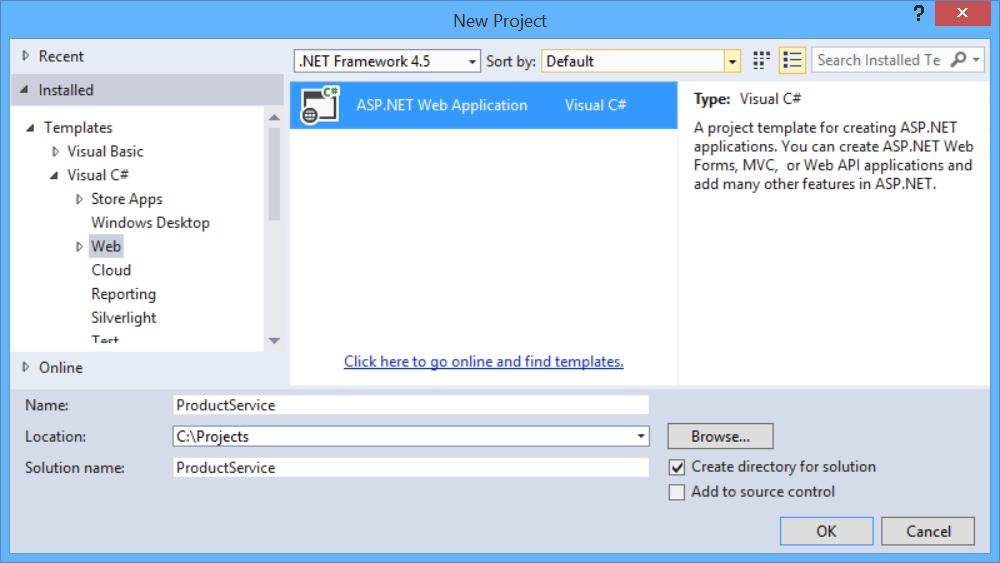
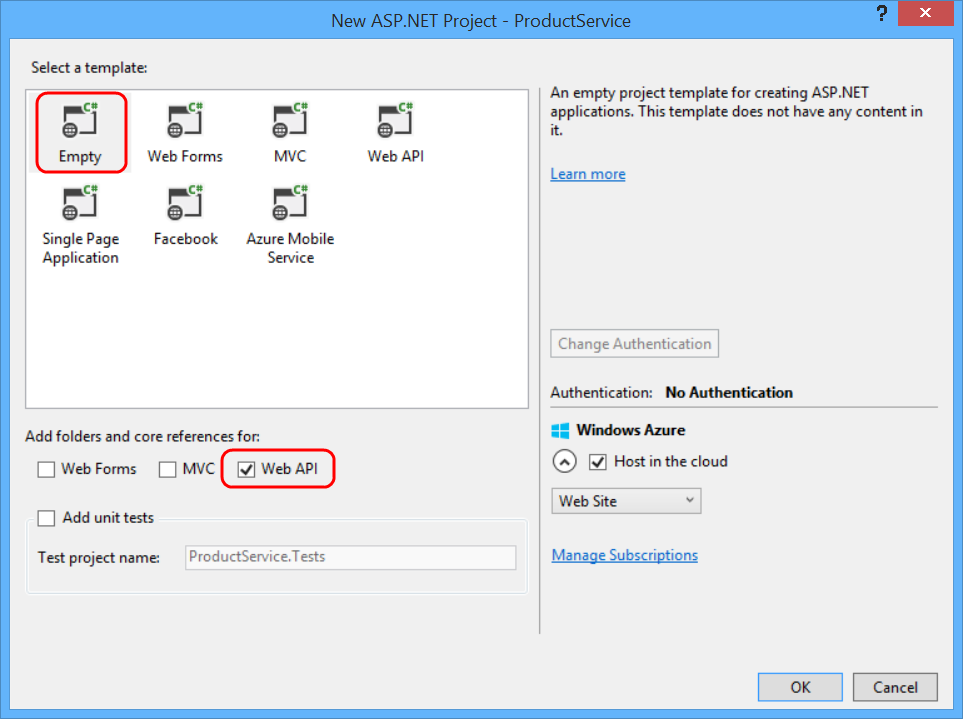
2.安装OData,ODP.NET
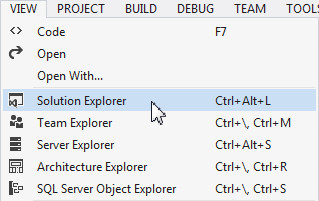
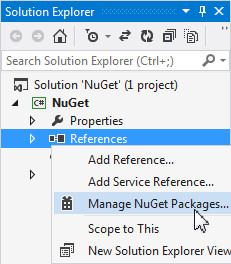
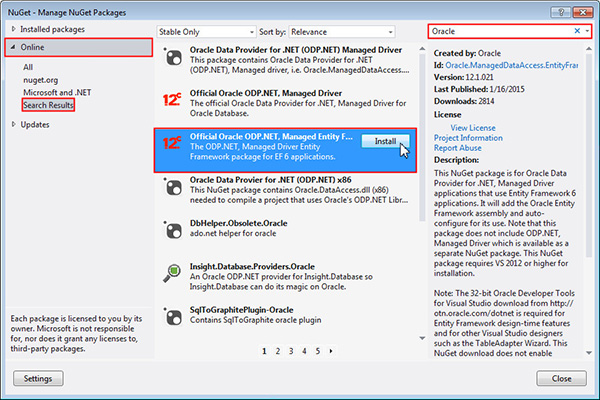
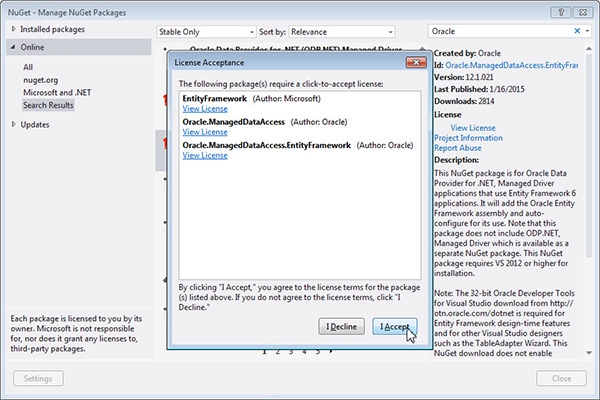
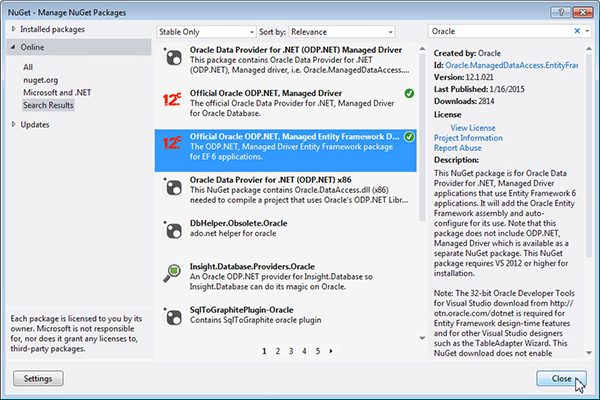
安装的包:
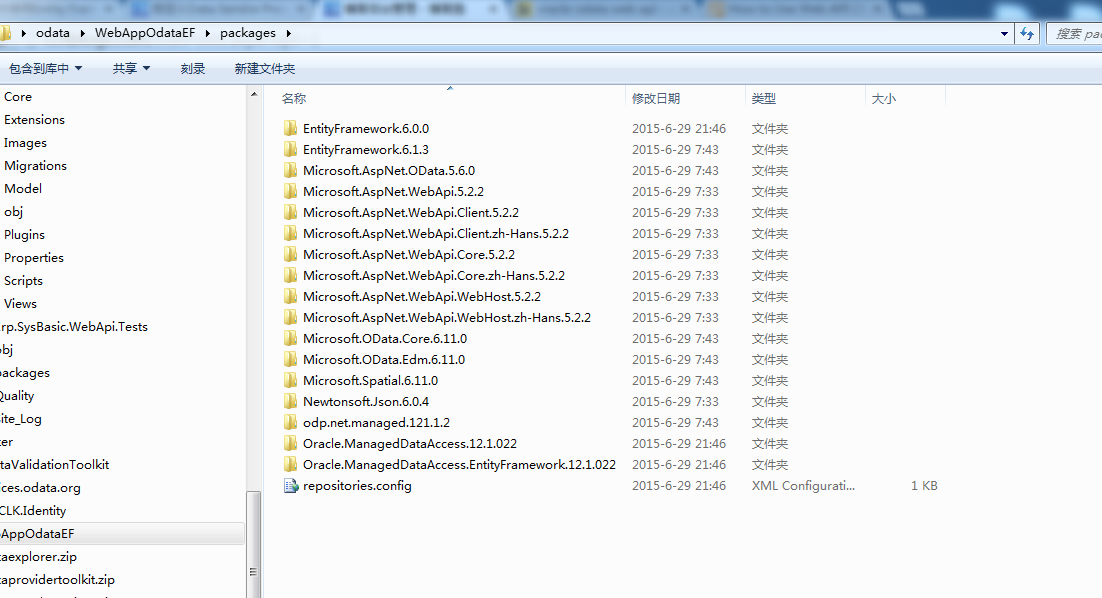
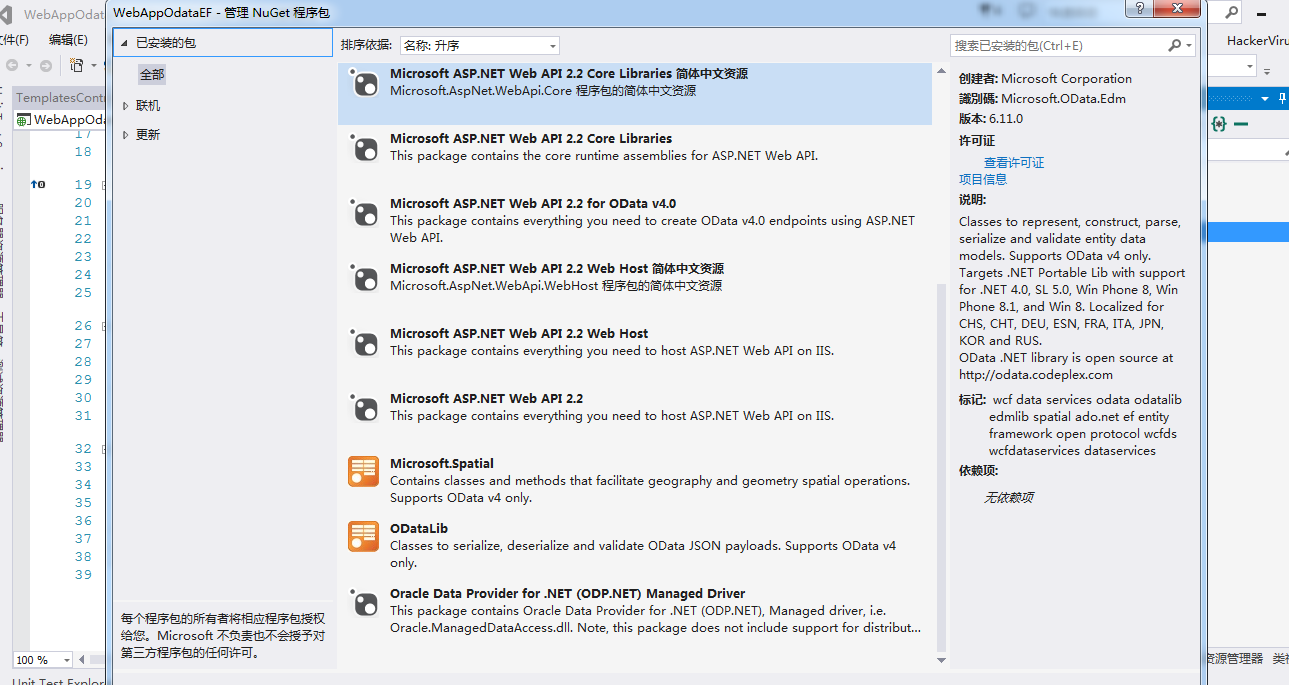
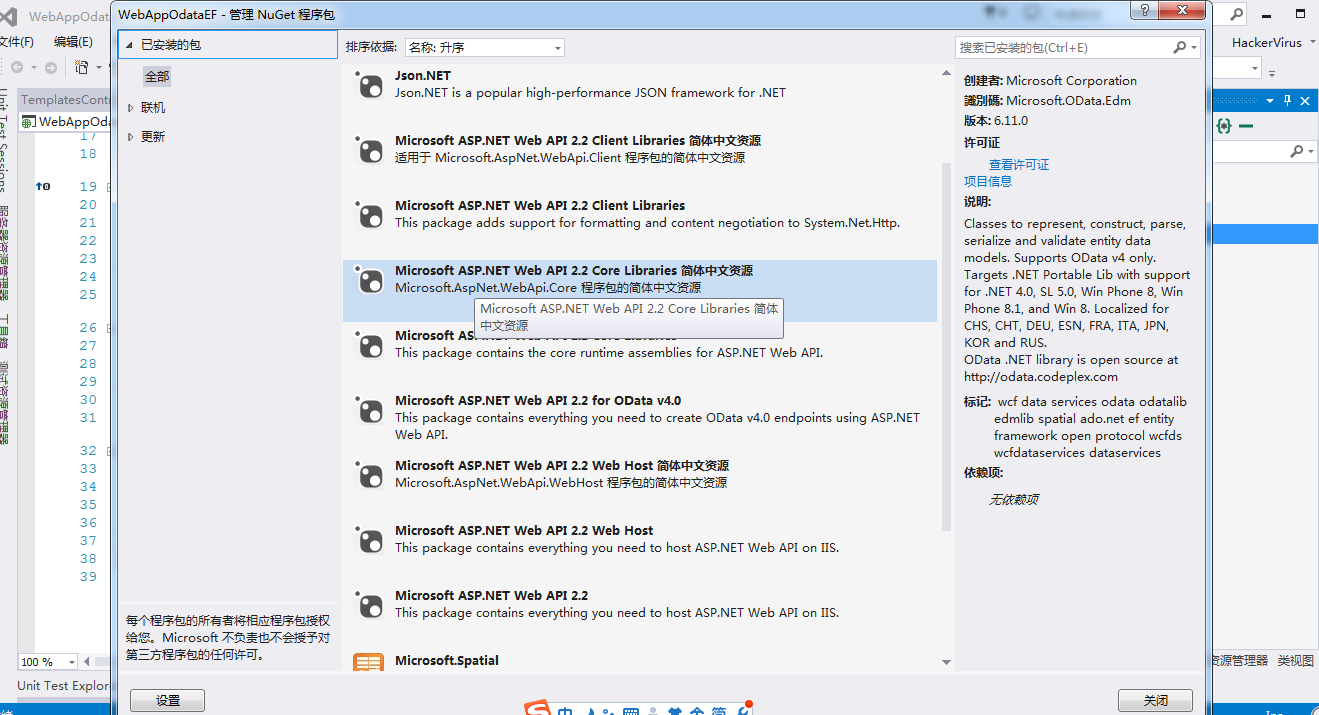
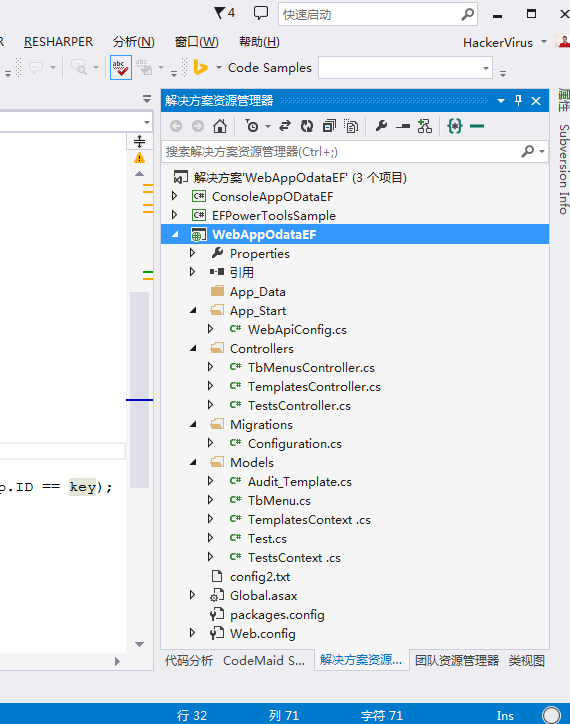
下面是部分代码:
using System;

using System.Collections.Generic;

using System.Linq;

using System.Web;

namespace WebAppOdataEF.Models

{

    public class AUDIT_TEMPLATE

    {

        /// <summary>

        /// Gets or sets the identifier.

        /// 自增ID

        /// </summary>

        /// <value>The identifier.</value>

        public decimal ID { get; set; }

        /// <summary>

        /// Gets or sets the audit template no.

        /// 审批模板编码

        /// </summary>

        /// <value>The audit template no.</value>

        public string AUDITTEMPLATENO { get; set; }

        /// <summary>

        /// Gets or sets the name of the audit template.

        /// 审批模板名称

        /// </summary>

        /// <value>The name of the audit template.</value>

        public string AUDITTEMPLATENAME { get; set; }

        /// <summary>

        /// Gets or sets the bill type no.

        /// 单据类型

        /// </summary>

        /// <value>The bill type no.</value>

        public string BILLTYPENO { get; set; }

        /// <summary>

        /// Gets or sets the remark.

        /// 备注

        /// </summary>

        /// <value>The remark.</value>

        public string REMARK { get; set; }

        /// <summary>

        /// Gets or sets the template status.

        /// 状态1有效 0无效

        /// </summary>

        /// <value>The template status.</value>

        public decimal TEMPLATESTATUS { get; set; }

        /// <summary>

        /// Gets or sets the company no.

        /// 公司编码

        /// </summary>

        /// <value>The company no.</value>

        public string COMPANYNO { get; set; }

        /// <summary>

        /// Gets or sets the create time.

        /// 创建时间

        /// </summary>

        /// <value>The create time.</value>

        public DateTime CREATETIME { get; set; }

        /// <summary>

        /// Gets or sets the create user no.

        /// 创建人

        /// </summary>

        /// <value>The create user no.</value>

        public string CREATEUSERNO { get; set; }

        /// <summary>

        /// Gets or sets the update time.

        /// 更新时间

        /// </summary>

        /// <value>The update time.</value>

        public DateTime UPDATETIME { get; set; }

        /// <summary>

        /// Gets or sets the update user no.

        /// 更新人

        /// </summary>

        /// <value>The update user no.</value>

        public string UPDATEUSERNO { get; set; }

    }

}
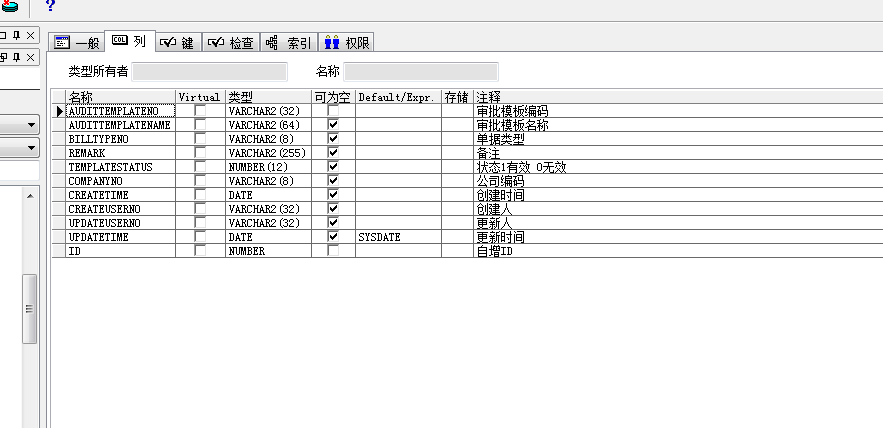
这个是实体代码,类名称和属性名称要和数据库中的表结构表名和字段名称一样,大小写都一样。
EF Context代码:
using System;

using System.Collections.Generic;

using System.Data.Entity;

using System.Data.Entity.ModelConfiguration.Conventions;

using System.Linq;

using System.Web;

namespace WebAppOdataEF.Models

{

    public class TemplatesContext : DbContext

    {

        static TemplatesContext()

        {

            Database.SetInitializer<TestsContext>(null);

            //Database.SetInitializer(new CreateDatabaseIfNotExists<TestsContext>());

            //Database.SetInitializer(new DropCreateDatabaseAlways<TestsContext>());

            //Database.SetInitializer(new DropCreateDatabaseIfModelChanges<TestsContext>());

        }

        /// <summary>

        /// Initializes a new instance of the <see cref="TemplatesContext"/> class.

        /// </summary>

        public TemplatesContext()

            : base("name=SysBasicOracleDbContext")

        {

            this.Configuration.LazyLoadingEnabled = false;

        }

        /// <summary>

        /// Gets or sets the templates.

        /// </summary>

        /// <value>The templates.</value>

        public DbSet<AUDIT_TEMPLATE> Templates { get; set; }

        protected override void OnModelCreating(DbModelBuilder modelBuilder)

        {

            modelBuilder.HasDefaultSchema("TEST");

            modelBuilder.Conventions.Remove<OneToManyCascadeDeleteConvention>();

            modelBuilder.Conventions.Remove<ManyToManyCascadeDeleteConvention>();

            modelBuilder.Conventions.Remove<PluralizingTableNameConvention>();

        }

    }

}
这里是你的用户,
"TEST" 一定要大写
modelBuilder.HasDefaultSchema("TEST");

Controller部分代码:
using System;

using System.Collections.Generic;

using System.Linq;

using System.Net;

using System.Net.Http;

using System.Web.Http;

using System.Web.OData;

using WebAppOdataEF.Models;

namespace WebAppOdataEF.Controllers

{

    public class TemplatesController : ODataController

    {

        TemplatesContext db = new TemplatesContext();

        private bool TestExists(int key)

        {

            return db.Templates.Any(p => p.ID == key);

        }

        protected override void Dispose(bool disposing)

        {

            db.Dispose();

            base.Dispose(disposing);

        }

        [EnableQuery]

        public IHttpActionResult Get()

        {

            return Ok(db.Templates);

        }

        [EnableQuery]

        public SingleResult<AUDIT_TEMPLATE> Get([FromODataUri] int key)

        {

            IQueryable<AUDIT_TEMPLATE> result = db.Templates.Where(p => p.ID == key);

            return SingleResult.Create(result);

        }

    }

}
using System;

using System.Collections.Generic;

using System.Linq;

using System.Net;

using System.Net.Http;

using System.Web.Http;

using WebAppOdataEF.Models;

using System.Data.Entity;

using System.Data.Entity.Infrastructure;

using System.Threading.Tasks;

using System.Web.OData;

namespace WebAppOdataEF.Controllers

{

    public class TestsController : ODataController

    {

        TestsContext db = new TestsContext();

        private bool TestExists(int key)

        {

            return db.Tests.Any(p => p.ID == key);

        }

        protected override void Dispose(bool disposing)

        {

            db.Dispose();

            base.Dispose(disposing);

        }

        [EnableQuery]

        public IHttpActionResult Get()

        {

            return Ok(db.Tests);

        }

        [EnableQuery]

        public SingleResult<TESTS> Get([FromODataUri] int key)

        {

            IQueryable<TESTS> result = db.Tests.Where(p => p.ID == key);

            return SingleResult.Create(result);

        }

        public async Task<IHttpActionResult> Post(TESTS product)

        {

            if (!ModelState.IsValid)

            {

                return BadRequest(ModelState);

            }

            db.Tests.Add(product);

            await db.SaveChangesAsync();

            return Created(product);

        }

        public async Task<IHttpActionResult> Patch([FromODataUri] int key, Delta<TESTS> product)

        {

            if (!ModelState.IsValid)

            {

                return BadRequest(ModelState);

            }

            var entity = await db.Tests.FindAsync(key);

            if (entity == null)

            {

                return NotFound();

            }

            product.Patch(entity);

            try

            {

                await db.SaveChangesAsync();

            }

            catch (DbUpdateConcurrencyException)

            {

                if (!TestExists(key))

                {

                    return NotFound();

                }

                else

                {

                    throw;

                }

            }

            return Updated(entity);

        }

        public async Task<IHttpActionResult> Put([FromODataUri] int key, TESTS update)

        {

            if (!ModelState.IsValid)

            {

                return BadRequest(ModelState);

            }

            if (key != update.ID)

            {

                return BadRequest();

            }

            db.Entry(update).State = EntityState.Modified;

            try

            {

                await db.SaveChangesAsync();

            }

            catch (DbUpdateConcurrencyException)

            {

                if (!TestExists(key))

                {

                    return NotFound();

                }

                else

                {

                    throw;

                }

            }

            return Updated(update);

        }

        public async Task<IHttpActionResult> Delete([FromODataUri] int key)

        {

            var product = await db.Tests.FindAsync(key);

            if (product == null)

            {

                return NotFound();

            }

            db.Tests.Remove(product);

            await db.SaveChangesAsync();

            return StatusCode(HttpStatusCode.NoContent);

        }

    }

}
WebApiConfig代码:
using System;

using System.Collections.Generic;

using System.Linq;

using System.Web.Http;

using WebAppOdataEF.Models;

using System.Web.OData.Builder;

using System.Web.OData.Extensions;

namespace WebAppOdataEF

{

    public static class WebApiConfig

    {

        public static void Register(HttpConfiguration config)

        {

            // Web API 配置和服务

            ODataModelBuilder builder = new ODataConventionModelBuilder();

            builder.EntitySet<TESTS>("Tests");

            builder.EntitySet<TB_MENU>("TbMenus");

            builder.EntitySet<AUDIT_TEMPLATE>("Templates");

            config.MapODataServiceRoute(

                routeName: "ODataRoute",

                routePrefix: null,

                model: builder.GetEdmModel());

            // Web API 路由

            //config.MapHttpAttributeRoutes();

            //config.Routes.MapHttpRoute(

            //    name: "DefaultApi",

            //    routeTemplate: "api/{controller}/{id}",

            //    defaults: new { id = RouteParameter.Optional }

            //);

        }

    }

}
WebApiApplication代码:
using System;

using System.Collections.Generic;

using System.Linq;

using System.Web;

using System.Web.Http;

using System.Web.Routing;

namespace WebAppOdataEF

{

    public class WebApiApplication : System.Web.HttpApplication

    {

        protected void Application_Start()

        {

            GlobalConfiguration.Configure(WebApiConfig.Register);

        }

    }

}
WebConfig文件:
<?xml version="1.0" encoding="utf-8"?>

<!--

  有关如何配置 ASP.NET 应用程序的详细信息,请访问

  http://go.microsoft.com/fwlink/?LinkId=301879

  -->

<configuration>

  <configSections>

    <!-- For more information on Entity Framework configuration, visit http://go.microsoft.com/fwlink/?LinkID=237468 -->

    <section name="entityFramework" type="System.Data.Entity.Internal.ConfigFile.EntityFrameworkSection, EntityFramework, Version=6.0.0.0, Culture=neutral, PublicKeyToken=b77a5c561934e089" requirePermission="false" />

    <!--<section name="oracle.manageddataaccess.client" type="OracleInternal.Common.ODPMSectionHandler, Oracle.ManagedDataAccess, Version=4.121.2.0, Culture=neutral, PublicKeyToken=89b483f429c47342" />-->

  </configSections>

  <appSettings></appSettings>
<!--<connectionStrings>
<add name="TestsContext" providerName="Oracle.ManagedDataAccess.Client"
connectionString="User Id=system;Password=111111;Data Source=XE"/>
<add name="SysBasicOracleDbContext" providerName="Oracle.ManagedDataAccess.Client" connectionString="User Id=test;Password=test;Data Source=test" />
</connectionStrings>-->
 <connectionStrings>
    <add name="SysBasicOracleDbContext" connectionString="Data Source= (DESCRIPTION =

    (ADDRESS = (PROTOCOL = TCP)(HOST = 127.0.0.1)(PORT = 1521))
    (CONNECT_DATA =

      (SERVER = DEDICATED)

      (SERVICE_NAME = test)

    )

  );User ID=test;Password=test;Persist Security Info=True" providerName="Oracle.ManagedDataAccess.Client" />

  </connectionStrings>

    <system.web>

    <compilation debug="true" targetFramework="4.5" />

    <httpRuntime targetFramework="4.5" />

  </system.web>

  <system.data>

    <DbProviderFactories>

      <remove invariant="Oracle.ManagedDataAccess.Client" />

      <add name="ODP.NET, Managed Driver" invariant="Oracle.ManagedDataAccess.Client" description="Oracle Data Provider for .NET, Managed Driver"

          type="Oracle.ManagedDataAccess.Client.OracleClientFactory, Oracle.ManagedDataAccess, Version=4.121.2.0, Culture=neutral, PublicKeyToken=89b483f429c47342" />

    </DbProviderFactories>

</system.data>

  <system.webServer>

    <handlers>

      <remove name="ExtensionlessUrlHandler-Integrated-4.0" />

      <remove name="OPTIONSVerbHandler" />

      <remove name="TRACEVerbHandler" />

      <add name="ExtensionlessUrlHandler-Integrated-4.0" path="*." verb="*" type="System.Web.Handlers.TransferRequestHandler" preCondition="integratedMode,runtimeVersionv4.0" />

    </handlers>

  </system.webServer>

  <runtime>

    <assemblyBinding xmlns="urn:schemas-microsoft-com:asm.v1">

      <dependentAssembly>

        <assemblyIdentity name="Microsoft.Owin" publicKeyToken="31bf3856ad364e35" />

        <bindingRedirect oldVersion="1.0.0.0-3.0.0.0" newVersion="3.0.0.0" />

      </dependentAssembly>

      <dependentAssembly>

        <assemblyIdentity name="Microsoft.Owin.Security.OAuth" publicKeyToken="31bf3856ad364e35" />

        <bindingRedirect oldVersion="1.0.0.0-3.0.0.0" newVersion="3.0.0.0" />

      </dependentAssembly>

      <dependentAssembly>

        <assemblyIdentity name="Microsoft.Owin.Security.Cookies" publicKeyToken="31bf3856ad364e35" />

        <bindingRedirect oldVersion="1.0.0.0-3.0.0.0" newVersion="3.0.0.0" />

      </dependentAssembly>

      <dependentAssembly>

        <assemblyIdentity name="Microsoft.Owin.Security" publicKeyToken="31bf3856ad364e35" />

        <bindingRedirect oldVersion="1.0.0.0-3.0.0.0" newVersion="3.0.0.0" />

      </dependentAssembly>

      <dependentAssembly>

        <assemblyIdentity name="Newtonsoft.Json" culture="neutral" publicKeyToken="30ad4fe6b2a6aeed" />

        <bindingRedirect oldVersion="0.0.0.0-6.0.0.0" newVersion="6.0.0.0" />

      </dependentAssembly>

      <dependentAssembly>

        <assemblyIdentity name="System.Web.Helpers" publicKeyToken="31bf3856ad364e35" />

        <bindingRedirect oldVersion="1.0.0.0-3.0.0.0" newVersion="3.0.0.0" />

      </dependentAssembly>

      <dependentAssembly>

        <assemblyIdentity name="System.Web.Mvc" publicKeyToken="31bf3856ad364e35" />

        <bindingRedirect oldVersion="1.0.0.0-5.2.2.0" newVersion="5.2.2.0" />

      </dependentAssembly>

      <dependentAssembly>

        <assemblyIdentity name="System.Web.Optimization" publicKeyToken="31bf3856ad364e35" />

        <bindingRedirect oldVersion="1.0.0.0-1.1.0.0" newVersion="1.1.0.0" />

      </dependentAssembly>

      <dependentAssembly>

        <assemblyIdentity name="System.Web.WebPages" publicKeyToken="31bf3856ad364e35" />

        <bindingRedirect oldVersion="1.0.0.0-3.0.0.0" newVersion="3.0.0.0" />

      </dependentAssembly>

      <dependentAssembly>

        <assemblyIdentity name="WebGrease" publicKeyToken="31bf3856ad364e35" />

        <bindingRedirect oldVersion="1.0.0.0-1.5.2.14234" newVersion="1.5.2.14234" />

      </dependentAssembly>

    </assemblyBinding>

  </runtime>

  <!--<oracle.manageddataaccess.client>

    <version number="*">

      <dataSources>

        <dataSource alias="XE" descriptor="(DESCRIPTION=(ADDRESS=(PROTOCOL=tcp)(HOST=localhost)(PORT=1521))(CONNECT_DATA=(SERVICE_NAME=XE))) "/>

        <dataSource alias="test" descriptor="(DESCRIPTION=(ADDRESS=(PROTOCOL=tcp)(HOST=127.0.0.1)(PORT=1521))(CONNECT_DATA=(SERVICE_NAME=test))) " />

      </dataSources>

    </version>

  </oracle.manageddataaccess.client>-->

  <entityFramework>

    <!--<defaultConnectionFactory type="System.Data.Entity.Infrastructure.SqlConnectionFactory, EntityFramework"/>-->

    <defaultConnectionFactory type="Oracle.ManagedDataAccess.EntityFramework.OracleConnectionFactory,

      Oracle.ManagedDataAccess.EntityFramework,

      Version=6.121.2.0,

      Culture=neutral,

      PublicKeyToken=89b483f429c47342" />

    <providers>

      <provider invariantName="System.Data.SqlClient" type="System.Data.Entity.SqlServer.SqlProviderServices, EntityFramework.SqlServer"/>

      <provider invariantName="Oracle.ManagedDataAccess.Client" type="Oracle.ManagedDataAccess.EntityFramework.EFOracleProviderServices,Oracle.ManagedDataAccess.EntityFramework, Version=6.121.2.0, Culture=neutral, PublicKeyToken=89b483f429c47342" />

    </providers>

  </entityFramework>

</configuration>
运行结果:
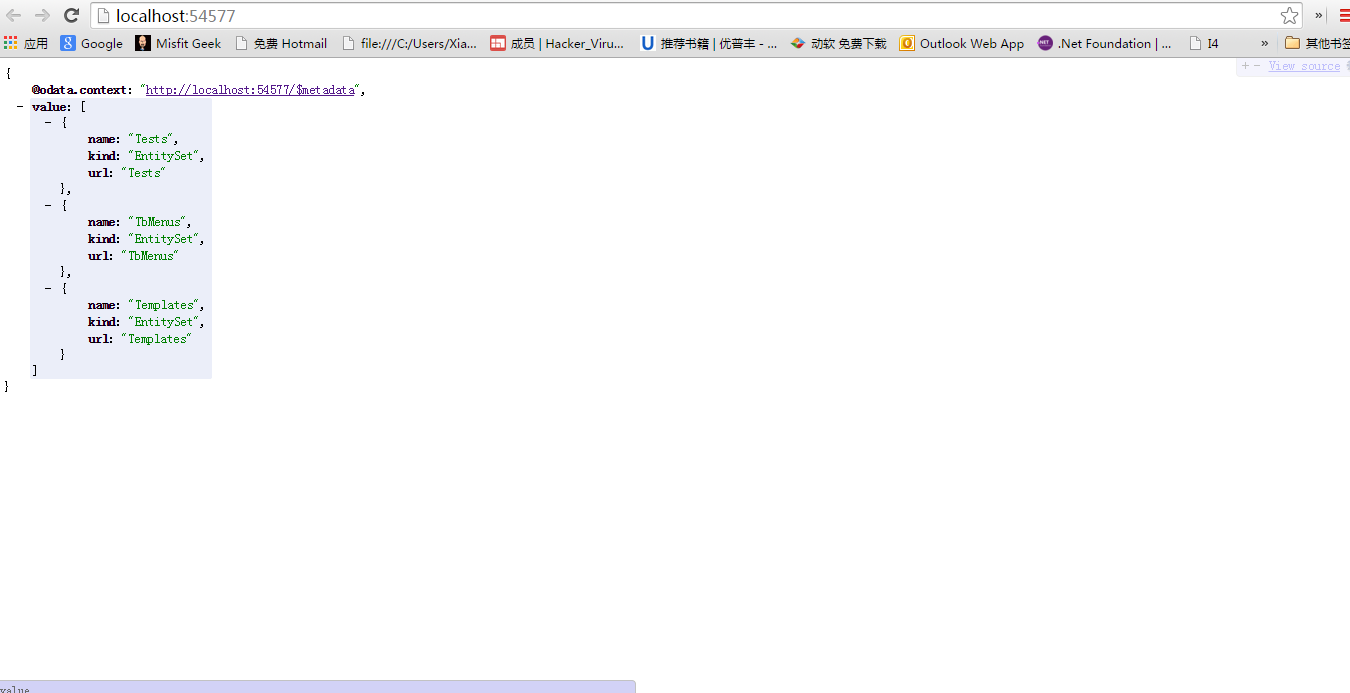
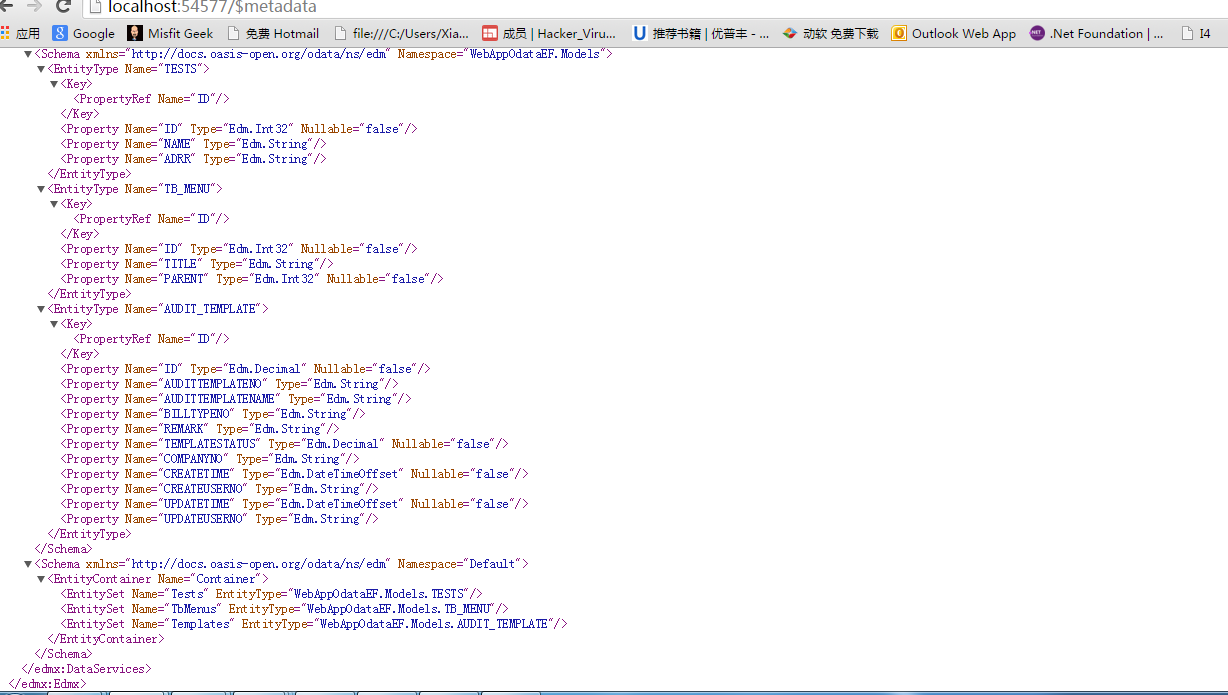
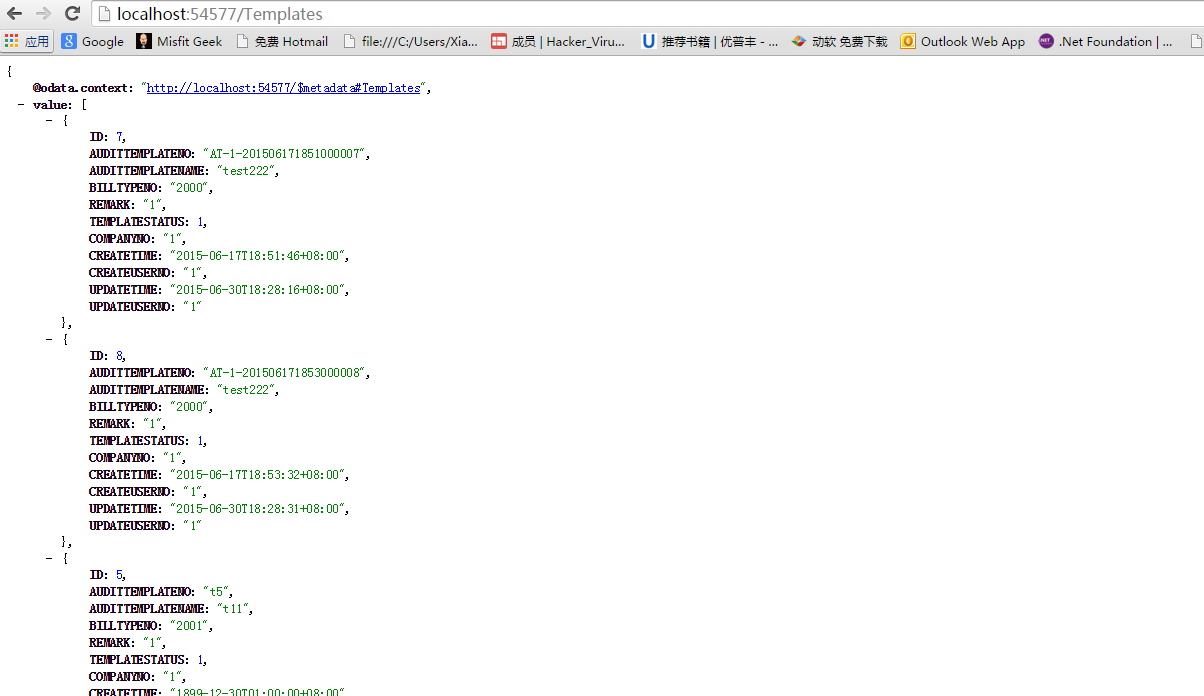
http://localhost:54577/Templates
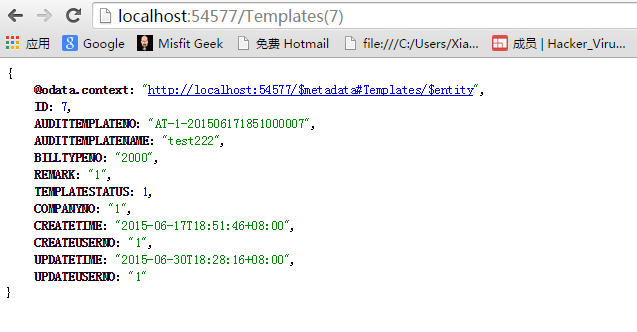
http://localhost:54577/Templates(7)
http://localhost:54577/Templates?$count=true
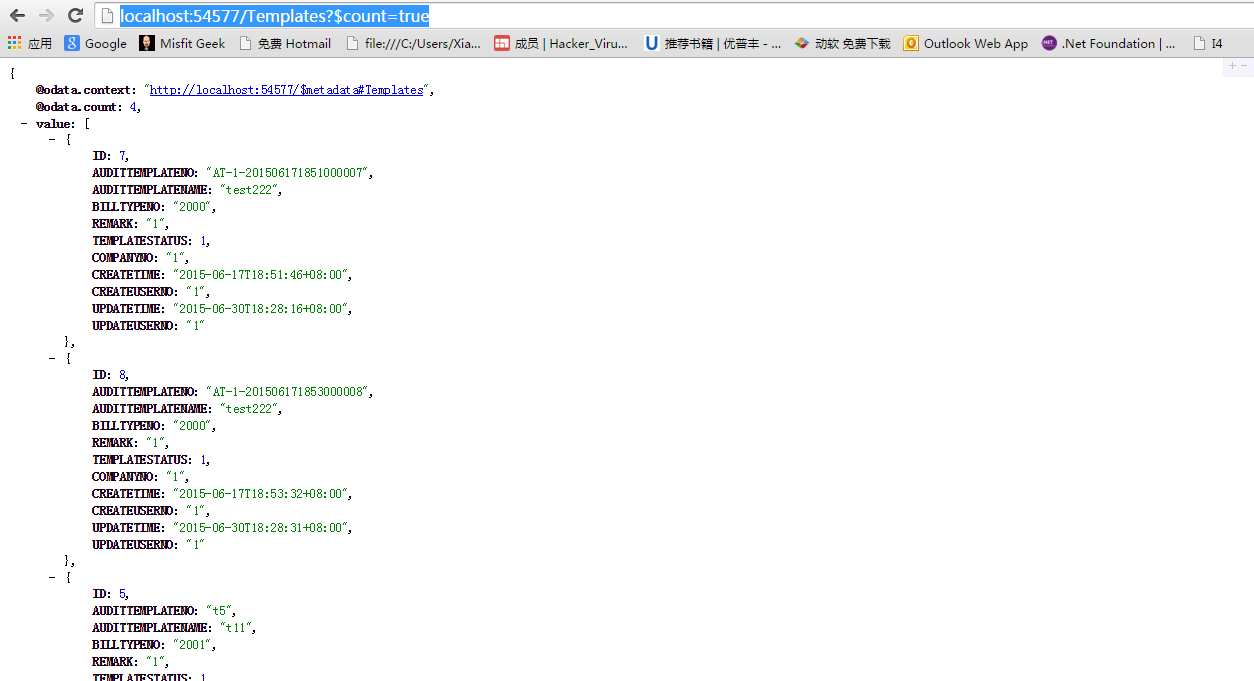
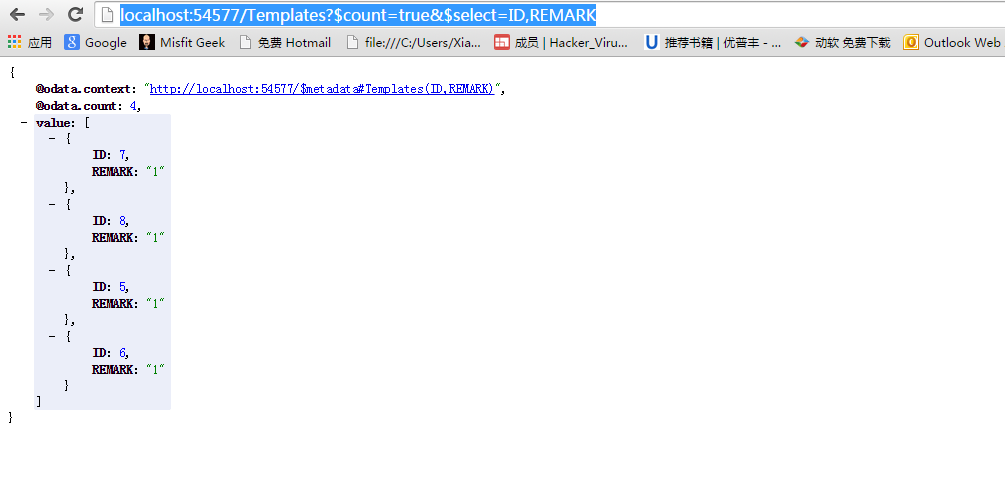
http://localhost:54577/Templates?$count=true&$select=ID,REMARK
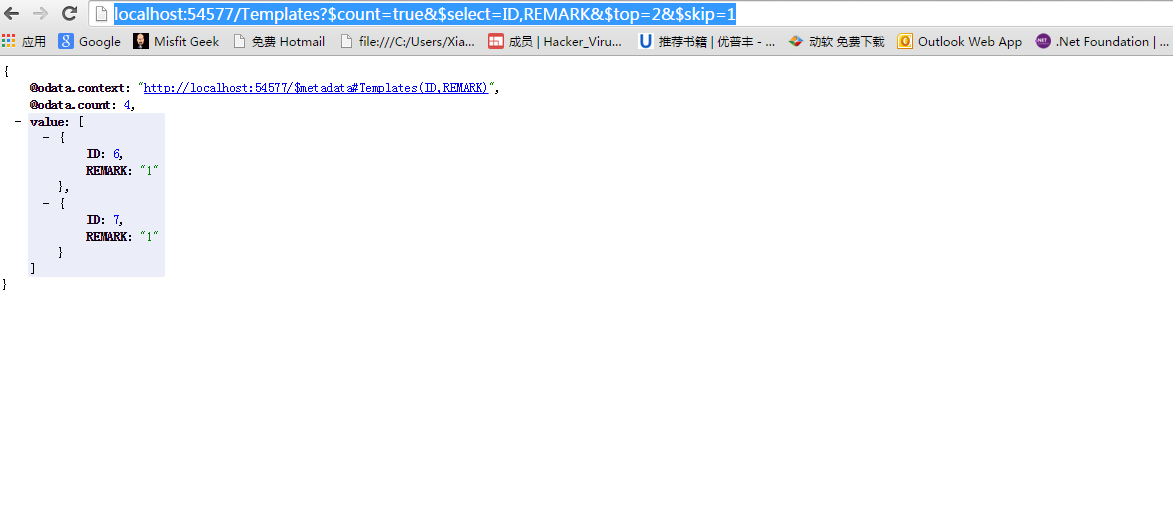
http://localhost:54577/Templates?$count=true&$select=ID,REMARK&$top=2&$skip=1
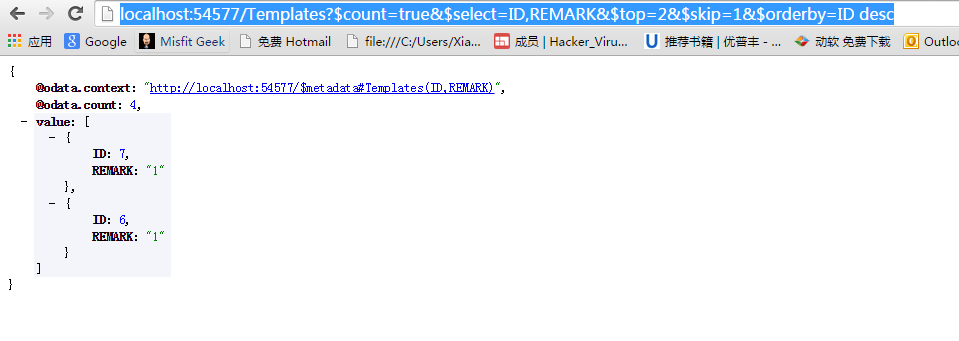
http://localhost:54577/Templates?$count=true&$select=ID,REMARK&$top=2&$skip=1&$orderby=ID%20desc
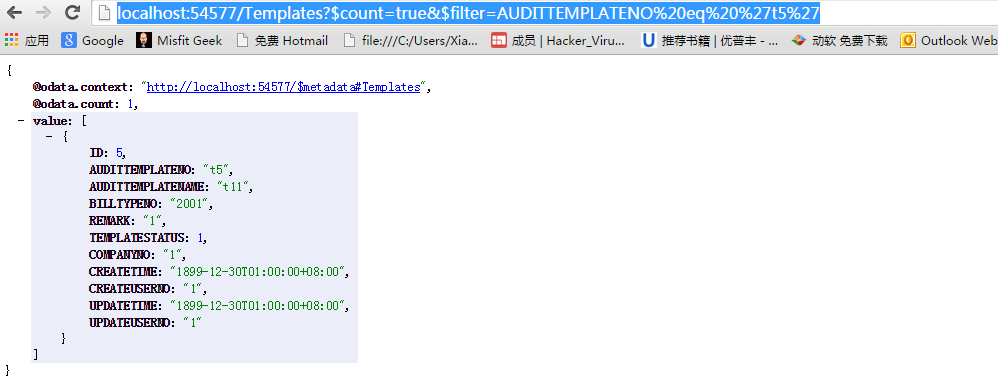
http://localhost:54577/Templates?$count=true&$filter=AUDITTEMPLATENO%20eq%20%27t5%27
请参考Odata.org官网:
基础操作:
http://www.odata.org/getting-started/basic-tutorial/#filter
高级操作:
http://www.odata.org/getting-started/advanced-tutorial/
Github地址:
http://odata.github.io/
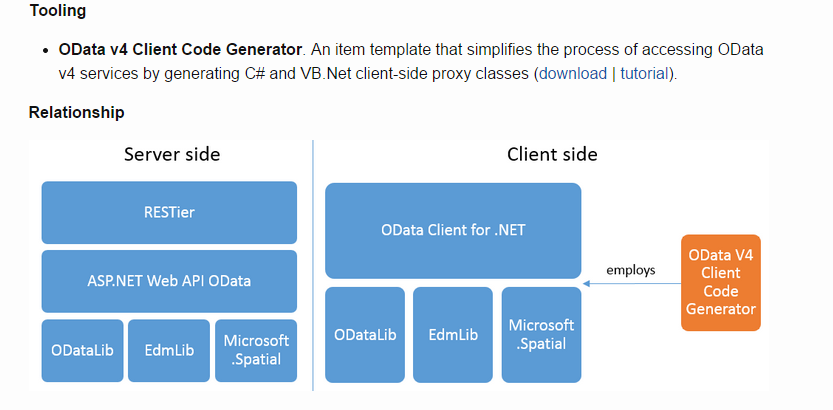
https://github.com/OData/RESTier
参考文章:
二篇教程(英文版):
1.Using NuGet to Install and Configure Oracle Data Provider for .NET
2.Entity Framework Code First and Code First Migrations for Oracle Database
http://www.cnblogs.com/yjmyzz/p/how-to-use-code-first-in-oracle-with-entity-framework-6.html
http://www.cnblogs.com/shanyou/archive/2010/02/19/1669360.html
http://www.asp.net/web-api/overview/odata-support-in-aspnet-web-api/odata-v4/create-an-odata-v4-endpoint
http://www.odata.org/blog/how-to-use-web-api-odata-to-build-an-odata-v4-service-without-entity-framework/
如何使用ASP.NET Web API OData在Oracle中使用Entity Framework 6.x Code-First方式开发 OData V4 Service的更多相关文章
- ASP.NET Web API WebHost宿主环境中管道、路由
ASP.NET Web API WebHost宿主环境中管道.路由 前言 上篇中说到ASP.NET Web API框架在SelfHost环境中管道.路由的一个形态,本篇就来说明一下在WebHost环境 ...
- ASP.NET Web API Selfhost宿主环境中管道、路由
ASP.NET Web API Selfhost宿主环境中管道.路由 前言 前面的几个篇幅对Web API中的路由和管道进行了简单的介绍并没有详细的去说明一些什么,然而ASP.NET Web API这 ...
- Global Error Handling in ASP.NET Web API 2(webapi2 中的全局异常处理)
目前,在Web API中没有简单的方法来记录或处理全局异常(webapi1中).一些未处理的异常可以通过exception filters进行处理,但是有许多情况exception filters无法 ...
- 解决ASP.NET Web API Json对象循环参考错误
前言 一般我们在开法 ASP.NET Web API 时,如果是使用 Entity Framework 技术来操作数据库的话,当两个 Entity 之间包含导览属性(Navigation Proper ...
- asp.net web api 的版本升级到 2.2的记录
asp.net web api 的版本 升级到 2.2的记录 asp.net web api 2.2相比1.0提升了不少 而且其中最重要的就是有了在线文档的自动字段注释的功能 再也不用写详细的字段说明 ...
- [水煮 ASP.NET Web API2 方法论](1-5)ASP.NET Web API Scaffolding(模板)
问题 我们想快速启动一个 ASP.NET Web API 解决方案. 解决方案 APS.NET 模板一开始就支持 ASP.NET Web API.使用模板往我们的项目中添加 Controller,在我 ...
- 杂项:ASP.NET Web API
ylbtech-杂项:ASP.NET Web API ASP.NET Web API 是一种框架,用于轻松构建可以访问多种客户端(包括浏览器和移动设备)的 HTTP 服务. ASP.NET Web A ...
- ASP.NET Web API 控制器创建过程(二)
ASP.NET Web API 控制器创建过程(二) 前言 本来这篇随笔应该是在上周就该写出来发布的,由于身体跟不上节奏感冒发烧有心无力,这种天气感冒发烧生不如死,也真正的体会到了什么叫病来如山倒,病 ...
- ASP.NET Web API 管道模型
ASP.NET Web API 管道模型 前言 ASP.NET Web API是一个独立的框架,也有着自己的一套消息处理管道,不管是在WebHost宿主环境还是在SelfHost宿主环境请求和响应都是 ...
随机推荐
- NewSQL——优化的SQL存储引擎(TokuDB, MemSQL)+?
NewSQL 是对各种新的可扩展/高性能数据库的简称,这类数据库不仅具有NoSQL对海量数据的存储管理能力,还保持了传统数据库支持ACID和SQL等特性. NewSQL 是指这样一类新式的关系型数据库 ...
- c#基础语言编程-多态
语言中的多态性是为了使程序有扩展性,为实现多态性,在程序中体现为接口.抽象类.父类.具体类. 接口就是一种规范,解决了多重继承的问题,类似一种规范,告诉我要做什么,具有什么能力,在接口中定义写行为属性 ...
- css开发经验&错误习惯
CSS开发经验 1.尽量用class来定义样式.尽量少使用 .div1 ul li{}这样的样式下去,因为如果li里面还有<div><ul><li>这些元素的话会 ...
- 提高你30%的设计效率的PPT快捷键
在编辑幻灯片的状态下: [Ctrl]+[A]选择全部对象或幻灯片 [Ctrl]+[B]应用(解除)文本加粗 [Ctrl]+[C]复制 [Ctrl]+[D]快速复制对象 [Ctrl]+[E]段落居中对齐 ...
- HDU5047Sawtooth(java大数)
HDU5047Sawtooth(java大数) 题目链接 题目大意:在一个矩形内画n个"M".问如何画可以把这个矩形分成最多的区域. 给出这个区域的数目. 解题思路:最好的方式就是 ...
- C#和java和android中的NetWorkAdapter,httpRequest,WebView,json,xml
原文地址:http://blog.csdn.net/intbird C#NetWorkAdapter 20121011.======================================== ...
- Assigning retained object to unsafe property;object will be released after assignment
解决方法,将变量 @property (assign) UILabel *titleView; 改为 @property (retain) UILabel *titleView;
- 让Hibernate生成的DDL脚本自动增加注释
我们知道可以通过Hibernate对象自动生成DDL建表语句,通过PowerDesigner工具可以反向工程生成数据字典,但是在生成的DDL中一直不能写上中文的注释,这就使我们生成的数据字典不具有可用 ...
- android 20 Intnet类重要的成员变量
Intnet类重要的成员变量: <intent-filter> <action android:name="android.intent.action.MAIN" ...
- python-gdb
https://blog.log4d.com/2013/11/python-gdb/ https://wiki.python.org/moin/DebuggingWithGdb