
POJ-3436 ACM Computer Factory(网络流EK)
As you know, all the computers used for ACM contests must be identical, so the participants compete on equal terms. That is why all these computers are historically produced at the same factory.
Every ACM computer consists of P parts. When all these parts are present, the computer is ready and can be shipped to one of the numerous ACM contests.
Computer manufacturing is fully automated by using N various machines. Each machine removes some parts from a half-finished computer and adds some new parts (removing of parts is sometimes necessary as the parts cannot be added to a computer in arbitrary order). Each machine is described by its performance (measured in computers per hour), input and output specification.
Input specification describes which parts must be present in a half-finished computer for the machine to be able to operate on it. The specification is a set of P numbers 0, 1 or 2 (one number for each part), where 0 means that corresponding part must not be present, 1 — the part is required, 2 — presence of the part doesn’t matter.
Output specification describes the result of the operation, and is a set of P numbers 0 or 1, where 0 means that the part is absent, 1 — the part is present.
The machines are connected by very fast production lines so that delivery time is negligibly small compared to production time.
After many years of operation the overall performance of the ACM Computer Factory became insufficient for satisfying the growing contest needs. That is why ACM directorate decided to upgrade the factory.
As different machines were installed in different time periods, they were often not optimally connected to the existing factory machines. It was noted that the easiest way to upgrade the factory is to rearrange production lines. ACM directorate decided to entrust you with solving this problem.
Input
Input file contains integers P N, then N descriptions of the machines. The description of ith machine is represented as by 2 P + 1 integers Qi Si,1 Si,2…Si,P Di,1 Di,2…Di,P, where Qi specifies performance, Si,j — input specification for part j, Di,k — output specification for part k.
Constraints
1 ≤ P ≤ 10, 1 ≤ N ≤ 50, 1 ≤ Qi ≤ 10000
Output
Output the maximum possible overall performance, then M — number of connections that must be made, then M descriptions of the connections. Each connection between machines A and B must be described by three positive numbers A B W, where W is the number of computers delivered from A to B per hour.
If several solutions exist, output any of them.
Sample Input
3 4
15 0 0 0 0 1 0
10 0 0 0 0 1 1
30 0 1 2 1 1 1
3 0 2 1 1 1 1
3 5
5 0 0 0 0 1 0
100 0 1 0 1 0 1
3 0 1 0 1 1 0
1 1 0 1 1 1 0
300 1 1 2 1 1 1
2 2
100 0 0 1 0
200 0 1 1 1
Sample Output
25 2
1 3 15
2 3 10
4 5
1 3 3
3 5 3
1 2 1
2 4 1
4 5 1
0 0
—————————————————–分割线——————————————————–
题意,有N个机器,每个机器对P个部分进行加工,但是每个机器对加工的对象都有要求,题中input specification 代表机器加工的对象必须满足的条件,其中为0的部分绝对不能存在,为1的部分必须存在,为2的部位存在与不存在都可以。Output specification 代表机器加工完成后的对象, 其中为0的部分代表加工后不存在,为1的部分代表加工后存在。用这些机器将全为0的零件加工成全为1的电脑。给出每个机器的加工速度,加工对象和加工后对象,求最快的加工速度。
解释案例:
3 4
15 0 0 0 0 1 0
10 0 0 0 0 1 1
30 0 1 2 1 1 1
3 0 2 1 1 1 1
有四个机器,每个机器对三个地方加工。
一开始的板子是空的,所以只能用0 0 0 开始的机器来加工,所以一开始只有1号和2号机子可以用,用1号机子后变成0 1 0 然后拿去三号机子,变成1 1 1,这一条路加工速度为15。用2号机子加工变成0 1 1,然后拿去三号机子加工,这条路加工为10,所以总的速度是25。
思路:对于每个点先要把点分割开,把点分开成两部分的意义在于,不能让最大流量超过本身的生产量。这是因为每个点我都需要一进一出,而我自己又有自己最大的生产量,所以我要保证在网络流图上跑的时候不仅不会超过前一个点带来的流量,也不会超过自己本身所可以承受的流量。如图:
假设c能承受的流量只有15 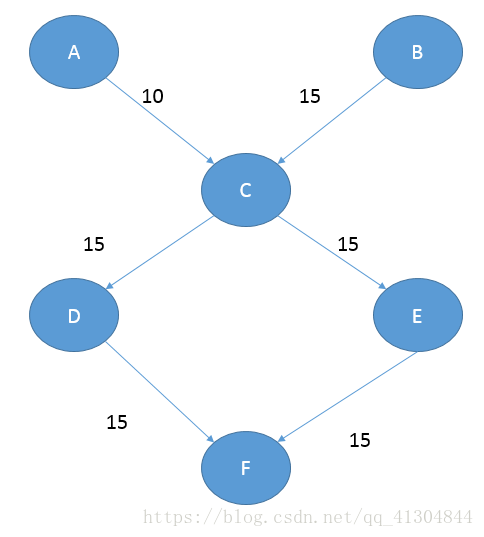
如果按这个图跑,那么我会超出自身可以承受的流量,超出15,使最大流变成30,这显然是不可以的 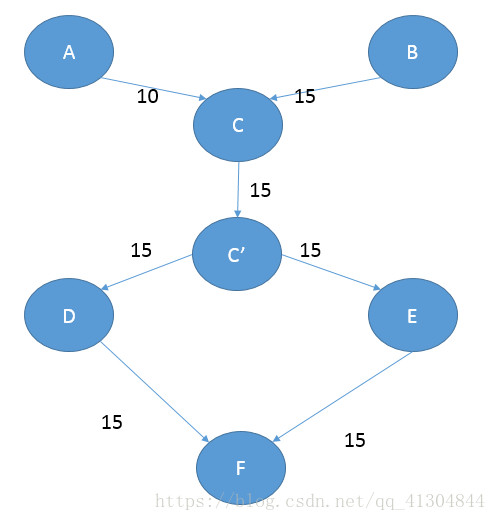
那么我这时候就需要对c点进行拆点,是一条从自身到自身的路的权值是自身的生产量,这样我就保证了我不会超出自身最大可以承受的流量。
同理,在这题中就需要对每个点来进行拆点,然后一个点用来接收流量,一个点用来发送流量,在这两个点之间用本身可以承受的最大流量来将这两个点连接起来,在这题中也就是本身的生产速度。最后跑一边最大流,然后对每条边判断,如果一开始的边比跑完以后的边的权值大,那么就说明有流量经过。
#include<map>

#include<ctime>

#include<cmath>

#include<stack>

#include<queue>

#include<string>

#include<vector>

#include<cstdio>

#include<cstdlib>

#include<cstring>

#include<iostream>

#include<algorithm>

typedef unsigned long long int ull;

typedef long long int ll;

const double pi = 4.0*atan(1.0);

const int inf = 0x3f3f3f3f;

const int maxn = ;

const int maxm = ;

using namespace std;

int n, m;

int maps[maxn][maxn];

int flow[maxn];

int pre[maxn];

int tmp[maxn][maxn];

int inp[maxn][maxn];

int oup[maxn][maxn];

int res[maxm][];

queue<int> q;

void init() {

    memset(inp, , sizeof(inp));

    memset(oup, , sizeof(oup));

    memset(tmp, , sizeof(tmp));

    memset(res, , sizeof(res));

    memset(maps, , sizeof(maps));

    memset(flow, , sizeof(flow));

}

void getmap() {

    int src = ;

    int des =  * m + ;

    int val;

    for(int i=; i<=m; i++) {

        scanf("%d", &val);

        maps[i][i+m] = val;

        bool flag = true;

        for(int j=; j<=n; j++) {

            scanf("%d", &inp[i][j]);

            if(inp[i][j] == )    flag = false;

        }

        if(flag)

            maps[src][i] = inf;

        flag = true;

        for(int j=; j<=n; j++) {

            scanf("%d", &oup[i][j]);

            if(oup[i][j] == )    flag = false;

        }

        if(flag)

            maps[i + m][des] = inf;

    }

    for(int i=; i<=m; i++) {

        for(int j=; j<=m; j++) {

            if(i == j)    continue;

            int flag = true;

            for(int k=; k<=n; k++) {

                if(oup[i][k] ==  && inp[j][k] == )    flag = false;

                if(oup[i][k] ==  && inp[j][k] == )    flag = false;

            }

            if(flag)

                maps[i+m][j] = inf;

        }

    }

}

int bfs(int src, int des) {

    while(!q.empty())    q.pop();

    memset(pre, -, sizeof(pre));

    q.push(src);

    pre[src] = ;

    flow[src] = inf;

    while(!q.empty()) {

        int index = q.front();

        q.pop();

        if(index == des)    break;

        for(int i=src; i<=des; i++) {

            if(i != src && maps[index][i] && pre[i] == -) {

                pre[i] = index;

                flow[i] = min(flow[index], maps[index][i]);

                q.push(i);

            }

        }

    }

    if(pre[des] == -)    return -;

    else    return flow[des];

}

int EK(int src, int des) {

    int ans = ;

    int val;

    while() {

        val = bfs(src, des);

        if(val == -)    break;

        int last = des;

        while(last != src) {

            maps[pre[last]][last] -= val;

            maps[last][pre[last]] += val;

            last = pre[last];

        }

        ans += val;

    }

    return ans;

}

int solve() {

    int ans = ;

    for(int i=; i<=m; i++) {

        for(int j=; j<=m; j++) {

            if(tmp[i + m][j] - maps[i + m][j] > ) {

                res[ans][] = i;

                res[ans][] = j;

                res[ans][] = tmp[i + m][j] - maps[i + m][j];

                ans++;

            }

        }

    }

    return ans;

}

int main() {

    while(~scanf("%d%d", &n, &m)) {

        init();

        getmap();

        int src = ;

        int des =  * m + ;

        /*

        for(int i=src; i<=des; i++) {

            for(int j=src; j<=des; j++) {

                printf("%d%c", maps[i][j], j==des ? '\n' : '\t');

            }

        }

        */

        memcpy(tmp, maps, sizeof(maps));

        int ans = EK(src, des);

        int tol = solve();

        printf("%d %d\n", ans, tol);

        for(int i=; i<tol; i++) {

            printf("%d %d %d\n", res[i][], res[i][], res[i][]);

        }

    }

    return ;

}
POJ-3436 ACM Computer Factory(网络流EK)的更多相关文章
- POJ - 3436 ACM Computer Factory 网络流
POJ-3436:http://poj.org/problem?id=3436 题意 组配计算机,每个机器的能力为x,只能处理一定条件的计算机,能输出特定的计算机配置.进去的要求有1,进来的计算机这个 ...
- POJ 3436 ACM Computer Factory (网络流,最大流)
POJ 3436 ACM Computer Factory (网络流,最大流) Description As you know, all the computers used for ACM cont ...
- Poj 3436 ACM Computer Factory (最大流)
题目链接: Poj 3436 ACM Computer Factory 题目描述: n个工厂,每个工厂能把电脑s态转化为d态,每个电脑有p个部件,问整个工厂系统在每个小时内最多能加工多少台电脑? 解题 ...
- kuangbin专题专题十一 网络流 POJ 3436 ACM Computer Factory
题目链接:https://vjudge.net/problem/POJ-3436 Sample input 1 3 4 15 0 0 0 0 1 0 10 0 0 0 0 1 1 30 0 1 2 1 ...
- POJ 3436 ACM Computer Factory 最大流,拆点 难度:1
题目 http://poj.org/problem?id=3436 题意 有一条生产线,生产的产品共有p个(p<=10)零件,生产线上共有n台(n<=50)机器,每台机器可以每小时加工Qi ...
- POJ - 3436 ACM Computer Factory(最大流)
https://vjudge.net/problem/POJ-3436 题目描述: 正如你所知道的,ACM 竞赛中所有竞赛队伍使用的计算机必须是相同的,以保证参赛者在公平的环境下竞争.这就是所有这些 ...
- POJ 3436 ACM Computer Factory(最大流+路径输出)
http://poj.org/problem?id=3436 题意: 每台计算机包含P个部件,当所有这些部件都准备齐全后,计算机就组装完成了.计算机的生产过程通过N台不同的机器来完成,每台机器用它的性 ...
- POJ 3436 ACM Computer Factory (拆点+输出解)
[题意]每台计算机由P个零件组成,工厂里有n台机器,每台机器针对P个零件有不同的输入输出规格,现在给出每台机器每小时的产量,问如何建立流水线(连接各机器)使得每小时生产的计算机最多. 网络流的建图真的 ...
- POJ 3436 ACM Computer Factory
题意: 为了追求ACM比赛的公平性,所有用作ACM比赛的电脑性能是一样的,而ACM董事会专门有一条生产线来生产这样的电脑,随着比赛规模的越来越大,生产线的生产能力不能满足需要,所以说ACM董事会想 ...
- poj 3436 ACM Computer Factory 最大流+记录路径
题目 题意: 每一个机器有一个物品最大工作数量,还有一个对什么物品进行加工,加工后的物品是什么样.给你无限多个初始都是000....的机器,你需要找出来经过这些机器操作后最多有多少成功的机器(111. ...
随机推荐
- 分布式ID生成系统 UUID与雪花(snowflake)算法
Leaf——美团点评分布式ID生成系统 -https://tech.meituan.com/MT_Leaf.html 网游服务器中的GUID(唯一标识码)实现-基于snowflake算法-云栖社区-阿 ...
- vmware can not be closed virtual machine is busy
VMware does not close when Windows Server 2003 ... |VMware Communities https://communities.vmware.co ...
- Oracle 创建外部表
Oracle 外部表能迅速的将海量的数据导入到数据库里面,外部表的创建使用步骤如下: 1 创建一个Directory:必须用sys用户创建,用户存放外部数据文件. create directory D ...
- [转帖]2015年时微软Win3.1崩溃迫使巴黎奥利机场短暂关闭
https://www.ithome.com/html/it/188796.htm IT之家讯 2015年11月14日消息,上周法国巴黎奥利机场因为微软的Windows 3.1系统出现故障不得不迫使所 ...
- spring AOP的用法
AOP,面向切面编程,它能把与核心业务逻辑无关的散落在各处并且重复的代码给封装起来,降低了模块之间的耦合度,便于维护.具体的应用场景有:日志,权限和事务管理这些方面.可以通过一张图来理解下: Spri ...
- MyBatis映射文件6
之前说了由Employee找Department,这一节讲一讲由Department找Employee,显然前者是多对一的关系,而后者是一对多的关系. Department的JavaBean: pri ...
- java获取本机ip(排除虚拟机等一些ip)最终解,总算找到方法了
本文参考https://blog.csdn.net/u011809209/article/details/77236602 本文参考https://blog.csdn.net/yinshuomail/ ...
- DAY06、元组、字典、集合
一.元组 1.定义:参数为for可以循环的对象 t1 = (1, 2) t2 = tuple((1, 2)) t3 = (1, ) #定义一个只有一个值的元组 2.常用操 ...
- Delphi中带缓存的数据更新技术
一. 概念 在网络环境下,数据库应用程序是c/s或者是多层结构的模式.在这种环境下,数据库应用程序的开发应当尽可能考虑减少网络数据传输量,并且尽量提高并发度.基于这个目的,带缓存的数据更新技术应运而生 ...
- DataSet 取值,DataSet行数,DataSet列数 从DataSet中取出特定值
1 DataSet.Table[0].Rows[ i ][ j ] 其中i 代表第 i 行数, j 代表第 j 列数 2 DataSet.Table[0].Rows[ i ].ItemArray[ j ...