
每周一练 之 数据结构与算法(Tree)
这是第六周的练习题,最近加班比较多,上周主要完成一篇 GraphQL入门教程 ,有兴趣的小伙伴可以看下哈。
下面是之前分享的链接:
- 1.每周一练 之 数据结构与算法(Stack)
- 2.每周一练 之 数据结构与算法(LinkedList)
- 3.每周一练 之 数据结构与算法(Queue)
- 4.每周一练 之 数据结构与算法(Set)
- 5.每周一练 之 数据结构与算法(Dictionary 和 HashTable)
本周练习内容:数据结构与算法 —— Tree
这些都是数据结构与算法,一部分方法是团队其他成员实现的,一部分我自己做的,有什么其他实现方法或错误,欢迎各位大佬指点,感谢。
一、什么是树?
1.树有什么特点,什么是二叉树和二叉搜索树(BST: Binary Search Tree)?
2.生活中常见的例子有哪些?
解析:
- 树有什么特点,什么是二叉树和二叉搜索树:
树是一种非线性的数据结构,以分层方式存储数据,用来表示有层级关系的数据。
每棵树至多只有一个根结点,根结点会有很多子节点,每个子节点只有一个父结点。
父结点和子节点是相对的。
- 生活中的例子:
如:家谱、公司组织架构图。
二、请实现二叉搜索树(BST),并实现以下方法:
insert(key):向树中插入一个新的键;search(key):树中查找一个键,如果节点存在返回true,不存在返回false;min():返回树中最小的值/键;max():返回树中最大的值/键;remove(key):移除某个键;
提示:所谓的键对应于之前章节所学的节点(Node)
class Node {

    constructor(key){

        this.key = key

        this.left = null

        this.right = null

    }

}

class BST {

    constructor(){

        this.root = null

    }

    /**

     * 插入一个节点

     * @param {*} node 插入的位置节点

     * @param {*} newNode 插入的节点

     */

    insertNode (node, newNode){

        if(newNode.key < node.key){

            if(node.left === null && node.right === null){

                node.left = newNode

            }else if(node.left !== null && node.right === null){

                node.right = newNode

            }else{

                this.insertNode(node.left, newNode)

            }

        }else{

            if(node.left === null && node.right === null){

                node.left = newNode

            }else if(node.left !== null && node.right === null){

                node.right = newNode

            }else{

                this.insertNode(node.right, newNode)

            }

        }

    }

    /**

     * 插入操作

     * @param {*} key

     */

    insert (key){

        let newNode = new Node(key)

        if(this.root === null){

            this.root = newNode

        }else{

            this.insertNode(this.root, newNode)

        }

    }

    searchNode (node, key){

        if(node === null) return false

        if(key < node.key){

            return this.searchNode(node.left, key)

        }else if(key > node.key){

            return this.searchNode(node.right, key)

        }else{

            return true

        }

    }

    /**

     * 搜索操作

     * @param {*} key

     */

    search (key){

        return this.searchNode(this.root, key)

    }

    /**

     * 最小值的节点

     */

    min (){

        let node = this.root

        if(node === null) return null

        while(node && node.left !== null){

            node = node.left

        }

        return node.key

    }

    /**

     * 最大值的节点

     */

    max (){

        let node = this.root

        if(node === null) return null

        while(node && node.right !== null){

            node = node.right

        }

        return node.key

    }

    /**

     * 找到最小节点

     * @param {*} node

     */

    findMinNode (node){

        if(node === null) return null

        while(node && node.left !== null){

            node = node.left

        }

        return node

    }

    /**

     * 删除一个节点

     * @param {*} node

     * @param {*} key

     */

    removeNode (node, key){

        if(node === null) return null

        if(key < node.key){

            node.left = this.removeNode(node.left, key)

            return node

        }else if(key > node.key){

            node.right = this.removeNode(node.right, key)

            return node

        }else{

            // 1.叶节点

            if(node.left === null && node.right === null){

                node = null

                return node

            }

            // 2.只有一个子节点

            if(node.left === null){

                node = node.right

                return node

            }else if(node.right === null){

                node = node.left

            }

            // 3.有两个子节点

            let curNode = this.findMinNode(node.right)

            node.key = curNode.key

            node.right = this.removeNode(node.right, curNode.key)

            return node

        }

    }

    /**

     * 删除一个节点

     * @param {*} key

     */

    remove (key){

        if(this.root === null) return null

        this.root = this.removeNode(this.root, key)

    }

}
三、基于题二实现二叉搜索树扩展以下方法:
preOrderTraverse(): 通过先序遍历方式遍历所有节点;inOrderTraverse(): 通过中序遍历方式遍历所有节点;postOrderTraverse(): 通过后序遍历方式遍历所有节点;
提示:
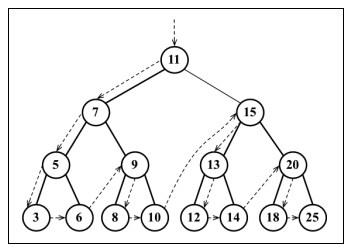
- 先序:先访问根节点,然后以同样方式访问左子树和右子树;(根==>左==>右)
输出 =》 11 7 5 3 6 9 8 10 15 13 12 14 20 18 25
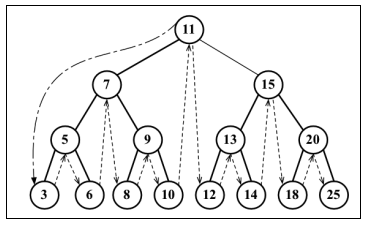
- 中序:先访问左子树,再访问根节点,最后访问右字数;以升序访问所有节点;(左==>根==>右)
输出 =》 3 5 6 7 8 9 10 11 12 13 14 15 18 20 25
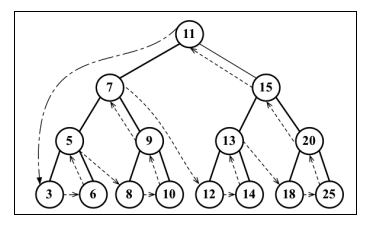
- 后序:先访问叶子节点,从左子树到右子树,再到根节点。(左==>右==>根)
输出 =》 3 6 5 8 10 9 7 12 14 13 18 25 20 15 11
解析:
// 1. 先序

BST.prototype.preOrderTraverseNode = function(node, callback){

    if(node !== null){

        callback(node.key)

        this.preOrderTraverseNode(node.left, callback)

        this.preOrderTraverseNode(node.right, callback)

    }

}

BST.prototype.preOrderTraverse = function(callback){

    this.preOrderTraverseNode(this.root, callback)

}

// 2. 中序

BST.prototype.inOrderTraverseNode = function(node, callback){

    if(node !== null){

        this.inOrderTraverseNode(node.left, callback)

        callback(node.key)

        this.inOrderTraverseNode(node.right, callback)

    }

}

BST.prototype.inOrderTraverse = function(callback){

    this.inOrderTraverseNode(this.root, callback)

}

// 3. 后序

BST.prototype.postOrderTraverseNode = function(node, callback){

    if(node !== null){

        this.postOrderTraverseNode(node.left, callback)

        this.postOrderTraverseNode(node.right, callback)

        callback(node.key)

    }

}

BST.prototype.postOrderTraverse = function(callback){

    this.postOrderTraverseNode(this.root, callback)

}
四、请实现从上往下打印二叉树
给定的二叉树为:[3, 9 , 20, null, null, 15, 7]
    3

   / \

  9  20

     / \

    15  7
请实现一个 printLevelOrder 方法,输出以下结果:
[

  [3],

  [9, 20],

  [15, 7]

]
来源:102.二叉树的层次遍历
解析:
- 方法一:
BST.prototype.printLevelOrder = function (root, arr = [], i = 0){

    if (root && (root.key || root.key === 0)) {

      !arr[i] && (arr[i] = [])

      arr[i].push(root.key)

      i++

      root.left && this.printLevelOrder(root.left, arr, i)

      root.right && this.printLevelOrder(root.right, arr, i)

    }

    return arr

}
- 方法二:
BST.prototype.printLevelOrder = function (){

    if(this.root === null) return []

    let result = [], queue = [this.root]

    while(true){

        let len = queue.length, arr = []

        while(len > 0){

            console.log(queue)

            let node = queue.shift()

            len -= 1

            arr.push(node.key)

            if(node.left !== null) queue.push(node.left)

            if(node.right !== null) queue.push(node.right)

        }

        if(arr.length === 0) return result

        result.push([...arr])

    }

}
五、给定一个二叉树,判断其是否是一个有效的二叉搜索树。
假设一个二叉搜索树具有如下特征:
- 节点的左子树只包含小于当前节点的数。
- 节点的右子树只包含大于当前节点的数。
- 所有左子树和右子树自身必须也是二叉搜索树。
示例 1:
输入:

    2

   / \

  1   3

输出: true
示例 2:
输入:

    5

   / \

  1   4

     / \

    3   6

输出: false

解释: 输入为: [5,1,4,null,null,3,6]。

根节点的值为 5 ,但是其右子节点值为 4 。
代码实现:
/**

 * 二叉树节点定义

 */

function TreeNode(val) {

  this.val = val;

  this.left = this.right = null;

}

/**

- @param {TreeNode} root

- @return {boolean}

*/

function isValidBST(root) {};
来源:99.验证二叉搜索树
解析:
function isValidBST(root) {

    let arr = []

    function inOrderTraverse(node){

        if(node === null) return;

        node.left && inOrderTraverse(node.left);

        arr.push(node.val);

        node.right && inOrderTraverse(node.right);

    }

    inOrderTraverse(root)

    for(let i = 0; i < arr.length - 1; i++){

        if(arr[i] >= arr[i+1]) return false

    }

    return true

};
每周一练 之 数据结构与算法(Tree)的更多相关文章
- 每周一练 之 数据结构与算法(Dictionary 和 HashTable)
这是第五周的练习题,上周忘记发啦,这周是复习 Dictionary 和 HashTable. 下面是之前分享的链接: 1.每周一练 之 数据结构与算法(Stack) 2.每周一练 之 数据结构与算法( ...
- 每周一练 之 数据结构与算法(LinkedList)
这是第三周的练习题,原本应该先发第二周的,因为周末的时候,我的母亲大人来看望她的宝贝儿子,哈哈,我得带她看看厦门这座美丽的城市呀. 这两天我抓紧整理下第二周的题目和答案,下面我把之前的也列出来: 1. ...
- 每周一练 之 数据结构与算法(Set)
这是第四周的练习题,五一放假结束,该收拾好状态啦. 下面是之前分享的链接: 1.每周一练 之 数据结构与算法(Stack) 2.每周一练 之 数据结构与算法(LinkedList) 2.每周一练 之 ...
- 每周一练 之 数据结构与算法(Queue)
这是第二周的练习题,这里补充下咯,五一节马上就要到了,自己的计划先安排上了,开发一个有趣的玩意儿. 下面是之前分享的链接: 1.每周一练 之 数据结构与算法(Stack) 2.每周一练 之 数据结构与 ...
- 每周一练 之 数据结构与算法(Stack)
最近公司内部在开始做前端技术的技术分享,每周一个主题的 每周一练,以基础知识为主,感觉挺棒的,跟着团队的大佬们学习和复习一些知识,新人也可以多学习一些知识,也把团队内部学习氛围营造起来. 我接下来会开 ...
- 【算法】273-每周一练 之 数据结构与算法(Tree)
这是第六周的练习题,最近加班比较多. 下面是之前分享的链接: [算法]200-每周一练 之 数据结构与算法(Stack) [算法]213-每周一练 之 数据结构与算法(LinkedList) [算法] ...
- 【算法】272-每周一练 之 数据结构与算法(Dictionary 和 HashTable)
这是第五周的练习题,上周忘记发啦,这周是复习 Dictionary 和 HashTable. 下面是之前分享的链接: [算法]200-每周一练 之 数据结构与算法(Stack) [算法]213-每周一 ...
- JavaScript 数据结构与算法之美 - 非线性表中的树、堆是干嘛用的 ?其数据结构是怎样的 ?
1. 前言 想学好前端,先练好内功,内功不行,就算招式练的再花哨,终究成不了高手. 非线性表(树.堆),可以说是前端程序员的内功,要知其然,知其所以然. 笔者写的 JavaScript 数据结构与算法 ...
- 【转】MySQL索引背后的数据结构及算法原理
摘要 本文以MySQL数据库为研究对象,讨论与数据库索引相关的一些话题.特别需要说明的是,MySQL支持诸多存储引擎,而各种存储引擎对索引的支持也各不相同,因此MySQL数据库支持多种索引类型,如BT ...
随机推荐
- 领扣(LeetCode)二叉树的所有路径 个人题解
给定一个二叉树,返回所有从根节点到叶子节点的路径. 说明: 叶子节点是指没有子节点的节点. 示例: 输入: 1 / \ 2 3 \ 5 输出: ["1->2->5", ...
- python:爬虫0
什么是网页爬虫,也叫网页蜘蛛.把互联网比作一个蜘蛛网,有好多节点,这个蜘蛛在网上爬来爬去,对对网页中的每个关键字进行建立索引,然后建立索引数据库,经过复杂的排序算法后,这些算法的结果将按照相关度的高低 ...
- 模块-time模块
time模块 time翻译过来就是时间,这个模块是与时间相关的模块,那么言外之意,如果我们在工作中遇到了对时间的需求(比如获取当前时间,获取时间戳等等)就要先想到time模块. time模块中对于时 ...
- (三十八)golang--json(对切片、map、结构体进行序列化)
JSON(javascript object notation)是一种轻量级的数据交换格式,易于人阅读和编写,同时也易于机器解析和生成.key-val JSON是在2001年开始推广的数据格式,目前已 ...
- vuejs之路由应用之一
什么是‘路由’,路由相当于一个映射,一个url地址对应一个组件,当url地址A变为url地址B,那么对应地址A的组件就会改变为对应地址B的组件.应用于spa,即:单页应用,url地址改变,它不会跳转页 ...
- TypeError: Cannot read property '_t' of undefined (VUE + ElementUI + i18n)
在使用vue的ElementUI库,在多语言时报错: TypeError: Cannot read property '_t' of undefined 错误是在点菜单栏时随机抛出的,F12抓不到,只 ...
- 开始你的api:NetApiStarter
在此之前,写过一篇 给新手的WebAPI实践 ,获得了很多新人的认可,那时还是基于.net mvc,文档生成还是自己闹洞大开写出来的,经过这两年的时间,netcore的发展已经势不可挡,自己也在不断的 ...
- Mac OS 终端利器 iTerm2(怕以后找不到,自存自用)
之前一直使用 Mac OS 自带的终端,用起来虽然有些不太方便,但总体来说还是可以接受的,是有想换个终端的想法,然后今天偶然看到一个终端利器 iTerm2,发现真的很强大,也非常的好用,按照网上配置了 ...
- createTextNode
createTextNode()方法将创建一个包含给定文本的新文本文档节点.这个方法的返回值是一个指向新建文本节点的引用指针: reference = document.createTextNode( ...
- 【数据结构】之顺序表(C语言描述)
顺序表是线性表的一种,它将元素存储在一段连续的内存空间中,表中的任意元素都可以通过下标快速的获取到,因此,顺序表适合查询操作频繁的场景,而不适合增删操作频繁的场景. 下面是使用 C语言 编写的顺序表的 ...