
[转载]We Recommend a Singular Value Decomposition
原文:http://www.ams.org/samplings/feature-column/fcarc-svd
Introduction
The topic of this article, the singular value decomposition, is one that should be a part of the standard mathematics undergraduate curriculum but all too often slips between the cracks. Besides being rather intuitive, these decompositions are incredibly useful. For instance, Netflix, the online movie rental company, is currently offering a $1 million prize for anyone who can improve the accuracy of its movie recommendation system by 10%. Surprisingly, this seemingly modest problem turns out to be quite challenging, and the groups involved are now using rather sophisticated techniques. At the heart of all of them is the singular value decomposition.
A singular value decomposition provides a convenient way for breaking a matrix, which perhaps contains some data we are interested in, into simpler, meaningful pieces. In this article, we will offer a geometric explanation of singular value decompositions and look at some of the applications of them.
The geometry of linear transformations
Let us begin by looking at some simple matrices, namely those with two rows and two columns. Our first example is the diagonal matrix

Geometrically, we may think of a matrix like this as taking a point (x, y) in the plane and transforming it into another point using matrix multiplication:

The effect of this transformation is shown below: the plane is horizontally stretched by a factor of 3, while there is no vertical change.
|
|
|
|
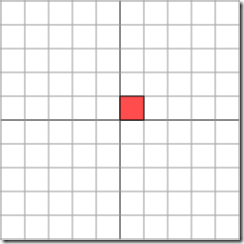

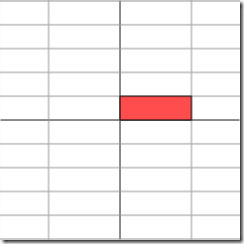
Now let's look at

which produces this effect
|
|
|
|


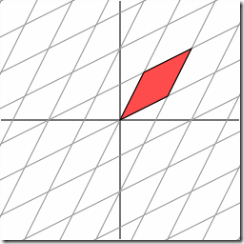
It is not so clear how to describe simply the geometric effect of the transformation. However, let's rotate our grid through a 45 degree angle and see what happens.
|
|
|
|
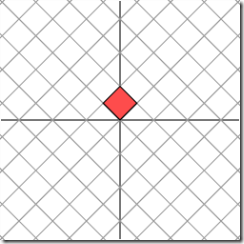

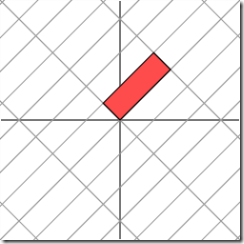
Ah ha. We see now that this new grid is transformed in the same way that the original grid was transformed by the diagonal matrix: the grid is stretched by a factor of 3 in one direction.
This is a very special situation that results from the fact that the matrix M is symmetric; that is, the transpose of M, the matrix obtained by flipping the entries about the diagonal, is equal to M. If we have a symmetric 2  2 matrix, it turns out that we may always rotate the grid in the domain so that the matrix acts by stretching and perhaps reflecting in the two directions. In other words, symmetric matrices behave like diagonal matrices.
Said with more mathematical precision, given a symmetric matrix M, we may find a set of orthogonal vectors vi so that Mvi is a scalar multiple of vi; that is
Mvi = λivi
where λi is a scalar. Geometrically, this means that the vectors vi are simply stretched and/or reflected when multiplied by M. Because of this property, we call the vectors vi eigenvectors of M; the scalars λi are called eigenvalues. An important fact, which is easily verified, is that eigenvectors of a symmetric matrix corresponding to different eigenvalues are orthogonal.
If we use the eigenvectors of a symmetric matrix to align the grid, the matrix stretches and reflects the grid in the same way that it does the eigenvectors.
The geometric description we gave for this linear transformation is a simple one: the grid is simply stretched in one direction. For more general matrices, we will ask if we can find an orthogonal grid that is transformed into another orthogonal grid. Let's consider a final example using a matrix that is not symmetric:

This matrix produces the geometric effect known as a shear.
|
|
|
|
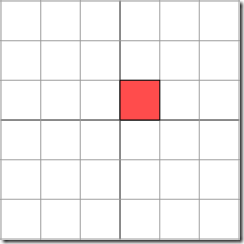


It's easy to find one family of eigenvectors along the horizontal axis. However, our figure above shows that these eigenvectors cannot be used to create an orthogonal grid that is transformed into another orthogonal grid. Nonetheless, let's see what happens when we rotate the grid first by 30 degrees,
|
|
|
|
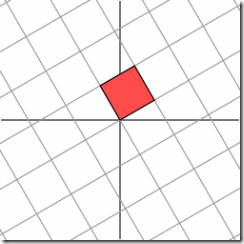

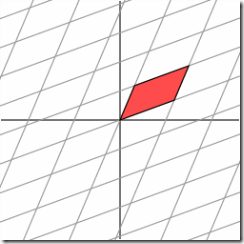
Notice that the angle at the origin formed by the red parallelogram on the right has increased. Let's next rotate the grid by 60 degrees.
|
|
|
|
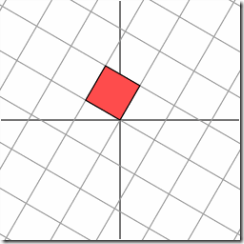

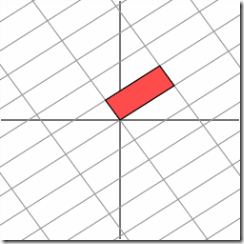
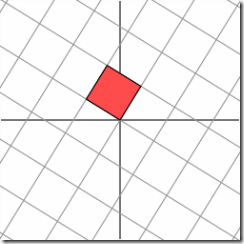
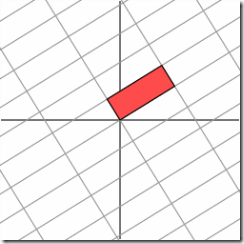
Hmm. It appears that the grid on the right is now almost orthogonal. In fact, by rotating the grid in the domain by an angle of roughly 58.28 degrees, both grids are now orthogonal.
|
|
|
|

The singular value decomposition
This is the geometric essence of the singular value decomposition for 2  2 matrices: for any 2
  2 matrix, we may find an orthogonal grid that is transformed into another orthogonal grid.
We will express this fact using vectors: with an appropriate choice of orthogonal unit vectors v1 and v2, the vectors Mv1 andMv2 are orthogonal.
|
|
|
|
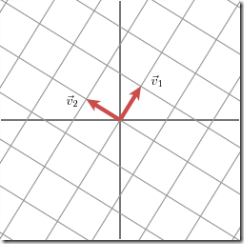

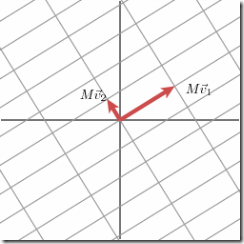
We will use u1 and u2 to denote unit vectors in the direction of Mv1 and Mv2. The lengths of Mv1 and Mv2--denoted by σ1and σ2--describe the amount that the grid is stretched in those particular directions. These numbers are called the singular values of M. (In this case, the singular values are the golden ratio and its reciprocal, but that is not so important here.)
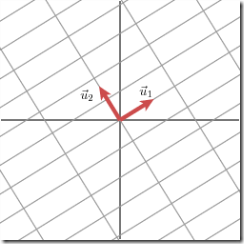
We therefore have
Mv1 = σ1u1
Mv2 = σ2u2
We may now give a simple description for how the matrix M treats a general vector x. Since the vectors v1 and v2 are orthogonal unit vectors, we have
x = (v1 x) v1 + (v2
 x) v2
x) v2
This means that
Mx = (v1 x) Mv1 + (v2
 x) Mv2
Mx = (v1 x) σ1u1 + (v2
 x) σ2u2
Remember that the dot product may be computed using the vector transpose
v x = vTx
which leads to
Mx = u1σ1 v1Tx + u2σ2 v2Tx
M = u1σ1 v1T + u2σ2 v2T
This is usually expressed by writing
M = UΣVT
where U is a matrix whose columns are the vectors u1 and u2, Σ is a diagonal matrix whose entries are σ1 and σ2, and V is a matrix whose columns are v1 and v2. The superscript T on the matrix V denotes the matrix transpose of V.
This shows how to decompose the matrix M into the product of three matrices: V describes an orthonormal basis in the domain, and U describes an orthonormal basis in the co-domain, and Σ describes how much the vectors in V are stretched to give the vectors in U.
How do we find the singular decomposition?
The power of the singular value decomposition lies in the fact that we may find it for any matrix. How do we do it? Let's look at our earlier example and add the unit circle in the domain. Its image will be an ellipse whose major and minor axes define the orthogonal grid in the co-domain.
|
|
|
|
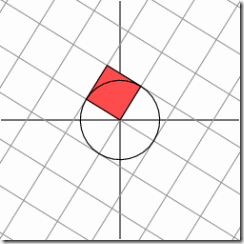

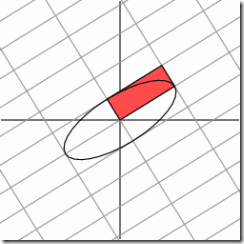
Notice that the major and minor axes are defined by Mv1 and Mv2. These vectors therefore are the longest and shortest vectors among all the images of vectors on the unit circle.
|
|
|
|
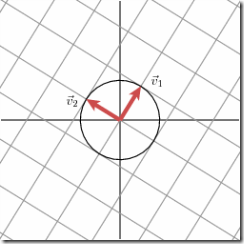


In other words, the function |Mx| on the unit circle has a maximum at v1 and a minimum at v2. This reduces the problem to a rather standard calculus problem in which we wish to optimize a function over the unit circle. It turns out that the critical points of this function occur at the eigenvectors of the matrix MTM. Since this matrix is symmetric, eigenvectors corresponding to different eigenvalues will be orthogonal. This gives the family of vectors vi.
The singular values are then given by σi = |Mvi|, and the vectors ui are obtained as unit vectors in the direction of Mvi. But why are the vectors ui orthogonal?
To explain this, we will assume that σi and σj are distinct singular values. We have
Mvi = σiui
Mvj = σjuj.
Let's begin by looking at the expression Mvi Mvj and assuming, for convenience, that the singular values are non-zero. On one hand, this expression is zero since the vectors vi, which are eigenvectors of the symmetric matrix MTM are orthogonal to one another:
Mvi Mvj = viTMT Mvj = vi
 MTMvj = λjvi
 vj = 0.
On the other hand, we have
Mvi Mvj = σiσj ui
 uj = 0
Therefore, ui and uj are othogonal so we have found an orthogonal set of vectors vi that is transformed into another orthogonal set ui. The singular values describe the amount of stretching in the different directions.
In practice, this is not the procedure used to find the singular value decomposition of a matrix since it is not particularly efficient or well-behaved numerically.
Another example
Let's now look at the singular matrix

The geometric effect of this matrix is the following:
|
|
|
|
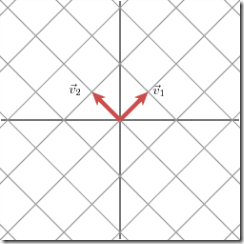

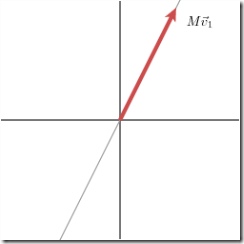
In this case, the second singular value is zero so that we may write:
M = u1σ1 v1T.
In other words, if some of the singular values are zero, the corresponding terms do not appear in the decomposition for M. In this way, we see that the rank of M, which is the dimension of the image of the linear transformation, is equal to the number of non-zero singular values.
Data compression
Singular value decompositions can be used to represent data efficiently. Suppose, for instance, that we wish to transmit the following image, which consists of an array of 15  25 black or white pixels.
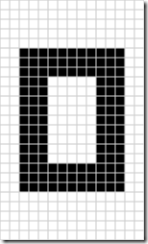
Since there are only three types of columns in this image, as shown below, it should be possible to represent the data in a more compact form.


We will represent the image as a 15  25 matrix in which each entry is either a 0, representing a black pixel, or 1, representing white. As such, there are 375 entries in the matrix.
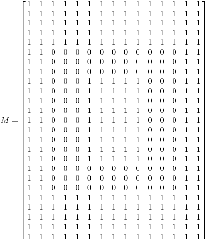
If we perform a singular value decomposition on M, we find there are only three non-zero singular values.
σ1 = 14.72
σ2 = 5.22
σ3 = 3.31
Therefore, the matrix may be represented as
M=u1σ1 v1T + u2σ2 v2T + u3σ3 v3T
This means that we have three vectors vi, each of which has 15 entries, three vectors ui, each of which has 25 entries, and three singular values σi. This implies that we may represent the matrix using only 123 numbers rather than the 375 that appear in the matrix. In this way, the singular value decomposition discovers the redundancy in the matrix and provides a format for eliminating it.
Why are there only three non-zero singular values? Remember that the number of non-zero singular values equals the rank of the matrix. In this case, we see that there are three linearly independent columns in the matrix, which means that the rank will be three.
Noise reduction
The previous example showed how we can exploit a situation where many singular values are zero. Typically speaking, the large singular values point to where the interesting information is. For example, imagine we have used a scanner to enter this image into our computer. However, our scanner introduces some imperfections (usually called "noise") in the image.

We may proceed in the same way: represent the data using a 15  25 matrix and perform a singular value decomposition. We find the following singular values:
σ1 = 14.15
σ2 = 4.67
σ3 = 3.00
σ4 = 0.21
σ5 = 0.19
...
σ15 = 0.05
Clearly, the first three singular values are the most important so we will assume that the others are due to the noise in the image and make the approximation
M  u1σ1 v1T + u2σ2 v2T + u3σ3 v3T
This leads to the following improved image.
|
Noisy image |
Improved image |
|
|
|


Data analysis
Noise also arises anytime we collect data: no matter how good the instruments are, measurements will always have some error in them. If we remember the theme that large singular values point to important features in a matrix, it seems natural to use a singular value decomposition to study data once it is collected.
As an example, suppose that we collect some data as shown below:
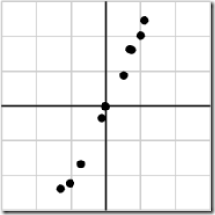
We may take the data and put it into a matrix:
|
-1.03 |
0.74 |
-0.02 |
0.51 |
-1.31 |
0.99 |
0.69 |
-0.12 |
-0.72 |
1.11 |
|
-2.23 |
1.61 |
-0.02 |
0.88 |
-2.39 |
2.02 |
1.62 |
-0.35 |
-1.67 |
2.46 |
and perform a singular value decomposition. We find the singular values
σ1 = 6.04
σ2 = 0.22
With one singular value so much larger than the other, it may be safe to assume that the small value of σ2 is due to noise in the data and that this singular value would ideally be zero. In that case, the matrix would have rank one meaning that all the data lies on the line defined by ui.
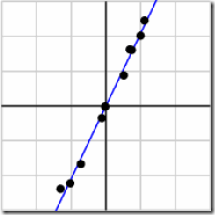
This brief example points to the beginnings of a field known as principal component analysis, a set of techniques that uses singular values to detect dependencies and redundancies in data.
In a similar way, singular value decompositions can be used to detect groupings in data, which explains why singular value decompositions are being used in attempts to improve Netflix's movie recommendation system. Ratings of movies you have watched allow a program to sort you into a group of others whose ratings are similar to yours. Recommendations may be made by choosing movies that others in your group have rated highly.
Summary
As mentioned at the beginning of this article, the singular value decomposition should be a central part of an undergraduate mathematics major's linear algebra curriculum. Besides having a rather simple geometric explanation, the singular value decomposition offers extremely effective techniques for putting linear algebraic ideas into practice. All too often, however, a proper treatment in an undergraduate linear algebra course seems to be missing.
This article has been somewhat impressionistic: I have aimed to provide some intuitive insights into the central idea behind singular value decompositions and then illustrate how this idea can be put to good use. More rigorous accounts may be readily found.
References:
- Gilbert Strang, Linear Algebra and Its Applications. Brooks Cole.
Strang's book is something of a classic though some may find it to be a little too formal.
- William H. Press et al, Numercial Recipes in C: The Art of Scientific Computing. Cambridge University Press.
Authoritative, yet highly readable. Older versions are available online.
- Dan Kalman, A Singularly Valuable Decomposition: The SVD of a Matrix, The College Mathematics Journal27 (1996), 2-23.
Kalman's article, like this one, aims to improve the profile of the singular value decomposition. It also a description of how least-squares computations are facilitated by the decomposition.
- If You Liked This, You're Sure to Love That, The New York Times, November 21, 2008.
This article describes Netflix's prize competition as well as some of the challenges associated with it.
[转载]We Recommend a Singular Value Decomposition的更多相关文章
- 奇异值分解(We Recommend a Singular Value Decomposition)
奇异值分解(We Recommend a Singular Value Decomposition) 原文作者:David Austin原文链接: http://www.ams.org/samplin ...
- 【转】奇异值分解(We Recommend a Singular Value Decomposition)
文章转自:奇异值分解(We Recommend a Singular Value Decomposition) 文章写的浅显易懂,很有意思.但是没找到转载方式,所以复制了过来.一个是备忘,一个是分享给 ...
- We Recommend a Singular Value Decomposition
We Recommend a Singular Value Decomposition Introduction The topic of this article, the singular val ...
- [转]奇异值分解(We Recommend a Singular Value Decomposition)
原文作者:David Austin原文链接: http://www.ams.org/samplings/feature-column/fcarc-svd译者:richardsun(孙振龙) 在这篇文章 ...
- Singular value decomposition
SVD is a factorization of a real or complex matrix. It has many useful applications in signal proces ...
- SVD singular value decomposition
SVD singular value decomposition https://en.wikipedia.org/wiki/Singular_value_decomposition 奇异值分解在统计 ...
- [Math Review] Linear Algebra for Singular Value Decomposition (SVD)
Matrix and Determinant Let C be an M × N matrix with real-valued entries, i.e. C={cij}mxn Determinan ...
- 关于SVD(Singular Value Decomposition)的那些事儿
SVD简介 SVD不仅是一个数学问题,在机器学习领域,有相当多的应用与奇异值都可以扯上关系,比如做feature reduction的PCA,做数据压缩(以图像压缩为代表)的算法,还有做搜索引擎语义层 ...
- Notes About Singular Value Decomposition
A brief summary of SVD: An original matrix Amn is represented as a muliplication of three matrices: ...
随机推荐
- Tomcat源码学习一
这段时间工作不太忙,所以抽时间学习了TOMCAT, TOMCAT实际就是负责保持TCP连接传递到部署的项目中.浏览器实质就是TCP发送器.将用户的请求封装成TCP发送请求.当然格式是双方协定的.使用的 ...
- WCF、Web API、WCF REST、Web Service 区别
Web Service It is based on SOAP and return data in XML form. It support only HTTP protocol. It is no ...
- 【WCF系列一】WCF入门教程(图文) VS2012
WCF的全称是Windows Communication Foundation,从英文名称上看,WCF就是基于Windows下一种通讯的基础架构.利用WCF能够实现基于Windows下的各种通讯技术的 ...
- Weblogic Server 的下载,安装配置与部署
下载 下载页面: http://www.oracle.com/technetwork/middleware/weblogic/downloads/wls-for-dev-1703574.html 目前 ...
- 【C基础】const用法
1.const 和 define 异同 同:const 和 define都是修饰常量 异:const修饰的常量只是编译器的一种优化,它是可以通过内存地址修改const修饰的常量:而define修饰的常 ...
- MSSQL数据库迁移到Oracle
MSSQL数据库迁移到Oracle 最近要把一个MSSQL数据库迁移到Oracle上面,打算借助PowerDesigner这个软件来实现;今天简单研究一下这个软件的运用;把一步简单的操作步骤记录下来: ...
- C++之Effective STL
今天看了下websocket的知识,了解到这是html5新增的特性,主要用于实时web的通信.之前客户端获取服务端的数据,是通过客户端发出请求,服务端进行响应的模式,或者通过ajax每隔一段时间从后台 ...
- HashTable类模板_C++
好久没看数据结构了,今天终于要用到hash,整理一下写了个hash类模板 template<typename T> class DataType { public: T key; Data ...
- ORM查询语言(OQL)简介高级篇
ORM查询语言(OQL)简介--高级篇:脱胎换骨 在写本文之前,一直在想文章的标题应怎么取.在写了<ORM查询语言(OQL)简介--概念篇>.<ORM查询语言(OQL)简介--实例篇 ...
- 函数模板的trick
函数模板的trick 让gcc支持成员函数模板的trick 罗朝辉 (http://www.cnblogs.com/kesalin/) 本文遵循“署名-非商业用途-保持一致”创作公用协议 gcc ...