
Longest Increasing Subsequences(最长递增子序列)的两种DP实现
 /**

  @description: Longest Increasing Subsequence

  @author:   seiyagoo

  @create:   2013.10.25

  @modified: 2013.10.26

 **/

 int LIS_1(int A[], int size){

     int *LIS   = new int[size];

     vector<int> *vec = new vector<int>[size];

     /* Compute optimized LIS values in bottom up manner */

     for(int i=; i < size; i++){

         LIS[i]=;                        //初始化默认长度

         int max_j=, flag=;

         for(int j=; j < i; j++){        //查表,找出前面最长的序列, 若将A[i]加入LIS[j](LIS[j]+1的含义)的递增子序列比当前的LIS[i]更长, 则更新LIS[i]

             if(A[i] > A[j] && LIS[i] < LIS[j]+){

                 LIS[i] = LIS[j]+;

                 max_j=j;

                 flag=;

             }

         }

         if(flag)                        //copy前面最长子序列到vec[i]

             vec[i].insert(vec[i].end(), vec[max_j].begin(), vec[max_j].end());

         vec[i].push_back(A[i]);       //最后放入A[i]

     }

     /*Show LIS of the current state*/

     vector<int>::iterator it;

     cout<<left;

     for(int i=; i<size; i++){

         cout<<setw()<<A[i]<< "  -->  ";

         for(it = vec[i].begin(); it!=vec[i].end(); it++)

             cout<<*it<<" ";

         cout<<endl;

     }

     /* Pick maximum of all LIS values, namely max{LIS[i]} */

     int max_len=;

     for(int i = ; i < size; i++ )

       if( max_len < LIS[i] )

          max_len = LIS[i];

     delete[] LIS;

     delete[] vec;

     return max_len;

 }
 /**

  @description: Longest Increasing Subsequence

  @author:   seiyagoo

  @create:   2013.10.25

  @modified: 2013.10.26

 **/

 // Binary search (note boundaries in the caller)

 // A[] is ceilIndex in the caller

 int CeilIndex(int A[], int l, int r, int key) {

     int m;

     while( r - l >  ) {

         m = l + (r - l)/;

         (A[m] >= key ? r : l) = m; // ternary expression returns an l-value

     }

     return r;

 }

 int LIS_2(int A[], int size) {

     // boundary case: when array size is one

     if(  == size ) return ;

     int *tailTable   = new int[size];

     vector<int> *vec = new vector<int>[size];

     int len; // always points empty slot

     //memset(tailTable, INT_MAX, sizeof(tailTable[0])*size);  @bug

     for(int i = ; i < size; i++)

         tailTable[i] = INT_MAX;

     tailTable[] = A[];          //tailTable[0] store the smallest value

     vec[].push_back(A[]);

     len = ;

     for( int i = ; i < size; i++ ) {

         if( A[i] < tailTable[] ) {  //case 1: new smallest value

             tailTable[] = A[i];

             /*discard and create*/

             vec[].clear();

             vec[].push_back(A[i]);

         }

         else if( A[i] > tailTable[len-] ) { //case 2: A[i] wants to extend largest subsequence

             tailTable[len++] = A[i];

             /*clone and extend*/

             vec[len-] = vec[len-];

             vec[len-].push_back(A[i]);

         }

         else { //case 3: A[i] wants to be current end candidate of an existing subsequence, It will replace ceil value in tailTable

             int ceilIndex = CeilIndex(tailTable, -, len-, A[i]);

             tailTable[ceilIndex] = A[i];

             /*discard, clone and extend*/

             vec[ceilIndex].clear();

             vec[ceilIndex] = vec[ceilIndex-];

             vec[ceilIndex].push_back(A[i]);

         }

         /*Printf all the active lists*/

         vector<int>::iterator it;

         cout<<left;

         cout<<"A["<<i<<"] = "<<A[i]<<endl<<endl;

         cout<<"active lists:"<<endl;

         for(int i=; i<len; i++){

             for(it = vec[i].begin(); it!=vec[i].end(); it++)

                 cout<<*it<<" ";

             cout<<endl;

         }

         /*Printf end elements of all the active lists*/

         cout<<endl<<"end elements array:"<<endl;

         for(int i = ; i < size; i++)

             if(tailTable[i] != INT_MAX)

                 cout<<tailTable[i]<<" ";

         cout<<endl;

         cout<<"-------------------------"<<endl;

     }

     delete[] tailTable;

     delete[] vec;

     return len;

 }
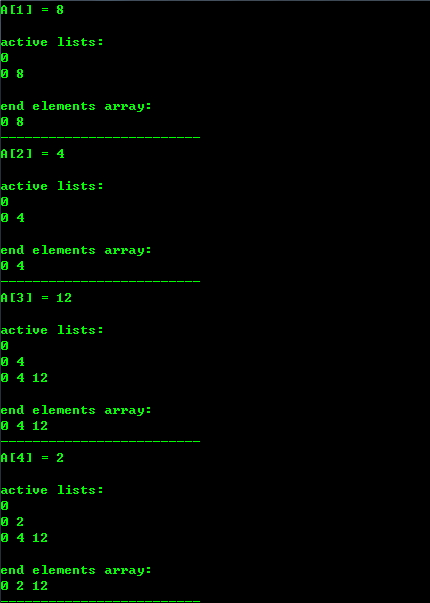
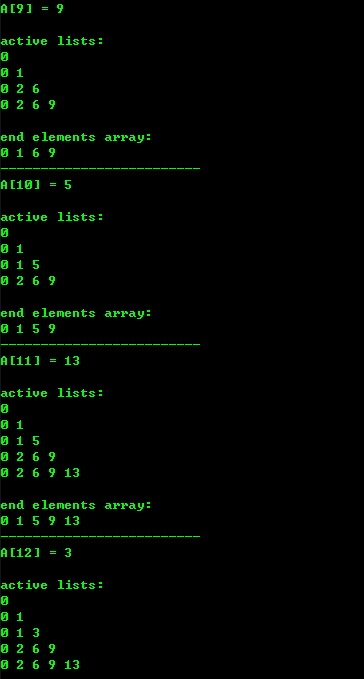
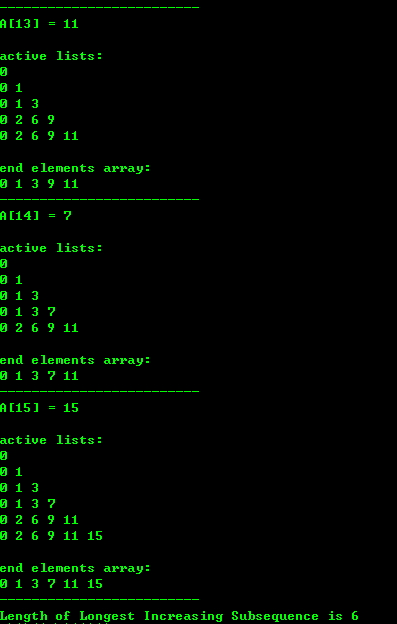
五、运行结果
example:


Longest Increasing Subsequences(最长递增子序列)的两种DP实现的更多相关文章
- leetcode300. Longest Increasing Subsequence 最长递增子序列 、674. Longest Continuous Increasing Subsequence
Longest Increasing Subsequence 最长递增子序列 子序列不是数组中连续的数. dp表达的意思是以i结尾的最长子序列,而不是前i个数字的最长子序列. 初始化是dp所有的都为1 ...
- [LintCode] Longest Increasing Subsequence 最长递增子序列
Given a sequence of integers, find the longest increasing subsequence (LIS). You code should return ...
- [LeetCode] Longest Increasing Subsequence 最长递增子序列
Given an unsorted array of integers, find the length of longest increasing subsequence. For example, ...
- 673. Number of Longest Increasing Subsequence最长递增子序列的数量
[抄题]: Given an unsorted array of integers, find the number of longest increasing subsequence. Exampl ...
- [LeetCode] 300. Longest Increasing Subsequence 最长递增子序列
Given an unsorted array of integers, find the length of longest increasing subsequence. Example: Inp ...
- [leetcode]300. Longest Increasing Subsequence最长递增子序列
Given an unsorted array of integers, find the length of longest increasing subsequence. Example: Inp ...
- poj 2533 Longest Ordered Subsequence 最长递增子序列
作者:jostree 转载请注明出处 http://www.cnblogs.com/jostree/p/4098562.html 题目链接:poj 2533 Longest Ordered Subse ...
- [LeetCode] Number of Longest Increasing Subsequence 最长递增序列的个数
Given an unsorted array of integers, find the number of longest increasing subsequence. Example 1: I ...
- POJ 2533 - Longest Ordered Subsequence - [最长递增子序列长度][LIS问题]
题目链接:http://poj.org/problem?id=2533 Time Limit: 2000MS Memory Limit: 65536K Description A numeric se ...
- [LeetCode] 673. Number of Longest Increasing Subsequence 最长递增序列的个数
Given an unsorted array of integers, find the number of longest increasing subsequence. Example 1: I ...
随机推荐
- 【习题 8-3 UVA - 12545】Bits Equalizer
[链接] 我是链接,点我呀:) [题意] 在这里输入题意 [题解] 如果1的个数第一个串比第2个串多. 那么就无解. 否则. 找几个位置去凑1 优先找'?'然后才是0的位置 剩余的全都用swap操作就 ...
- python RESTful API框架:Eve 高速入门
Eve是一款Python的REST API框架.用于公布高可定制的.全功能的RESTful的Web服务.帮你轻松创建和部署API,本文翻译自Eve官方站点: http://python-eve.org ...
- ubuntu网络重启后或主机重启后,/etc/resolv.conf恢复原样的解决办法
ubuntu网络重启后或主机重启后,/etc/resolv.conf恢复原样的解决办法 /etc/resolv.conf中设置dns之后每次重启该文件会被覆盖,针对这种情况找了一些个解决方法 防止/e ...
- 修改android的wifi客户端名称的两种方法
修改android的wifi客户端名称的两种方法 手机连接到无线路由时,在dhcp的客户端列表里面是这样的名称"android-89425253e5de3a2",这就是安卓 ...
- linux设置tab键的宽度为4
先cd 到~目录 ~$ cd ~$ vi .vimrc set nu
- Mysql数据库的瓶颈处理一点建议
Mysql数据库的瓶颈处理一点建议 我们在使用Mysql数据库是常见的两个瓶颈是CPU和I/O的瓶颈,CPU在饱和的时候一般发生在数据装入内存或从磁盘上读取数据时候.磁盘I/O瓶颈的出 ...
- 建立一个 Openshift "Do-It-Yourself" 应用
建立一个 Openshift "Do-It-Yourself" 应用 Openshift 的 "Do-It-Yourself" 就是自己可以编译定制 WEB ...
- Solr 读数据流程
Solr 读数据流程: 1.用户提供搜索关键词,也就是搜索语句,需要经过分词器处理以及语言处理. 2.对处理之后的关键词,搜索索引找出对应Document 即记录. 3.用户根据需要从找到的Docum ...
- Android代码模拟物理、屏幕点击事件
一.应用中模拟物理和屏幕点击事件 例如,模拟对某个view的点击事件 private void simulateClick(View view, float x, float y) { long do ...
- python关于字典的操作
https://www.cnblogs.com/RENQIWEI1995/p/7931374.html 最常用的代码举例: dict = {'Name': 'Zara', 'Age': 7, 'Cla ...