
WPF: Creation of Text Labels for 3D Scene
原文:WPF: Creation of Text Labels for 3D Scene
转载:http://www.codeproject.com/KB/WPF/WPF_Text3D.aspx
Download demo - 26.46 KBDownload source - 37.19 KB
Introduction
Some time ago, I started working on my application that takes the advantages of 3D graphics to display some results. I am .NET developer so I have chosen Windows Presentation Foundation (WPF) as my framework to create 3D graphics. I have to admit that this
is powerful library that allows to create 3D graphics quite easy. It is not hard to understand how to create a 3D scene using sets of triangles. What is more, many articles describe how to do it. I encountered some problems when I started adding some text
to my 3D scene. I think that this article may help other developers to choose the best way of writing text on a 3D scene.
Background
Let's start, our goal is to add some text labels to the 3D scene. We have at least two approaches:
- 3D label creation
- 2D label creation and overlay it on the scene
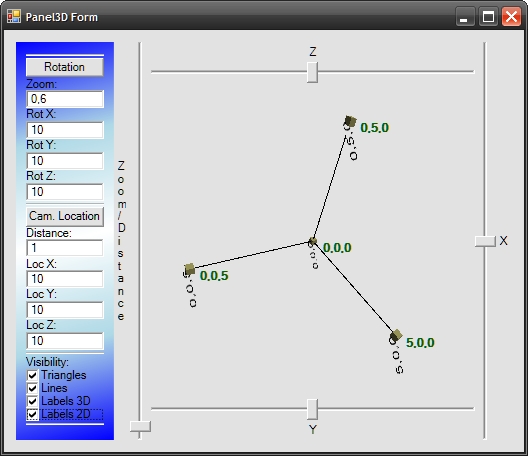
The first approach is based on the creation of a 3D object in the scene (typically it is a rectangle) and writing text on it (it can be achieved using the brush made from text). The sample result is showed in the picture below:

The second approach is based on layers. The bottom layer is Viweport3D and the top layer isCanvas. The top layer is transparent and overlays the
Viewport3D. This approach usesTexBlocks that are members of the
Canvas but the 2D location depends on the location in 3D space. The picture below presents that approach:

Of course, both approaches have some advantages and disadvantages. The 3D labels based on the first approach are more useful when the text is a part of the scene. The labels based on the second approach are more readable (but the solution is more complex).
The picture below shows both approaches:

Using the Code
The sample code draws the coordinate system and some labels on it. The scene could be rotated using the sliders.Checkboxes from the left pane allow to switch on / switch off the visibility of elements of the scene (especially labels 2D and 3D).
I do not want to go into detail as to how this application is created. I want to focus on the two approaches mentioned previously.
3D Labels
To illustrate how to create a label in 3D, I am going to describe how to create the function:CreateTextLabel3D. This function is going to be responsible for returning theModelVisual3D object that represents the label in 3D space.
Such a function has the following declaration:
 Collapse |Copy
Code
/// <summary>

/// Creates a ModelVisual3D containing a text label.

/// </summary>

/// <param name="text">The string to be drawn</param>

/// <param name="textColor">The color of the text.</param>

/// <param name="isDoubleSided">Visible from both sides?</param>

/// <param name="height">Height of the characters</param>

/// <param name="basePoint">The base point of the label</param>

/// <param name="isBasePointCenterPoint">if set to <c>true</c> the base point

/// is center point of the label.</param>

/// <param name="vectorOver">Horizontal direction of the label</param>

/// <param name="vectorUp">Vertical direction of the label</param>

/// <returns>Suitable for adding to your Viewport3D</returns>

/// <remarks>Two vectors: vectorOver and vectorUp are creating the surface

/// on which we are drawing the text. Both those vectors are used for

/// calculation of label size, so it is reasonable that each co-ordinate

/// should be 0 or 1. e.g. [1,1,0] or [1,0,1], etc...</remarks>

public static ModelVisual3D CreateTextLabel3D( string text, Brush textColor,

    bool isDoubleSided, double

    height, Point3D basePoint, bool isBasePointCenterPoint, Vector3D vectorOver,

    Vector3D vectorUp);
How It Works?
- First we need to create a
TextBlockthat allows us to create a label: Collapse |Copy
CodeTextBlock textblock = new TextBlock(new Run(text));
textblock.Foreground = textColor; // setting the text color
textblock.FontFamily = new FontFamily("Arial"); // setting the font to be used - Now we have to create a brush and material that contains the
TextBlockcreated in the previous step: Collapse |Copy
CodeDiffuseMaterial mataterialWithLabel = new DiffuseMaterial();
// Allows the application of a 2-D brush,
// like a SolidColorBrush or TileBrush, to a diffusely-lit 3-D model.
// we are creating the brush from the TextBlock
mataterialWithLabel.Brush = new VisualBrush(textblock); - Now it is time to create the object in the 3D space that will be covered by the text:
Collapse |Copy
Code//calculation of text width (assuming that characters are square):
double width = text.Length * height;
// we need to find the four corners
// p0: the lower left corner; p1: the upper left
// p2: the lower right; p3: the upper right
Point3D p0 = basePoint;
// when the base point is the center point we have to set it up in different way
if(isBasePointCenterPoint)
p0 = basePoint - width / 2 * vectorOver - height / 2 * vectorUp;
Point3D p1 = p0 + vectorUp * 1 * height;
Point3D p2 = p0 + vectorOver * width;
Point3D p3 = p0 + vectorUp * 1 * height + vectorOver * width;
// we are going to create object in 3D now:
// this object will be painted using the (text) brush created before
// the object is rectangle made of two triangles (on each side).
MeshGeometry3D mg_RestangleIn3D = new MeshGeometry3D();
mg_RestangleIn3D.Positions = new Point3DCollection();
mg_RestangleIn3D.Positions.Add(p0); // 0
mg_RestangleIn3D.Positions.Add(p1); // 1
mg_RestangleIn3D.Positions.Add(p2); // 2
mg_RestangleIn3D.Positions.Add(p3); // 3
// when we want to see the text on both sides:
if (isDoubleSided)
{
mg_RestangleIn3D.Positions.Add(p0); // 4
mg_RestangleIn3D.Positions.Add(p1); // 5
mg_RestangleIn3D.Positions.Add(p2); // 6
mg_RestangleIn3D.Positions.Add(p3); // 7
}
mg_RestangleIn3D.TriangleIndices.Add(0);
mg_RestangleIn3D.TriangleIndices.Add(3);
mg_RestangleIn3D.TriangleIndices.Add(1);
mg_RestangleIn3D.TriangleIndices.Add(0);
mg_RestangleIn3D.TriangleIndices.Add(2);
mg_RestangleIn3D.TriangleIndices.Add(3);
// when we want to see the text on both sides:
if (isDoubleSided)
{
mg_RestangleIn3D.TriangleIndices.Add(4);
mg_RestangleIn3D.TriangleIndices.Add(5);
mg_RestangleIn3D.TriangleIndices.Add(7);
mg_RestangleIn3D.TriangleIndices.Add(4);
mg_RestangleIn3D.TriangleIndices.Add(7);
mg_RestangleIn3D.TriangleIndices.Add(6);
} - We are covering the object created in the previous step using the material created at the beginning:
Collapse |Copy
Code// texture coordinates must be set to
// stretch the TextBox brush to cover
// the full side of the 3D label.
mg_RestangleIn3D.TextureCoordinates.Add(new Point(0, 1));
mg_RestangleIn3D.TextureCoordinates.Add(new Point(0, 0));
mg_RestangleIn3D.TextureCoordinates.Add(new Point(1, 1));
mg_RestangleIn3D.TextureCoordinates.Add(new Point(1, 0));
// when the label is double sided:
if (isDoubleSided)
{
mg_RestangleIn3D.TextureCoordinates.Add(new Point(1, 1));
mg_RestangleIn3D.TextureCoordinates.Add(new Point(1, 0));
mg_RestangleIn3D.TextureCoordinates.Add(new Point(0, 1));
mg_RestangleIn3D.TextureCoordinates.Add(new Point(0, 0));
} - Now it is time to create
ModelVisual3Dthat we want to return: Collapse |Copy
CodeModelVisual3D result = new ModelVisual3D();
// we are setting the content:
// our 3D rectangle object covered with material that is made of label
// (TextBox with text)
result.Content = new GeometryModel3D(mg_RestangleIn3D, mataterialWithLabel); ;
return result;
2D Labels
This solution is much more complicated and it is hard to prepare one function that deals with all tasks.
First of all, we have to create two layers:
Viewport3Das the bottom layerCanvasas the top layer
The XAML code below presents a sample of two overlaid layers:
Collapse |CopyCode
<Grid ClipToBounds="True">

<Viewport3D Name="mainViewport" ClipToBounds="True" Grid.Column="0" Grid.Row="0">

<Viewport3D.Camera>

<PerspectiveCamera FarPlaneDistance="100" LookDirection="-11,-10,-9" UpDirection="0,1,0"

    NearPlaneDistance="1" Position="11,10,9" FieldOfView="70" />

</Viewport3D.Camera> <ModelVisual3D> <ModelVisual3D.Content>

<DirectionalLight Color="White" Direction="-2,-3,-1" />

</ModelVisual3D.Content>

</ModelVisual3D>

</Viewport3D> <Canvas Name="mainViewportCanvas" ClipToBounds="True"

	Grid.Column="0" Grid.Row="0">

</Canvas>

</Grid>
The second task is localization of the point from 3D space on our overlaid canvas. To transform the location, we can use the following function:
Collapse |CopyCode
public static Point Get2DPoint(Point3D p3d, Viewport3D vp)

{

    bool TransformationResultOK;

    Viewport3DVisual vp3Dv = VisualTreeHelper.GetParent(

    vp.Children[0]) as Viewport3DVisual;

    Matrix3D m = MathUtils.TryWorldToViewportTransform

			(vp3Dv, out TransformationResultOK);

    if (!TransformationResultOK) return new Point(0, 0);

    Point3D pb = m.Transform(p3d);

    Point p2d = new Point(pb.X, pb.Y);

    return p2d;

}
Note that this function uses function TryWorldToViewportTransform from 3D Tools package (availablehere):
_3DTools.MathUtils.TryWorldToViewportTransform.
The next task is creation and localization of the TextBlock:
Collapse |CopyCode
UIElement IModelVisual3D.GetUIElement

	(ModelVisual3DFilter FilterSettings, Viewport3D DestinationViewport3D)

{

    if (FilterSettings.Texts2D)

    {

        TextBlock tb = new TextBlock();

        tb.Text = Description;

        Point p2d = Panel3DMath.Get2DPoint(this.Point3D, DestinationViewport3D);

        Canvas.SetTop(tb, p2d.Y);

        Canvas.SetLeft(tb, p2d.X);

        return tb;

    }

    else

        return new UIElement();

}
The last thing is adding the TextBlock (created before) to our canvas.
Collapse |CopyCode
this.mainViewportCanvas.Children.Add(element.GetUIElement(filter,mainViewport));
Summary
I hope that my two approaches that could be used during creation of text labels for 3D scenes might be interesting for the reader. The Polish version of this article will be available soon onmy blog.
WPF: Creation of Text Labels for 3D Scene的更多相关文章
- WPF换肤之八:创建3D浏览效果
原文:WPF换肤之八:创建3D浏览效果 上节中,我们展示了WPF中的异步以及界面线程交互的方式,使得应用程序的显示更加的流畅.这节我们主要讲解如何设计一个具有3D浏览效果的天气信息浏览器. 效果显示 ...
- 在WPF中使用PlaneProjection模拟动态3D效果
原文:在WPF中使用PlaneProjection模拟动态3D效果 虽然在WPF中也集成了3D呈现的功能,在简单的3D应用中,有时候并不需要真实光影的3D场景.毕竟使用3D引擎会消耗很多资源,有时候使 ...
- 泡泡一分钟:Project AutoVision - Localization and 3D Scene Perception for an Autonomous Vehicle with a Multi-Camera System
Project AutoVision - Localization and 3D Scene Perception for an Autonomous Vehicle with a Multi-Cam ...
- Chapter 1:Create You First 3D Scene With Three.js
1,各浏览器对WebGL的支持 手机浏览器对WebGL的支持: 书的源码:https://github.com/josdirksen/learning-threejs 第一次用浏览器打开代码可能无法正 ...
- cocos2d-x-3.1 Text Labels(官方正式译文)
介绍 cocos2d支持(true type字体)标签,和纹理地图集标签. LabelTTF 标签的优缺点: 全部 TTF 字体的长处: 随意大小,支持调整字距. 易于使用. 不须要外部编辑器. 创建 ...
- 优化WPF 3D性能
Maximize WPF 3D Performance .NET Framework 4.5 As you use the Windows Presentation Foundation (WPF ...
- Unity3D Keynote
[Unity3D Keynote] 1.场景文件扩展名为.unity. 2.up为Y正方向,down为Y负方向,right为X正方向,left为X负方向,forward为Z正方向,back为z负方向. ...
- WPF中的3D Wireframe
原文:WPF中的3D Wireframe WPF不支持画三维线,但开发人员提供了ScreenSpaceLines3D 类用于实现这个功能.我已经在程序中实现并成功显示3D Wireframe,并能够进 ...
- WPF 3D 知识点大全以及实例
引言 现在物联网概念这么火,如果监控的信息能够实时在手机的客服端中以3D形式展示给我们,那种体验大家可以发挥自己的想象. 那生活中我们还有很多地方用到这些,如上图所示的Kinect 在医疗上的应用,当 ...
随机推荐
- 30、在LCD上显示摄像头图像
1. 准备虚拟机2.安装工具链sudo tar xjf arm-linux-gcc-4.3.2.tar.bz2 -C /设置环境变量:sudo vi /etc/environment : PATH=& ...
- (十二)RabbitMQ消息队列-性能测试
原文:(十二)RabbitMQ消息队列-性能测试 硬件配置 宿主机用的联想3850X6的服务器四颗E7-4850v3的处理器,DDR4内存,两块1.25TB的pcie固态.在宿主机上使用的事esxi5 ...
- ios开发之图层与核心动画一:图层CALayer的认识
#import "ViewController.h" @interface ViewController () @property (weak, nonatomic) IBOutl ...
- iOS开发Quzrtz2D 十:圆形图片的绘制以及加边框圆形图片的绘制
一:圆形图片的绘制 @interface ViewController () @property (weak, nonatomic) IBOutlet UIImageView *imageV; @en ...
- Qt元类型(MetaType)注册门(使用qRegisterMetaType注册错误等级)
昨天调试项目时,突然发现如下消息: QObject::connect: Cannot queue arguments of type 'ERROR_LEVEL' (Make sure 'ERROR_L ...
- android通用適配器
一.需求分析 在寻常的android开发过程中.ListView.GridView适配的编写是一件非常麻烦并且非常反复的事情,每次都须要考虑性能的优化.item的编写.获取网络图片时候信息的错乱等问题 ...
- C语言编写静态链接库及其使用
本篇讲述使用C语言编写静态链接库,而且使用C和C++的方式来调用等. 一.静态库程序:执行时不独立存在,链接到可执行文件或者动态库中,目标程序的归档. 1.用C编写静态库步骤 a.建立项目(Win32 ...
- html5中input的type类型有哪些(总结)
html5中input的type类型有哪些(总结) 一.总结 一句话总结:时间.颜色.(邮件.电话.url).(数字.数字范围).搜索search 二.html5中input的type类型 值 描述 ...
- 使用RpcLite构建SOA/Web服务
使用RpcLite构建SOA/Web服务 SOA框架系列 1. 使用RpcLite构建SOA/Web服务 提到Web服务最先想到的就是WebService此外常用的还有WCF.ServiceStack ...
- 复杂json解析(json里面嵌套json)
调用第三方接口,返回一堆json,我只想取得里面的某一个属性,但是返回的比较复杂,无法直接拿到属性,格式类似于这样: {"video":{"id":" ...