
Linked List Start!
(1)Delete Node in a Linked List

题意简单明了,用后一个节点来替换要删除的节点即可。代码如下:
 /**

  * Definition for singly-linked list.

  * public class ListNode {

  *     int val;

  *     ListNode next;

  *     ListNode(int x) { val = x; }

  * }

  */

 public class Solution {

     public void deleteNode(ListNode node) {

         node.val = node.next.val;

         node.next = node.next.next;

     }

 }
(2)Reverse Linked List

解题方法一:递归法
在反转当前节点之前先反转后续节点。这样从头结点开始,层层深入直到尾结点才开始反转指针域的指向。简单的说就是从尾结点开始,逆向反转各个结点的指针域指向。
代码如下:
 /**

  * Definition for singly-linked list.

  * public class ListNode {

  *     int val;

  *     ListNode next;

  *     ListNode(int x) { val = x; }

  * }

  */

 public class Solution {

     public ListNode reverseList(ListNode head) {

         if (head == null) {

             return null;

         }

         if (head.next == null) {

             return head;

         }//递归解法一定要有判断条件:此时说明到达反转前的尾节点,可以开始执行反转操作

         ListNode p = head.next;

         ListNode n = reverseList(p);

         p.next = head;  //当前节点的指针域指向前一节点

         head.next = null;  //前一节点的指针域置null

         return n;

     }

 }
解题方法二:迭代法
 /**

  * Definition for singly-linked list.

  * public class ListNode {

  *     int val;

  *     ListNode next;

  *     ListNode(int x) { val = x; }

  * }

  */

 public class Solution {

     public ListNode reverseList(ListNode head) {

         ListNode pre = null;// 第一个节点肯定是(反转后的)尾节点,尾节点的next为NULL

         while (head != null) {//当前节点为空,说明到了(反转前的)尾节点

             ListNode temp = head.next;//当前节点的下一个指针临时储存

             head.next = pre;//当前节点指针指向上一个节点

             //指针向下移动

             pre = head;

             head = temp;

         }

         return pre;

     }

 }
(3)Remove Duplicates from Sorted List
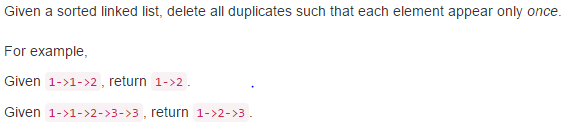
解题思路:遍历一次,遇到重复的节点删除(将前一节点的指针指向该节点的下一个节点)即可。
代码如下:
 /**

  * Definition for singly-linked list.

  * public class ListNode {

  *     int val;

  *     ListNode next;

  *     ListNode(int x) { val = x; }

  * }

  */

 public class Solution {

     public ListNode deleteDuplicates(ListNode head) {

         if (head == null) {

             return null;

         }

         ListNode node = head;

         while (node.next != null)  {

             if (node.val == node.next.val) {

                 node.next = node.next.next;

             } else {

                 node = node.next;

             }

         }

         return head;

     }

 }
(4)Merge Two Sorted Lists

解题思路:简单明了,创建一个新节点dummy作为头结点,然后l1和l2进行比较,小的先加入,哪个链表有剩余最后加入即可。
代码如下:
 * Definition for singly-linked list.

  * public class ListNode {

  *     int val;

  *     ListNode next;

  *     ListNode(int x) { val = x; }

  * }

  */

 public class Solution {

     public ListNode mergeTwoLists(ListNode l1, ListNode l2) {

         ListNode dummy = new ListNode(0);

         ListNode lastNode = dummy;

         while (l1 != null && l2 != null) {

             if (l1.val < l2.val) {

                 lastNode.next = l1;

                 l1 = l1.next;

             } else {

                 lastNode.next = l2;

                 l2 = l2.next;

             }

             lastNode = lastNode.next;

         }

         if (l1 != null) {

             lastNode.next = l1;

         } else {

             lastNode.next = l2;

         }

         return dummy.next;

     }

 }
(5)Swap Nodes in Pairs

解题思路:n1、n2为第一组结点,头结点的next指向n2,n1的next指向n2的next,n2的next指向n1。然后进行下一组...
代码如下:
 /**

  * Definition for singly-linked list.

  * public class ListNode {

  *     int val;

  *     ListNode next;

  *     ListNode(int x) { val = x; }

  * }

  */

 public class Solution {

     public ListNode swapPairs(ListNode head) {

         ListNode dummy = new ListNode(0);

         dummy.next = head;//新节点的next指针指向原链表的头结点

         head = dummy;//现在的头结点就是dummy

         while (head.next != null && head.next.next != null) {

             ListNode n1 = head.next;

             ListNode n2 = head.next.next;

             // head->n1->n2->...

             // => head->n2->n1->...

             head.next = n2;

             n1.next = n2.next;

             n2.next = n1;

             //移向下一组节点

             head = n1;

         }

         return dummy.next;

     }

 }
Linked List Start!的更多相关文章
- [LeetCode] Linked List Random Node 链表随机节点
Given a singly linked list, return a random node's value from the linked list. Each node must have t ...
- [LeetCode] Plus One Linked List 链表加一运算
Given a non-negative number represented as a singly linked list of digits, plus one to the number. T ...
- [LeetCode] Odd Even Linked List 奇偶链表
Given a singly linked list, group all odd nodes together followed by the even nodes. Please note her ...
- [LeetCode] Delete Node in a Linked List 删除链表的节点
Write a function to delete a node (except the tail) in a singly linked list, given only access to th ...
- [LeetCode] Palindrome Linked List 回文链表
Given a singly linked list, determine if it is a palindrome. Follow up: Could you do it in O(n) time ...
- [LeetCode] Reverse Linked List 倒置链表
Reverse a singly linked list. click to show more hints. Hint: A linked list can be reversed either i ...
- [LeetCode] Remove Linked List Elements 移除链表元素
Remove all elements from a linked list of integers that have value val. Example Given: 1 --> 2 -- ...
- [LeetCode] Intersection of Two Linked Lists 求两个链表的交点
Write a program to find the node at which the intersection of two singly linked lists begins. For ex ...
- [LeetCode] Linked List Cycle II 单链表中的环之二
Given a linked list, return the node where the cycle begins. If there is no cycle, return null. Foll ...
- [LeetCode] Linked List Cycle 单链表中的环
Given a linked list, determine if it has a cycle in it. Follow up: Can you solve it without using ex ...
随机推荐
- 家里蹲大学数学杂志 Charleton University Mathematics Journal 官方目录[共七卷493期,6055页]
家里蹲大学数学杂志[官方网站]从由赣南师范大学张祖锦老师于2010年创刊;每年一卷, 自己有空则出版, 没空则搁置, 所以一卷有多期.本杂志至2016年12月31日共7卷493期, 6055页.既然做 ...
- 使用composer管理php项目
composer global require "fxp/composer-asset-plugin:~1.1.1" composer create-project --prefe ...
- java Servlet Filter 拦截Ajax请求
/** * 版权:Copyright 2016-2016 AudaqueTech. Co. Ltd. All Rights Reserved. * 描述: * 创建人:赵巍 * 创建时间:2016年1 ...
- Java 判断文件夹、文件是否存在、否则创建文件夹
1.判断文件是否存在,不存在创建文件 File file=new File("C:\\Users\\QPING\\Desktop\\JavaScript\\2.htm"); if( ...
- requestWindowFeature(Window.FEATURE_NO_TITLE)无效解决方法
今天在<第一行代码>上学习做自定义标题栏,需要将系统自带的标题栏隐藏掉,使用自定义的标题栏,结果发现,requestWindowFeature(Window.FEATURE_NO_TITL ...
- C#获取网页内容的三种方式
C#通常有三种方法获取网页内容,使用WebClient.WebBrowser或者HttpWebRequest/HttpWebResponse... 方法一:使用WebClient (引用自:http: ...
- WPF 绑定的校验
为进行校验,必须准备一个RangeValidationRule类,该类继承自ValidationRule 该类实现如下: class RangeValidationRule : ValidationR ...
- 45个android实例源码
分享45个android实例源码,很好很强大http://www.apkbus.com/android-20978-1-1.html andriod闹钟源代码http://www.apkbus.com ...
- Android自动化学习笔记:获取APK包名的几种方法
---------------------------------------------------------------------------------------------------- ...
- php命名空间和autoload
参考: 1.http://www.cnblogs.com/thinksasa/p/3423480.html PHP的命名空间 2.http://blog.jjonline.cn/phptech/15 ...