
spring boot开发笔记——mybatis
概述
mybatis框架的优点,就不用多说了,今天这边干货主要讲mybatis的逆向工程,以及springboot的集成技巧,和分页的使用
因为在日常的开发中,当碰到特殊需求之类会手动写一下sql语句,大部分的时候完全可以用mybatis的逆向工程替代。
mybatis逆向工程
相比较而言,代码形式的逆向工程,更加灵活方便,简单,易于管理,而且可以上传到git中存储。而且也只需要简单的三步就能完成自动生成代码。下面介绍如果搭建并生成xml和代码
第一步:搭建工程
本项目使用的是maven搭建的工程,在你的pom文件中加入以下依赖:(这里以mysql数据库为例)
        <!-- https://mvnrepository.com/artifact/org.mybatis/mybatis -->

        <dependency>

            <groupId>org.mybatis</groupId>

            <artifactId>mybatis</artifactId>

            <version>3.4.0</version>

        </dependency>

        <!-- https://mvnrepository.com/artifact/mysql/mysql-connector-java -->

        <dependency>

            <groupId>mysql</groupId>

            <artifactId>mysql-connector-java</artifactId>

            <version>5.1.34</version>

        </dependency>

        <!-- https://mvnrepository.com/artifact/log4j/log4j -->

        <dependency>

            <groupId>log4j</groupId>

            <artifactId>log4j</artifactId>

            <version>1.2.17</version>

        </dependency>

        <!-- https://mvnrepository.com/artifact/org.mybatis.generator/mybatis-generator-core -->

        <dependency>

            <groupId>org.mybatis.generator</groupId>

            <artifactId>mybatis-generator-core</artifactId>

            <version>1.3.5</version>

        </dependency>

    </dependencies>
第二步:配置generatorConfig.xml
该xml文件是mybatis的配置项 这里记录了数据库连接的配置,
<?xml version="1.0" encoding="UTF-8"?>

<!DOCTYPE generatorConfiguration

        PUBLIC "-//mybatis.org//DTD MyBatis Generator Configuration 1.0//EN"

        "http://mybatis.org/dtd/mybatis-generator-config_1_0.dtd">

<generatorConfiguration>

    <context id="testTables" targetRuntime="MyBatis3">

        <commentGenerator>

            <!-- 是否去除自动生成的注释 true:是 : false:否 -->

            <property name="suppressAllComments" value="true" />

        </commentGenerator>

        <!--数据库连接的信息:驱动类、连接地址、用户名、密码 -->

        <jdbcConnection driverClass="com.mysql.jdbc.Driver"

                        connectionURL="jdbc:mysql://localhost:3306/database" userId="root"

                        password="123456">

        </jdbcConnection>

        <!-- 默认false,把JDBC DECIMAL 和 NUMERIC 类型解析为 Integer,为 true时把JDBC DECIMAL和NUMERIC类型解析为java.math.BigDecimal -->

        <javaTypeResolver>

            <property name="forceBigDecimals" value="false" />

        </javaTypeResolver>

        <!-- targetProject:生成PO类的位置,重要!! -->

        <javaModelGenerator targetPackage="springboot.modal.vo"

                            targetProject=".\src">

            <!-- enableSubPackages:是否让schema作为包的后缀 -->

            <property name="enableSubPackages" value="false" />

            <!-- 从数据库返回的值被清理前后的空格 -->

            <property name="trimStrings" value="true" />

        </javaModelGenerator>

        <!-- targetProject:mapper映射文件生成的位置,重要!! -->

        <sqlMapGenerator targetPackage="springboot.dao"

                         targetProject=".\src">

            <property name="enableSubPackages" value="false" />

        </sqlMapGenerator>

        <!-- targetPackage:mapper接口生成的位置,重要!! -->

        <javaClientGenerator type="XMLMAPPER"

                             targetPackage="springboot.dao"

                             targetProject=".\src">

            <property name="enableSubPackages" value="false" />

        </javaClientGenerator>

        <!-- 指定数据库表,要生成哪些表,就写哪些表,要和数据库中对应,不能写错! -->

        <table tableName="t_contents" domainObjectName="ContentVo" mapperName="ContentVoMapper" ></table>

    </context>

</generatorConfiguration>
第三步:启动类
启动类主要设置main方法以及,制定配置文件generatorConfig.xml的路径
import org.mybatis.generator.api.MyBatisGenerator;

import org.mybatis.generator.config.Configuration;

import org.mybatis.generator.config.xml.ConfigurationParser;

import org.mybatis.generator.internal.DefaultShellCallback;

import java.io.File;

import java.util.ArrayList;

import java.util.List;

public class Generator {

    public static void main(String args[]) throws  Exception{

        List<String> warnings = new ArrayList<String>();

        boolean overwrite  = true;

        File configFile = new File("./src/main/resources/generatorconfig.xml");

        System.out.println(configFile.exists());

        ConfigurationParser cp = new ConfigurationParser(warnings);

        Configuration config = cp.parseConfiguration(configFile);

        DefaultShellCallback callback = new DefaultShellCallback(overwrite);

        MyBatisGenerator myBatisGenerator = new MyBatisGenerator(config, callback, warnings);

        myBatisGenerator.generate(null);

    }

}
当然如果有你想要设置日志输出的话,可以加一个log4j.properties,简单配置一下日志输出:
# Global logging configuration

log4j.rootLogger=DEBUG, stdout

# MyBatis logging configuration...

log4j.logger.org.mybatis.example.BlogMapper=TRACE

# Console output...

log4j.appender.stdout=org.apache.log4j.ConsoleAppender

log4j.appender.stdout.layout=org.apache.log4j.PatternLayout

log4j.appender.stdout.layout.ConversionPattern=%5p [%t] - %m%n
最后运行启动类Generator,运行之前得确保,在数据库中先创建好表
工程已经搭建好了,可以参考github上:
mybatis逆向工程GitHub
逆向工程如何使用
mapper中的方法
逆向工程生成完毕后,mybatis会在mapper中提供一些默认的接口和参数,下面就介绍一下这些方法的使用:
| 方法 | 功能说明 |
|---|---|
| int countByExample(UserExample example) | 按条件计数 |
| int deleteByPrimaryKey(Integer id) | 按主键删除 |
| int deleteByExample(UserExample example) | 按条件删除 |
| String/Integer insert(User record) | 插入数据,返回值的ID |
| String/Integer insertSelective(User record) | 插入一条数据,只插入不为null的字段 |
| User selectByPrimaryKey(Integer id) | 按主键查询 |
| List selectByExample(UserExample example) | 按条件查询 |
| List selectByExampleWithBLOGs(UserExample example) | 按条件查询(包括BLOB字段)。只有当数据表中的字段类型有为二进制的才会产生。 |
| int updateByPrimaryKey(User record) | 按主键更新 |
| int updateByPrimaryKeySelective(User record) | 按主键更新值不为null的字段 |
| int updateByExample(User record, UserExample example) | 按条件更新 |
| int updateByExampleSelective(User record, UserExample example) | 按条件更新值不为null的字段 |
example类中的方法
mybatis的逆向工程中会生成实例及实例对应的example,example用于添加条件,相当where后面的部分
xxxExample example = new xxxExample();

Criteria criteria = new Example().createCriteria();
下表是常用方法
| 方法 | 说明 |
|---|---|
| example.setOrderByClause(“字段名 ASC”); | 添加升序排列条件,DESC为降序 |
| example.setDistinct(false) | 去除重复,boolean型,true为选择不重复的记录。 |
| criteria.andXxxIsNull | 添加字段xxx为null的条件 |
| criteria.andXxxIsNotNull | 添加字段xxx不为null的条件 |
| criteria.andXxxNotEqualTo(value) | 添加xxx字段不等于value条件 |
| criteria.andXxxGreaterThan(value) | 添加xxx字段大于value条件 |
| criteria.andXxxGreaterThanOrEqualTo(value) | 添加xxx字段大于等于value条件 |
| criteria.andXxxLessThan(value) | 添加xxx字段小于value条件 |
| criteria.andXxxLessThanOrEqualTo(value) | 添加xxx字段小于等于value条件 |
| criteria.andXxxIn(List<?>) | 添加xxx字段值在List<?>条件 |
| criteria.andXxxNotIn(List<?>) | 添加xxx字段值不在List<?>条件 |
| criteria.andXxxLike(“%”+value+”%”) | 添加xxx字段值为value的模糊查询条件 |
| criteria.andXxxNotLike(“%”+value+”%”) | 添加xxx字段值不为value的模糊查询条件 |
| criteria.andXxxBetween(value1,value2) | 添加xxx字段值在value1和value2之间条件 |
| criteria.andXxxNotBetween(value1,value2) | 添加xxx字段值不在value1和value2之间条件 |
sringboot整合mybatis
springboot整合mybatis很简单 只需要简单的配置即可以。
这里使用时xml方式,注解方式相对而言是清爽一些,但是sql全都堆砌在java文件中,并不利于阅读,而且也没有xml方式灵活。
项目构建
这里使用的是maven来构建项目,下面是pom文件:
  <properties>

        <java.version>1.8</java.version>

    </properties>

    <parent>

        <groupId>org.springframework.boot</groupId>

        <artifactId>spring-boot-starter-parent</artifactId>

        <version>1.5.1.RELEASE</version>

        <relativePath/>

    </parent>

    <dependencies>

        <!-- 数据库连接池-->

        <dependency>

            <groupId>com.alibaba</groupId>

            <artifactId>druid</artifactId>

            <version>1.0.18</version>

        </dependency>

        <!-- mysql -->

        <dependency>

            <groupId>mysql</groupId>

            <artifactId>mysql-connector-java</artifactId>

            <version>5.1.35</version>

            <scope>runtime</scope>

        </dependency>

        <!-- spring boot 配置 -->

        <dependency>

            <groupId>org.springframework.boot</groupId>

            <artifactId>spring-boot-starter-web</artifactId>

        </dependency>

        <dependency>

            <groupId>org.springframework.boot</groupId>

            <artifactId>spring-boot-starter-thymeleaf</artifactId>

        </dependency>

        <dependency>

            <groupId>org.springframework.boot</groupId>

            <artifactId>spring-boot-starter-test</artifactId>

            <scope>test</scope>

        </dependency>

        <dependency>

            <groupId>org.mybatis.spring.boot</groupId>

            <artifactId>mybatis-spring-boot-starter</artifactId>

            <version>1.2.0</version>

        </dependency>

    </dependencies>
工程搭建
搭建springboot第一件事就是使用配置application.properties。整合mybatis的时候需要配置jdbc的信息,这里还用了阿里的连接池Druid.下面是详细的配置信息:
server.port=80

#spring.datasource.type=com.alibaba.druid.pool.DruidDataSource

spring.datasource.driverClassName=com.mysql.jdbc.Driver

spring.datasource.url=jdbc:mysql://localhost:3306/bootmybatis?useSSL=false&useUnicode=true&characterEncoding=utf-8&autoReconnect=true

#用户名

spring.datasource.username=root

#密码

spring.datasource.password=123456

spring.datasource.initialSize=20

spring.datasource.minIdle=10

spring.datasource.maxActive=100

# 输出mybatis日志 sql语句方便调试

logging.level.com.dao=DEBUG
下图是工程结构图:
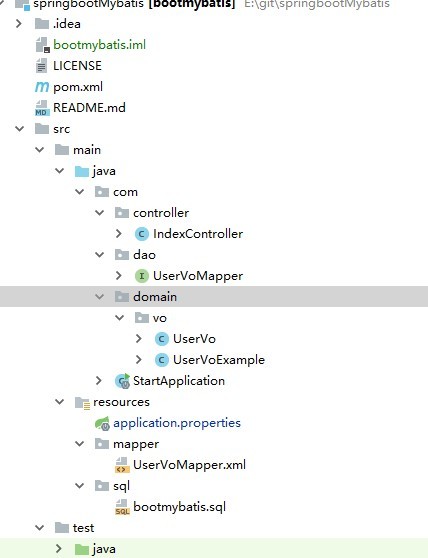
这里的UserVoMapper,UserVo,UserVoExample,都是使用的逆向工程生成的
启动类代码:
package com;

import com.alibaba.druid.pool.DruidDataSource;

import org.apache.ibatis.session.SqlSessionFactory;

import org.mybatis.spring.SqlSessionFactoryBean;

import org.mybatis.spring.annotation.MapperScan;

import org.springframework.boot.Banner;

import org.springframework.boot.SpringApplication;

import org.springframework.boot.autoconfigure.EnableAutoConfiguration;

import org.springframework.boot.autoconfigure.SpringBootApplication;

import org.springframework.boot.context.properties.ConfigurationProperties;

import org.springframework.context.annotation.Bean;

import org.springframework.context.annotation.ComponentScan;

import org.springframework.core.io.support.PathMatchingResourcePatternResolver;

import javax.sql.DataSource;

@SpringBootApplication

@ComponentScan

@EnableAutoConfiguration

@MapperScan("com.dao")

public class StartApplication {

    public static void main(String[] args) throws Exception {

        SpringApplication app = new SpringApplication(StartApplication.class);

        app.setBannerMode(Banner.Mode.OFF);

        app.run(args);

    }

    // datasource注入

    @Bean

    @ConfigurationProperties(prefix = "spring.datasource")

    public DataSource dataSource() {

        return new DruidDataSource();

    }

    //mybatis SQLSession注入

    @Bean

    public SqlSessionFactory sqlSessionFactoryBean() throws Exception {

        SqlSessionFactoryBean sqlSessionFactoryBean = new SqlSessionFactoryBean();

        sqlSessionFactoryBean.setDataSource(dataSource());

        PathMatchingResourcePatternResolver resolver = new PathMatchingResourcePatternResolver();

        // 这里设置mybatis xml文件的地址

        sqlSessionFactoryBean.setMapperLocations(resolver.getResources("classpath:/mapper/*.xml"));

        return sqlSessionFactoryBean.getObject();

    }

}
测试
在IndexController代码如下:
package com.controller;

import com.dao.UserVoMapper;

import com.domain.vo.UserVo;

import org.springframework.beans.factory.annotation.Autowired;

import org.springframework.stereotype.Controller;

import org.springframework.web.bind.annotation.GetMapping;

import org.springframework.web.bind.annotation.ResponseBody;

@Controller

public class IndexController {

    @Autowired

    UserVoMapper userDao;

    @GetMapping(value = "")

    @ResponseBody

    public UserVo index(){

        UserVo userVo = new UserVo();

        userVo.setUsername("SELECTIVE");

        userVo.setPassword("123456");

        userVo.setAddress("北京");

        userDao.insertSelective(userVo);

        userVo = userDao.selectByPrimaryKey(1);

        return userVo;

    }

}
启动startApplication,在浏览器中输入http://127.0.0.1,即可查看到结果。
如果有不明白的可以去git上查看源码,传送门
喜欢的话,给个star
spring boot开发笔记——mybatis的更多相关文章
- Spring Boot学习笔记——Spring Boot与MyBatis的集成(项目示例)
1.准备数据库环境 # 创建数据库 CREATE DATABASE IF NOT EXISTS zifeiydb DEFAULT CHARSET utf8 COLLATE utf8_general_c ...
- Spring Boot学习笔记2——基本使用之最佳实践[z]
前言 在上一篇文章Spring Boot 学习笔记1——初体验之3分钟启动你的Web应用已经对Spring Boot的基本体系与基本使用进行了学习,本文主要目的是更加进一步的来说明对于Spring B ...
- spring boot 2使用Mybatis多表关联查询
模拟业务关系:一个用户user有对应的一个公司company,每个用户有多个账户account. spring boot 2的环境搭建见上文:spring boot 2整合mybatis 一.mysq ...
- spring boot 2整合mybatis
mybatis-spring-boot-starter主要有两种解决方案,一种是使用注解,一种是使用XML. 参考这篇文章动手跑了一个例子,稍微不同之处,原文是spring boot,这里改成了spr ...
- Spring Boot:整合MyBatis框架
综合概述 MyBatis 是一款优秀的持久层框架,它支持定制化 SQL.存储过程以及高级映射.MyBatis 避免了几乎所有的 JDBC 代码和手动设置参数以及获取结果集.MyBatis 可以使用简单 ...
- Spring Boot:实现MyBatis动态数据源
综合概述 在很多具体应用场景中,我们需要用到动态数据源的情况,比如多租户的场景,系统登录时需要根据用户信息切换到用户对应的数据库.又比如业务A要访问A数据库,业务B要访问B数据库等,都可以使用动态数据 ...
- Spring Boot:实现MyBatis动态创建表
综合概述 在有些应用场景中,我们会有需要动态创建和操作表的需求.比如因为单表数据存储量太大而采取分表存储的情况,又或者是按日期生成日志表存储系统日志等等.这个时候就需要我们动态的生成和操作数据库表了. ...
- spring boot 开发环境搭建(Eclipse)
Spring Boot 集成教程 Spring Boot 介绍 Spring Boot 开发环境搭建(Eclipse) Spring Boot Hello World (restful接口)例子 sp ...
- Spring Boot 学习笔记(六) 整合 RESTful 参数传递
Spring Boot 学习笔记 源码地址 Spring Boot 学习笔记(一) hello world Spring Boot 学习笔记(二) 整合 log4j2 Spring Boot 学习笔记 ...
随机推荐
- Jquery对表格的一些简单应用 查询&即时匹配&点击高亮等
代码如下(暂时没有用原生js实现): <!DOCTYPE html> <html lang="en"> <head> <meta char ...
- 转载:Opencv调整运行窗口图片的大小
本文来自:http://blog.csdn.net/cumtml/article/details/52807961 Opencv在运算时显示图片问题 总结在opencv中,图片显示的问题.简要解决图片 ...
- jq动画分析1
<!DOCTYPE html PUBLIC "-//W3C//DTD XHTML 1.0 Transitional//EN" "http://www.w3.org/ ...
- TCC细读 - 1 例子流程
http://www.iocoder.cn/categories/TCC-Transaction/ https://github.com/changmingxie/tcc-transaction 细读 ...
- 尚硅谷springboot学习25-嵌入式Servlet容器
SpringBoot默认使用Tomcat作为嵌入式的Servlet容器:
- Spring Boot文档维护:集成Swagger2
一.Swagger简介 在日常的工作中,我们往往需要给前端(WEB端.IOS.Android)或者第三方提供接口,这个时我们就需要提供一份详细的API说明文档.但维护一份详细的文档可不是一件简单的事情 ...
- 使用wireshark以及filddler配合抓去手机端的TCP以及HTTP请求
在测试手机客户端时,有时候需要查看网络请求状况.使用在IDE中查看log的方式,能够解决问题,但是会比较复杂.wireshark不能够做代理,而fiddler主要是抓HTTP请求,没有wireshar ...
- kalman filter卡尔曼滤波器- 数学推导和原理理解-----网上讲的比较好的kalman filter和整理、将预测值和观测值融和
= 参考/转自: 1 ---https://blog.csdn.net/u010720661/article/details/63253509 2----http://www.bzarg.com/p/ ...
- python入门(五):切片列表元祖字典
1.切片 针对序列,使用切片可以获得我们想要的内容 序列:字符串.列表.元祖 特点:可以使用坐标获取某一个值.坐标是从0开始算 >>> s="0123456789" ...
- ConcurrentModificationException并发修改异常
//创建集合对象 Collection c = new ArrayList(); c.add("hello"); c.add("world"); c.add(& ...