
Linux下面rsync 实现 完全一致的同步方法
1. 在某些特殊的linux机器上面, 比如龙芯后者是飞腾服务器,部分工具不太好用, 需要使用x86弄好之后进行同步过去, 这个时候scp 最简单但是网络流量非常大, 不如使用rsync, rsync 一开始不知道能够实现source文件夹的删除操作, destation文件夹也可以重演.
2. rsync的两种模式
ssh模式和daemon模式.
简单起见 可以使用ssh-copy-id 实现无密码登录的话 可以使用 ssh 模式 更加方便一些.
关于rsync的两种模式:

    该部分额外的内容来自IBM官方网站上的一篇文章。该文章把rsync的运行模式扩展成了四种,但我认为rsync官方文档的两种模式的划分更加合理一些。

    所谓rsync daemon,就是在一台机器上永久运行的rsync进程。在任何一台安装rsync的机器上运行rsync --daemon,则这台机器上运行的rsync就是rsync daemon。我们可以把文件发送给daemon,也可以向daemon请求文件。

    daemon模式非常适合创建中心备份服务器,或项目存储库。

    两种模式的区别前面已经说过,shell模式在源路径和目的路径中使用一个冒号,而daemon模式使用两个冒号。

    关于rsync命令的语法:

本地拷贝:

   rsync [选项] SRC… DEST,在本地进行复制操作

shell模式:

   rsync [选项] [user@]Host:SRC… [DEST],拉动作,从远程主机拉文件到本地

   rsync [选项] SRC… [user@]Host:DEST,推动作,把本地文件推送到远程主机

daemon模式:

   rsync [选项] [user@]Host::SRC… [DEST],拉动作

   rsync [选项] rsync://[user@]Host [:port]/SRC… [DEST],仍然是拉动作

   rsync [选项] SRC... [user@]Host::DEST,推动作

   rsync [选项] SRC...rsync://[user@]Host [:port]/DEST,仍然是推动作
来源: https://blog.csdn.net/s1070/article/details/77978907
3. 简单测试验证:
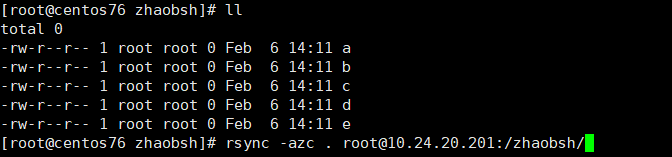
host01

mkdir /zhaobsh

touch a b c d e

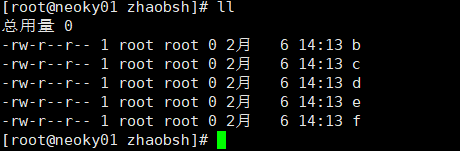
host02

mkdir /zhaobsh

touch b c d e f
然后在源文件的host01 机器上面执行命令
rsync -azc . root@10.24.20.201:/zhaobsh/
host02 机器 执行命令之前的文件为:
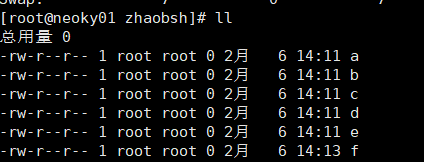
执行命令之后的文件为:
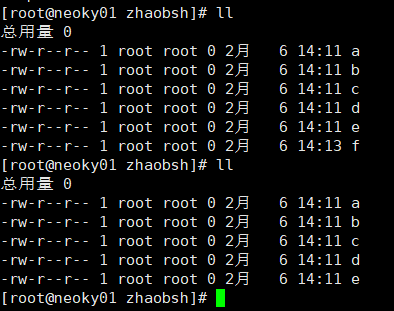
4. 如果想验证能够删除 source 里面不存在的文件 那么需要添加参数
rsync -azc . --delete root@10.24.20.201:/zhaobsh/
就会发现 source 里面没有的文件 f 就会在destination
5. 其实GNU工具链非常好 里面的东西非常实用 直接看help的话 就能学到很多东西(就是自己的耐心不够)
[root@centos76 zhaobsh]# rsync --help

rsync  version 3.1.2  protocol version 31

Copyright (C) 1996-2015 by Andrew Tridgell, Wayne Davison, and others.

Web site: http://rsync.samba.org/

Capabilities:

    64-bit files, 64-bit inums, 64-bit timestamps, 64-bit long ints,

    socketpairs, hardlinks, symlinks, IPv6, batchfiles, inplace,

    append, ACLs, xattrs, iconv, symtimes, prealloc

rsync comes with ABSOLUTELY NO WARRANTY.  This is free software, and you

are welcome to redistribute it under certain conditions.  See the GNU

General Public Licence for details.

rsync is a file transfer program capable of efficient remote update

via a fast differencing algorithm.

Usage: rsync [OPTION]... SRC [SRC]... DEST

  or   rsync [OPTION]... SRC [SRC]... [USER@]HOST:DEST

  or   rsync [OPTION]... SRC [SRC]... [USER@]HOST::DEST

  or   rsync [OPTION]... SRC [SRC]... rsync://[USER@]HOST[:PORT]/DEST

  or   rsync [OPTION]... [USER@]HOST:SRC [DEST]

  or   rsync [OPTION]... [USER@]HOST::SRC [DEST]

  or   rsync [OPTION]... rsync://[USER@]HOST[:PORT]/SRC [DEST]

The ':' usages connect via remote shell, while '::' & 'rsync://' usages connect

to an rsync daemon, and require SRC or DEST to start with a module name.

Options

 -v, --verbose               increase verbosity

     --info=FLAGS            fine-grained informational verbosity

     --debug=FLAGS           fine-grained debug verbosity

     --msgs2stderr           special output handling for debugging

 -q, --quiet                 suppress non-error messages

     --no-motd               suppress daemon-mode MOTD (see manpage caveat)

 -c, --checksum              skip based on checksum, not mod-time & size

 -a, --archive               archive mode; equals -rlptgoD (no -H,-A,-X)

     --no-OPTION             turn off an implied OPTION (e.g. --no-D)

 -r, --recursive             recurse into directories

 -R, --relative              use relative path names

     --no-implied-dirs       don't send implied dirs with --relative

 -b, --backup                make backups (see --suffix & --backup-dir)

     --backup-dir=DIR        make backups into hierarchy based in DIR

     --suffix=SUFFIX         set backup suffix (default ~ w/o --backup-dir)

 -u, --update                skip files that are newer on the receiver

     --inplace               update destination files in-place (SEE MAN PAGE)

     --append                append data onto shorter files

     --append-verify         like --append, but with old data in file checksum

 -d, --dirs                  transfer directories without recursing

 -l, --links                 copy symlinks as symlinks

 -L, --copy-links            transform symlink into referent file/dir

     --copy-unsafe-links     only "unsafe" symlinks are transformed

     --safe-links            ignore symlinks that point outside the source tree

     --munge-links           munge symlinks to make them safer (but unusable)

 -k, --copy-dirlinks         transform symlink to a dir into referent dir

 -K, --keep-dirlinks         treat symlinked dir on receiver as dir

 -H, --hard-links            preserve hard links

 -p, --perms                 preserve permissions

 -E, --executability         preserve the file's executability

     --chmod=CHMOD           affect file and/or directory permissions

 -A, --acls                  preserve ACLs (implies --perms)

 -X, --xattrs                preserve extended attributes

 -o, --owner                 preserve owner (super-user only)

 -g, --group                 preserve group

     --devices               preserve device files (super-user only)

     --copy-devices          copy device contents as regular file

     --specials              preserve special files

 -D                          same as --devices --specials

 -t, --times                 preserve modification times

 -O, --omit-dir-times        omit directories from --times

 -J, --omit-link-times       omit symlinks from --times

     --super                 receiver attempts super-user activities

     --fake-super            store/recover privileged attrs using xattrs

 -S, --sparse                handle sparse files efficiently

     --preallocate           allocate dest files before writing them

 -n, --dry-run               perform a trial run with no changes made

 -W, --whole-file            copy files whole (without delta-xfer algorithm)

 -x, --one-file-system       don't cross filesystem boundaries

 -B, --block-size=SIZE       force a fixed checksum block-size

 -e, --rsh=COMMAND           specify the remote shell to use

     --rsync-path=PROGRAM    specify the rsync to run on the remote machine

     --existing              skip creating new files on receiver

     --ignore-existing       skip updating files that already exist on receiver

     --remove-source-files   sender removes synchronized files (non-dirs)

     --del                   an alias for --delete-during

     --delete                delete extraneous files from destination dirs

     --delete-before         receiver deletes before transfer, not during

     --delete-during         receiver deletes during the transfer

     --delete-delay          find deletions during, delete after

     --delete-after          receiver deletes after transfer, not during

     --delete-excluded       also delete excluded files from destination dirs

     --ignore-missing-args   ignore missing source args without error

     --delete-missing-args   delete missing source args from destination

     --ignore-errors         delete even if there are I/O errors

     --force                 force deletion of directories even if not empty

     --max-delete=NUM        don't delete more than NUM files

     --max-size=SIZE         don't transfer any file larger than SIZE

     --min-size=SIZE         don't transfer any file smaller than SIZE

     --partial               keep partially transferred files

     --partial-dir=DIR       put a partially transferred file into DIR

     --delay-updates         put all updated files into place at transfer's end

 -m, --prune-empty-dirs      prune empty directory chains from the file-list

     --numeric-ids           don't map uid/gid values by user/group name

     --usermap=STRING        custom username mapping

     --groupmap=STRING       custom groupname mapping

     --chown=USER:GROUP      simple username/groupname mapping

     --timeout=SECONDS       set I/O timeout in seconds

     --contimeout=SECONDS    set daemon connection timeout in seconds

 -I, --ignore-times          don't skip files that match in size and mod-time

 -M, --remote-option=OPTION  send OPTION to the remote side only

     --size-only             skip files that match in size

     --modify-window=NUM     compare mod-times with reduced accuracy

 -T, --temp-dir=DIR          create temporary files in directory DIR

 -y, --fuzzy                 find similar file for basis if no dest file

     --compare-dest=DIR      also compare destination files relative to DIR

     --copy-dest=DIR         ... and include copies of unchanged files

     --link-dest=DIR         hardlink to files in DIR when unchanged

 -z, --compress              compress file data during the transfer

     --compress-level=NUM    explicitly set compression level

     --skip-compress=LIST    skip compressing files with a suffix in LIST

 -C, --cvs-exclude           auto-ignore files the same way CVS does

 -f, --filter=RULE           add a file-filtering RULE

 -F                          same as --filter='dir-merge /.rsync-filter'

                             repeated: --filter='- .rsync-filter'

     --exclude=PATTERN       exclude files matching PATTERN

     --exclude-from=FILE     read exclude patterns from FILE

     --include=PATTERN       don't exclude files matching PATTERN

     --include-from=FILE     read include patterns from FILE

     --files-from=FILE       read list of source-file names from FILE

 -0, --from0                 all *-from/filter files are delimited by 0s

 -s, --protect-args          no space-splitting; only wildcard special-chars

     --address=ADDRESS       bind address for outgoing socket to daemon

     --port=PORT             specify double-colon alternate port number

     --sockopts=OPTIONS      specify custom TCP options

     --blocking-io           use blocking I/O for the remote shell

     --stats                 give some file-transfer stats

 -8, --8-bit-output          leave high-bit chars unescaped in output

 -h, --human-readable        output numbers in a human-readable format

     --progress              show progress during transfer

 -P                          same as --partial --progress

 -i, --itemize-changes       output a change-summary for all updates

     --out-format=FORMAT     output updates using the specified FORMAT

     --log-file=FILE         log what we're doing to the specified FILE

     --log-file-format=FMT   log updates using the specified FMT

     --password-file=FILE    read daemon-access password from FILE

     --list-only             list the files instead of copying them

     --bwlimit=RATE          limit socket I/O bandwidth

     --outbuf=N|L|B          set output buffering to None, Line, or Block

     --write-batch=FILE      write a batched update to FILE

     --only-write-batch=FILE like --write-batch but w/o updating destination

     --read-batch=FILE       read a batched update from FILE

     --protocol=NUM          force an older protocol version to be used

     --iconv=CONVERT_SPEC    request charset conversion of filenames

     --checksum-seed=NUM     set block/file checksum seed (advanced)

 -4, --ipv4                  prefer IPv4

 -6, --ipv6                  prefer IPv6

     --version               print version number

(-h) --help                  show this help (-h is --help only if used alone)

Use "rsync --daemon --help" to see the daemon-mode command-line options.

Please see the rsync(1) and rsyncd.conf(5) man pages for full documentation.

See http://rsync.samba.org/ for updates, bug reports, and answers
Linux下面rsync 实现 完全一致的同步方法的更多相关文章
- Windows Linux 之间rsync同步CODE文件
Windows Linux 之间rsync同步CODE文件 一.环境Windows:OS:Microsoft Windows Web Server 2008 SP1IP:192.168.88.197 ...
- Linux下Rsync+sersync实现数据实时同步
inotify 的同步备份机制有着缺点,于是看了sersync同步,弥补了rsync的缺点.以下转自:http://www.osyunwei.com/archives/7447.html 前言: 一. ...
- linux下rsync和tar增量备份梳理
前面总结过一篇全量备份/增量备份/差异备份说明,下面介绍下linux下rsync和tar两种增量备份的操作记录: 1)rsync备份 rsync由于本身的特性,在第一次rsync备份后,以后每次都只是 ...
- Linux下Rsync+Inotify-tools实现数据实时同步
Linux下Rsync+Inotify-tools实现数据实时同步 注意:下面的三个案例都是rsync 每次都是全量的同步(这就坑爹了),而且 file列表是循环形式触发rsync ,等于有10个文件 ...
- linux设置rsync+inotify实时同步文件
linux设置rsync+inotify实时同步文件 应用场景: 同步接收方:test01 接收目录:/opt/software/test/a/ 同步发起方:test02 同步目录:/opt/so ...
- Linux服务-rsync
目录 1. rsync简介 2. rsync特性 3. rsync的ssh认证协议 4. rsync命令 5. rsync+inotify Linux服务-rsync 1. rsync简介 rsync ...
- linux中rsync备份文件
linux中rsync备份文件 备份文件的方式 备份方式: cp : 本机复制 scp: 远程复制 推(本地上传到远程服务器): scp 1.txt root@ip:[路径] [root@m01 ~] ...
- Linux 安装Rsync和配置
1.检查rsync 是否已经安装 [root@test home]# rpm -qa|grep rsync 若已经安装,则使用rpm -e 命令卸载. [root@test home]#rpm -e ...
- 【Linux】rsync同步文件 & 程序自启动
rsync使用 1. 为什么使用rsync? rsync解决linux系统下文件同步时, 增量同步问题. 使用场景: 线上需要定时备份数据文件(视频资源), 使用rsync完成每天的增量备份. 参见: ...
- Rsync(远程同步): linux中Rsync命令的实际示例
rsync的 ( 远程同步 )为在Linux / Unix系统局部 拷贝和同步文件和目录远程以及一个最常用的命令. 随着rsync命令的帮助,您可以复制并在目录中远程和本地同步数据,在磁盘和网络,进行 ...
随机推荐
- Kubernetes的拐点助推器:左手开源,右手边缘计算
摘要:KubeEdge 是首个基于 Kubernetes 扩展的,提供云边协同能力的开放式智能边缘计算平台,也是 CNCF 在智能边缘领域的首个正式项目.依托 Kubernetes 强大的容器编排和调 ...
- 云图说|图解制品仓库CodeArts Artifact
摘要:制品仓库用于存放由源码编译生成的.可运行的二进制文件,重要作用是实现制品文件的可信存储,支撑软件开发活动. 本文分享自华为云社区<[云图说]第277期 图解制品仓库CodeArts Art ...
- 化蛹成蝶,华为云DevCloud助力互联网+转型,重构钢铁产业链
摘要:随着电子商务迅速发展,各个行业巨头纷纷投入互联网+的怀抱,钢铁行业作为典型的传统行业,如何实现华丽转身,拥抱市场,加快产业新旧动能转换? 本文分享自华为云社区<化蛹成蝶,华为云DevClo ...
- 鸿蒙轻内核源码分析:MMU协处理器
摘要:本系列首先了解下ARM CP15协处理器的知识,接着介绍下协处理器相关的汇编指令,最后分析下MMU相关汇编代码. 本文分享自华为云社区<鸿蒙轻内核A核源码分析系列六 MMU协处理器> ...
- 从java到JavaScript(1),看Dart:对比Java/Go/Swift/Rust
关于 JIT与AOT,之前整理过<JIT-动态编译与AOT-静态编译:java/ java/ JavaScript/Dart乱谈>,一文不足以概括dart. 从编程语言生态看Dart 大多 ...
- 开心档之C++ 数据结构
C++ 数据结构 C/C++ 数组允许定义可存储相同类型数据项的变量,但是结构是 C++ 中另一种用户自定义的可用的数据类型,它允许您存储不同类型的数据项. 结构用于表示一条记录,假设您想要跟踪图书馆 ...
- 应用火山引擎 DataTester“避坑”,抖音实现用 A/B 实验快速试错
更多技术交流.求职机会,欢迎关注字节跳动数据平台微信公众号,回复[1]进入官方交流群 A/B 测试产品可以说是企业科学决策的基础"设施",能够帮助企业快速迭代产品. 在字节跳动,每 ...
- 最优订单执行算法相关Paper介绍
更多精彩内容,欢迎关注公众号:数量技术宅,也可添加技术宅个人微信号:sljsz01,与我交流. 随着量化交易.高频交易的竞争日益激烈,事实证明,交易执行显着影响量化策略的投资绩效. 因此,许多从业者开 ...
- 【django-vue】课程表数据录入 课程分类接口 所有课程接口 课程详情接口 所有章节接口 课程列表前端 课程详情前端
目录 上节回顾 APSchudler 双写一致性 今日内容 1 课程表数据录入 2 课程分类接口 2.1 路由 2.2 序列化类 2.3 视图类 3 所有课程接口(过滤,排序) 3.1 表模型 3.2 ...
- 工作中使用Redis的10种场景
前言 Redis作为一种优秀的基于key/value的缓存,有非常不错的性能和稳定性,无论是在工作中,还是面试中,都经常会出现. 今天这篇文章就跟大家一起聊聊,我在实际工作中使用Redis的10种场景 ...