
[原]零基础学习SDL开发之在Android使用SDL2.0加载字体
在上一篇文章我们知道了如何在android使用SDL2.0来渲染显示一张png图,而且在上上一篇我们知道如何使用sdl来渲染输出bmp图,那么sdl是否可以渲染输出自己喜爱的字体库的字体呢?答案是当然可以。
我们需要移植SDL_ttf字体库来支持相应的字体的渲染输出。
一、移植SDL_ttf库:
使用如下命令,从SDL Mercurial获取SDL_image的源码:
hg clone https://hg.libsdl.org/SDL_ttf/
将SDL_ttf拷贝到在上一篇文章中的android-project\jni\下,将平台相关的代码去掉以及自动自动化相关的文件去掉,保留android相关的代码与文件。
二、在android中添加相关的引用:
修改android-project\jni\src\Android.mk,添加相关的引用:
LOCAL_PATH := $(call my-dir)

include $(CLEAR_VARS)

LOCAL_MODULE := main

SDL_PATH := ../SDL

SDL_IMAGE_PATH := ../SDL2_image

SDL_TTF_PATH := ../SDL_ttf

LOCAL_C_INCLUDES := $(LOCAL_PATH)/$(SDL_PATH)/include

LOCAL_C_INCLUDES +=    $(LOCAL_PATH)/$(SDL_IMAGE_PATH)

LOCAL_C_INCLUDES +=    $(LOCAL_PATH)/$(SDL_TTF_PATH)

# Add your application source files here...

LOCAL_SRC_FILES := $(SDL_PATH)/src/main/android/SDL_android_main.c \

    SDL_lesson.c

LOCAL_SHARED_LIBRARIES := SDL2

LOCAL_SHARED_LIBRARIES += SDL2_image

LOCAL_SHARED_LIBRARIES += SDL2_ttf

LOCAL_LDLIBS := -lGLESv1_CM -lGLESv2 -llog

include $(BUILD_SHARED_LIBRARY)
三、代码中引用相关的头文件:
/*

 * SDL_lesson.c

 * Clipping Sprite Sheets

 *  Created on: Aug 12, 2014

 *      Author: clarck

 */

#include <jni.h>

#include "SDL.h"

#include "SDL_image.h"

#include "SDL_ttf.h"

#include "SDL_logger.h"

#include "SDL_main.h"

#include "SDL_cleanup.h"

//The attributes of the screen

const int SCREEN_WIDTH = ;

const int SCREEN_HEIGHT = ;

struct SDL_Window *window = NULL;

struct SDL_Renderer *render = NULL;

struct SDL_Texture *background = NULL;

struct SDL_Texture *image = NULL;

struct SDL_Surface *surface = NULL;

struct SDL_Texture *texture = NULL;
四、加载图片的部分修改为IMG_LoadTexture:
* SDL_lesson.c

 * Clipping Sprite Sheets

 *  Created on: Aug ,

 *      Author: clarck

 */

#include <jni.h>

#include "SDL.h"

#include "SDL_image.h"

#include "SDL_ttf.h"

#include "SDL_logger.h"

#include "SDL_main.h"

#include "SDL_cleanup.h"

//The attributes of the screen

const int SCREEN_WIDTH = ;

const int SCREEN_HEIGHT = ;

struct SDL_Window *window = NULL;

struct SDL_Renderer *render = NULL;

struct SDL_Texture *background = NULL;

struct SDL_Texture *image = NULL;

struct SDL_Surface *surface = NULL;

struct SDL_Texture *texture = NULL;

/*

 * Loads a image into a texture on the rendering device

 * @param file The image file to load

 * @param ren The renderer to load the texture onto

 * @return the loaded texture, or NULL if something went wrong.

 */

SDL_Texture* loadTexture(const char *file, SDL_Renderer *render) {

    struct SDL_Texture *texture = NULL;

    texture = IMG_LoadTexture(render, file);

    if (texture == NULL) {

        LOGE("SDL_CreateTextureFromSurface failed %s", SDL_GetError());

    } else {

        LOGI("SDL_CreateTextureFromSurface successful.");

    }

    return texture;

}

/*

 * Draw an SDL_Texture to an SDL_Renderer at position x, y, preserving

 * the texture's width and height

 * @param tex The source texture we want to draw

 * @param ren The renderer we want to draw too

 * @param x The x coordinate to draw too

 * @param y The y coordinate to draw too

 * @param w The width of the texture to draw

 * @param h The height of the texture to draw

 */

void renderTexture(SDL_Texture *tex, SDL_Renderer *ren, SDL_Rect dst,

        SDL_Rect *clip) {

    SDL_RenderCopy(ren, tex, clip, &dst);

}

/*

 * Draw an SDL_Texture to an SDL_Renderer at position x, y, preserving

 * the texture's width and height and taking a clip of the texture if desired

 * If a clip is passed, the clip's width and height will be used instead of the texture's

 * @param tex The source texture we want to draw

 * @param rend The renderer we want to draw too

 * @param x The x coordinate to draw too

 * @param y The y coordinate to draw too

 * @param clip The sub-section of the texture to draw (clipping rect)

 *        default of nullptr draws the entire texture

 */

void renderTexture2(SDL_Texture *tex, SDL_Renderer *ren, int x, int y,

        SDL_Rect *clip) {

    SDL_Rect dst;

    dst.x = x;

    dst.y = y;

    if (clip != NULL) {

        dst.w = clip->w;

        dst.h = clip->h;

    } else {

        SDL_QueryTexture(tex, NULL, NULL, &dst.w, &dst.h);

    }

    renderTexture(tex, ren, dst, clip);

}
五、添加字体渲染功能函数:
/*

 * SDL_lesson.c

 * Clipping Sprite Sheets

 *  Created on: Aug 12, 2014

 *      Author: clarck

 */

#include <jni.h>

#include "SDL.h"

#include "SDL_image.h"

#include "SDL_ttf.h"

#include "SDL_logger.h"

#include "SDL_main.h"

#include "SDL_cleanup.h"

//The attributes of the screen

const int SCREEN_WIDTH = ;

const int SCREEN_HEIGHT = ;

struct SDL_Window *window = NULL;

struct SDL_Renderer *render = NULL;

struct SDL_Texture *background = NULL;

struct SDL_Texture *image = NULL;

struct SDL_Surface *surface = NULL;

struct SDL_Texture *texture = NULL;

/*

 * Loads a image into a texture on the rendering device

 * @param file The image file to load

 * @param ren The renderer to load the texture onto

 * @return the loaded texture, or NULL if something went wrong.

 */

SDL_Texture* loadTexture(const char *file, SDL_Renderer *render) {

    struct SDL_Texture *texture = NULL;

    texture = IMG_LoadTexture(render, file);

    if (texture == NULL) {

        LOGE("SDL_CreateTextureFromSurface failed %s", SDL_GetError());

    } else {

        LOGI("SDL_CreateTextureFromSurface successful.");

    }

    return texture;

}

/*

 * Draw an SDL_Texture to an SDL_Renderer at position x, y, preserving

 * the texture's width and height

 * @param tex The source texture we want to draw

 * @param ren The renderer we want to draw too

 * @param x The x coordinate to draw too

 * @param y The y coordinate to draw too

 * @param w The width of the texture to draw

 * @param h The height of the texture to draw

 */

void renderTexture(SDL_Texture *tex, SDL_Renderer *ren, SDL_Rect dst,

        SDL_Rect *clip) {

    SDL_RenderCopy(ren, tex, clip, &dst);

}

/*

 * Draw an SDL_Texture to an SDL_Renderer at position x, y, preserving

 * the texture's width and height and taking a clip of the texture if desired

 * If a clip is passed, the clip's width and height will be used instead of the texture's

 * @param tex The source texture we want to draw

 * @param rend The renderer we want to draw too

 * @param x The x coordinate to draw too

 * @param y The y coordinate to draw too

 * @param clip The sub-section of the texture to draw (clipping rect)

 *        default of nullptr draws the entire texture

 */

void renderTexture2(SDL_Texture *tex, SDL_Renderer *ren, int x, int y,

        SDL_Rect *clip) {

    SDL_Rect dst;

    dst.x = x;

    dst.y = y;

    if (clip != NULL) {

        dst.w = clip->w;

        dst.h = clip->h;

    } else {

        SDL_QueryTexture(tex, NULL, NULL, &dst.w, &dst.h);

    }

    renderTexture(tex, ren, dst, clip);

}

SDL_Texture* renderText(char *message, char *fontFile, SDL_Color color,

        int fontSize, SDL_Renderer *renderer) {

    //Open the font

    TTF_Font *font = TTF_OpenFont(fontFile, fontSize);

    if (font == NULL) {

        LOGE("renderText error: %s", SDL_GetError());

        return NULL;

    }

    surface = TTF_RenderText_Blended(font, message, color);

    if (surface == NULL) {

        TTF_CloseFont(font);

        LOGE("TTF_RenderText_Blended error: %s", SDL_GetError());

        return NULL;

    }

    texture = SDL_CreateTextureFromSurface(renderer, surface);

    if (texture == NULL) {

        LOGE("SDL_CreateTextureFromSurface error: %s", SDL_GetError());

    }

    //Clean up the surface and font

    SDL_FreeSurface(surface);

    TTF_CloseFont(font);

    return texture;

}
六、编写主函数功能:
/*

 * SDL_lesson.c

 * Clipping Sprite Sheets

 *  Created on: Aug 12, 2014

 *      Author: clarck

 */

#include <jni.h>

#include "SDL.h"

#include "SDL_image.h"

#include "SDL_ttf.h"

#include "SDL_logger.h"

#include "SDL_main.h"

#include "SDL_cleanup.h"

//The attributes of the screen

const int SCREEN_WIDTH = ;

const int SCREEN_HEIGHT = ;

struct SDL_Window *window = NULL;

struct SDL_Renderer *render = NULL;

struct SDL_Texture *background = NULL;

struct SDL_Texture *image = NULL;

struct SDL_Surface *surface = NULL;

struct SDL_Texture *texture = NULL;

/*

 * Loads a image into a texture on the rendering device

 * @param file The image file to load

 * @param ren The renderer to load the texture onto

 * @return the loaded texture, or NULL if something went wrong.

 */

SDL_Texture* loadTexture(const char *file, SDL_Renderer *render) {

    struct SDL_Texture *texture = NULL;

    texture = IMG_LoadTexture(render, file);

    if (texture == NULL) {

        LOGE("SDL_CreateTextureFromSurface failed %s", SDL_GetError());

    } else {

        LOGI("SDL_CreateTextureFromSurface successful.");

    }

    return texture;

}

/*

 * Draw an SDL_Texture to an SDL_Renderer at position x, y, preserving

 * the texture's width and height

 * @param tex The source texture we want to draw

 * @param ren The renderer we want to draw too

 * @param x The x coordinate to draw too

 * @param y The y coordinate to draw too

 * @param w The width of the texture to draw

 * @param h The height of the texture to draw

 */

void renderTexture(SDL_Texture *tex, SDL_Renderer *ren, SDL_Rect dst,

        SDL_Rect *clip) {

    SDL_RenderCopy(ren, tex, clip, &dst);

}

/*

 * Draw an SDL_Texture to an SDL_Renderer at position x, y, preserving

 * the texture's width and height and taking a clip of the texture if desired

 * If a clip is passed, the clip's width and height will be used instead of the texture's

 * @param tex The source texture we want to draw

 * @param rend The renderer we want to draw too

 * @param x The x coordinate to draw too

 * @param y The y coordinate to draw too

 * @param clip The sub-section of the texture to draw (clipping rect)

 *        default of nullptr draws the entire texture

 */

void renderTexture2(SDL_Texture *tex, SDL_Renderer *ren, int x, int y,

        SDL_Rect *clip) {

    SDL_Rect dst;

    dst.x = x;

    dst.y = y;

    if (clip != NULL) {

        dst.w = clip->w;

        dst.h = clip->h;

    } else {

        SDL_QueryTexture(tex, NULL, NULL, &dst.w, &dst.h);

    }

    renderTexture(tex, ren, dst, clip);

}

SDL_Texture* renderText(char *message, char *fontFile, SDL_Color color,

        int fontSize, SDL_Renderer *renderer) {

    //Open the font

    TTF_Font *font = TTF_OpenFont(fontFile, fontSize);

    if (font == NULL) {

        LOGE("renderText error: %s", SDL_GetError());

        return NULL;

    }

    surface = TTF_RenderText_Blended(font, message, color);

    if (surface == NULL) {

        TTF_CloseFont(font);

        LOGE("TTF_RenderText_Blended error: %s", SDL_GetError());

        return NULL;

    }

    texture = SDL_CreateTextureFromSurface(renderer, surface);

    if (texture == NULL) {

        LOGE("SDL_CreateTextureFromSurface error: %s", SDL_GetError());

    }

    //Clean up the surface and font

    SDL_FreeSurface(surface);

    TTF_CloseFont(font);

    return texture;

}

int main(int argc, char *argv[]) {

    //char *filefolder = "/storage/sdcard0/";

    char *filefolder = argv[];

    char *font_temp = "sample.ttf";

    char *image_temp = "image.png";

    char *background_temp = "background.png";

    LOGI("natvie_SDL %s", filefolder);

    char *background_file = (char*) malloc(

            strlen(filefolder) + strlen(background_temp) + );

    strcpy(background_file, filefolder);

    strcat(background_file, background_temp);

    LOGI("natvie_SDL background_file : %s", background_file);

    char *image_file = (char*) malloc(

            strlen(filefolder) + strlen(image_temp) + );

    strcpy(image_file, filefolder);

    strcat(image_file, image_temp);

    LOGI("natvie_SDL image_file : %s", image_file);

    char *font_file = (char*) malloc(

            strlen(filefolder) + strlen(font_temp) + );

    strcpy(font_file, filefolder);

    strcat(font_file, font_temp);

    LOGI("natvie_SDL font_file : %s", font_file);

    if (SDL_Init(SDL_INIT_EVERYTHING) != ) {

        LOGE("SDL_Init failed %s", SDL_GetError());

        return ;

    }

    if (TTF_Init() != ) {

        LOGE("TTF_Init failed %s", SDL_GetError());

        SDL_Quit();

        return ;

    }

    window = SDL_CreateWindow("lesson5", , , SCREEN_WIDTH, SCREEN_HEIGHT,

            SDL_WINDOW_SHOWN);

    if (window == NULL) {

        LOGE("SDL_CreateWindow failed %s", SDL_GetError());

        TTF_Quit();

        SDL_Quit();

        return ;

    }

    render = SDL_CreateRenderer(window, -,

            SDL_RENDERER_ACCELERATED | SDL_RENDERER_PRESENTVSYNC);

    if (render == NULL) {

        LOGE("SDL_CreateRenderer failed %s", SDL_GetError());

        cleanup_window(window);

        TTF_Quit();

        SDL_Quit();

        return ;

    }

    SDL_Color color = { , , ,  };

    image = renderText("TTF fonts are cool !", font_file, color, , render);

    if (image == NULL) {

        cleanup_texture(image);

        cleanup_render(render);

        cleanup_window(window);

        TTF_Quit();

        SDL_Quit();

        return ;

    }

    //Clear the window

    SDL_RenderClear(render);

    //Draw our image in the center of the window

    //We need the foreground image's width to properly compute the position

    //of it's top left corner so that the image will be centered

    int iW, iH;

    int x = SCREEN_WIDTH /  - iW / ;

    int y = SCREEN_HEIGHT /  - iH / ;

    SDL_Event e;

    int quit = ;

    while (quit != ) {

        //Read any events that occured, for now we'll just quit if any event occurs

        while (SDL_PollEvent(&e)) {

            //If user closes the window

            if (e.type == SDL_QUIT) {

                quit = ;

            }

            if (e.type == SDL_KEYDOWN && e.key.keysym.sym == SDLK_ESCAPE) {

                quit = ;

            }

        }

        //Rendering

        SDL_RenderClear(render);

        //Draw the image

        renderTexture2(image, render, x, y, NULL);

        SDL_RenderPresent(render);

    }

    //Destroy the various items

    cleanup_texture(image);

    cleanup_render(render);

    cleanup_window(window);

    IMG_Quit();

    SDL_Quit();

    return ;

}
七、修改SDLActivity,添加SDL_ttf动态库的load:
// Load the .so

    static {

        System.loadLibrary("SDL2");

        System.loadLibrary("SDL2_image");

        //System.loadLibrary("SDL2_mixer");

        //System.loadLibrary("SDL2_net");

        System.loadLibrary("SDL2_ttf");

        System.loadLibrary("main");

    }
运行截图:
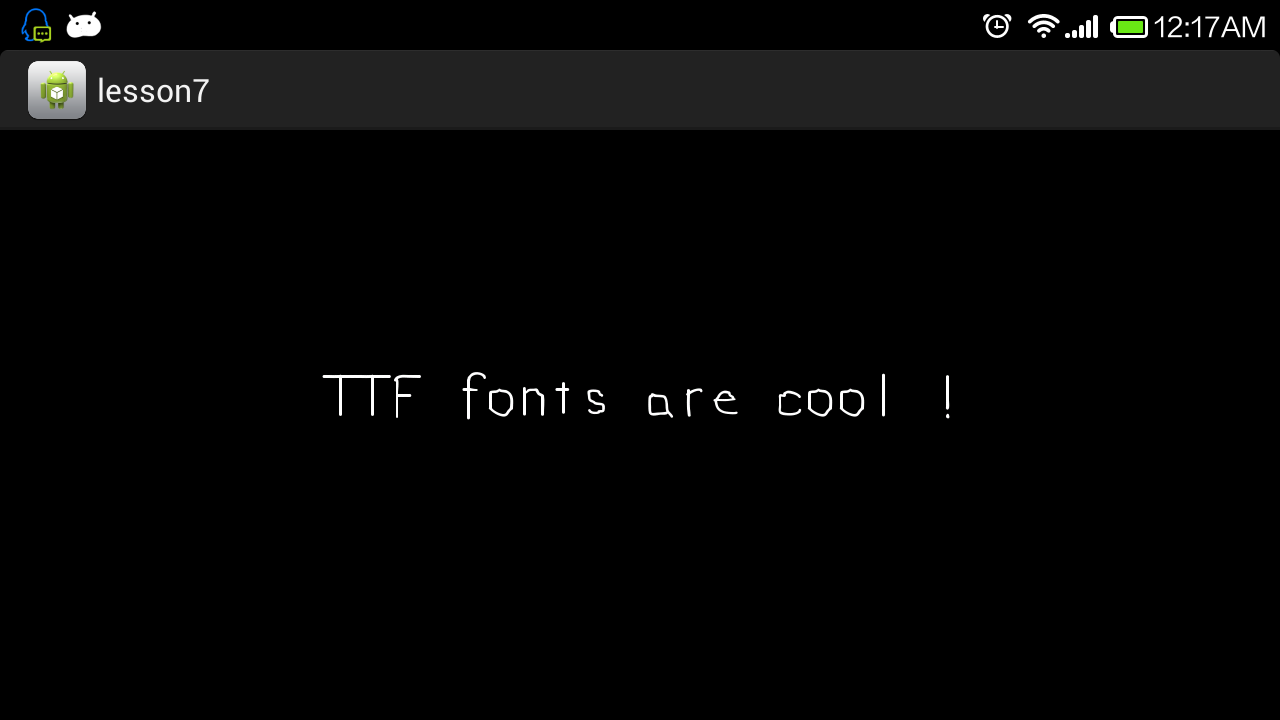
[原]零基础学习SDL开发之在Android使用SDL2.0加载字体的更多相关文章
- [原]零基础学习SDL开发之在Android使用SDL2.0显示BMP叠加图
关于如何移植在android上使用SDL,可以参考[原]零基础学习SDL开发之移植SDL2.0到Android 和 [原]零基础学习SDL开发之在Android使用SDL2.0显示BMP图 . 在一篇 ...
- [原]零基础学习SDL开发之在Android使用SDL2.0显示BMP图
关于如何移植SDL2.0到安卓上面来参考我的上一篇文章:[原]零基础学习SDL开发之移植SDL2.0到Android 在一篇文章我们主要使用SDL2.0来加载一张BMP图来渲染显示. 博主的开发环境: ...
- [原]零基础学习SDL开发之在Android使用SDL2.0渲染PNG图片
在上一篇文章我们知道了如何在android使用SDL2.0来渲染显示一张bmp图,但是如果是一张png或者一张jpg的图,那么还能显示成功么?答案是否定的 我们需要移植SDL_image库来支持除bm ...
- [原]零基础学习在Android进行SDL开发系列文章
[原]零基础学习SDL开发之移植SDL2.0到Android [原]零基础学习SDL开发之在Android使用SDL2.0显示BMP图 [原]零基础学习SDL开发之在Android使用SDL2.0显示 ...
- [原]零基础学习SDL开发之移植SDL2.0到Android
在[原]SDL开发教程我们知道了如何在pc下使用SDL进行开发,在android上面是否一样可以使用呢?答案是肯定的. 下面我们进行移植SDL到Android,这里都是基于SDL最新版进行移植的,在E ...
- [原]零基础学习视频解码之android篇系列文章
截止今天,<零基础学习视频解码系列文章>.<零基础学习在Android进行SDL开发系列文章>以及<零基础学习视频解码之android篇>系列文章基本算是告一段落了 ...
- [原]零基础学习视频解码之安装ffmpeg
写在文章前面:ffmpeg是一个开源的编解码框架,拥有很强大的功能.但是对于如果使用其来做开发呈现着严重两极分化,大神们讨论着高深的问题,大多数像我这样的小白连门都进不去.最近无意间领会了如何入门,现 ...
- [原]零基础学习在Android进行SDL开发后记
本着学习交流记录的目的编写了这个系列文章,主要用来记录如何从零开始学习SDL开发的过程,在这个过程中遇到了很多问题,差点就放弃了.首先是SDL的Android移植的时候遇到了比较坑的是SDL移植到An ...
- [原]零基础学习视频解码之seek
现在,我们要添加一些功能,当你看不能倒带的电影,是不是很烦? 那么函数av_seek_frame功能看起来是多么赏心悦目. 我们将让左,右箭头来回走在影片中通过一个小的向上和向下箭头很多,其中“三多一 ...
随机推荐
- 深入理解JavaScript系列(43):设计模式之状态模式
介绍 状态模式(State)允许一个对象在其内部状态改变的时候改变它的行为,对象看起来似乎修改了它的类. 正文 举个例子,就比如我们平时在下载东西,通常就会有好几个状态,比如准备状态(ReadySta ...
- [转]glyphicons-halflings-regular字体 图标
本文转自:http://www.ijquery.cn/?p=377 一.介绍 采用这种字体,我们可以避免网站制作中采用好多图片,一方面解决了浏览器的兼容性问题.另一方面,这些字体都是矢量字体,我们只要 ...
- Node.js学习笔记(二) --- CommonJs和Nodejs 中自定义模块
一. 什么是 CommonJs? JavaScript 是一个强大面向对象语言,它有很多快速高效的解释器. 然而, JavaScript标准定义的 API 是为了构建基于浏览器的应用程序.并没有制定一 ...
- C# XML相关
XmlDocument doc = new XmlDocument(); 1.string类型的xml,如何转换成xml类型 doc.LoadXml("需要传入的string类型的xml&q ...
- Python下ImportError: DLL load failed: 找不到指定的模块
环境:Anaconda3 Python3.7 scarpy1.5 版本似乎都能对的上.但是在cmd下报错 如下截图. 从以上错误来看,应该是lxml包有异常. pip uninstall lxml包. ...
- ASP.NET Visual Studio2010 发布Web网站问题详解
今天研究了一下如何发布web网站,之前总是没耐心,遇到点问题就没心情搞了,今天总算有点耐心搞明白了.其实遇到的问题还是挺多的,网上也没有太全的解释,所以结合自己还有别人的方法进行一下总结. 环境:Wi ...
- springboot+mybatis+thymeleaf+docker构建的个人站点开源项目(集成了个人主页、个人作品、个人博客)
前言 My Site 主要功能有:个人首页.个人作品.个人博客为一体的站点,网站的文章和作品均由markdown进行编写,可以满足你的基本需求.如果觉得这个项目不错,请为它点赞支持. 项目架构 JDK ...
- springboot自定义异常
SpringBoot自定义异常以及异常处理 在web项目中,我们可能需要给前端返回不同的提示码.例如:401表示没有权限,500代表位置异常,200代表请求成功等.但是这些提示码远远不能满足我们返回给 ...
- js数组详解
1,什么是数组 数组是值得有序集合,每个值叫做一个元素,而每个元素在数组中有一个位置,以数字表示,称为索引.js的数组是无类型的,数组元素可以是任意类型,同一个数组中的不同元素可能是对象或数组 ...
- css3动画基础详解(@keyframes和animation)
我们经常会看到CSS3能制作出很炫酷的动画效果,但是自己却只能做一些简单的.原因是对CSS3动画只知其一,不知其二.最近正好有做动画的项目,于是花时间将css3动画做了一个探究之旅,记录在册. 动画是 ...