
2023-04-06:拥抱Golang,优化FFmpeg音频编码器,探究encode_audio.c的内部结构。
2023-04-06:拥抱Golang,优化FFmpeg音频编码器,探究encode_audio.c的内部结构。
答案2023-04-06:
见moonfdd/ffmpeg-go库。
这段代码是一个示例程序,用于将音频 PCM 数据编码为 MP2 格式的音频文件。下面是代码的详细步骤:
1.导入 ffmpeg-go 和 os 等 Go 库;
2.定义一些变量,包括输出文件名、音频编解码器、音频编解码上下文、音频帧、音频数据包等;
3.查找 MP2 编码器并分配音频编解码上下文;
4.配置音频编解码参数,设置音频采样率、通道数、位率等;
5.打开音频编解码器;
6.创建输出文件;
7.开始编码过程,并将编码后的音频数据写入输出文件中。
具体地,编码过程包括以下几个步骤:
1.初始化音频帧;
2.将音频 PCM 数据填充到音频帧中;
3.发送音频帧到编解码器中进行编码;
4.从编解码器中读取编码后的音频数据包;
5.将编码后的音频数据包写入输出文件中。
最后,释放内存空间并关闭文件和编码器。在该示例程序中,我们需要手动设置 FFmpeg 库的路径,以便正确加载库文件。
命令如下:
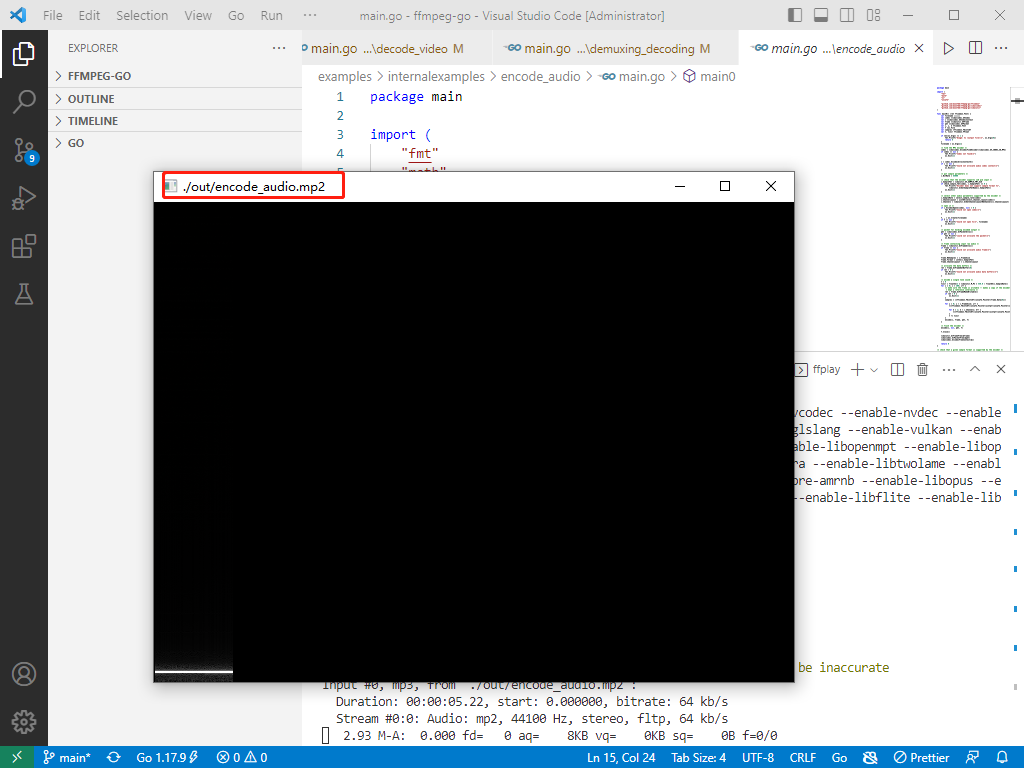
go run ./examples/internalexamples/encode_audio/main.go ./out/encode_audio.mp2

./lib/ffplay ./out/encode_audio.mp2
golang代码如下:
package main

import (

	"fmt"

	"math"

	"os"

	"unsafe"

	"github.com/moonfdd/ffmpeg-go/ffcommon"

	"github.com/moonfdd/ffmpeg-go/libavcodec"

	"github.com/moonfdd/ffmpeg-go/libavutil"

)

func main0() (ret ffcommon.FInt) {

	var filename string

	var codec *libavcodec.AVCodec

	var c *libavcodec.AVCodecContext

	var frame *libavutil.AVFrame

	var pkt *libavcodec.AVPacket

	var i, j, k ffcommon.FInt

	var f *os.File

	var samples *ffcommon.FUint16T

	var t, tincr ffcommon.FFloat

	if len(os.Args) <= 1 {

		fmt.Printf("Usage: %s <output file>\n", os.Args[0])

		return 0

	}

	filename = os.Args[1]

	/* find the MP2 encoder */

	codec = libavcodec.AvcodecFindEncoder(libavcodec.AV_CODEC_ID_MP2)

	if codec == nil {

		fmt.Printf("Codec not found\n")

		os.Exit(1)

	}

	c = codec.AvcodecAllocContext3()

	if c == nil {

		fmt.Printf("Could not allocate audio codec context\n")

		os.Exit(1)

	}

	/* put sample parameters */

	c.BitRate = 64000

	/* check that the encoder supports s16 pcm input */

	c.SampleFmt = libavutil.AV_SAMPLE_FMT_S16

	if check_sample_fmt(codec, c.SampleFmt) == 0 {

		fmt.Printf("Encoder does not support sample format %s",

			libavutil.AvGetSampleFmtName(c.SampleFmt))

		os.Exit(1)

	}

	/* select other audio parameters supported by the encoder */

	c.SampleRate = select_sample_rate(codec)

	c.ChannelLayout = uint64(select_channel_layout(codec))

	c.Channels = libavutil.AvGetChannelLayoutNbChannels(c.ChannelLayout)

	/* open it */

	if c.AvcodecOpen2(codec, nil) < 0 {

		fmt.Printf("Could not open codec\n")

		os.Exit(1)

	}

	f, _ = os.Create(filename)

	if f == nil {

		fmt.Printf("Could not open %s\n", filename)

		os.Exit(1)

	}

	/* packet for holding encoded output */

	pkt = libavcodec.AvPacketAlloc()

	if pkt == nil {

		fmt.Printf("could not allocate the packet\n")

		os.Exit(1)

	}

	/* frame containing input raw audio */

	frame = libavutil.AvFrameAlloc()

	if frame == nil {

		fmt.Printf("Could not allocate audio frame\n")

		os.Exit(1)

	}

	frame.NbSamples = c.FrameSize

	frame.Format = int32(c.SampleFmt)

	frame.ChannelLayout = c.ChannelLayout

	/* allocate the data buffers */

	ret = frame.AvFrameGetBuffer(0)

	if ret < 0 {

		fmt.Printf("Could not allocate audio data buffers\n")

		os.Exit(1)

	}

	/* encode a single tone sound */

	t = 0

	tincr = float32(2 * libavutil.M_PI * 440.0 / float64(c.SampleRate))

	for i = 0; i < 200; i++ {

		/* make sure the frame is writable -- makes a copy if the encoder

		 * kept a reference internally */

		ret = frame.AvFrameMakeWritable()

		if ret < 0 {

			os.Exit(1)

		}

		samples = (*ffcommon.FUint16T)(unsafe.Pointer(frame.Data[0]))

		for j = 0; j < c.FrameSize; j++ {

			*(*ffcommon.FUint16T)(unsafe.Pointer(uintptr(unsafe.Pointer(samples)) + uintptr(2*j*2))) = ffcommon.FUint16T(math.Sin(float64(t)) * 10000)

			for k = 1; k < c.Channels; k++ {

				*(*ffcommon.FUint16T)(unsafe.Pointer(uintptr(unsafe.Pointer(samples)) + uintptr((2*j+k)*2))) = *(*ffcommon.FUint16T)(unsafe.Pointer(uintptr(unsafe.Pointer(samples)) + uintptr(2*j*2)))

			}

			t += tincr

		}

		encode(c, frame, pkt, f)

	}

	/* flush the encoder */

	encode(c, nil, pkt, f)

	f.Close()

	libavutil.AvFrameFree(&frame)

	libavcodec.AvPacketFree(&pkt)

	libavcodec.AvcodecFreeContext(&c)

	return 0

}

/* check that a given sample format is supported by the encoder */

func check_sample_fmt(codec *libavcodec.AVCodec, sample_fmt libavutil.AVSampleFormat) ffcommon.FInt {

	p := codec.SampleFmts

	for *p != libavutil.AV_SAMPLE_FMT_NONE {

		if *p == sample_fmt {

			return 1

		}

		p = (*libavutil.AVSampleFormat)(unsafe.Pointer(uintptr(unsafe.Pointer(p)) + uintptr(8)))

	}

	return 0

}

/* just pick the highest supported samplerate */

func select_sample_rate(codec *libavcodec.AVCodec) ffcommon.FInt {

	var p *ffcommon.FInt

	var best_samplerate ffcommon.FInt

	if codec.SupportedSamplerates == nil {

		return 44100

	}

	p = codec.SupportedSamplerates

	for *p != 0 {

		if best_samplerate == 0 || int32(math.Abs(float64(44100-*p))) < int32(math.Abs(float64(44100-best_samplerate))) {

			best_samplerate = *p

		}

		p = (*int32)(unsafe.Pointer(uintptr(unsafe.Pointer(p)) + uintptr(4)))

	}

	return best_samplerate

}

/* select layout with the highest channel count */

func select_channel_layout(codec *libavcodec.AVCodec) ffcommon.FInt {

	var p *ffcommon.FUint64T

	var best_ch_layout ffcommon.FUint64T

	var best_nb_channels ffcommon.FInt

	if codec.ChannelLayouts == nil {

		return libavutil.AV_CH_LAYOUT_STEREO

	}

	p = codec.ChannelLayouts

	for *p != 0 {

		nb_channels := libavutil.AvGetChannelLayoutNbChannels(*p)

		if nb_channels > best_nb_channels {

			best_ch_layout = *p

			best_nb_channels = nb_channels

		}

		p = (*uint64)(unsafe.Pointer(uintptr(unsafe.Pointer(p)) + uintptr(8)))

	}

	return ffcommon.FInt(best_ch_layout)

}

func encode(ctx *libavcodec.AVCodecContext, frame *libavutil.AVFrame, pkt *libavcodec.AVPacket, output *os.File) {

	var ret ffcommon.FInt

	/* send the frame for encoding */

	ret = ctx.AvcodecSendFrame(frame)

	if ret < 0 {

		fmt.Printf("Error sending the frame to the encoder\n")

		os.Exit(1)

	}

	/* read all the available output packets (in general there may be any

	 * number of them */

	for ret >= 0 {

		ret = ctx.AvcodecReceivePacket(pkt)

		if ret == -libavutil.EAGAIN || ret == libavutil.AVERROR_EOF {

			return

		} else if ret < 0 {

			fmt.Printf("Error encoding audio frame\n")

			os.Exit(1)

		}

		output.Write(ffcommon.ByteSliceFromByteP(pkt.Data, int(pkt.Size)))

		pkt.AvPacketUnref()

	}

}

func main() {

	os.Setenv("Path", os.Getenv("Path")+";./lib")

	ffcommon.SetAvutilPath("./lib/avutil-56.dll")

	ffcommon.SetAvcodecPath("./lib/avcodec-58.dll")

	ffcommon.SetAvdevicePath("./lib/avdevice-58.dll")

	ffcommon.SetAvfilterPath("./lib/avfilter-56.dll")

	ffcommon.SetAvformatPath("./lib/avformat-58.dll")

	ffcommon.SetAvpostprocPath("./lib/postproc-55.dll")

	ffcommon.SetAvswresamplePath("./lib/swresample-3.dll")

	ffcommon.SetAvswscalePath("./lib/swscale-5.dll")

	genDir := "./out"

	_, err := os.Stat(genDir)

	if err != nil {

		if os.IsNotExist(err) {

			os.Mkdir(genDir, 0777) //  Everyone can read write and execute

		}

	}

	main0()

}
2023-04-06:拥抱Golang,优化FFmpeg音频编码器,探究encode_audio.c的内部结构。的更多相关文章
- ffmpeg音频编码
在弄音频采集时,需要设置缓存的大小,如果只是简单的采集和直接播放PCM数据,缓存的大小一般不影响播放和保存. 但是,如果需要使用FFMpeg音频编码,这时,音频缓存的大小必须设置av_samples_ ...
- 最简单的基于FFMPEG的音频编码器(PCM编码为AAC)
http://blog.csdn.net/leixiaohua1020/article/details/25430449 本文介绍一个最简单的基于FFMPEG的音频编码器.该编码器实现了PCM音频采样 ...
- Golang 优化之路——bitset
写在前面 开发过程中会经常处理集合这种数据结构,简单点的处理方法都是使用内置的map实现.但是如果要应对大量数据,例如,存放大量电话号码,使用map占用内存大的问题就会凸显出来.内存占用高又会带来一些 ...
- Contest2073 - 湖南多校对抗赛(2015.04.06)
Contest2073 - 湖南多校对抗赛(2015.04.06) Problem A: (More) Multiplication Time Limit: 1 Sec Memory Limit: ...
- http://www.liangxiansen.cn/2017/04/06/consul/
Consul 使用手册 | 一个梦 http://www.liangxiansen.cn/2017/04/06/consul/ 基于Consul的分布式锁实现 https://mp.weixin.qq ...
- 最简单的基于FFmpeg的编码器-纯净版(不包含libavformat)
===================================================== 最简单的基于FFmpeg的视频编码器文章列表: 最简单的基于FFMPEG的视频编码器(YUV ...
- ffmpeg 音频转换(amr2mp3)
yasm:http://yasm.tortall.net/Download.html(汇编器,新版本的ffmpeg增加了汇编代码) lame:http://lame.sourceforge.net/d ...
- ffmpeg 音频转码
大多数厂家摄像机输出的音频流格式都是PCM,有一些场合(比如讲音视频流保存成Ts流)需要将PCM格式转成AAC格式.基本的思路是先解码得到音频帧,再将音频帧编码成AAC格式.编码和解码之间需要添加一个 ...
- vmware虚拟机下ubuntu 13.04使用zeranoe脚本交叉编译ffmpeg
2013-07-01今天是建党节,习总书记指出,党的建设要以“照镜子.正衣冠.洗洗澡.治治病”为总要求.希望我们的党越来越纯洁,为人民谋福利.言归正传,每次项目中需要编译相应的ffmpeg,都很费时费 ...
- ffmpeg音频播放代码示例-avcodec_decode_audio4
一.概述 最近在学习ffmpeg解码的内容,参考了官方的教程http://dranger.com/ffmpeg/tutorial03.html,结果发现这个音频解码的教程有点问题.参考了各种博客,并同 ...
随机推荐
- 搭建简单nfs共享
1.查看是否安装nfs,rpcbind包 rpm -q nfs-utils rpm -q rpcbind 2.安装包 服务端和客户端 yum -y install nfs-utils 3.修改配置 ...
- 从babel编译结果分析class的实现原理
示例: class A { // 属性表达式 prop1 = 1; // get方法 get value() { console.log('Getting the current value!'); ...
- 记一个jdbc创建数据库、用户操作时,创建新用户提示CREATE USER权限问题
手写存储表数据库信息,访问链接动态数据源操作: mysql: 1.root登录服务器 进入数据库 mysql -u root -p2.创建数据库 create database shop; shop ...
- codec
1.codec究竟是什么 音频解码芯片:Audio codec,又叫声卡:本质就是ADC和DAC 2.codec的作用 在移动设备中,codec的作用可以归结为4种,分别如下: playback:对P ...
- odoo ORM API学习总结兼orm学习教程
环境 odoo-14.0.post20221212.tar ORM API学习总结/学习教程 模型(Model) Model字段被定义为model自身的属性 from odoo import mode ...
- 使用containerd搭建MinIO集群服务
概述 因为在云服务器上默认只有一块磁盘,如果直接在系统盘上安装MinIO,会被拒绝,所以这里采用containerd的方式绕过这一限制 操作环境 操作系统 CentOS 7.9 MinIO版本 REL ...
- Java8 lambda常用操作
参考博客:https://www.cnblogs.com/hmy-1365/p/12923435.html
- “==” 与 equals 区别 简化易懂版
首先,我们只需要看Object中的equals 方法写的是啥 很显然,就是一句话,"==" 与 equals方法作用完全一致. 都是用来比较在内存的首地址,即用来比较两个引用变量是 ...
- Win系统下实现任意exe静态免杀
Win系统下实现任意exe静态免杀?很简单 近几天用C++写了个远控,发现生成出来的exe都会被识别,可能是有人和我写的代码差不多,细想了一下,可能只有静态过不了,动态应该是可以过的,毕竟不可能巧到流 ...
- groovy, Scala和kotlin区别
所谓Scala的目的是什么?事实上Scala作者Martin Odesky他在<Programming in Scala>中写到,Scala的目的是为了更好的融合OO与FP,确实,不是取代 ...