
netty(三)---NioEventLoop分析
问题 :
- NioEventLoop 作用到底是什么?是在哪里用到的?
- NioEventLoop 和我们开头创建的 ServerBootstrap 和 EventLoopGroup 是什么关系 ?
- NioEventLoop 和 NioChannel 怎么传递的(按合理,一个channel应该分配一个NioEventLoop)
- NioEventLoop 工作原理
概述
要知道 NioEventLoop 就必须从 EventLoopGroup 说起,以下是它们的类结构图。
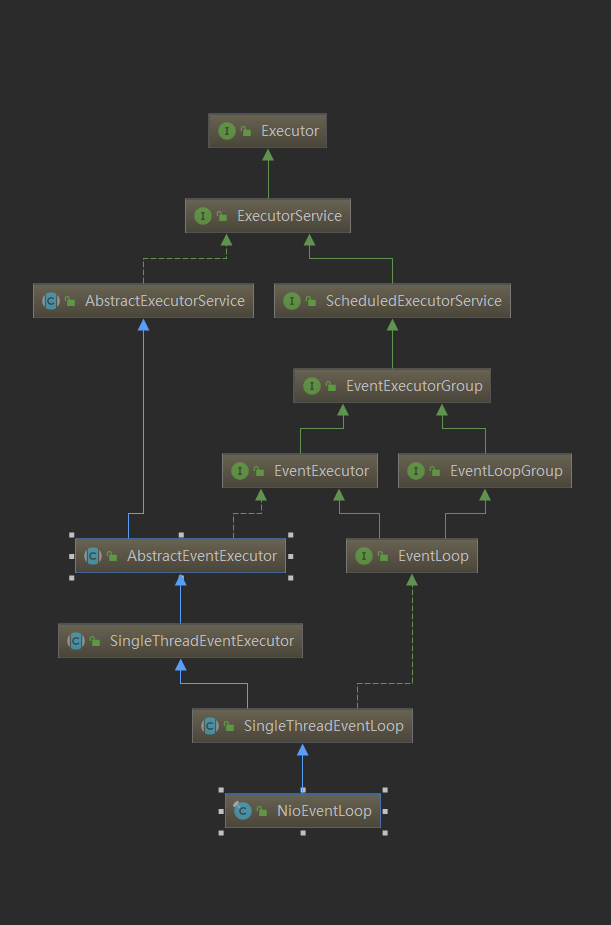 我们在分析 netty 服务端处理的过程中,有一个 createChannel() 的过程,然后调用 group().next() 方法返回一个 NioEventLoop ,剩下的东西就交给这个 NioEventLoop 来处理了,实际中 EventLoopGroup 包含这一个 NioEventLoop 数组,它们是执行处理的实施者。
源码分析
EventLoopGroup 的父类 MultithreadEventLoopGroup分析
public abstract class MultithreadEventLoopGroup extends MultithreadEventExecutorGroup implements EventLoopGroup {

    private static final InternalLogger logger = InternalLoggerFactory.getInstance(MultithreadEventLoopGroup.class);

    private static final int DEFAULT_EVENT_LOOP_THREADS;

    //默认EventLoopThreads处理线程数

    static {

        DEFAULT_EVENT_LOOP_THREADS = Math.max(1, SystemPropertyUtil.getInt(

                "io.netty.eventLoopThreads", Runtime.getRuntime().availableProcessors() * 2));

        if (logger.isDebugEnabled()) {

            logger.debug("-Dio.netty.eventLoopThreads: {}", DEFAULT_EVENT_LOOP_THREADS);

        }

    }

    /**

     * @see {@link MultithreadEventExecutorGroup#MultithreadEventExecutorGroup(int, Executor, Object...)}

     */

    protected MultithreadEventLoopGroup(int nThreads, Executor executor, Object... args) {

        super(nThreads == 0 ? DEFAULT_EVENT_LOOP_THREADS : nThreads, executor, args);

    }

    /**

     * @see {@link MultithreadEventExecutorGroup#MultithreadEventExecutorGroup(int, ThreadFactory, Object...)}

     */

    protected MultithreadEventLoopGroup(int nThreads, ThreadFactory threadFactory, Object... args) {

        super(nThreads == 0 ? DEFAULT_EVENT_LOOP_THREADS : nThreads, threadFactory, args);

    }

    @Override

    protected ThreadFactory newDefaultThreadFactory() {

        return new DefaultThreadFactory(getClass(), Thread.MAX_PRIORITY);

    }

    @Override

    public EventLoop next() {

        return (EventLoop) super.next();

    }

    @Override

    protected abstract EventLoop newChild(Executor executor, Object... args) throws Exception;

}
MultithreadEventExecutorGroup 类
public abstract class MultithreadEventExecutorGroup extends AbstractEventExecutorGroup {

	//接受到任务,交给children 执行

    private final EventExecutor[] children;

    private final Set<EventExecutor> readonlyChildren;

    private final AtomicInteger childIndex = new AtomicInteger();

    private final AtomicInteger terminatedChildren = new AtomicInteger();

    private final Promise<?> terminationFuture = new DefaultPromise(GlobalEventExecutor.INSTANCE);

    /**

     * Create a new instance.

     *

     * @param nThreads          the number of threads that will be used by this instance.

     * @param threadFactory     the ThreadFactory to use, or {@code null} if the default should be used.

     * @param args              arguments which will passed to each {@link #newChild(Executor, Object...)} call

     */

    protected MultithreadEventExecutorGroup(int nThreads, ThreadFactory threadFactory, Object... args) {

        this(nThreads, threadFactory == null ? null : new ThreadPerTaskExecutor(threadFactory), args);

    }

    /**

     * Create a new instance.

     *

     * @param nThreads          the number of threads that will be used by this instance.

     * @param executor          the Executor to use, or {@code null} if the default should be used.

     * @param args              arguments which will passed to each {@link #newChild(Executor, Object...)} call

     */

    protected MultithreadEventExecutorGroup(int nThreads, Executor executor, Object... args) {

        if (nThreads <= 0) {

            throw new IllegalArgumentException(String.format("nThreads: %d (expected: > 0)", nThreads));

        }

        if (executor == null) {

            executor = new ThreadPerTaskExecutor(newDefaultThreadFactory());

        }

        children = new EventExecutor[nThreads];

        for (int i = 0; i < nThreads; i ++) {

            boolean success = false;

            try {

                children[i] = newChild(executor, args);

                success = true;

            } catch (Exception e) {

                // TODO: Think about if this is a good exception type

                throw new IllegalStateException("failed to create a child event loop", e);

            } finally {

                if (!success) {

                    for (int j = 0; j < i; j ++) {

                        children[j].shutdownGracefully();

                    }

                    for (int j = 0; j < i; j ++) {

                        EventExecutor e = children[j];

                        try {

                            while (!e.isTerminated()) {

                                e.awaitTermination(Integer.MAX_VALUE, TimeUnit.SECONDS);

                            }

                        } catch (InterruptedException interrupted) {

                            Thread.currentThread().interrupt();

                            break;

                        }

                    }

                }

            }

        }

        final FutureListener<Object> terminationListener = new FutureListener<Object>() {

            @Override

            public void operationComplete(Future<Object> future) throws Exception {

                if (terminatedChildren.incrementAndGet() == children.length) {

                    terminationFuture.setSuccess(null);

                }

            }

        };

        for (EventExecutor e: children) {

            e.terminationFuture().addListener(terminationListener);

        }

        Set<EventExecutor> childrenSet = new LinkedHashSet<EventExecutor>(children.length);

        Collections.addAll(childrenSet, children);

        readonlyChildren = Collections.unmodifiableSet(childrenSet);

    }

    protected ThreadFactory newDefaultThreadFactory() {

        return new DefaultThreadFactory(getClass());

    }

    @Override

    public EventExecutor next() {

        return children[Math.abs(childIndex.getAndIncrement() % children.length)];

    }

    ...
可以看到构造方法,就是创建多个 child (真正处理的执行者)。其中 newChild 交给子类实现,我们看一下NioEventLoopGroup newChild 的实现。
    @Override

    protected EventLoop newChild(Executor executor, Object... args) throws Exception {

        return new NioEventLoop(this, executor, (SelectorProvider) args[0]);

    }
至此,我们摸清了最终“干活”的人就是 NioEventLoop 。
参考资料
无
netty(三)---NioEventLoop分析的更多相关文章
- Netty源码分析之NioEventLoop(三)—NioEventLoop的执行
前面两篇文章Netty源码分析之NioEventLoop(一)—NioEventLoop的创建与Netty源码分析之NioEventLoop(二)—NioEventLoop的启动中我们对NioEven ...
- Netty源码分析第2章(NioEventLoop)---->第1节: NioEventLoopGroup之创建线程执行器
Netty源码分析第二章: NioEventLoop 概述: 通过上一章的学习, 我们了解了Server启动的大致流程, 有很多组件与模块并没有细讲, 从这个章开始, 我们开始详细剖析netty的各个 ...
- Netty源码分析第2章(NioEventLoop)---->第3节: 初始化线程选择器
Netty源码分析第二章:NioEventLoop 第三节:初始化线程选择器 回到上一小节的MultithreadEventExecutorGroup类的构造方法: protected Multi ...
- Netty源码分析第2章(NioEventLoop)---->第6节: 执行select操作
Netty源码分析第二章: NioEventLoop 第六节: 执行select操作 分析完了selector的创建和优化的过程, 这一小节分析select相关操作 跟到跟到select操作的入口 ...
- Netty源码分析之NioEventLoop(二)—NioEventLoop的启动
上篇文章中我们对Netty中NioEventLoop创建流程与源码进行了跟踪分析.本篇文章中我们接着分析NioEventLoop的启动流程: Netty中会在服务端启动和新连接接入时通过chooser ...
- Netty源码分析第2章(NioEventLoop)---->第2节: NioEventLoopGroup之NioEventLoop的创建
Netty源码分析第二章: NioEventLoop 第二节: NioEventLoopGroup之NioEventLoop的创建 回到上一小节的MultithreadEventExecutorG ...
- Netty源码分析第2章(NioEventLoop)---->第4节: NioEventLoop线程的启动
Netty源码分析第二章: NioEventLoop 第四节: NioEventLoop线程的启动 之前的小节我们学习了NioEventLoop的创建以及线程分配器的初始化, 那么NioEvent ...
- Netty源码分析第2章(NioEventLoop)---->第5节: 优化selector
Netty源码分析第二章: NioEventLoop 第五节: 优化selector 在剖析selector轮询之前, 我们先讲解一下selector的创建过程 回顾之前的小节, 在创建NioEv ...
- Netty源码分析第2章(NioEventLoop)---->第7节: 处理IO事件
Netty源码分析第二章: NioEventLoop 第七节:处理IO事件 上一小节我们了解了执行select()操作的相关逻辑, 这一小节我们继续学习select()之后, 轮询到io事件的相关 ...
随机推荐
- 在多租户(容器)数据库中如何创建PDB:方法1 从种子创建PDB
基于版本:19c (12.2.0.3) AskScuti 创建方法:从零开始创建一个PDB(从PDB$SEED创建新的PDB) 对应路径:Creating a PDB --> Creating ...
- 132. 分割回文串 II
Q: 给定一个字符串 s,将 s 分割成一些子串,使每个子串都是回文串. 返回符合要求的最少分割次数. 示例: 输入: “aab” 输出: 1 解释: 进行一次分割就可将 s 分割成 [“aa”,“b ...
- hadoop中遇到的各种错误记录
hadoop中namenode无法启动 转载链接:https://blog.csdn.net/love666666shen/article/details/74350358 使用pi ...
- 配置数据库属性validationQuery
配置数据库时,属性validationQuery默认值为“select 1”,对于oracle值应为“select 1 from dual” validationQuery属性:用来验证数据库连接的语 ...
- HTML的媒体元素(视频+音频)
网页的媒体元素 包括 视频 音频 首先创建一个文件夹,放视频和音频 播放(非自动播放+自动播放) 视频播放 1.1. 打开网页不自动播放 <video src="../ ...
- 新的存储网站,和存储单元dropbox
新的存储网站,和存储单元dropbox 待办 https://www.dropbox.com/home google 登陆 google邮箱 密码 521google 但是免费存储量只有2G goog ...
- python写excel总结
废话不说,直接上代码:import xlrd import xlwt # 读excel然后写到mysql的套路def updata_info(): book = xlrd.open_workbook( ...
- Flink流处理(一)- 状态流处理简介
1. Flink 简介 Flink 是一个分布式流处理器,提供直观且易于使用的API,以供实现有状态的流处理应用.它能够以fault-tolerant的方式高效地运行在大规模系统中. 流处理技术在当今 ...
- java_获取指定ip的定位
因为自己网站后台做了一个进站ip统计,之前只是获取了ip,这次优化了下,把ip的大致区域弄出来了 废话不多说,进正题 首先要用到几个网络大头的api 淘宝API:http://ip.taobao.co ...
- testng如何实现用例间依赖
todo: 参考: https://www.cnblogs.com/znicy/p/6534893.html