
LeetCode:Container With Most Water,Trapping Rain Water
Container With Most Water
Given n non-negative integers a1, a2, ..., an, where each represents a point at coordinate (i, ai). n vertical lines are drawn such that the two endpoints of line i is at (i, ai) and (i, 0). Find two lines, which together with x-axis forms a container, such that the container contains the most water.
Note: You may not slant the container.
算法1:枚举容器的两个边界,时间复杂度O(n^2)。大数据超时
class Solution {

public:

    int maxArea(vector<int> &height) {

        int res = 0, n = height.size();

        for(int i = 0; i < n; i++)//左边界

            for(int j = i+1; j < n; j++)//右边界

            {

                int tmp = (j-i)*min(height[i],height[j]);

                if(res < tmp)res = tmp;

            }

        return res;

    }

};
对上面的稍加改进,根据当前的已经计算出来的结果以及左边界的值,可以算出容器右边界的下界。不过还是超时
class Solution {

public:

    int maxArea(vector<int> &height) {

        int res = 0, n = height.size();

        for(int i = 0; i < n; i++)//左边界

        {

            if(height[i] == 0)continue;

            for(int j = max(i+1, res/height[i]+i); j < n; j++)//右边界

            {

                int tmp = (j-i)*min(height[i],height[j]);

                if(res < tmp)res = tmp;

            }

        }

        return res;

    }

};
算法2:时间复杂度O(nlogn)。
构建结构体包含height和height在原数组中的位置
struct Node
{
int height;
int index;
};
对该结构体数组按照height的值递增排序,假设排序后的数组为vec.
假设f[i] 表示数组vec[i,i+1,…]内所有height按照原来的位置顺序排列好以后的最大水量
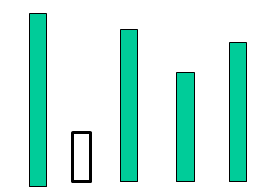
那么f[i-1]可以在O(1)时间内计算出来:因为vec[i-1].height 小于vec[i,i+1,…]内的所有height,所以以vec[i-1].index为边界的容器高度为vec[i-1].height,最大水量只需要分别计算vec[i,i+1,…]内按原始位置排列最前面和最后面的height,取两者的较大值。即下图中,黑色是最低的,要计算以黑色为边界的容器的最大水量,只需要分别和第一个和最后一个计算,去两者较大值
class Solution {

    struct Node

    {

        int height;

        int index;

        Node(int h, int i):height(h),index(i){}

        Node(){}

        bool operator < (const Node &a)const

        {

            return height < a.height;

        }

    };

public:

    int maxArea(vector<int> &height) {

        int res = 0, n = height.size();

        if(n <= 1)return 0;

        vector<Node>vec(n);

        for(int i = 0; i < n; i++)

        {

            vec[i].index = i;

            vec[i].height = height[i];

        }

        sort(vec.begin(), vec.end());

        int start = vec[n-1].index, end = start;//记录已经处理完的height的原始位置的左右端点

        for(int i = n-2; i >= 0 ; i--)

        {

            start = min(start, vec[i].index);

            end = max(end, vec[i].index);

            res = max(res, max(vec[i].height*(vec[i].index - start), vec[i].height*(end - vec[i].index)));

        }

        return res;

    }

};
算法3:时间复杂度O(n),两个指针i, j分别从前后向中间移动,两个指针分别表示容器的左右边界。每次迭代用当前的容量更新最大容量,然后把高度小的边界对应的指针往中间移动一位。 本文地址
正确性证明:由于水的容量是有较小的那个边界决定的,因此某次迭代中,假设height[i] < height[j],那么j 减小肯定不会使水的容量增大,只有i 增加才有可能使水的容量增大。但是会不会有这种可能:当前的i 和 某个k (k > j)是最大容量, 这也是不可能的,因为按照我们的移动规则,既然右指针从k 移动到了j,说明i 的左边一定存在一个边界 m,使m > k,那么[m, k]的容量肯定大于[i, k],所以[i,k]不可能是最大容量。可以参考here
class Solution {

public:

    int maxArea(vector<int> &height) {

        int res = 0, n = height.size();

        int left = 0, right = n-1;

        while(left < right)

        {

            res = max(res, (right-left)*min(height[left], height[right]));

            if(height[left] < height[right])

                left++;

            else right--;

        }

        return res;

    }

};
Given n non-negative integers representing an elevation map where the width of each bar is 1, compute how much water it is able to trap after raining.
For example,
Given [0,1,0,2,1,0,1,3,2,1,2,1], return 6.

The above elevation map is represented by array [0,1,0,2,1,0,1,3,2,1,2,1]. In this case, 6 units of rain water (blue section) are being trapped.
注意和上一题的区别,上一题相当于在每个位置放一个挡板,挡板之间可以蓄水;这一题是放置宽度为1的柱子,柱子上面可以蓄水。
算法4:分析某个柱子,发现该柱子上水的高度和其左右两边的最高柱子有关,设该柱子左边所有柱子中最高的为leftmax,右边所有柱子中最高的为rightmax,如果min(leftmax, rightmax) 大于该柱子的高度,那么该柱子上可以蓄水为min(leftmax, rightmax) - 该柱子高度,如果min(leftmax, rightmax) <= 该柱子高度,则该柱子上没有蓄水。
可以从后往前扫描一遍数组求得某个柱子右边的最高柱子,从前往后扫描一遍数组求得某个柱子左边的最高柱子, 然后按照上面的分析可以求得所有的蓄水量。
class Solution {

public:

    int trap(int A[], int n) {

        int res = 0;

        vector<int>rightMax(n);//柱子右边最大的柱子高度

        int maxv = 0;

        for(int i = n-1; i >= 0; i--)

        {

            rightMax[i] = maxv;

            maxv < A[i] ? maxv = A[i] : maxv;

        }

        maxv = 0;

        int conHeight;

        for(int i = 0; i < n; i++)

        {//此时maxv为柱子i左边最大的柱子高度

            conHeight = min(maxv, rightMax[i]);

            if(conHeight > A[i])

                res += conHeight - A[i];

            maxv < A[i] ? maxv = A[i] : maxv;

        }

        return res;

    }

};
上面的代码时间空间复杂度都是O(n),扫描了两次数组
算法5:可以换一种思路,如下图,如果我们求出了两个红色框的面积,然后再减去框内黑色柱子的面积,就是水的面积了,时间复杂度O(N),空间O(1), 数组扫描2次
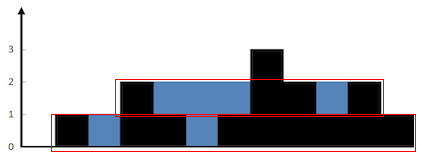
如何求红色框内的面积呢,我们先求出最大的柱子高度,然后左右分开求。求面积是是一层一层的累加

class Solution {

public:

    int trap(int A[], int n) {

        int maxHeight = 0, maxIdx = 0;

        for(int i = 0; i < n; i++)//求最大高度

            if(A[i] > maxHeight)

            {

                maxHeight = A[i];

                maxIdx = i;

            }

        int height = 0;

        int pillarArea = 0;//柱子面积

        int totalArea = 0;//总面积

        for(int i = 0; i < maxIdx; i++)

        {

            if(A[i] > height)

            {

                totalArea += (A[i] - height)*(maxIdx - i);

                height = A[i];

            }

            pillarArea += A[i];

        }

        height = 0;

        for(int i = n-1; i > maxIdx; i--)

        {

            if(A[i] > height)

            {

                totalArea += (A[i] - height)*(i - maxIdx);

                height = A[i];

            }

            pillarArea += A[i];

        }

        return totalArea - pillarArea;

    }

};
算法6:参考here,也是和算法5一样求面积,但是这里利用上一题的左右指针思想,只需要扫描一遍数组
class Solution {

public:

    int trap(int A[], int n) {

        int left = 0, right = n-1;

        int totalArea = 0, pillarArea = 0, height = 0;

        while(left <= right)

        {

            if(A[left] < A[right])

            {

                if(A[left] > height)

                {

                    totalArea += (A[left]-height)*(right - left + 1);

                    height = A[left];

                }

                pillarArea += A[left];

                left++;

            }

            else

            {

                if(A[right] > height)

                {

                    totalArea += (A[right]-height)*(right - left + 1);

                    height = A[right];

                }

                pillarArea += A[right];

                right--;

            }

        }

        return totalArea - pillarArea;

    }

};
【版权声明】转载请注明出处:http://www.cnblogs.com/TenosDoIt/p/3812880.html
LeetCode:Container With Most Water,Trapping Rain Water的更多相关文章
- [LeetCode] 接雨水,题 Trapping Rain Water
这题放上来是因为自己第一回见到这种题,觉得它好玩儿 =) Trapping Rain Water Given n non-negative integers representing an eleva ...
- 【LeetCode每天一题】Trapping Rain Water(获得雨水的容量)
Given n non-negative integers representing an elevation map where the width of each bar is 1, comput ...
- LeetCode 42. 接雨水(Trapping Rain Water)
题目描述 给定 n 个非负整数表示每个宽度为 1 的柱子的高度图,计算按此排列的柱子,下雨之后能接多少雨水. 上面是由数组 [0,1,0,2,1,0,1,3,2,1,2,1] 表示的高度图,在这种情况 ...
- leetcode 11. Container With Most Water 、42. Trapping Rain Water 、238. Product of Array Except Self 、407. Trapping Rain Water II
11. Container With Most Water https://www.cnblogs.com/grandyang/p/4455109.html 用双指针向中间滑动,较小的高度就作为当前情 ...
- [LeetCode] Trapping Rain Water 收集雨水
Given n non-negative integers representing an elevation map where the width of each bar is 1, comput ...
- [LeetCode] 42. Trapping Rain Water 收集雨水
Given n non-negative integers representing an elevation map where the width of each bar is 1, comput ...
- [LeetCode] Trapping Rain Water II 收集雨水之二
Given an m x n matrix of positive integers representing the height of each unit cell in a 2D elevati ...
- [Leetcode][Python]42: Trapping Rain Water
# -*- coding: utf8 -*-'''__author__ = 'dabay.wang@gmail.com' 42: Trapping Rain Waterhttps://oj.leetc ...
- leetcode#42 Trapping rain water的五种解法详解
leetcode#42 Trapping rain water 这道题十分有意思,可以用很多方法做出来,每种方法的思想都值得让人细细体会. 42. Trapping Rain WaterGiven n ...
随机推荐
- [Shell]字符截取命令:cut, printf, awk, sed
------------------------------------------------------------------------------------------- [cut命令] ...
- windows 硬盘格式不一样的文件移动 导致拒绝访问 权限丢失 0字节解决办法
解决此问题,必须关闭“简单文件共享”,然后获取文件夹的所有权: 1. 关闭“简单文件共享”: a. 单击“开始”,然后单击“我的电脑”. b. 在“工具”菜单上,单击“文件夹选项”,然后单击“查看”选 ...
- 新建MMS草稿保存后,再进入草稿修改收件人,退出到会话界面,会显示两条草稿
分析原因:新建彩信草稿,保存后,再打开草稿,修改收件人,再保存会产生新的threadId, 而之前保存的草稿theadId还存在,导致此问题. (必现. 解决方法:将原来的Thread_id和新的收件 ...
- UWP深入学习六:Build better apps: Windows 10 by 10 development series
Promotion in the Windows Store In this article, I walk through how to Give your Store listing a mak ...
- php中文截取无乱码方法
直接使用PHP函数substr截取中文字符可能会出现乱码,主要是substr可能硬生生的将一个中文字符“锯”成两半.解决办法: 1.使用mbstring扩展库的mb_substr截取就不会出现乱码了. ...
- 【收藏】android WebView总结
来自:http://blog.csdn.net/chenshijun0101/article/details/7045394 浏览器控件是每个开发环境都具备的,这为马甲神功提供了用武之地,window ...
- processing学习笔记
这是从http://funprogramming.org/视频学习过程中做的笔记,没法看视频的话,请FQ 点point(x,y); 线line(x,y,x2,y2); 背景background(x), ...
- 6.5 为什么Android用Java不用c实现?
C/C++过于底层,开发者要花很多的经历对C/C++的语言研究清楚,例如C/C++的内存机制,如果稍不注意,就会忘了开启或者释放.而Java的GC会自动处理这些,省去了很多的时间让开发者专注于自己的业 ...
- linux-6的yum软件仓库
yum命令 命令 作用 yum repolist all 列出所有仓库 yum list all 列出仓库中的所有软件包 yum info 软件包名称 查看软件包信息 yum install ...
- log_reuse_wait_desc为REPLICATION,日志暴大,无法收缩
早上检查数据发现,有一台数据的硬盘空间只剩下几MB.习惯性检查日志文件,发现日志文件居然暴增到了350多GB 首先备份日志,再收缩-------无变化.(实际上日志备份每1小时1挡,正常在跑.) -- ...