
SSTable and Log Structured Storage: LevelDB
If Protocol Buffers is the lingua franca of individual data record at Google, then the Sorted String Table (SSTable) is one of the most popular outputs for storing, processing, and exchanging datasets. As the name itself implies, an SSTable is a simple abstraction to efficiently store large numbers of key-value pairs while optimizing for high throughput, sequential read/write workloads.
Unfortunately, the SSTable name itself has also been overloaded by the industry to refer to services that go well beyond just the sorted table, which has only added unnecessary confusion to what is a very simple and a useful data structure on its own. Let's take a closer look under the hood of an SSTable and how LevelDB makes use of it.
SSTable: Sorted String Table
Imagine we need to process a large workload where the input is in Gigabytes or Terabytes in size. Additionally, we need to run multiple steps on it, which must be performed by different binaries - in other words, imagine we are running a sequence of Map-Reduce jobs! Due to size of input, reading and writing data can dominate the running time. Hence, random reads and writes are not an option, instead we will want to stream the data in and once we're done, flush it back to disk as a streaming operation. This way, we can amortize the disk I/O costs. Nothing revolutionary, moving right along.

A "Sorted String Table" then is exactly what it sounds like, it is a file which contains a set of arbitrary, sorted key-value pairs inside. Duplicate keys are fine, there is no need for "padding" for keys or values, and keys and values are arbitrary blobs. Read in the entire file sequentially and you have a sorted index. Optionally, if the file is very large, we can also prepend, or create a standalone key:offset index for fast access. That's all an SSTable is: very simple, but also a very useful way to exchange large, sorted data segments.
SSTable and BigTable: Fast random access?
Once an SSTable is on disk it is effectively immutable because an insert or delete would require a large I/O rewrite of the file. Having said that, for static indexes it is a great solution: read in the index, and you are always one disk seek away, or simply memmap the entire file to memory. Random reads are fast and easy.
Random writes are much harder and expensive, that is, unless the entire table is in memory, in which case we're back to simple pointer manipulation. Turns out, this is the very problem that Google's BigTable set out to solve: fast read/write access for petabyte datasets in size, backed by SSTables underneath. How did they do it?
SSTables and Log Structured Merge Trees
We want to preserve the fast read access which SSTables give us, but we also want to support fast random writes. Turns out, we already have all the necessary pieces: random writes are fast when the SSTable is in memory (let's call it MemTable), and if the table is immutable then an on-disk SSTable is also fast to read from. Now let's introduce the following conventions:
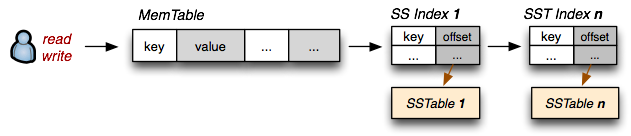
- On-disk
SSTableindexes are always loaded into memory - All writes go directly to the
MemTableindex - Reads check the MemTable first and then the SSTable indexes
- Periodically, the MemTable is flushed to disk as an SSTable
- Periodically, on-disk SSTables are "collapsed together"
What have we done here? Writes are always done in memory and hence are always fast. Once the MemTable reaches a certain size, it is flushed to disk as an immutable SSTable. However, we will maintain all the SSTable indexes in memory, which means that for any read we can check the MemTable first, and then walk the sequence of SSTable indexes to find our data. Turns out, we have just reinvented the "The Log-Structured Merge-Tree" (LSM Tree), described by Patrick O'Neil, and this is also the very mechanism behind "BigTable Tablets".
LSM & SSTables: Updates, Deletes and Maintenance
This "LSM" architecture provides a number of interesting behaviors: writes are always fast regardless of the size of dataset (append-only), and random reads are either served from memory or require a quick disk seek. However, what about updates and deletes?
Once the SSTable is on disk, it is immutable, hence updates and deletes can't touch the data. Instead, a more recent value is simply stored in MemTable in case of update, and a "tombstone" record is appended for deletes. Because we check the indexes in sequence, future reads will find the updated or the tombstone record without ever reaching the older values! Finally, having hundreds of on-disk SSTables is also not a great idea, hence periodically we will run a process to merge the on-disk SSTables, at which time the update and delete records will overwrite and remove the older data.
SSTables and LevelDB
Take an SSTable, add a MemTable and apply a set of processing conventions and what you get is a nice database engine for certain type of workloads. In fact, Google's BigTable, Hadoop's HBase, and Cassandra amongst others are all using a variant or a direct copy of this very architecture.
Simple on the surface, but as usual, implementation details matter a great deal. Thankfully, Jeff Dean and Sanjay Ghemawat, the original contributors to the SSTable and BigTable infrastructure at Google released LevelDB earlier last year, which is more or less an exact replica of the architecture we've described above:
- SSTable under the hood, MemTable for writes
- Keys and values are arbitrary byte arrays
- Support for Put, Get, Delete operations
- Forward and backward iteration over data
- Built-in Snappy compression
Designed to be the engine for IndexDB in WebKit (aka, embedded in your browser), it is easy to embed, fast, and best of all, takes care of all the SSTable and MemTable flushing, merging and other gnarly details.
Working with LevelDB: Ruby
LevelDB is a library, not a standalone server or service - although you could easily implement one on top. To get started, grab your favorite language bindings (ruby), and let's see what we can do:
require 'leveldb' # gem install leveldb-ruby

db = LevelDB::DB.new "/tmp/db"

db.put "b", "bar"

db.put "a", "foo"

db.put "c", "baz"

puts db.get "a" # => foo

db.each do |k,v|

 p [k,v] # => ["a", "foo"], ["b", "bar"], ["c", "baz"]

end

db.to_a # => [["a", "foo"], ["b", "bar"], ["c", "baz"]]
We can store keys, retrieve them, and perform a range scan all with a few lines of code. The mechanics of maintaining the MemTables, merging the SSTables, and the rest is taken care for us by LevelDB - nice and simple.
LevelDB in WebKit and Beyond
SSTable is a very simple and useful data structure - a great bulk input/output format. However, what makes the SSTable fast (sorted and immutable) is also what exposes its very limitations. To address this, we've introduced the idea of a MemTable, and a set of "log structured" processing conventions for managing the many SSTables.
All simple rules, but as always, implementation details matter, which is why LevelDB is such a nice addition to the open-source database engine stack. Chances are, you will soon find LevelDB embedded in your browser, on your phone, and in many other places. Check out the LevelDB source, scan the docs, and take it for a spin.
SSTable and Log Structured Storage: LevelDB的更多相关文章
- The storage wars: Shadow Paging, Log Structured Merge and Write Ahead Logging
The storage wars: Shadow Paging, Log Structured Merge and Write Ahead Logging previous: Seek, and yo ...
- Log Structured Merge Trees (LSM)
1 概念 LSM = Log Structured Merge Trees 来源于google的bigtable论文. 2 解决问题 传统的数据库如MySql采用B+树存放数据,B ...
- Log Structured Merge Trees(LSM) 算法
十年前,谷歌发表了 “BigTable” 的论文,论文中很多很酷的方面之一就是它所使用的文件组织方式,这个方法更一般的名字叫 Log Structured-Merge Tree. LSM是当前被用在许 ...
- Managing IIS Log File Storage
Managing IIS Log File Storage You can manage the amount of server disk space that Internet Informa ...
- LSM(Log Structured Merge Trees ) 笔记
目录 一.大幅度制约存储介质吞吐量的原因 二.传统数据库的实现机制 三.LSM Tree的历史由来 四.提高写吞吐量的思路 4.1 一种方式是数据来后,直接顺序落盘 4.2 另一种方式,是保证落盘的数 ...
- Log Structured Merge Trees(LSM) 原理
http://www.open-open.com/lib/view/open1424916275249.html
- 分布式学习材料Distributed System Prerequisite List
接下的内容按几个大类来列:1. 文件系统a. GFS – The Google File Systemb. HDFS1) The Hadoop Distributed File System2) Th ...
- sstable, bigtable,leveldb,cassandra,hbase的lsm基础
先看懂文献1和2 1. 先了解sstable.SSTable: Sorted String Table [2] [10] WiscKey: 类似myisam, key value分离, 根据ssd优 ...
- leveldb - log格式
log文件在LevelDb中的主要作用是系统故障恢复时,能够保证不会丢失数据.因为在将记录写入内存的Memtable之前,会先写入Log文件,这样即使系统发生故障,Memtable中的数据没有来得及D ...
随机推荐
- hibernate连接查询
Hibernate的HQL语言类似于SQL语言,更适合于Java面向对象的思想. 类与数据库映射好了,不必考虑数据库. 实现Class1的表与Class2的表的联合查询: Class1的class2属 ...
- 第91讲:Akka第一个案例动手实战架构设计
我们来看一下Akka的一个简单的wordcount的案例架构设计 从图中我们可以看出,不同的行我们是交给不同的actor进行入理的,每行首先进行map操作,识别出每个单词,然后交给reduce步骤的a ...
- C语言itoa()函数和atoi()函数详解(整数转字符C实现)
1.int/float to string/array: C语言提供了几个标准库函数,可以将任意类型(整型.长整型.浮点型等)的数字转换为字符串,下面列举了各函数的方法及其说明. ● itoa():将 ...
- vscode调试HTML
使用 live-server npm i -g live-server 注:最好还是把live-server安装成全局,这样在使用时整个项目就是一个站点. Ctrl+` 进入命令行终端 打开帮助提示: ...
- RaisingStudio.PackageManager 发布 1.0版
从此免去命今行打包的痛苦,安装本Module后,可以在Dashbaord的Modules里看到一个Download页,进入可看到全部已安装模块列表(与Installed页内容一致),可搜索找到要打包的 ...
- 用VS连接oracle数据库时ORA-12504错误
在用VS2008连接oracle数据库时,可能会出现: ORA-12504: TNS: 监听程序在 CONNECT_DATA 中未获得 SERVICE_NAME 只需在web.config文件Data ...
- 【基础知识】.Net基础加强 第05天
一. . 字符串的特性:不可变性(ToUpper()演示).字符串池.字符串留用(不常用) 1. 不可变性:由于字符串是不可变的.所以每次修改字符串都是创建一个单独的字符串副本(有拷贝了一个字符串): ...
- Dynamic CRM 2015学习笔记 系列汇总
这里列出所有 Dynamic CRM 2015学习笔记 系列文章,方便大家查阅.有任何建议.意见.需要,欢迎大家提交评论一起讨论. 本文原文地址:Dynamic CRM 2015学习笔记 系列汇总 一 ...
- 作业七:团队项目——Alpha版本冲刺阶段-04
昨天进展:象棋图片以及窗体完成 今天安排:代码编写.
- 学习WPF——元素绑定
概念 从源对象提取一些信息,并用这些信息设置目标对象的属性 示例 在给TextBlock控件的FontSize属性赋值时,我们使用了绑定表达式 数据绑定表达式使用XAML的标记扩展(因此具有花括号)( ...