
压缩感知重构算法之IHT算法python实现
压缩感知重构算法之OMP算法python实现
压缩感知重构算法之CoSaMP算法python实现
压缩感知重构算法之SP算法python实现
压缩感知重构算法之IHT算法python实现
压缩感知重构算法之OLS算法python实现
压缩感知重构算法之IRLS算法python实现
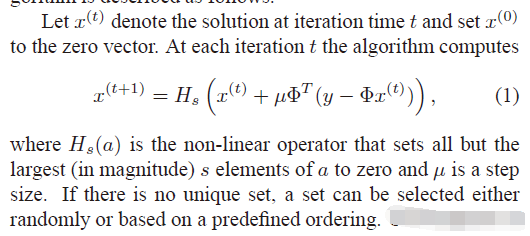
IHT(iterative hard thresholding )算法是压缩感知中一种非常重要的贪婪算法,它具有算法简单的有点,且易于实现,在实际中应用较多。本文给出了IHT算法的python和matlab代码(本文给出的代码未经过优化,所以重建质量不是非常好),以及完整的仿真过程。
算法流程
python代码
要利用python实现,电脑必须安装以下程序
- python (本文用的python版本为3.5.1)
- numpy python包(本文用的版本为1.10.4)
- scipy python包(本文用的版本为0.17.0)
- pillow python包(本文用的版本为3.1.1)
#coding:utf-8

#%%%%%%%%%%%%%%%%%%%%%%%%%%%%%%%%%%%%%%%%%%%%%%%%%%%%%%%%%

# DCT基作为稀疏基,重建算法为IHT算法,图像按列进行处理

#  参考文献: Carrillo R E, Polania L F, Barner K E. Iterative hard thresholding for compressed sensing

#with partially known support[C]

#//Acoustics, Speech and Signal Processing (ICASSP),

#2011 IEEE International Conference on. IEEE, 2011: 4028-4031.

#

#%%%%%%%%%%%%%%%%%%%%%%%%%%%%%%%%%%%%%%%%%%%%%%%%%%%%%%%%%

#导入集成库

import math

# 导入所需的第三方库文件

import  numpy as np    #对应numpy包

from PIL import Image  #对应pillow包

#读取图像,并变成numpy类型的 array

im = np.array(Image.open('lena.bmp'))#图片大小256*256

#生成高斯随机测量矩阵

sampleRate=0.7  #采样率

Phi=np.random.randn(256,256)

u, s, vh = np.linalg.svd(Phi)

Phi = u[:256*sampleRate,] #将测量矩阵正交化

#生成稀疏基DCT矩阵

mat_dct_1d=np.zeros((256,256))

v=range(256)

for k in range(0,256):

    dct_1d=np.cos(np.dot(v,k*math.pi/256))

    if k>0:

        dct_1d=dct_1d-np.mean(dct_1d)

    mat_dct_1d[:,k]=dct_1d/np.linalg.norm(dct_1d)

#随机测量

img_cs_1d=np.dot(Phi,im)

#IHT算法函数

def cs_IHT(y,D):

    K=math.floor(y.shape[0]/3)  #稀疏度

    result_temp=np.zeros((256))  #初始化重建信号

    u=0.5  #影响因子

    result=result_temp

    for j in range(K):  #迭代次数

        x_increase=np.dot(D.T,(y-np.dot(D,result_temp)))    #x=D*(y-D*y0)

        result=result_temp+np.dot(x_increase,u) #   x(t+1)=x(t)+D*(y-D*y0)

        temp=np.fabs(result)

        pos=temp.argsort()

        pos=pos[::-1]#反向,得到前面L个大的位置

        result[pos[K:]]=0

        result_temp=result

    return  result

#重建

sparse_rec_1d=np.zeros((256,256))   # 初始化稀疏系数矩阵

Theta_1d=np.dot(Phi,mat_dct_1d)   #测量矩阵乘上基矩阵

for i in range(256):

    print('正在重建第',i,'列。。。')

    column_rec=cs_IHT(img_cs_1d[:,i],Theta_1d)  #利用IHT算法计算稀疏系数

    sparse_rec_1d[:,i]=column_rec;

img_rec=np.dot(mat_dct_1d,sparse_rec_1d)          #稀疏系数乘上基矩阵

#显示重建后的图片

image2=Image.fromarray(img_rec)

image2.show()
matlab代码
%代码在matlab2010b测试通过

function Demo_CS_IHT()

%%%%%%%%%%%%%%%%%%%%%%%%%%%%%%%%%%%%%%%%%%%%%%%%%%%%%%%%%%%%%%%%%%%%%%%%%%%

% the DCT basis is selected as the sparse representation dictionary

% instead of seting the whole image as a vector, I process the image in the

% fashion of column-by-column, so as to reduce the complexity.

% Author: Chengfu Huo, roy@mail.ustc.edu.cn, http://home.ustc.edu.cn/~roy

% Reference: T. Blumensath and M. Davies, “Iterative Hard Thresholding for

% Compressed Sensing,” 2008.

%%%%%%%%%%%%%%%%%%%%%%%%%%%%%%%%%%%%%%%%%%%%%%%%%%%%%%%%%%%%%%%%%%%%%%%%%%%

%------------ read in the image --------------

img=imread('lena.bmp');     % 256*256大小

img=double(img);

[height,width]=size(img);

sampleRate=0.7; %采样率

%------------ form the measurement matrix and base matrix ---------------

%Phi=randn(floor(height/3),width);  % only keep one third of the original data

%Phi = Phi./repmat(sqrt(sum(Phi.^2,1)),[floor(height/3),1]); % normalize each column

Phi = orth(rand(256, 256));

Phi=Phi(1:256*sampleRate, :);

mat_dct_1d=zeros(256,256);  % building the DCT basis (corresponding to each column)

for k=0:1:255

    dct_1d=cos([0:1:255]'*k*pi/256);

    if k>0

        dct_1d=dct_1d-mean(dct_1d);

    end;

    mat_dct_1d(:,k+1)=dct_1d/norm(dct_1d);

end

%--------- projection ---------

img_cs_1d=Phi*img;          % treat each column as a independent signal

%-------- recover using omp ------------

sparse_rec_1d=zeros(height,width);

Theta_1d=Phi*mat_dct_1d;

for i=1:width

    column_rec=cs_iht(img_cs_1d(:,i),Theta_1d,height);

    sparse_rec_1d(:,i)=column_rec';           % sparse representation

end

img_rec_1d=mat_dct_1d*sparse_rec_1d;          % inverse transform

%------------ show the results --------------------

figure(1)

subplot(2,2,1),imagesc(img),title('original image')

subplot(2,2,2),imagesc(Phi),title('measurement mat')

subplot(2,2,3),imagesc(mat_dct_1d),title('1d dct mat')

psnr = 20*log10(255/sqrt(mean((img(:)-img_rec_1d(:)).^2)));

subplot(2,2,4),imshow(uint8(img_rec_1d));

title(strcat('PSNR=',num2str(psnr),'dB'));

disp('over')

%************************************************************************%

function hat_x=cs_iht(y,T_Mat,m)

% y=T_Mat*x, T_Mat is n-by-m

% y - measurements

% T_Mat - combination of random matrix and sparse representation basis

% m - size of the original signal

% the sparsity is length(y)/4

hat_x_tp=zeros(m,1);         % initialization with the size of original

s=floor(length(y)/4);        % sparsity

u=0.5;                       % impact factor

% T_Mat=T_Mat/sqrt(sum(sum(T_Mat.^2))); % normalizae the whole matrix

for times=1:s

    x_increase=T_Mat'*(y-T_Mat*hat_x_tp);

    hat_x=hat_x_tp+u*x_increase;

    [val,pos]=sort((hat_x),'descend');  % why? worse performance with abs()

    hat_x(pos(s+1:end))=0;   % thresholding, keeping the larges s elements

    hat_x_tp=hat_x;          % update

end
参考文章
1、Carrillo R E, Polania L F, Barner K E. Iterative hard thresholding for compressed sensing with partially known support[C]//Acoustics, Speech and Signal Processing (ICASSP), 2011 IEEE International Conference on. IEEE, 2011: 4028-4031.
欢迎python爱好者加入:学习交流群 667279387
压缩感知重构算法之IHT算法python实现的更多相关文章
- 压缩感知重构算法之IRLS算法python实现
压缩感知重构算法之OMP算法python实现 压缩感知重构算法之CoSaMP算法python实现 压缩感知重构算法之SP算法python实现 压缩感知重构算法之IHT算法python实现 压缩感知重构 ...
- 压缩感知重构算法之OLS算法python实现
压缩感知重构算法之OMP算法python实现 压缩感知重构算法之CoSaMP算法python实现 压缩感知重构算法之SP算法python实现 压缩感知重构算法之IHT算法python实现 压缩感知重构 ...
- 压缩感知重构算法之CoSaMP算法python实现
压缩感知重构算法之OMP算法python实现 压缩感知重构算法之CoSaMP算法python实现 压缩感知重构算法之SP算法python实现 压缩感知重构算法之IHT算法python实现 压缩感知重构 ...
- 压缩感知重构算法之SP算法python实现
压缩感知重构算法之OMP算法python实现 压缩感知重构算法之CoSaMP算法python实现 压缩感知重构算法之SP算法python实现 压缩感知重构算法之IHT算法python实现 压缩感知重构 ...
- 压缩感知重构算法之OMP算法python实现
压缩感知重构算法之OMP算法python实现 压缩感知重构算法之CoSaMP算法python实现 压缩感知重构算法之SP算法python实现 压缩感知重构算法之IHT算法python实现 压缩感知重构 ...
- 浅谈压缩感知(三十一):压缩感知重构算法之定点连续法FPC
主要内容: FPC的算法流程 FPC的MATLAB实现 一维信号的实验与结果 基于凸优化的重构算法 基于凸优化的压缩感知重构算法. 约束的凸优化问题: 去约束的凸优化问题: 在压缩感知中,J函数和H函 ...
- 浅谈压缩感知(三十):压缩感知重构算法之L1最小二乘
主要内容: l1_ls的算法流程 l1_ls的MATLAB实现 一维信号的实验与结果 前言 前面所介绍的算法都是在匹配追踪算法MP基础上延伸的贪心算法,从本节开始,介绍基于凸优化的压缩感知重构算法. ...
- 浅谈压缩感知(二十八):压缩感知重构算法之广义正交匹配追踪(gOMP)
主要内容: gOMP的算法流程 gOMP的MATLAB实现 一维信号的实验与结果 稀疏度K与重构成功概率关系的实验与结果 一.gOMP的算法流程 广义正交匹配追踪(Generalized OMP, g ...
- 浅谈压缩感知(二十六):压缩感知重构算法之分段弱正交匹配追踪(SWOMP)
主要内容: SWOMP的算法流程 SWOMP的MATLAB实现 一维信号的实验与结果 门限参数a.测量数M与重构成功概率关系的实验与结果 SWOMP与StOMP性能比较 一.SWOMP的算法流程 分段 ...
随机推荐
- python——inspect模块
inspect模块常用功能 import inspect # 导入inspect模块 inspect.isfunction(fn) # 检测fn是不是函数 inspect.isgenerator((x ...
- 详细讲解 Redis 的两种安装部署方式
Redis 是一款比较常用的 NoSQL 数据库,我们通常使用 Redis 来做缓存,这是一篇关于 Redis 安装的文章,所以不会涉及到 Redis 的高级特性和使用场景,Redis 能够兼容绝大部 ...
- SqlServer2005 查询 第六讲 null
今天们来讲sql命令中的这个null参数 null null: 可以理解成[没有值,空值]的意思 注意以下几点 --1.零和null是不一样的,null表示空值,而零表示的一个确定的值 --2.nul ...
- JAVA继承中子父类的构造方法
首先,构造方法本身会有一个隐式的无参构造(默认): ①不写构造方法,类中的第一行代码事实上有一个默认的无参构造(系统会隐式为你写好) public class Student { private St ...
- shell——数组
默认从0开始索引:也可以单独(像字典一样)pid[35420]=httpd -k ssl, 只能是一维的 bash4.0增加了关联数组 数组赋值: declare -a myarray声明数组 一次一 ...
- ubuntukylin16.04LTS(乌班图麒麟版长期支持版,并非银河麒麟)安装体验
最近,国产银河麒麟版在政府部门推广使用.我有幸接触了,感觉还是不错的.这次政府软件正版化整改中,也列入了windows和银河麒麟的选项.我想试安装一下,可是没找到.就近找了它的类似系统ubuntuky ...
- ubuntu server 1604 设置笔记本盒盖 不操作
sudo vim /etc/systemd/logind.conf //打开配置文件 找到 #HandleLidSwitch=suspend 改为 HandleLidSwitch=ignore ...
- [Windows篇] 在windows 10上源码编译gtest 并编写CMakeLists.txt
本文首发于个人博客https://kezunlin.me/post/aca50ff8/,欢迎阅读! compile gtest on windows 10 Guide compile gtest on ...
- 《Git的常用操作》
Git的常用操作: git checkout -b 本地分支 #创建本地的分支—本地分支,并切换到该分支下. git branch --set-upstream-to=origin/远程分支 本地分支 ...
- Spring与Shiro整合 登陆操作
Spring与Shiro整合 登陆操作 作者 : Stanley 罗昊 [转载请注明出处和署名,谢谢!] 编写登陆Controller方法 讲解: 首先,如果你登陆失败的时候,它会把你的异常信息丢到 ...