
压缩感知重构算法之CoSaMP算法python实现
压缩感知重构算法之OMP算法python实现
压缩感知重构算法之CoSaMP算法python实现
压缩感知重构算法之SP算法python实现
压缩感知重构算法之IHT算法python实现
压缩感知重构算法之OLS算法python实现
压缩感知重构算法之IRLS算法python实现
算法流程
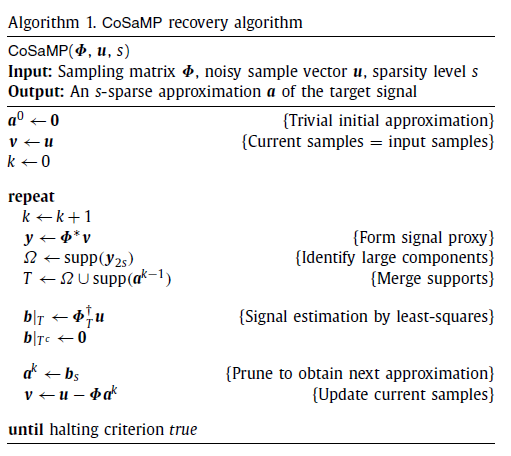
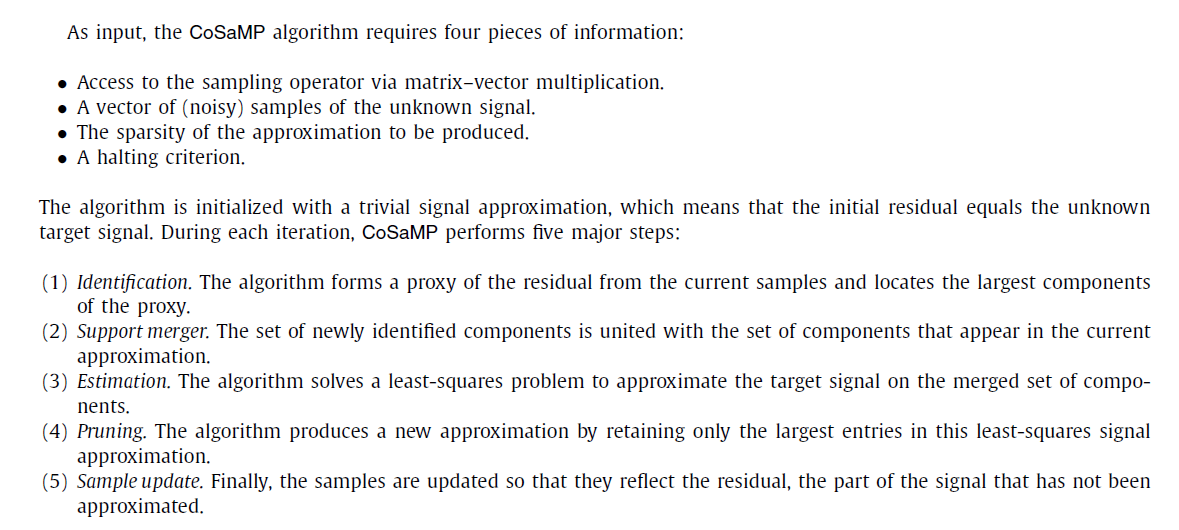
算法分析
python代码
要利用python实现,电脑必须安装以下程序
- python (本文用的python版本为3.5.1)
- numpy python包(本文用的版本为1.10.4)
- scipy python包(本文用的版本为0.17.0)
- pillow python包(本文用的版本为3.1.1)
#coding:utf-8

#%%%%%%%%%%%%%%%%%%%%%%%%%%%%%%%%%%%%%%%%%%%%%%%%%%%%%%%%%%%%%%%%%%%%%%%%%

# DCT基作为稀疏基,重建算法为CoSaMP算法,图像按列进行处理

# 参考文献: D. Deedell andJ. Tropp, “COSAMP: Iterative Signal Recovery from

#Incomplete and Inaccurate Samples,” 2008.

#%%%%%%%%%%%%%%%%%%%%%%%%%%%%%%%%%%%%%%%%%%%%%%%%%%%%%%%%%%%%%%%%%%%%%%%%%%%

#导入集成库

import math

# 导入所需的第三方库文件

import  numpy as np    #对应numpy包

from PIL import Image  #对应pillow包

#读取图像,并变成numpy类型的 array

im = np.array(Image.open('lena.bmp'))#图片大小256*256

#生成高斯随机测量矩阵

sampleRate=0.5  #采样率

Phi=np.random.randn(256*sampleRate,256)

# Phi=np.random.randn(256,256)

# u, s, vh = np.linalg.svd(Phi)

# Phi = u[:256*sampleRate,] #将测量矩阵正交化

#生成稀疏基DCT矩阵

mat_dct_1d=np.zeros((256,256))

v=range(256)

for k in range(0,256):

    dct_1d=np.cos(np.dot(v,k*math.pi/256))

    if k>0:

        dct_1d=dct_1d-np.mean(dct_1d)

    mat_dct_1d[:,k]=dct_1d/np.linalg.norm(dct_1d)

#随机测量

img_cs_1d=np.dot(Phi,im)

#CoSaMP算法函数

def cs_CoSaMP(y,D):

    S=math.floor(y.shape[0]/4)  #稀疏度

    residual=y  #初始化残差

    pos_last=np.array([],dtype=np.int64)

    result=np.zeros((256))

    for j in range(S):  #迭代次数

        product=np.fabs(np.dot(D.T,residual))

        pos_temp=np.argsort(product)

        pos_temp=pos_temp[::-1]#反向,得到前面L个大的位置

        pos_temp=pos_temp[0:2*S]#对应步骤3

        pos=np.union1d(pos_temp,pos_last)

        result_temp=np.zeros((256))

        result_temp[pos]=np.dot(np.linalg.pinv(D[:,pos]),y)

        pos_temp=np.argsort(np.fabs(result_temp))

        pos_temp=pos_temp[::-1]#反向,得到前面L个大的位置

        result[pos_temp[:S]]=result_temp[pos_temp[:S]]

        pos_last=pos_temp

        residual=y-np.dot(D,result)

    return  result

#重建

sparse_rec_1d=np.zeros((256,256))   # 初始化稀疏系数矩阵

Theta_1d=np.dot(Phi,mat_dct_1d)   #测量矩阵乘上基矩阵

for i in range(256):

    print('正在重建第',i,'列。。。')

    column_rec=cs_CoSaMP(img_cs_1d[:,i],Theta_1d)  #利用CoSaMP算法计算稀疏系数

    sparse_rec_1d[:,i]=column_rec;

img_rec=np.dot(mat_dct_1d,sparse_rec_1d)          #稀疏系数乘上基矩阵

#显示重建后的图片

image2=Image.fromarray(img_rec)

image2.show()
matlab代码
function Demo_CS_CoSaMP()

%%%%%%%%%%%%%%%%%%%%%%%%%%%%%%%%%%%%%%%%%%%%%%%%%%%%%%%%%%%%%%%%%%%%%%%%%%%

% the DCT basis is selected as the sparse representation dictionary

% instead of seting the whole image as a vector, I process the image in the

% fashion of column-by-column, so as to reduce the complexity.

% Author: Chengfu Huo, roy@mail.ustc.edu.cn, http://home.ustc.edu.cn/~roy

% Reference: D. Deedell andJ. Tropp, “COSAMP: Iterative Signal Recovery from

% Incomplete and Inaccurate Samples,” 2008.

%%%%%%%%%%%%%%%%%%%%%%%%%%%%%%%%%%%%%%%%%%%%%%%%%%%%%%%%%%%%%%%%%%%%%%%%%%%

%------------ read in the image --------------

img=imread('lena.bmp');     % testing image

img=double(img);

[height,width]=size(img);

%------------ form the measurement matrix and base matrix ---------------

Phi=randn(floor(height/2),width);  % only keep one third of the original data

Phi = Phi./repmat(sqrt(sum(Phi.^2,1)),[floor(height/2),1]); % normalize each column

mat_dct_1d=zeros(256,256);  % building the DCT basis (corresponding to each column)

for k=0:1:255

    dct_1d=cos([0:1:255]'*k*pi/256);

    if k>0

        dct_1d=dct_1d-mean(dct_1d);

    end;

    mat_dct_1d(:,k+1)=dct_1d/norm(dct_1d);

end

%--------- projection ---------

img_cs_1d=Phi*img;          % treat each column as a independent signal

%-------- recover using omp ------------

sparse_rec_1d=zeros(height,width);

Theta_1d=Phi*mat_dct_1d;

for i=1:width

    column_rec=cs_cosamp(img_cs_1d(:,i),Theta_1d,height);

    sparse_rec_1d(:,i)=column_rec';           % sparse representation

end

img_rec_1d=mat_dct_1d*sparse_rec_1d;          % inverse transform

%------------ show the results --------------------

figure(1)

subplot(2,2,1),imagesc(img),title('original image')

subplot(2,2,2),imagesc(Phi),title('measurement mat')

subplot(2,2,3),imagesc(mat_dct_1d),title('1d dct mat')

psnr = 20*log10(255/sqrt(mean((img(:)-img_rec_1d(:)).^2)));

subplot(2,2,4),imshow(uint8(img_rec_1d));

title(strcat('PSNR=',num2str(psnr),'dB'));

disp('over')

%************************************************************************%

function hat_x=cs_cosamp(y,T_Mat,m)

% y=T_Mat*x, T_Mat is n-by-m

% y - measurements

% T_Mat - combination of random matrix and sparse representation basis

% m - size of the original signal

% the sparsity is length(y)/4

n=length(y);                           % length of measurements

s=floor(n/4);                                 % sparsity

r_n=y;                                 % initial residuals

sig_pos_lt=[];                         % significant pos for last time iteration

for times=1:s                          % number of iterations

    product=abs(T_Mat'*r_n);

    [val,pos]=sort(product,'descend');

    sig_pos_cr=pos(1:2*s);             % significant pos for curretn iteration

    sig_pos=union(sig_pos_cr,sig_pos_lt);

    Aug_t=T_Mat(:,sig_pos);            % current selected entries of T_Mat

    aug_x_cr=zeros(m,1);

    aug_x_cr(sig_pos)=(Aug_t'*Aug_t)^(-1)*Aug_t'*y;  % temp recovered x (sparse)

    [val,pos]=sort(abs(aug_x_cr),'descend');

    hat_x=zeros(1,m);

    hat_x(pos(1:s))=aug_x_cr(pos(1:s));% recovered x with s sparsity

    sig_pos_lt=pos(1:s);               % refresh the significant positions

    r_n=y-T_Mat*hat_x';

end
参考文献
1、D. Deedell andJ. Tropp, “COSAMP: Iterative Signal Recovery from Incomplete and Inaccurate Samples,” 2008.
欢迎python爱好者加入:学习交流群 667279387
压缩感知重构算法之CoSaMP算法python实现的更多相关文章
- 压缩感知重构算法之IRLS算法python实现
压缩感知重构算法之OMP算法python实现 压缩感知重构算法之CoSaMP算法python实现 压缩感知重构算法之SP算法python实现 压缩感知重构算法之IHT算法python实现 压缩感知重构 ...
- 压缩感知重构算法之OLS算法python实现
压缩感知重构算法之OMP算法python实现 压缩感知重构算法之CoSaMP算法python实现 压缩感知重构算法之SP算法python实现 压缩感知重构算法之IHT算法python实现 压缩感知重构 ...
- 压缩感知重构算法之IHT算法python实现
压缩感知重构算法之OMP算法python实现 压缩感知重构算法之CoSaMP算法python实现 压缩感知重构算法之SP算法python实现 压缩感知重构算法之IHT算法python实现 压缩感知重构 ...
- 压缩感知重构算法之SP算法python实现
压缩感知重构算法之OMP算法python实现 压缩感知重构算法之CoSaMP算法python实现 压缩感知重构算法之SP算法python实现 压缩感知重构算法之IHT算法python实现 压缩感知重构 ...
- 压缩感知重构算法之OMP算法python实现
压缩感知重构算法之OMP算法python实现 压缩感知重构算法之CoSaMP算法python实现 压缩感知重构算法之SP算法python实现 压缩感知重构算法之IHT算法python实现 压缩感知重构 ...
- 压缩感知重构算法之压缩采样匹配追踪(CoSaMP)
压缩采样匹配追踪(CompressiveSampling MP)是D. Needell继ROMP之后提出的又一个具有较大影响力的重构算法.CoSaMP也是对OMP的一种改进,每次迭代选择多个原子,除了 ...
- 浅谈压缩感知(二十三):压缩感知重构算法之压缩采样匹配追踪(CoSaMP)
主要内容: CoSaMP的算法流程 CoSaMP的MATLAB实现 一维信号的实验与结果 测量数M与重构成功概率关系的实验与结果 一.CoSaMP的算法流程 压缩采样匹配追踪(CompressiveS ...
- 浅谈压缩感知(二十八):压缩感知重构算法之广义正交匹配追踪(gOMP)
主要内容: gOMP的算法流程 gOMP的MATLAB实现 一维信号的实验与结果 稀疏度K与重构成功概率关系的实验与结果 一.gOMP的算法流程 广义正交匹配追踪(Generalized OMP, g ...
- 浅谈压缩感知(二十五):压缩感知重构算法之分段正交匹配追踪(StOMP)
主要内容: StOMP的算法流程 StOMP的MATLAB实现 一维信号的实验与结果 门限参数Ts.测量数M与重构成功概率关系的实验与结果 一.StOMP的算法流程 分段正交匹配追踪(Stagewis ...
随机推荐
- len、is、==、可变于不可变类型
a="asdfghjkl;'iuygb" b="小米" c=['a','b','c'] d= {'name':1,'age':24} # len统计字符或元素的 ...
- java多线程回顾3:线程安全
1.线程安全问题 关于线程安全问题,有一个经典案例:银行取钱问题. 假设有一个账户,有两个线程从账户里取钱,如果余额大于取钱金额,则取钱成功,反之则失败. 下面来看下线程不安全的程序会出什么问题. 账 ...
- 网站搭建-windows 系统 本地 网站搭建 - IIS
上一章有提到IIS安装,现在打开它: 点击浏览,如果没有启动的话,先点击启动. ip先选好,第一个吧,本机的(IIS自己提供了初始网页的东西). 然后可以自己去https://www.freemoba ...
- springboot配置springMVC
/** * @ClassName MvcConfigure * @Description SpringMVC配置 * @Author JAGNG * @Date 2019/10/28 10:23 ** ...
- Obtaining the backtrace - libunwind
Sometimes when working on a large project, I find it useful to figure out all the places from which ...
- PostGIS 爆管分析之根据爆点找出所有影响阀门
环境: Win10 ArcMap10.4(用于数据处理) postgresql9.4 postgis2.2.3 pgRouting2.3(postgresql插件) 说明: 做爆管分析的第一步,需要先 ...
- 【论文阅读】TextSnake: A Flexible Representation for Detecting Text of Arbitrary Shapes
TextSnake: A Flexible Representation for Detecting Text of Arbitrary Shapes ECCV2018 北京大学.face++ 思路: ...
- ehcache同步原理
最近研究ehcache同步时发现一个问题: 现有A.B两个服务器,由A服务器向B服务器同步信息,采用RMI方式手动方式进行同步 配置信息如下: <?xml version="1.0&q ...
- spring日志体系浅析(spring 5.x)
日志是进行软件开发必不可少的一项功能,目前流行着很多开源日志库,比如log4j.log4j2.logback.JDK Logging.commons-logging.slf4j等. 几种日志产品的介绍 ...
- [折腾笔记] 洛谷P1149-火柴棒等式 AC记
原题链接: https://www.luogu.org/problem/P1149 题面简述: 给你n根火柴棍,你可以拼出多少个形如"A+B=C""A+B=C" ...